Within Materials
What the alloy says about the weapon
A small fragment can reveal whether a weapon was built for light weight, heat resistance, predictable fragmentation, or penetration.
On this page
- Why composition is the first clue
- Steel, aluminium, titanium, nickel, tungsten and uranium roles
- How alloy choice points to design priorities
Page outline Jump by section
Introduction
A metal fragment does more than identify a weapon. It often reveals the priorities that shaped the design. Engineers must constantly trade weight against strength, heat resistance against cost, penetration against toughness, and manufacturing simplicity against peak performance. Those choices are embedded in alloy composition. When analysts recover fragments from a missile, shell, warhead or penetrator, the metal itself can indicate whether the original designers were optimising for long range, high speed, armour penetration, controlled fragmentation, thermal endurance or production economy.

In foreign materiel exploitation, alloy identification therefore becomes a shortcut to understanding design intent. A fragment that contains aluminium-lithium alloy suggests a different set of priorities from one made of titanium, tungsten heavy alloy or depleted uranium. The composition alone does not reveal the entire weapon, but it often exposes the engineering problem that the designers were trying to solve.[ScienceDirect]sciencedirect.comDevelopment and applications of aluminum alloys for…by SS Li · 2023 · Cited by 1050 — Al alloys are widely used in the st…
Why Composition Is the First Clue
The external appearance of many military systems can be deceptive. Two missile bodies may look similar while being designed around very different operational requirements. Material selection helps separate those possibilities.
Every alloy family carries advantages and penalties. A designer selecting a material is effectively choosing which performance characteristics matter most. As a result, recovered fragments often allow analysts to infer priorities before they understand the complete design.
For example:
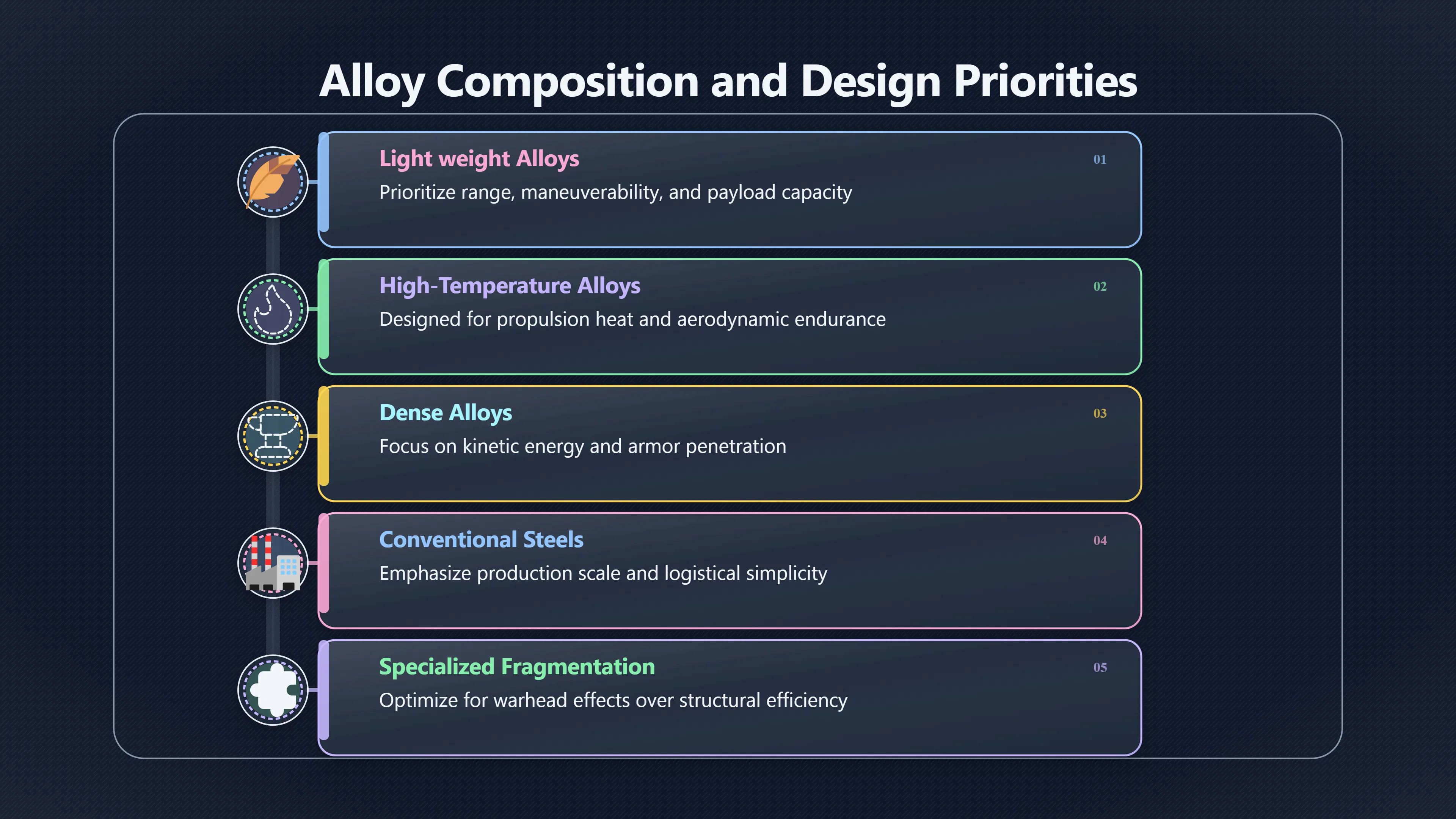
- Lightweight alloys usually indicate a premium on range, manoeuvrability or payload capacity.
- High-temperature alloys suggest sustained exposure to propulsion heat or aerodynamic heating.
- Dense alloys point towards kinetic-energy transfer and penetration.
- Tough but inexpensive steels may indicate a requirement for mass production and predictable behaviour rather than maximum performance.
- Specialised fragmentation materials can reveal an emphasis on warhead effects rather than structural efficiency.
Because these trade-offs are fundamental, alloy selection often survives even when the weapon itself is heavily damaged.[sciencedirect.com]sciencedirect.comDevelopment and applications of aluminum alloys for…by SS Li · 2023 · Cited by 1050 — Al alloys are widely used in the st…
Steel, Aluminium, Titanium, Nickel, Tungsten and Uranium Roles
Steel: Strength, Cost and Controlled Failure
Steel remains one of the most revealing materials in weapon fragments because its exact composition and heat treatment can vary enormously.
A relatively simple low-alloy steel often indicates a design focused on affordability, manufacturability and predictable mechanical behaviour. In warheads, certain steels are selected because they fragment in a controlled and repeatable manner. In missile structures, higher-strength steels can provide durability without the expense of more exotic materials.
The key insight is that steel often reflects a balanced design philosophy. When analysts encounter sophisticated systems built around conventional steels, it can suggest that designers prioritised reliability, production scale or logistical simplicity over absolute weight reduction.
Aluminium Alloys: Range and Weight Reduction
Aluminium alloys are strongly associated with aerospace structures because they provide high strength relative to weight. Aerospace applications continue to rely heavily on aluminium despite competition from composites because of its favourable balance of mass, strength, corrosion resistance and manufacturability.[ScienceDirect]sciencedirect.comDevelopment and applications of aluminum alloys for…by SS Li · 2023 · Cited by 1050 — Al alloys are widely used in the st…
When fragments reveal advanced aluminium-lithium compositions, the signal becomes even stronger. Aluminium-lithium alloys are specifically valued for reducing structural weight while maintaining strength and fatigue resistance. Their use generally indicates that designers considered weight savings important enough to justify more specialised materials and manufacturing processes.[premierscience.com]premierscience.comPremier Science A Review of Manufacturing Processes for AluminumPremier ScienceA Review of Manufacturing Processes for Aluminum…May 31, 2025 — This review provides an overview of the manufacturing p…
In practical terms, aluminium-rich fragments often point towards priorities such as:
- Longer range from a given propulsion system.
- Greater payload fraction.
- Improved manoeuvrability.
- Reduced launch weight.
Titanium: Performance Under Stress
Titanium occupies a middle ground between aluminium and high-temperature superalloys. It is significantly lighter than steel while retaining excellent strength and corrosion resistance.
Finding titanium fragments often suggests that designers were willing to accept higher material and manufacturing costs in exchange for weight savings combined with structural robustness. Titanium is particularly attractive in areas exposed to elevated temperatures or demanding mechanical loads.[jilm.or.jp]jilm.or.jpTechnical Issues of Titanium and Aluminum Alloys for…November 16, 2018 — In the aviation fields, aluminum alloys have been used aggres…
A titanium-intensive design usually signals an emphasis on high performance rather than minimum cost. For analysts, extensive titanium use can indicate a weapon intended to operate in more demanding thermal or aerodynamic environments.

Nickel-Based Alloys: Surviving Extreme Heat
Nickel-rich alloys are rarely chosen for lightweight structures. Their value lies in maintaining strength at temperatures that would weaken many other metals.
When fragments contain nickel-based superalloys, the most likely explanation is that the component was expected to endure severe thermal stress. Such alloys are associated with turbine environments and other applications where heat resistance is more important than weight. Advanced nickel superalloys derive their value from carefully engineered microstructures that remain stable under prolonged high-temperature exposure.[thermalprocessing.com]thermalprocessing.comDeveloping a superalloy with superior heat resistanceOctober 11, 2019 — Meher and his colleagues prepared a nickel-based superalloy that also contained aluminum, cobalt, tantalum, ruthenium…
The presence of these alloys therefore points towards a design priority centred on thermal endurance and sustained performance under extreme operating conditions.
Tungsten: Density and Penetration
Tungsten heavy alloys are among the clearest examples of alloy choice exposing design priorities. Their defining characteristic is exceptional density combined with high strength. They are widely used where concentrated mass is required.[mdpi.com]mdpi.comProcessing, Microstructure, and Mechanical Behavior of…by R Patel · 2025 · Cited by 20 — Tungsten heavy alloys (WHAs) are two-phas…
Recovered tungsten fragments strongly suggest that designers prioritised kinetic effectiveness. In penetrators, high density allows more energy to be delivered into a smaller area. Research on tungsten heavy alloys highlights properties such as strength, hardness and deformation behaviour that support penetration performance.[ResearchGate]researchgate.netResearch Gate Tungsten heavy alloys for kinetic energy penetratorsTungsten heavy alloys for kinetic energy penetratorsJuly 25, 2024 — Tungsten heavy alloys are preferred materials for kinetic…
When tungsten appears in weapon fragments, analysts can often infer that defeating hardened targets was a primary design objective rather than minimising cost or weight.
Uranium Alloys: Maximum Armour Defeat
Depleted uranium alloys represent an even more specialised choice. Like tungsten, uranium is extremely dense, but its mechanical behaviour under impact differs in important ways.
Military studies and technical reviews have noted that depleted uranium alloys can exhibit characteristics that improve penetration performance against armour. Uranium alloys are also exceptionally hard, and some formulations were specifically developed to survive the enormous acceleration forces experienced during launch. UNIDIR → Building a more secure world.+2gulflink.health.mil[unidir.org]unidir.orguranium alloys could be interchangeableUNIDIR → Building a more secure world.Uranium WeaponsJanuary 17, 2013 — DU alloys are very hard and pyrophoric, properties which make the…
As a result, the discovery of uranium-alloy fragments typically points to a weapon designed with armour penetration as a dominant requirement. Few materials communicate design intent as directly.
How Alloy Choice Points to Design Priorities
The most useful analytical question is not simply “What metal is this?” but “Why was this metal worth choosing?”
Several recurring patterns emerge.
Lightweight alloys indicate performance through efficiency. Aluminium and titanium fragments often reveal that designers were trying to maximise range, speed, payload or manoeuvrability by reducing structural mass.[sciencedirect.com]sciencedirect.comDevelopment and applications of aluminum alloys for…by SS Li · 2023 · Cited by 1050 — Al alloys are widely used in the st…
High-temperature alloys indicate survival in harsh environments. Nickel-rich superalloys and specialised titanium components suggest that heat management was a critical engineering challenge.[thermalprocessing.com]thermalprocessing.comDeveloping a superalloy with superior heat resistanceOctober 11, 2019 — Meher and his colleagues prepared a nickel-based superalloy that also contained aluminum, cobalt, tantalum, ruthenium…
Dense alloys indicate energy concentration. Tungsten and uranium point towards systems intended to transfer maximum kinetic energy into hardened targets.[researchgate.net]researchgate.netResearch Gate Tungsten heavy alloys for kinetic energy penetratorsTungsten heavy alloys for kinetic energy penetratorsJuly 25, 2024 — Tungsten heavy alloys are preferred materials for kinetic…
Conventional alloys can indicate deliberate optimisation. A weapon built from relatively ordinary steels is not necessarily unsophisticated. In many cases, the choice reflects a preference for predictable manufacturing, reliable field performance and scalable production.
Exotic alloys reveal willingness to pay for capability. When designers adopt expensive materials that require specialised processing, they are signalling that operational performance was judged more important than procurement cost.

Reading Design Philosophy from a Fragment
The most valuable insight from alloy analysis is that materials embody engineering priorities. Every weapon designer faces the same constraints of mass, heat, strength, manufacturability and cost. The chosen alloy records which of those constraints mattered most.
A fragment containing aluminium-lithium alloy suggests a search for lighter structures. Titanium hints at strength under demanding conditions. Nickel-rich alloys point to thermal endurance. Tungsten and uranium indicate a focus on penetration and energy delivery. Even ordinary steels can reveal an emphasis on reliability, controlled fragmentation or large-scale production.
For analysts engaged in reverse engineering foreign military technology, alloy identification therefore provides more than a materials inventory. It offers a direct view into the design philosophy of the weapon itself.
Amazon book picks
Further Reading
Books and field guides related to What the alloy says about the weapon. Use these as the next step if you want deeper reading beyond the article.
Metallurgy for the Non-metallurgist
Shows how alloy selection reflects engineering priorities.
Introduction to the Physical Metallurgy of Welding
Provides insight into alloy behaviour and processing consequences.
Callister's Materials Science and Engineering: An Introductio...
Explains relationships between composition, properties and design choices.
eBay marketplace picks
Marketplace Samples
Live-tested eBay searches with available results related to this page.




Endnotes
1.
Source: sciencedirect.com
Link:https://www.sciencedirect.com/science/article/pii/S2238785423024006
Source snippet
Development and applications of aluminum alloys for...by SS Li · 2023 · Cited by 1050 — Al alloys are widely used in the st...
2.
Source: dierk-raabe.com
Title: Dierk Raabe Aluminium alloys for aerospace applications
Link:https://www.dierk-raabe.com/aluminium/aluminium-alloys-for-aerospace-applications/
Source snippet
Aluminium alloys for aerospace applications - Dierk RaabeThe evolution of aluminum alloys in aerospace engineering reflects a continuous...
3.
Source: eucass.eu
Link:https://www.eucass.eu/component/docindexer/?id=4194&task=download
Source snippet
as reducing other operation costs. The use of new Al-Li alloys can...
4.
Source: chinalcometal.com
Link:https://www.chinalcometal.com/blog/how-titanium-alloys-and-aluminum-lithium-alloys-are-used-in-aircraft-design-and-[maintenance
Source snippet
How Titanium Alloys and Aluminum-Lithium...13 Feb 2025 — Aluminum–lithium alloys are primarily used in primary airframe structures where...
5.
Source: jilm.or.jp
Link:https://www.jilm.or.jp/uploads_content/2018/11/alma201803.pdf
Source snippet
Technical Issues of Titanium and Aluminum Alloys for...November 16, 2018 — In the aviation fields, aluminum alloys have been used aggres...
Published: November 16, 2018
6.
Source: thermalprocessing.com
Title: Developing a superalloy with superior heat resistance
Link:https://thermalprocessing.com/developing-a-superalloy-with-superior-heat-resistance/
Source snippet
October 11, 2019 — Meher and his colleagues prepared a nickel-based superalloy that also contained aluminum, cobalt, tantalum, ruthenium...
Published: October 11, 2019
7.
Source: mdpi.com
Link:https://www.mdpi.com/2504-4494/9/6/186
Source snippet
Processing, Microstructure, and Mechanical Behavior of...by R Patel · 2025 · Cited by 20 — Tungsten heavy alloys (WHAs) are two-phas...
8.
Source: pmc.ncbi.nlm.nih.gov
Title: PMCMicrostructure and Properties of Tungsten Heavy Alloy
Link:https://pmc.ncbi.nlm.nih.gov/articles/PMC7663691/
Source snippet
by P Skoczylas · 2020 · Cited by 22 — Tungsten heavy alloys (THA) are used in the defense industry for subcaliber bullet cores due to...
9.
Source: researchgate.net
Title: Research Gate Tungsten heavy alloys for kinetic energy penetrators
Link:https://www.researchgate.net/publication/382582351_Tungsten_heavy_alloys_for_kinetic_energy_penetrators_a_review
Source snippet
Tungsten heavy alloys for kinetic energy penetratorsJuly 25, 2024 — Tungsten heavy alloys are preferred materials for kinetic...
Published: July 25, 2024
10.
Source: unidir.org
Title: uranium alloys could be interchangeable
Link:https://unidir.org/wp-content/uploads/2023/09/uranium-weapons-en-328.pdf
Source snippet
UNIDIR → Building a more secure world.Uranium WeaponsJanuary 17, 2013 — DU alloys are very hard and pyrophoric, properties which make the...
Published: January 17, 2013
11.
Source: gulflink.health.mil
Link:https://gulflink.health.mil/du_ii/du_ii_tabe.htm
Source snippet
TAB E -- Development of DU MunitionsThe selection of U-3/4Ti was derived in part from improved designs and alloys that allowed the DU cor...
12.
Source: researchgate.net
Link:https://www.researchgate.net/publication/237021712_New_Materials_for_Tank_Gun_Projectiles-Taking_Aim_at_Future_Threats
Source snippet
ResearchGate(PDF) New Materials for Tank Gun Projectiles-Taking Aim...of DU alloy penetrators. Defeating armor requires that the maximum...
13.
Source: researchgate.net
Link:https://www.researchgate.net/publication/303637237_Chapter_15-Aerospace_Applications_of_Aluminum-lithium_Alloys
Source snippet
important are high · (1) Structural efficiency: As mentioned in subsection 15.3...
14.
Source: premierscience.com
Title: Premier Science A Review of Manufacturing Processes for Aluminum
Link:https://premierscience.com/pje-24-553/
Source snippet
Premier ScienceA Review of Manufacturing Processes for Aluminum...May 31, 2025 — This review provides an overview of the manufacturing p...
Published: May 31, 2025
Additional References
15.
Source: scribd.com
Link:https://www.scribd.com/document/690165538/Missile-Materials
Source snippet
Missile Materials: Properties and Challenges | PDF | TitaniumAluminum alloys contribute to missile airframe and propulsion system efficie...
16.
Source: chinatungsten.com
Link:https://www.chinatungsten.com/information-bank/Articles-about-Tungsten/Tungsten-Heavy-Alloy-Design-Manual.pdf
Source snippet
TUNGSTEN HEAVY ALLOY Design ManualTungsten heavy alloys (WHAs) are ideally suited to a wide range of density applications, offering a den...
17.
Source: arxiv.org
Link:https://arxiv.org/pdf/physics/0301059
Source snippet
Depleted-Uranium Weapons: the Whys and Whereforesby A Gsponer · 2003 · Cited by 6 — This calls for a hard high-strength heavy alloy, with...
18.
Source: mkubeenterprise.com
Title: failure modes in tungsten heavy alloy components and prevention
Link:https://mkubeenterprise.com/failure-modes-in-tungsten-heavy-alloy-components-and-prevention/
Source snippet
Tungsten Heavy Alloy Failure Modes: Causes, Mechanisms...24 Dec 2025 — Understand common failure modes in tungsten heavy alloy component...
19.
Source: iiss.org
Title: iiss critical raw materials and european defence 25032025
Link:https://www.iiss.org/globalassets/media-library—content–migration/files/research-papers/2025/03/iiss_critical-raw-materials-and-european-defence_25032025.pdf
Source snippet
Critical Raw Materials and European Defence25 Mar 2025 — Titanium, titanium alloys, nickel, chromium, man- ganese, molybdenum, vanadium a...
20.
Source: academia.edu
Link:https://www.academia.edu/48351947/Recent_Progress_in_Processing_of_Tungsten_Heavy_Alloys
Source snippet
Microstructural factors like tungsten particle size and...Read more...
21.
Source: scribd.com
Link:https://www.scribd.com/document/356163182/268884386-Depleted-Uranium-vs-Tungsten-for-Tank-Un-Ammunition-Report-No-107-pdf
Source snippet
or materials. Depleted uranium (DU) offers superior penetration...
22.
Source: eureka.patsnap.com
Title: tungsten heavy alloy heat resistant
Link:https://eureka.patsnap.com/materials/tungsten-heavy-alloy-heat-resistant
Source snippet
PatSnap EurekaTungsten Heavy Alloy Heat Resistant Alloy22 May 2026 — Heat-treatable W-Fe-Ni-Cr-Mo-C alloys achieve room-temperature hardn...
Published: May 2026
23.
Source: youtube.com
Title: ASM Digital Short Course: Materials Characterization and the Selection Process
Link:https://www.youtube.com/watch?v=2IBi-DIXpHg
Source snippet
How One Metallurgist's "FORBIDDEN" Alloy Made Iowa Battleship Armor Stop 2,700-Pound AP Shells...
24.
Source: Wikipedia
Title: Nuclear weapon design
Link:https://en.wikipedia.org/wiki/Nuclear_weapon_design
Source snippet
Nuclear weapon designNuclear weapons design means the physical, chemical, and engineering arrangements that cause the physics package...
Topic Tree