Within Materials
The factory clues inside battlefield debris
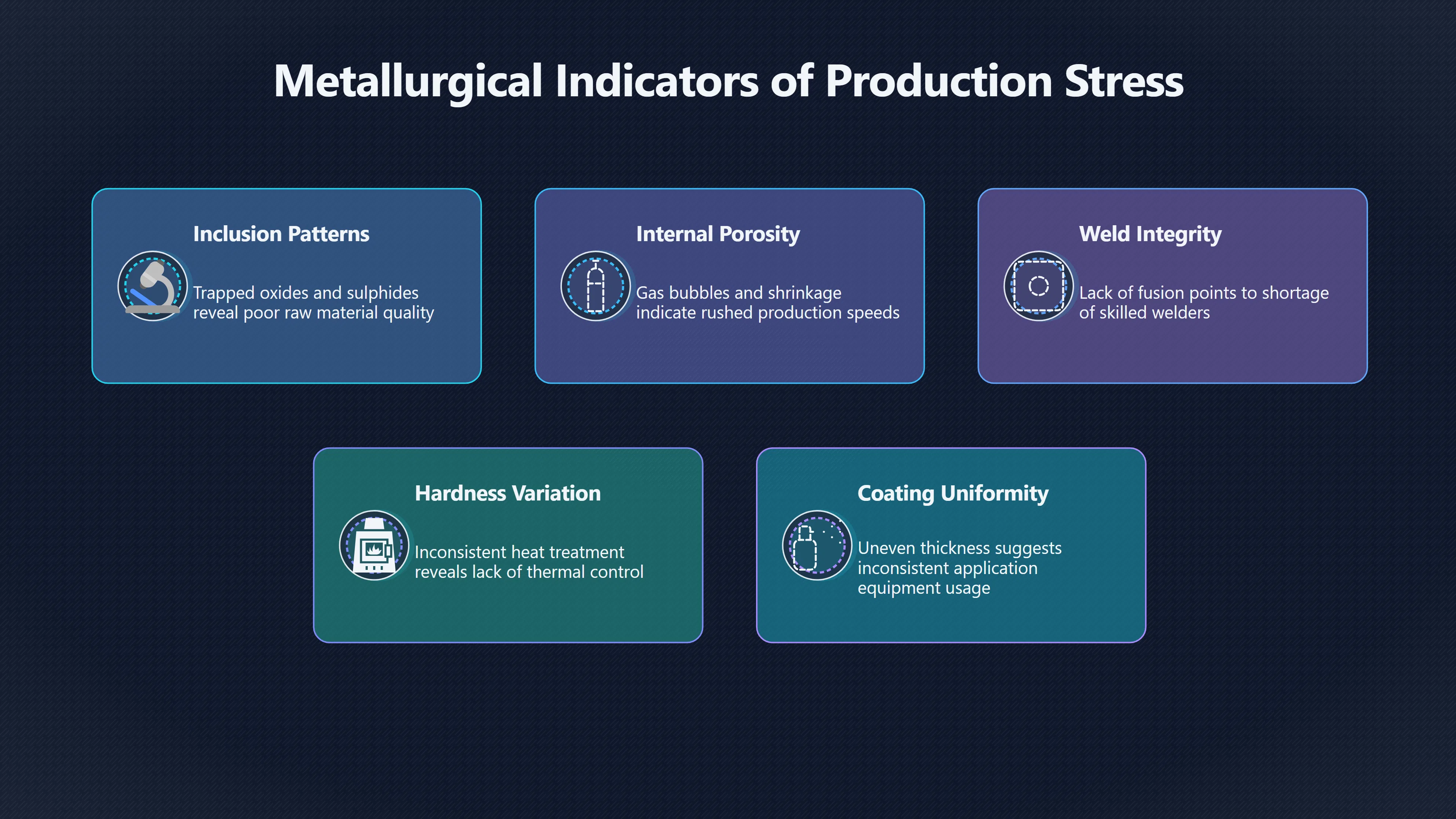
Voids, inclusions, poor welds, uneven coatings, and inconsistent hardness can expose rushed production or weak factory control.
On this page
- Inclusions, voids and weld defects
- Uneven coatings and inconsistent hardness
- What flaws reveal about supply chains and process control
Page outline Jump by section
Introduction
When analysts recover fragments from foreign missiles, drones, rockets or artillery munitions, they are not only examining what engineers intended to build. They are also examining what factories were actually capable of producing at scale. Small metallurgical flaws—trapped inclusions, internal voids, poor welds, uneven coatings or inconsistent hardness—can reveal production shortcuts, equipment limitations, workforce issues, material shortages and quality-control failures that are invisible in design drawings. In the context of reverse engineering foreign military technology, these defects help distinguish a sophisticated design from a sophisticated manufacturing capability. A weapon may appear advanced on paper yet still be constrained by the realities of industrial production, supply-chain disruption or rushed wartime output.[Waru University]waru.eduMIL STD 11991BWaru UniversityMIL-STD-11991B26 Aug 2015 — This standard establishes the requirements for the management of parts, materials, and process…
The Factory Clues Inside Battlefield Debris
Metallurgical examination often focuses on whether defects appear isolated or systematic. A single flaw may be accidental. Repeated flaws across multiple recovered examples can indicate a manufacturing pattern.
Military production depends on controlling chemistry, heat treatment, welding, machining and coating processes within narrow tolerances. Modern quality systems are designed to detect deviations before parts enter service. When fragments repeatedly show defects that should have been screened out, analysts gain insight into the maturity and discipline of the production process itself.[Waru University]waru.eduMIL STD 11991BWaru UniversityMIL-STD-11991B26 Aug 2015 — This standard establishes the requirements for the management of parts, materials, and process…
The most revealing evidence often comes from imperfections that form during manufacture and remain embedded in the metal throughout the weapon’s life.
Inclusions, Voids and Weld Defects
What Inclusions Reveal
Non-metallic inclusions are foreign materials trapped within metal during production. They may consist of oxides, sulphides, slag residues or other contaminants introduced during melting, casting or welding. Excessive inclusions reduce toughness and can create preferred fracture paths under stress.[Wikipedia]WikipediaWelding defectWelding defect
In weapon fragments, inclusion patterns can reveal:
- Poor raw-material quality.
- Inadequate refining or melting processes.
- Contaminated feedstock.
- Relaxed inspection standards.
- Substitution of lower-grade materials during supply shortages.
The significance is often comparative. If fragments from different production batches show varying inclusion densities, analysts may infer changing access to materials or fluctuations in factory quality control.
Internal Voids and Porosity
Voids form when molten metal shrinks during solidification or when gas becomes trapped inside the material. These defects reduce structural integrity and can indicate problems with casting practice, process control or production speed.[Wikipedia]WikipediaMetallurgical failure analysisMetallurgical failure analysis
In military hardware, widespread porosity can suggest:
- Pressure to increase production rates.
- Insufficient process monitoring.
- Ageing industrial equipment.
- Inadequate inspection capacity.
The location of voids matters as much as their existence. Voids concentrated in highly stressed regions may indicate that manufacturing limitations prevented the producer from meeting the original design specification.
Weld Quality as an Industrial Indicator
Welds are particularly valuable because they preserve evidence of manufacturing discipline. Common defects include lack of fusion, incomplete penetration, slag inclusions, cracking and gas porosity. These flaws typically arise from insufficient heat input, poor process control, inadequate preparation or operator error.[HD Soudage]hdsoudage.frHD SoudageWelding Defects: Mastering Quality and Avoiding Critical…Yesterday — 2 days ago — The most common welding defects are inclus…
When recovered fragments contain recurring weld defects, analysts may infer:
- Shortages of skilled welders.
- Inadequate training.
- Compressed production schedules.
- Weak inspection procedures.
- Production expansion beyond normal factory capacity.
A technically advanced missile assembled with inconsistent welding can indicate an industrial system struggling to translate design sophistication into reliable mass production.
Uneven Coatings and Inconsistent Hardness
Coatings That Expose Process Problems
Protective coatings are intended to prevent corrosion, manage heat, reduce wear or improve environmental resistance. Under microscopic examination, coating thickness, adhesion and uniformity can reveal the quality of production processes.
Uneven coatings may indicate:
- Inconsistent application equipment.
- Variations between production facilities.
- Material shortages leading to thinner protective layers.
- Reduced inspection standards during periods of high output.
In some cases, coating defects appear only in later production lots, suggesting that wartime demand or sanctions pressure forced manufacturers to alter established production methods.
Hardness Variation as a Heat-Treatment Signature
Hardness testing is one of the most useful tools for evaluating manufacturing consistency. Proper heat treatment should produce relatively predictable properties within a component. Significant variation between neighbouring regions may indicate inconsistent heating, cooling or tempering.[robins.af.mil]af.milSubmit recommended changes or problems with this Technical Order to 406 SCMS/GUEE, Robins AFB, GA 31098. Questions concerning technical ….
Recovered fragments sometimes show:
- Over-hardened regions prone to brittle fracture.
- Under-hardened regions with reduced strength.
- Sharp transitions between different hardness levels.
- Differences between nominally identical components.
Such findings can reveal that factories lacked precise thermal control, used substitute materials requiring different treatment cycles, or were unable to maintain process consistency across production runs.
For foreign materiel exploitation, hardness variation is particularly useful because it reflects actual manufacturing performance rather than intended design values.

What Flaws Reveal About Supply Chains and Process Control
Manufacturing defects become especially informative when interpreted alongside broader industrial conditions. Modern weapon production depends on stable access to specialised alloys, critical minerals, machine tools, skilled labour and inspection equipment. Disruptions in any of these areas can leave signatures in recovered metal fragments.[IISS]iiss.orgDefence supply chains beyond CRMs: dependencies and…6 May 2026 — European Commissioner for Defence and Space Andrius Kubilius has…
A rise in defects across multiple weapon samples may indicate:
- Substitution of lower-quality raw materials.
- Loss of experienced manufacturing personnel.
- Expansion into less capable subcontractor networks.
- Production under sanctions-related constraints.
- Reduced inspection capacity due to wartime demand.
Importantly, analysts rarely rely on a single defect. The strongest conclusions emerge when multiple indicators point in the same direction. For example, elevated inclusion levels combined with inconsistent hardness and poorer weld quality provide stronger evidence of production stress than any one observation alone.
This approach helps separate temporary factory problems from deeper industrial limitations. A nation may still produce advanced weapons, but recurring manufacturing flaws can reveal bottlenecks that restrict production rates, reduce reliability or increase maintenance burdens.
Why Defects Matter More Than Appearances
A recovered fragment can challenge assumptions created by external appearances. A weapon may feature sophisticated guidance electronics, advanced aerodynamics or modern packaging, yet metallurgical examination may reveal a production system operating near its limits.
Repeated inclusions, porosity, weld defects, coating irregularities and hardness inconsistencies provide insight into the gap between design ambition and manufacturing execution. For analysts engaged in reverse engineering foreign military technology, these flaws are valuable not because they identify a weapon, but because they expose the condition of the industrial base behind it. In many cases, the most important intelligence is not what a factory intended to build, but what it was consistently capable of delivering.[waru.edu]waru.eduMIL STD 11991BWaru UniversityMIL-STD-11991B26 Aug 2015 — This standard establishes the requirements for the management of parts, materials, and process…
Amazon book picks
Further Reading
Books and field guides related to The factory clues inside battlefield debris. Use these as the next step if you want deeper reading beyond the article.
Metallurgy for the Non-metallurgist
Explains manufacturing imperfections and material quality clues.
Failure Analysis of Engineering Materials
Covers defects, inclusions, process errors and failure evidence.
Manufacturing Engineering and Technology
Provides context for production methods and defect generation.
Materials and Processes in Manufacturing
Explains process control, quality issues and production constraints.
eBay marketplace picks
Marketplace Samples
Live-tested eBay searches with available results related to this page.
Endnotes
1.
Source: waru.edu
Title: MIL STD 11991B
Link:https://www.waru.edu/sites/default/files/2024-01/MIL-STD%2011991B.pdf
Source snippet
Waru UniversityMIL-STD-11991B26 Aug 2015 — This standard establishes the requirements for the management of parts, materials, and process...
2.
Source: Wikipedia
Title: Metallurgical failure analysis
Link:https://en.wikipedia.org/wiki/Metallurgical_failure_analysis
3.
Source: Wikipedia
Title: Welding defect
Link:https://en.wikipedia.org/wiki/Welding_defect
4.
Source: robins.af.mil
Link:https://www.robins.af.mil/Portals/59/[documents
Source snippet
Submit recommended changes or problems with this Technical Order to 406 SCMS/GUEE, Robins AFB, GA 31098. Questions concerning technical...
5.
Source: iiss.org
Link:https://www.iiss.org/online-analysis/military-balance/2026/05/defence-supply-chains-beyond-crms-dependencies-and-bottlenecks/
Source snippet
Defence supply chains beyond CRMs: dependencies and...6 May 2026 — European Commissioner for Defence and Space Andrius Kubilius has...
Published: May 2026
6.
Source: iiss.org
Title: iiss critical raw materials and european defence 25032025
Link:https://www.iiss.org/globalassets/media-library—content–migration/files/research-papers/2025/03/iiss_critical-raw-materials-and-european-defence_25032025.pdf
Source snippet
Critical Raw Materials and European Defence25 Mar 2025 — The international supply chain for critical materials, as it has developed in re...
7.
Source: iiss.org
Link:https://www.iiss.org/research-paper/2025/09/tracking-the-components-of-missiles-and-uavs-used-by-russia-in-ukraine-what-lessons-for-control-regimes/
Source snippet
[weaknesses]({{ 'weaknesses/' | relative_url }}) of international efforts to prevent unauthorised recipients from accessing lethal technologies.Read more...
8.
Source: hdsoudage.fr
Link:https://www.hdsoudage.fr/en/blog/welding-defects-avoiding-critical-errors.html
Source snippet
HD SoudageWelding Defects: Mastering Quality and Avoiding Critical...Yesterday — 2 days ago — The most common welding defects are inclus...
Additional References
9.
Source: iiwelding.org
Link:https://iiwelding.org/wp-content/uploads/2023/08/IIW-White-Paper-first-Edition.pdf
Source snippet
IIW White paperThe objective of research relating to welding technology is to provide greater productivity and enhanced quality for welde...
10.
Source: facebook.com
Link:https://www.facebook.com/ismail.saad.18/posts/common-casting-defects-casting-quality-directly-affects-strength-reliability-and/25494991436870261/
Source snippet
Internal voids formed when molten metal contracts during...COMMON CASTING DEFECTS Casting quality directly affects strength, reliability...
11.
Source: iss.europa.eu
Link:https://www.iss.europa.eu/sites/default/files/2026-05/CP_189_0.pdf
Source snippet
europa.euBEIJING'S CRITICAL RAW MATERIAL WEAPONRheinmetall's CEO has indicated that supply chain issues have become the main constraint o...
12.
Source: hcss.nl
Link:https://hcss.nl/wp-content/uploads/2025/01/Raw-material-and-supply-chain-vulnerabilities-in-Dutch-defence-sector-HCSS-2024-V2.pdf
Source snippet
(1) to identify and analyse geopolitical vulnerabilities along the supply chain of the respec- tive military platform, with a...Read more...
13.
Source: researchgate.net
Link:https://www.researchgate.net/publication/354771149_Defect_Types
Source snippet
(PDF) Defect TypesThis chapter provides an overview of the common types of defects found in various structural materials and joints in ai...
14.
Source: militarnyi.com
Link:https://militarnyi.com/en/news/strikes-industry-sanctions-russia-iskander/
Source snippet
ities, along with sanctions from Western countries, have led to the failure to...Read more...
15.
Source: youtube.com
Title: What does quality mean when you’re providing military-grade solutions?
Link:http://www.youtube.com/watch?v=tf-kc_K0WZU
Source snippet
Conflict Armament Research weapons analysis Intro to CAR's forensic mark recovery operations for the 'Weapon Tracing: Pathways Forward' p...
16.
Source: linkedin.com
Link:https://www.linkedin.com/posts/international-institute-for-strategic-studies_missiledialogueinitiative-activity-7376996451769307138–fPJ
Source snippet
e need for joint measures to counter drone and cyber threats.Read more...
17.
Source: scribd.com
Link:https://www.scribd.com/doc/283866382/Military-Metallurgy
Source snippet
rationales rather than just one or two in great...Read more...
18.
Source: ndt.net
Title: Faisal2021 Chapter DefectTypes
Link:https://www.ndt.net/article/ndt-review/papers/Faisal2021_Chapter_DefectTypes.pdf
Source snippet
Defect Types, Chapter 3/10by N Faisal · 2021 · Cited by 21 — Abstract This chapter provides an overview of the common types of defects fo...
Topic Tree