Within Foreign Materiel
What Missile Debris Says About Supply Chains
Fragments from missiles and UAVs can expose imported chips, sensors and materials behind a weapons program.
On this page
- Component identification
- Imported electronics
- Sanctions and enforcement clues
Page outline Jump by section
Introduction
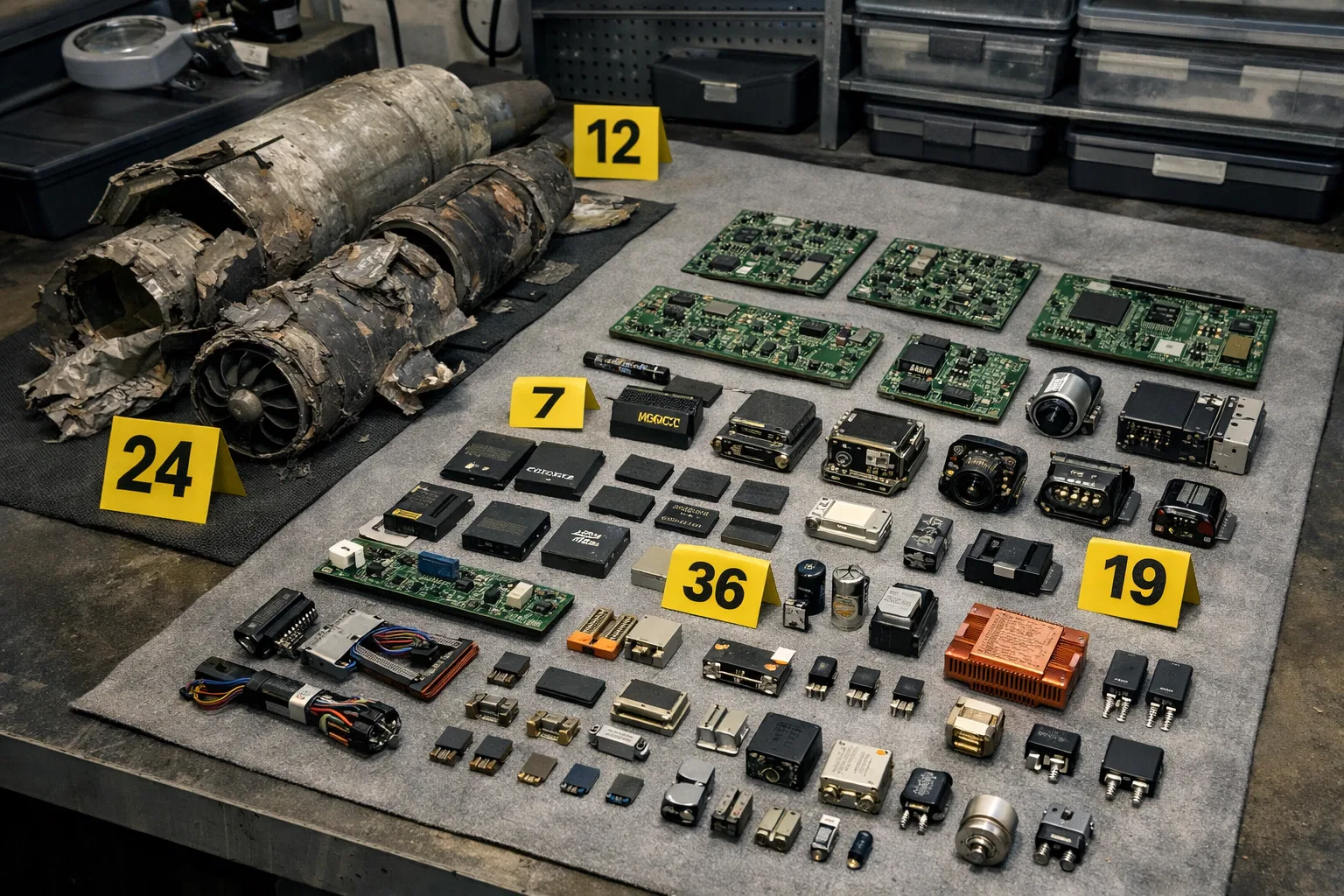
Fragments from modern missiles and drones can say more than the weapon’s shape or range. A recovered circuit board, motor, sensor, navigation unit or batch marking can expose the commercial supply chain behind a weapons programme: which parts were imported, which components were locally substituted, which distributors sat in the middle, and where sanctions enforcement is weakest. That makes debris exploitation a form of supply-chain intelligence within the wider practice of reverse engineering foreign military technology.
The clearest evidence now comes from Ukraine, where investigators have examined Russian, Iranian and North Korean missiles and uncrewed aerial vehicles used since 2022. The pattern is not that every weapon is simply “foreign-made inside”. It is more precise: missiles and drones often combine domestic airframes, explosives and military design with globally available electronics, navigation modules, radio-frequency parts, power converters, processors, memory chips, connectors, sensors and manufacturing inputs. Those clues can turn a wreckage field into a map of procurement routes, diversion points and enforcement failures.[IISS]iiss.orgpub25 094 tracking the components of missiles and uavs used by russia in ukrainepub25 094 tracking the components of missiles and uavs used by russia in ukraine
Why debris has become supply-chain evidence
The supply-chain value of missile and drone debris comes from the fact that modern precision weapons are modular. Even when the weapon is designed by a sanctioned state, many internal functions are performed by components that also exist in civilian markets: processors, memory, voltage regulators, satellite-navigation receivers, radio modules, inertial sensors, cameras, connectors, relays and power-management devices. These parts are often marked with manufacturer logos, date codes, lot numbers or model identifiers. Investigators record those markings, photograph the part in context and then ask manufacturers, governments or intermediaries to help trace how the item moved through the market.[IISS]iiss.orgpub25 094 tracking the components of missiles and uavs used by russia in ukrainepub25 094 tracking the components of missiles and uavs used by russia in ukraine
Conflict Armament Research describes this as field documentation rather than desk speculation. Its teams photograph weapons and components in situ, record markings, enter data into a tracing database and, where possible, establish chain of custody through formal tracing with governments, manufacturers and transfer intermediaries. The result is not always a complete map of a weapon’s full bill of materials, because impact damage, recovery conditions and access all limit what can be examined. But even partial debris can reveal repeat components, production dates and common procurement nodes across several weapons.[IISS]iiss.orgpub25 094 tracking the components of missiles and uavs used by russia in ukrainepub25 094 tracking the components of missiles and uavs used by russia in ukraine
This matters because supply-chain clues answer questions that ordinary performance analysis cannot. A missile fragment can show whether a weapon was recently produced, whether it uses a domestic substitute for a sanctioned foreign part, whether a drone model has been modified since earlier recoveries, and whether different weapons share the same imported electronics. That turns reverse engineering from “how does this weapon work?” into “how is this weapon still being built?”
What investigators identify inside missiles and drones
Component identification usually begins with the parts that survive well enough to read. Electronics are especially valuable because chips and modules often carry standardised markings. In Russian, Iranian and North Korean missiles and drones recovered in Ukraine, investigators have documented processors, controllers, memories, amplifiers, radio-navigation equipment, communications modules, voltage converters, power transistors, relays, connectors and other commercial electronic parts. The European Commission’s Common High Priority Items list was explicitly built from battlefield findings, including electronic components, radio-frequency transceiver modules, printed-circuit-board-related items and high-precision metalworking inputs found in or critical to Russian military systems.[Finance]finance.ec.europa.euFinance List of common high priority itemsFinance List of common high priority items
The details can be surprisingly specific. In one Kh-69 air-launched cruise missile recovered near Kyiv in August 2024, CAR documented almost 800 intact components. Among them were voltage converters in the missile’s imaging infrared sensor and satellite-navigation module, as well as MOSFET power transistors from the on-board computer and thermal-vision camera. These are not decorative finds; they point to the subsystems that make a missile guide, sense, compute and manage electrical power.[IISS]iiss.orgpub25 094 tracking the components of missiles and uavs used by russia in ukrainepub25 094 tracking the components of missiles and uavs used by russia in ukraine
UAV debris often yields a different pattern. Shahed-136-pattern one-way attack drones have been recovered in large numbers and contain many components that are commercially available. In a sample of nearly 2,000 components from 20 Shahed-136-pattern UAVs documented between 2022 and 2024, investigators could identify more than 1,400 branded producers; all but 15 were foreign in origin, made by companies headquartered in 13 countries other than Russia or Iran.[IISS]iiss.orgpub25 094 tracking the components of missiles and uavs used by russia in ukrainepub25 094 tracking the components of missiles and uavs used by russia in ukraine
Ukraine’s War & Sanctions database shows how such evidence is turned into a public component catalogue. Its “foreign components in weapons” portal listed 5,816 components across 202 weapon units as of 25 May 2026, including named examples from UAVs such as Chinese turbojet engines, Taiwanese relays, US transceivers and memory chips, network switches, mesh modems and connectors. The portal is not neutral academic literature; it is a Ukrainian government-linked sanctions resource. But it is useful because it turns recovered hardware into searchable component-level evidence for investigators, exporters and policymakers.[War & Sanctions]war-sanctions.gur.gov.uaWar & Sanctions Foreign components in weaponsWar & Sanctions Foreign components in weapons
Imported electronics are not evenly distributed
One of the most important findings is that “foreign components” are not equally important across all weapon types. Missiles and drones can sit at different points on the domestic-versus-imported spectrum.
In CAR’s sample of 3,211 components documented between February 2022 and April 2025, Russian ballistic and cruise missiles had a larger domestic component share than Russian UAVs. The IISS report based on CAR data shows that roughly one-third of components documented in Russian ballistic and cruise missiles were produced in Russia, while the Russian-produced share in Russian UAVs was far smaller. That difference matters: it suggests that Russia has been more able to substitute or produce certain missile components domestically than it has for many drone components.[IISS]iiss.orgpub25 094 tracking the components of missiles and uavs used by russia in ukrainepub25 094 tracking the components of missiles and uavs used by russia in ukraine
The Kh-69 example shows how sanctions pressure and domestic substitution can appear in the debris itself. In the recovered missile examined in August 2024, almost half of the 466 dated and identified components were manufactured in Russia, and 45% of all documented components were produced in Russia in 2023 alone. Looking at the year markings, CAR found that 29% of components with a 2021 mark were Russian, but that jumped to 90% for components produced in 2023 and 94% for those produced in 2024. That is exactly the kind of clue analysts look for: not merely whether a foreign component exists, but whether a weapons producer is replacing imported parts after sanctions bite.[IISS]iiss.orgpub25 094 tracking the components of missiles and uavs used by russia in ukrainepub25 094 tracking the components of missiles and uavs used by russia in ukraine
Shahed-pattern UAVs tell a different story. Their large-scale use creates a constant need for foreign electronics, and their debris has shown very short timelines between component manufacture and battlefield use. One Shahed-136 recovered in April 2023 contained a DC-to-DC converter manufactured by a China-based company in January 2023, implying that the part was produced, procured, integrated and deployed within roughly three months. That kind of date-code evidence is far stronger than a general claim that a sanctioned actor “somehow” obtained parts; it points to a living supply chain, not a pre-war stockpile.[IISS]iiss.orgpub25 094 tracking the components of missiles and uavs used by russia in ukrainepub25 094 tracking the components of missiles and uavs used by russia in ukraine
The most revealing clues are often ordinary parts
A common misunderstanding is that investigators are mainly looking for exotic military-grade technology. In many cases, the opposite is true. The most useful evidence may be mundane commercial electronics because those parts are widely traded, heavily intermediated and difficult to control at scale.
The IISS report notes that claims about Russia stripping household appliances for missile parts became a popular early-war trope, but CAR found no direct evidence supporting that specific claim. What investigators did find repeatedly was more important: Russian missiles and UAVs relied heavily on commercially available components that could be integrated into many military products. That distinction matters. The issue is not improvised cannibalisation from refrigerators; it is the use of normal global electronics supply chains to feed military production.[IISS]iiss.orgpub25 094 tracking the components of missiles and uavs used by russia in ukrainepub25 094 tracking the components of missiles and uavs used by russia in ukraine
This is why component tracing often leads away from the headline manufacturer and towards distributors. CAR’s tracing work found that diversion typically occurs further down the supply chain, often at the distributor level. Across hundreds of trace investigations involving different manufacturers and components, supply chains frequently converged on a small number of large distributors or intermediaries. That does not automatically mean the original manufacturer knew the final military end use. In the IISS/CAR sample, there was no evidence that the branded manufacturers had directly exported missile- or UAV-related components to Russia after the 2022 invasion, Iran or North Korea, or had prior knowledge of the eventual military use before sale.[IISS]iiss.orgpub25 094 tracking the components of missiles and uavs used by russia in ukrainepub25 094 tracking the components of missiles and uavs used by russia in ukraine
The difficulty is structural. Manufacturers and distributors may be dealing with components that have multiple civilian uses, travel through diffuse distribution networks, are produced in huge volumes and are often not individually serialised. That makes a single chip or power component hard to track once it leaves authorised channels. For enforcement agencies, the practical question becomes less “who made the part?” and more “where did the part leave ordinary commerce and enter a diversion network?”[IISS]iiss.orgpub25 094 tracking the components of missiles and uavs used by russia in ukrainepub25 094 tracking the components of missiles and uavs used by russia in ukraine
How debris points to procurement networks
Supply-chain clues become more powerful when the same names, markings, distributors or part families appear across multiple recoveries. CAR’s field dispatches show how this works in practice. Investigators have linked identical component sets across Russian systems including Kh-101, Kh-50 and 9M544 missiles; identified post-invasion components in Russian weapons; dated newly produced Russian missiles used in attacks on Kyiv; and traced components in Iranian Shahed UAVs used by Russia.[conflictarm.com]conflictarm.comConflict Armament ResearchConflict Armament Research
Iranian-origin drones are especially revealing because they connect multiple conflict theatres. CAR’s early analysis of Iranian UAVs used by Russian forces in Ukraine found that the drones originated in Iran and included many recently manufactured components produced by companies mostly based in the United States. Later field dispatches identified the Iran-based company Mado as the producer of engines found in Shahed-136 UAVs in Ukraine, and another dispatch identified Sarmad Electronic Sepahan as the producer of components found in UAVs used by Russia.[conflictarm.com]conflictarm.comConflict Armament ResearchConflict Armament Research
The supply-chain picture also extends beyond Russia and Iran. In 2024, CAR documented electronic components in the navigation subsystem of North Korean KN-23 or KN-24 ballistic missiles used in Ukraine. Tracing work on two components made by an EU-based company found that they had been legally exported in multiple consignments to a Hong Kong distributor before reaching customers in China, one of which had significant ties to North Korea. That kind of finding is exactly why debris exploitation is valuable: it can connect a missile fragment recovered in Ukraine to a legal export, a distributor, a reported end user and a sanctioned weapons programme.[IISS]iiss.orgpub25 094 tracking the components of missiles and uavs used by russia in ukrainepub25 094 tracking the components of missiles and uavs used by russia in ukraine
The same logic applies to older and parallel cases. The IISS report notes that Iranian procurement through East Asian companies has been documented before, including the “Karl Lee” network of China-based shell companies used to export dual-use goods for Iran’s missile programme. It also points to cases in Yemen where components in Houthi missiles and UAVs included Chinese-branded products or passed through China-based logistics intermediaries. Debris from one battlefield can therefore illuminate procurement patterns that recur across several conflicts.[IISS]iiss.orgpub25 094 tracking the components of missiles and uavs used by russia in ukrainepub25 094 tracking the components of missiles and uavs used by russia in ukraine
Sanctions clues: what enforcement learns from wreckage
The most direct policy use of component evidence is the targeting of export controls and sanctions. The Common High Priority Items list is a good example. The EU, working with partners including the United States, United Kingdom and Japan, grouped battlefield-recovered and weapon-relevant items into 50 Harmonised System codes, including integrated circuits, wireless communications items, satellite-navigation equipment, passive electronics, discrete components, bearings, optical components, testing equipment and CNC machine tools. The list explicitly cites systems such as the Kalibr cruise missile, Kh-101 cruise missile, Orlan-10 UAV and Ka-52 helicopter.[Finance]finance.ec.europa.euFinance List of common high priority itemsFinance List of common high priority items
The list is not static. The European Commission says it will be adjusted in light of what is found in Russian military systems on the battlefield. That is a significant shift: debris is not just evidence after an attack, but a feedback mechanism for regulators. If investigators repeatedly find a component type in missiles or drones, that part can move from being an obscure commercial item to a high-priority due-diligence target.[Finance]finance.ec.europa.euFinance List of common high priority itemsFinance List of common high priority items
The IISS/CAR analysis suggests that this approach is directionally useful but incomplete. A preliminary assessment found that the vast majority of documented components in sample Kh-69 missiles, KN-23 or KN-24 missiles and Shahed-136-pattern UAVs fell within the Common High Priority List, with more than 25% of components from Shahed-pattern UAVs and about 40% from Kh-69 missiles falling under Tier 1 integrated circuits. Fewer than 10% of components in the sample were outside the list. That confirms the list is catching much of the battlefield evidence, but also underlines how dependent enforcement remains on fresh recovered hardware and tracing.[IISS]iiss.orgpub25 094 tracking the components of missiles and uavs used by russia in ukrainepub25 094 tracking the components of missiles and uavs used by russia in ukraine
Enforcement actions increasingly mirror those debris findings. In October 2024, the US Treasury sanctioned 275 individuals and entities in 17 jurisdictions, including China, India, Switzerland, Thailand and Türkiye, saying they were involved in supplying Russia with advanced technology and equipment. Treasury described Russia as increasingly reliant on complex transnational schemes to procure critical technological and manufacturing components, including items on the Common High Priority List.[U.S. Department of the Treasury]home.treasury.govOpen source on treasury.gov.
Other sanctions have focused on specific routes and component categories. In May 2024, Treasury said Hong Kong-based companies had made hundreds of shipments of foreign-origin microelectronics to Russian technology firms, and identified a PRC-based company that had shipped communications equipment to Russian companies including SMT-iLOGIC, which it described as part of a procurement network for foreign-origin technology used to manufacture Orlan drones. It also named a Hong Kong supplier of noise-suppressing filters, pressure sensors and microcontrollers found in Russian missile systems and UAVs.[U.S. Department of the Treasury]home.treasury.govOpen source on treasury.gov.
Criminal cases add another layer. In October 2024, the US Department of Justice charged Russian nationals in an alleged illicit procurement network to smuggle US-sourced microelectronics with military applications from US distributors to a Russia-based supplier serving manufacturers for the Russian military. Such cases show how component evidence, trade records, finance and export-control enforcement can converge.[Department of Justice]justice.govOpen source on justice.gov.

What the evidence can and cannot prove
Supply-chain analysis from debris is powerful, but it has limits. A chip bearing a US, Japanese, European, Taiwanese or Chinese company mark does not by itself prove that the company sold directly to a sanctioned weapons programme. Semiconductor supply chains are complex: a company may design a chip in one country, manufacture it in another, sell through authorised distributors and lose visibility after resale. Some parts may also be counterfeit, which CAR has confirmed with branded manufacturers in some cases.[IISS]iiss.orgpub25 094 tracking the components of missiles and uavs used by russia in ukrainepub25 094 tracking the components of missiles and uavs used by russia in ukraine
Date codes are useful but also need care. A component manufactured after February 2022 is strong evidence that sanctioned actors continued to obtain parts after the invasion, but it does not automatically identify the route. A part made before sanctions may come from old stock, prior legal exports or later diversion from third countries. Investigators therefore treat production date, component type, weapon assembly markings and trace responses as a bundle of evidence rather than relying on a single label.
There is also a sampling problem. Battlefield debris is opportunistic. Investigators see what is recovered, accessible and intact enough to document. The IISS report cautions that the data does not comprehensively reflect every component in a missile system or every weapon used in the conflict; it reflects what investigators could examine. That is why the strongest conclusions are comparative and repeated: recurring components, shared supply nodes, post-invasion date marks and consistent reliance on particular categories of commercial electronics.[IISS]iiss.orgpub25 094 tracking the components of missiles and uavs used by russia in ukrainepub25 094 tracking the components of missiles and uavs used by russia in ukraine
Why this changes how foreign military technology is reverse engineered
Traditional reverse engineering asks how a weapon performs and how to counter it. Supply-chain exploitation adds another question: what external dependencies keep the weapon programme alive? That can be just as operationally important as understanding guidance logic or warhead design.
For defenders, component evidence can identify chokepoints. If several drone models depend on the same class of satellite-navigation receiver, voltage converter or communications module, governments can prioritise those items for licensing, customs screening and distributor due diligence. If tracing repeatedly leads to the same intermediary jurisdictions or trading companies, sanctions and enforcement can focus there rather than treating the entire global electronics market as equally risky.[IISS]iiss.orgpub25 094 tracking the components of missiles and uavs used by russia in ukrainepub25 094 tracking the components of missiles and uavs used by russia in ukraine
For analysts, debris also reveals adaptation. The Kh-69 evidence suggests a shift towards Russian-made components in more recent missile production, while Shahed-pattern UAVs still show heavy reliance on foreign electronics. That contrast is more useful than a simple claim that sanctions “work” or “fail”. It suggests sanctions and controls may force substitution in some subsystems, reroute procurement in others, and leave high-volume drone production dependent on commercial supply chains.[IISS]iiss.orgpub25 094 tracking the components of missiles and uavs used by russia in ukrainepub25 094 tracking the components of missiles and uavs used by russia in ukraine
For manufacturers and distributors, the lesson is uncomfortable but clear. Even ordinary parts can become strategic evidence once they appear in a missile or drone. The War & Sanctions portal urges manufacturers and distributors to maintain enhanced risk-based due diligence, share red flags through counterparties and avoid re-export channels to high-risk jurisdictions. The IISS/CAR analysis reaches a similar conclusion from a different angle: globalised, distributor-centric supply chains are a central vulnerability in export control.[War & Sanctions]war-sanctions.gur.gov.uaWar & Sanctions Foreign components in weaponsWar & Sanctions Foreign components in weapons
The lasting value of a broken circuit board
A recovered missile body may tell investigators what was fired. A recovered circuit board can tell them how the weapon was built, who supplied the parts, when those parts entered the chain and which enforcement gaps remain open. That is why supply-chain clues have become one of the most important forms of evidence inside modern missiles and drones.
The most revealing story is not that sanctioned states use foreign technology; that is now well documented. The sharper lesson is that debris can distinguish stockpiles from new procurement, domestic substitution from continued import dependence, manufacturer origin from distributor diversion, and broad sanctions policy from specific enforceable chokepoints. In modern military reverse engineering, the supply chain is part of the weapon.
eBay marketplace picks
Marketplace Samples
Live-tested eBay searches with available results related to this page.
Endnotes
1.
Source: iiss.org
Title: pub25 094 tracking the components of missiles and uavs used by russia in ukraine
Link:https://www.iiss.org/globalassets/media-library—content–migration/files/research-papers/2025/09/pub25-094-tracking-the-components-of-missiles-and-uavs-used-by-russia-in-ukraine.pdf
2.
Source: conflictarm.com
Title: Conflict Armament Research
Link:https://www.conflictarm.com/field-dispatches/
3.
Source: home.treasury.gov
Link:https://home.treasury.gov/news/press-releases/jy2270
4.
Source: home.treasury.gov
Link:https://home.treasury.gov/news/press-releases/jy2700
5.
Source: home.treasury.gov
Link:https://home.treasury.gov/news/press-releases/jy2318
6.
Source: justice.gov
Link:https://www.justice.gov/usao-sdny/pr/two-russian-nationals-charged-their-participation-illicit-procurement-network-exported
7.
Source: home.treasury.gov
Link:https://home.treasury.gov/news/press-releases/sb0313
8.
Source: home.treasury.gov
Link:https://home.treasury.gov/news/press-releases/jy2546
9.
Source: home.treasury.gov
Link:https://home.treasury.gov/news/press-releases/jy2117
10.
Source: home.treasury.gov
Title: 2026 NPFRA
Link:https://home.treasury.gov/system/files/246/2026-NPFRA.pdf
11.
Source: home.treasury.gov
Link:https://home.treasury.gov/news/press-releases/jy2404
12.
Source: home.treasury.gov
Link:https://home.treasury.gov/news/press-releases/jy1978
13.
Source: home.treasury.gov
Title: 2024 National Proliferation Financing Risk Assessment
Link:https://home.treasury.gov/system/files/136/2024-National-Proliferation-Financing-Risk-Assessment.pdf
14.
Source: justice.gov
Link:https://www.justice.gov/file/1277101/dl?inline=
15.
Source: justice.gov
Link:https://www.justice.gov/archives/opa/pr/russian-german-national-extradited-illegally-exporting-russia-sensitive-us-sourced
16.
Source: justice.gov
Title: russian german national arrested illegally exporting russia sensitive us sourced
Link:https://www.justice.gov/archives/opa/pr/russian-german-national-arrested-illegally-exporting-russia-sensitive-us-sourced
17.
Source: justice.gov
Link:https://www.justice.gov/usao-sdny/pr/russian-german-national-extradited-illegally-exporting-russia-sensitive-us-sourced
18.
Source: justice.gov
Link:https://www.justice.gov/archives/opa/pr/fact-sheet-disruptive-technology-strike-force-efforts-first-year-prevent-sensitive
19.
Source: justice.gov
Title: russian german national arrested illegally exporting russia sensitive us sourced
Link:https://www.justice.gov/usao-sdny/pr/russian-german-national-arrested-illegally-exporting-russia-sensitive-us-sourced
20.
Source: justice.gov
Link:https://www.justice.gov/archives/opa/speech/deputy-assistant-attorney-general-eun-young-choi-delivers-keynote-remarks-gir-live
21.
Source: justice.gov
Title: department announces five cases tied disruptive technology strike force
Link:https://www.justice.gov/archives/opa/pr/justice-department-announces-five-cases-tied-disruptive-technology-strike-force
22.
Source: justice.gov
Link:https://www.justice.gov/archives/opa/speech/assistant-attorney-general-national-security-matthew-g-olsen-delivers-remarks-roundtable
23.
Source: iiss.org
Link:https://www.iiss.org/research-paper/2025/09/tracking-the-components-of-missiles-and-uavs-used-by-russia-in-ukraine-what-lessons-for-control-regimes/
24.
Source: iiss.org
Link:https://www.iiss.org/globalassets/media-library—content–migration/files/research-papers/2025/09/pub25-094-executive-summary.pdf
25.
Source: iiss.org
Link:https://www.iiss.org/globalassets/media-library—content–migration/files/publications—free-files/strategic-dossier/uavs-2026/iiss_uavs-isr-deterrence-and-war_032026.pdf
26.
Source: iiss.org
Title: russia war in ukraine ballistic and cruise trajectories
Link:https://www.iiss.org/globalassets/media-library—content–migration/files/research-papers/2023/09/mdiukr/russia-war-in-ukraine_ballistic-and-cruise-trajectories.pdf
27.
Source: iiss.org
Link:https://www.iiss.org/globalassets/media-library—content–migration/files/research-papers/open-source-analysis-of-irans-missile-and-uav-capabilities-and-proliferation.pdf
28.
Source: iiss.org
Link:https://www.iiss.org/globalassets/media-library—content–migration/files/publications—free-files/strategic-dossier/pds-2025/chapters/iiss_progress-and-shortfalls-in-europes-defence_2025_ch-3_integrated-air-and-missile-defence.pdf
29.
Source: iiss.org
Link:https://www.iiss.org/globalassets/media-library—content–migration/files/publications—free-files/strategic-dossier/uavs-2026/iiss_ch-4-uavs-isr-deterrence-and-war_032026.pdf
30.
Source: iiss.org
Title: iiss critical raw materials and european defence 25032025
Link:https://www.iiss.org/globalassets/media-library—content–migration/files/research-papers/2025/03/iiss_critical-raw-materials-and-european-defence_25032025.pdf
31.
Source: iiss.org
Title: the defence policy and economics of the middle east and north africa1
Link:https://www.iiss.org/globalassets/media-library—content–migration/files/research-papers/2022/05/the-defence-policy-and-economics-of-the-middle-east-and-north-africa1.pdf
32.
Source: conflictarm.com
Link:https://www.conflictarm.com/
33.
Source: conflictarm.com
Link:https://www.conflictarm.com/publications/
34.
Source: conflictarm.com
Link:https://www.conflictarm.com/reports/weapons-of-the-war-in-ukraine/
35.
Source: finance.ec.europa.eu
Title: Finance List of common high priority items
Link:https://finance.ec.europa.eu/system/files/2023-09/list-common-high-priority-items_en.pdf
36.
Source: war-sanctions.gur.gov.ua
Title: War & Sanctions Foreign components in weapons
Link:https://war-sanctions.gur.gov.ua/en/components
37.
Source: finance.ec.europa.eu
Link:https://finance.ec.europa.eu/document/download/586f9b62-50c3-46e3-9940-de73ae96a24b_en?filename=faqs-sanctions-russia-export-related-restrictions-russia_en.pdf
38.
Source: finance.ec.europa.eu
Link:https://finance.ec.europa.eu/document/download/66e8fd7d-8057-4b9b-96c2-5e54bf573cd1_en?filename=faqs-sanctions-russia-consolidated_en.pdf
39.
Source: policy.trade.ec.europa.eu
Title: 2025 update eu control list dual use items 2025 09 08 en
Link:https://policy.trade.ec.europa.eu/news/2025-update-eu-control-list-dual-use-items-2025-09-08_en
40.
Source: single-market-economy.ec.europa.eu
Link:https://single-market-economy.ec.europa.eu/system/files/2023-03/Raw%20Materials%20Foresight%20Study%202023.pdf
41.
Source: ec.europa.eu
Title: eu DRON E
Link:https://ec.europa.eu/programmes/erasmus-plus/project-result-content/bbb7abc9-dd14-4b0a-afac-fa1689715702/ENG_2020-1-RS01-KA202-065370_1.pdf
42.
Source: publications.jrc.ec.europa.eu
Title: eu Case Study of Andalusia space ecosystem
Link:https://publications.jrc.ec.europa.eu/repository/bitstream/JRC143531/JRC143531_01.pdf
43.
Source: war-sanctions.gur.gov.ua
Link:https://war-sanctions.gur.gov.ua/en/components?f%5Btitle_uk%5D=wgroup-380&page=3&per-page=12
44.
Source: war-sanctions.gur.gov.ua
Link:https://war-sanctions.gur.gov.ua/en/components?f%5Btitle_uk%5D=wgroup-333&page=8&per-page=12
45.
Source: dictionary.cambridge.org
Link:https://dictionary.cambridge.org/dictionary/english/conflict
Additional References
46.
Source: youtube.com
Link:https://www.youtube.com/watch?v=-5rrq1WXeSw
Source snippet
SANCTIONS FAIL? 100+ US Microchips & Western Tech Traced Inside New Russian Cruise Missile...
47.
Source: youtube.com
Link:https://www.youtube.com/watch?v=ZC0fAdPNYJ4
Source snippet
How Western parts end up in Russian missiles...
48.
Source: youtube.com
Title: Kamikaze Drone: Stolen engine used on Shahed-136
Link:https://www.youtube.com/watch?v=WTEJPRTO3mI
Source snippet
Ukraine Captures "Hacked" Mohajer-6 Drone, Finds Western Parts Powering Russia's Iranian Drones...
49.
Source: hsgac.senate.gov
Link:https://www.hsgac.senate.gov/wp-content/uploads/09.10.2024-Majority-Staff-Report-The-U.S.-Technology-Fueling-Russias-War-in-Ukraine.pdf
50.
Source: youtube.com
Link:https://www.youtube.com/watch?v=nm3GFfZPnyw
Source snippet
Business and Human Rights Centre...
51.
Source: merriam-webster.com
Link:https://www.merriam-webster.com/dictionary/conflict
52.
Source: facebook.com
Link:https://www.facebook.com/unbnewsroom/posts/european-officials-say-russia-increasing-attempts-to-obtain-western-technologyre/1297566199252878/
53.
Source: facebook.com
Link:https://www.facebook.com/irishtimes/posts/explainer-how-russian-manufacturers-are-utilising-components-produced-in-ireland/1344274581064123/
54.
Source: facebook.com
Link:https://www.facebook.com/ukrnewsfeed/posts/foreign-tech-inside-russian-drones-what-investigators-founddespite-sanctions-the/122155638800654935/
55.
Source: nako.org.ua
Link:https://nako.org.ua/wp-content/uploads/2025/12/2024-02-09-11_55_57-globalization-weaponized.pdf
Topic Tree