Within Foreign Materiel
How Weapon Parts Trace Sanctions Gaps
Technical exploitation of debris can support sanctions cases by showing how restricted components reached weapons.
On this page
- Serial numbers and components
- Commercial supply paths
- Policy consequences
Page outline Jump by section
Introduction
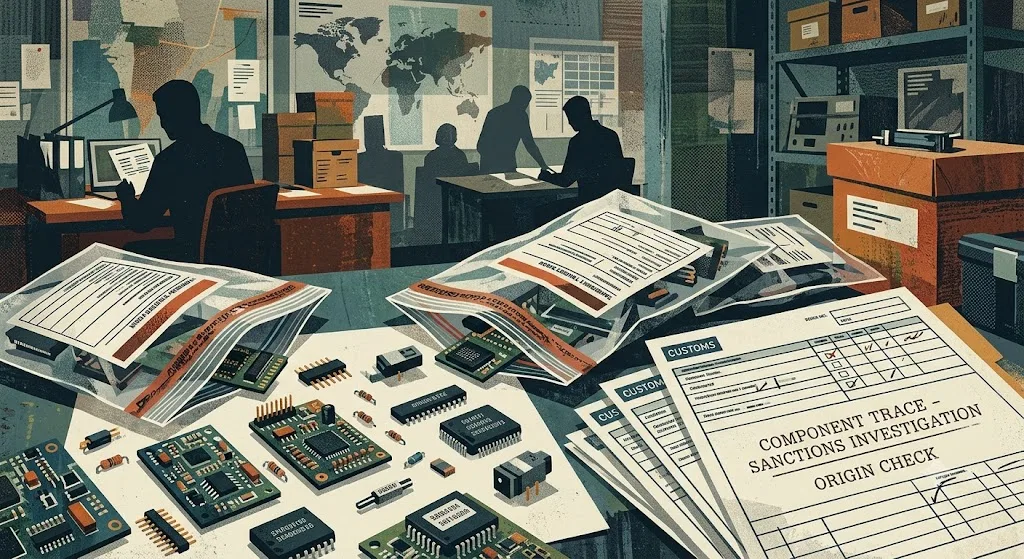
Weapons debris has become a sanctions enforcement tool. When investigators recover a Russian missile, drone or electronic-warfare system in Ukraine, they are not only learning how the weapon works; they are also documenting the foreign chips, sensors, navigation modules, machine-tool dependencies and serial numbers that reveal how restricted technology reached the battlefield. That makes component tracing a governance intervention: it turns reverse engineering from a technical intelligence exercise into evidence for export-control updates, customs alerts, company due diligence, criminal investigations and sanctions designations.
The core lesson is uncomfortable but useful. Modern weapons often depend on commercially available electronics that move through long, international supply chains. Battlefield exploitation can show which parts matter, which intermediaries are recurring, and where enforcement is weak. Ukraine’s public and private partners have used recovered components to build databases, pass serial numbers to governments, identify high-risk tariff codes and press manufacturers and distributors to close diversion routes. The same evidence also shows the limits of sanctions: many components are cheap, common, dual-use and hard to control once they leave authorised distribution channels.
Why debris now matters to sanctions enforcement
Reverse engineering foreign military technology usually evokes performance questions: how accurate a missile is, how its guidance works, or what countermeasure might defeat it. Component tracing asks a different question: what does this weapon reveal about the supply chain that made it possible? A circuit board in a cruise missile can carry manufacturer markings, lot codes, date codes and sometimes serialised identifiers. A navigation receiver, microcontroller or power-management chip may show whether the part was made before or after an export-control change. A repeated component across several weapons can identify a dependency that enforcement agencies can prioritise.
This is why component tracing has become especially important in the war in Ukraine. Ukraine’s Defence Intelligence “War & Sanctions” portal described 5,816 foreign-produced components across 202 weapon units as of 25 May 2026, presenting them as a tool for depriving Russia of access to technology used in attacks.[War & Sanctions]war-sanctions.gur.gov.uaWar & SanctionsForeign components in weapons25 May 2026 — Components in the aggressors weapon. The worlds only open database portal of… Earlier, Ukraine’s National Agency on Corruption Prevention launched an open database with more than 2,000 foreign components found in Russian and Iranian weapons used against Ukraine, framing the database as a non-proliferation and sanctions-policy instrument rather than simply a technical catalogue.[NABU]nazk.gov.uaNABUThe NACP launches the world's first open database with…7 Dec 2023 — The database currently contains information on foreign compone…
The policy value lies in specificity. A general statement that “Western technology is in Russian weapons” is politically powerful but hard to enforce. A recovered part with a manufacturer, model, date marking and serial number can be checked against sales records, distributors, customs filings, re-export declarations and known procurement networks. In July 2026, Ukraine’s sanctions policy commissioner Vladyslav Vlasiuk said Ukraine had handed partner governments hundreds of serial numbers from foreign components found in Russian missiles and drones so those governments could investigate how the parts entered Russia.[Presidents Office Ukraine]president.gov.uaOpen source on president.gov.ua.
Serial numbers and components
What investigators can learn from the markings
The most useful recovered component is not necessarily the most advanced one. It is the one that can be traced. Investigators look for manufacturer logos, product codes, batch markings, date codes, serial numbers, board layouts, packaging residues and any relationship between the part and the wider subsystem. A navigation unit may reveal reliance on satellite positioning. A field-programmable gate array or microcontroller may point to a guidance, communications or control function. A memory chip may indicate a supply family used across multiple weapon types.
Conflict Armament Research has shown how this kind of technical exploitation can reveal commonality across Russian systems. In its work on advanced Russian weapons used in Ukraine, CAR reported identifying 144 non-Russian manufacturers of more than 650 unique component models in Russian materiel, including repeated electronics in missile satellite-navigation systems.[ArcGIS StoryMaps]storymaps.arcgis.comOpen source on arcgis.com. CAR has also documented post-invasion components in Russian weapons: in March 2023, its field team recorded three Russian weapons containing identical components bearing the marks of a US-based company and indicating production in August 2022, months after the full-scale invasion began.[ArcGIS StoryMaps]storymaps.arcgis.comOpen source on arcgis.com.
That kind of date evidence matters because sanctions enforcement is often about timing. A component made before a control was imposed may still raise diversion questions, but a component produced after the control or after a company adopted enhanced screening creates a sharper enforcement trail. It can prompt questions about whether the part was exported lawfully to an intermediary, whether it was re-exported without authorisation, whether a distributor ignored red flags, or whether documentation was falsified.
The evidence is not automatically proof of manufacturer wrongdoing. Many chips and electronic parts pass through layers of authorised distributors, brokers, resellers, repair channels and grey-market traders. But serialised tracing can separate broad reputational pressure from actionable evidence. It gives regulators and prosecutors a starting point: who first sold the item, who bought it, when it left the controlled jurisdiction, and whether later parties were already sanctioned, newly created, co-located with risky firms or unusually active in high-priority goods.

Why common parts can be strategically important
One striking feature of Russian weapons exploitation is that many critical parts are not exotic military-only devices. The Royal United Services Institute’s 2022 “Silicon Lifeline” report found more than 450 foreign-made components in Russian weapons recovered in Ukraine, including at least 80 kinds subject to US export controls; Reuters reported the same study as evidence that Moscow had acquired critical technology from companies in the United States, Europe and Asia.[RUSI]static.rusi.orgSilicon Lifeline final webSilicon Lifeline final web
This changes the enforcement problem. If a weapon depends on a custom military seeker, a small number of specialised suppliers may be controllable. If it uses commercial microelectronics, the pool of lawful civilian buyers is huge. The part may appear in industrial equipment, cars, telecommunications devices or consumer electronics. That makes blanket prohibition difficult and increases the value of battlefield feedback: rather than trying to control every electronic component equally, governments can identify the particular tariff lines, models and suppliers repeatedly found in weapons.
KSE Institute’s January 2024 work illustrates the same point at a larger scale. Its report examined almost 2,800 foreign components found in Russian military equipment destroyed or captured on the battlefield, including Kinzhal missiles, Shahed drones, armoured vehicles, helicopters and electronic-warfare systems; it concluded that components from Western companies were present in almost all of them.[Kyiv School of Economics]kse.uaOpen source on kse.ua. The accompanying paper stated that 95% of all parts found in Russian battlefield weapons were sourced from producers in coalition countries, with 72% from US-based producers.[Kyiv School of Economics]kse.uaChallenges of Export Controls EnforcementChallenges of Export Controls Enforcement
Those figures should be read carefully. “Producer origin” is not the same as “direct sale to Russia”, and a company whose part is found in a weapon may have complied with the law. But the numbers are still enforcement-relevant because they show where cooperation is most needed: manufacturers, distributors, customs authorities, financial institutions and export-control agencies in coalition economies all possess fragments of the supply-chain picture.
Commercial supply paths
The weak point is often the re-export chain
Component tracing repeatedly points to a familiar pattern: direct exports to Russia are restricted, but parts move through third countries, trading companies, freight forwarders and newly created importers. The enforcement problem is therefore less like guarding one border and more like monitoring a shifting commercial network.
The US Treasury has repeatedly targeted third-country evasion networks. In October 2024 it sanctioned 275 individuals and entities involved in supplying Russia with advanced technology and equipment, naming networks across 17 jurisdictions including India, China, Switzerland, Thailand and Türkiye.[U.S. Department of the Treasury]home.treasury.govOpen source on treasury.gov. In June 2024, Treasury identified Russia-based Design Partner Microchip as an importer of electronic components, including high-priority Harmonized System goods, and said it had collaborated with multiple US-designated Russian entities to procure electronic components from outside Russia.[U.S. Department of the Treasury]home.treasury.govOpen source on treasury.gov.
This is where recovered components become more than battlefield evidence. Once a part is identified in a weapon, investigators can compare it with trade records. If exports of that product category to Russia fall after sanctions but exports to a neighbouring or intermediary jurisdiction rise, that does not by itself prove diversion. But it creates a red flag. If the same intermediary appears in customs data, corporate registries, shipping records or financial alerts, the case becomes stronger.
Journalistic investigations have added detail to this pattern. A February 2026 Times investigation, summarised in search results, reported British-made components in Russian Geran-2 drones and other military equipment, with supply-chain data suggesting components were sold on by third parties to Russian companies and no allegation that the British manufacturers were directly involved or aware.[The Times]thetimes.comThe Times British hardware found in Russian drones used in UkraineIn 2025, Russian drones attacked Ukraine nearly every night, contributing to over 500 civilian deaths. More than 4,000 suicide drones hav… Reuters reported in February 2026 that Ukraine imposed sanctions on foreign companies from China, the United Arab Emirates, Panama and former Soviet states accused of supplying components for Russian missiles and drones.[Reuters]reuters.comIn recent months, Russia has intensified missile and drone attacks on Ukraine, particularly targeting its energy and logistics infrastruc…
Why end-use paperwork is not enough
Traditional export control often relies on licences, end-user certificates and screening against restricted-party lists. Those tools remain essential, but weapons component tracing shows their limits. A part may be exported for an apparently civilian purpose, then resold. A distributor may not know the final destination. A newly formed company may have no sanctions history but share an address, owner, logistics provider or trade pattern with a risky network.
The G7’s 2024 industry guidance on Russian export-control and sanctions evasion reflects this shift. Canada’s published version warns about new importers or exporters of Common High Priority List items, parties located at the same address as a sanctioned entity, sudden increases in import value or volume, and companies that shipped primarily to Russia before 24 February 2022 but then began shipping to new third-country parties afterwards.[Global Affairs Canada]international.gc.ca2024 09 24 advisory conseil.aspx2024 09 24 advisory conseil.aspx These are not technical weapon specifications; they are behavioural indicators generated by the merger of trade data, enforcement experience and battlefield component findings.
A Guardian report in February 2026 on UK machinery exported to an Armenian firm linked by experts to Russia’s war machine illustrates the governance tension. The machinery was for carbon-fibre prepreg production, a dual-use material relevant to aerospace and weapons systems; the exporter said it undertook end-user checks and received full export approval, while sanctions experts warned that end-user undertakings may be of limited practical value where diversion risk is high.[The Guardian]theguardian.comOpen source on theguardian.com.
The practical consequence is that enforcement increasingly demands “know your customer” plus “know your customer’s customer” where high-risk goods are concerned. Component tracing supplies the reason: if the same classes of parts keep appearing in missiles and drones, exporters and regulators have evidence that ordinary paperwork is not stopping diversion.
From traced parts to policy consequences
The Common High Priority List turns debris into customs targets
The clearest example of component tracing becoming policy is the Common High Priority List, a coordinated list of goods at heightened risk of diversion to Russia. The US Bureau of Industry and Security says the list publicises 50 items that pose a heightened risk of illegal diversion because of their importance to Russia’s war efforts.[Bureau of Industry and Security]bis.govOpen source on bis.gov. The UK government describes the list as composed of Western items critical to Russian weapons systems and military development, and says business plays a key role in preventing them from reaching Russia.[GOV.UK]GOV.UKRussia Sanctions – Common High Priority Items ListRussia Sanctions – Common High Priority Items List
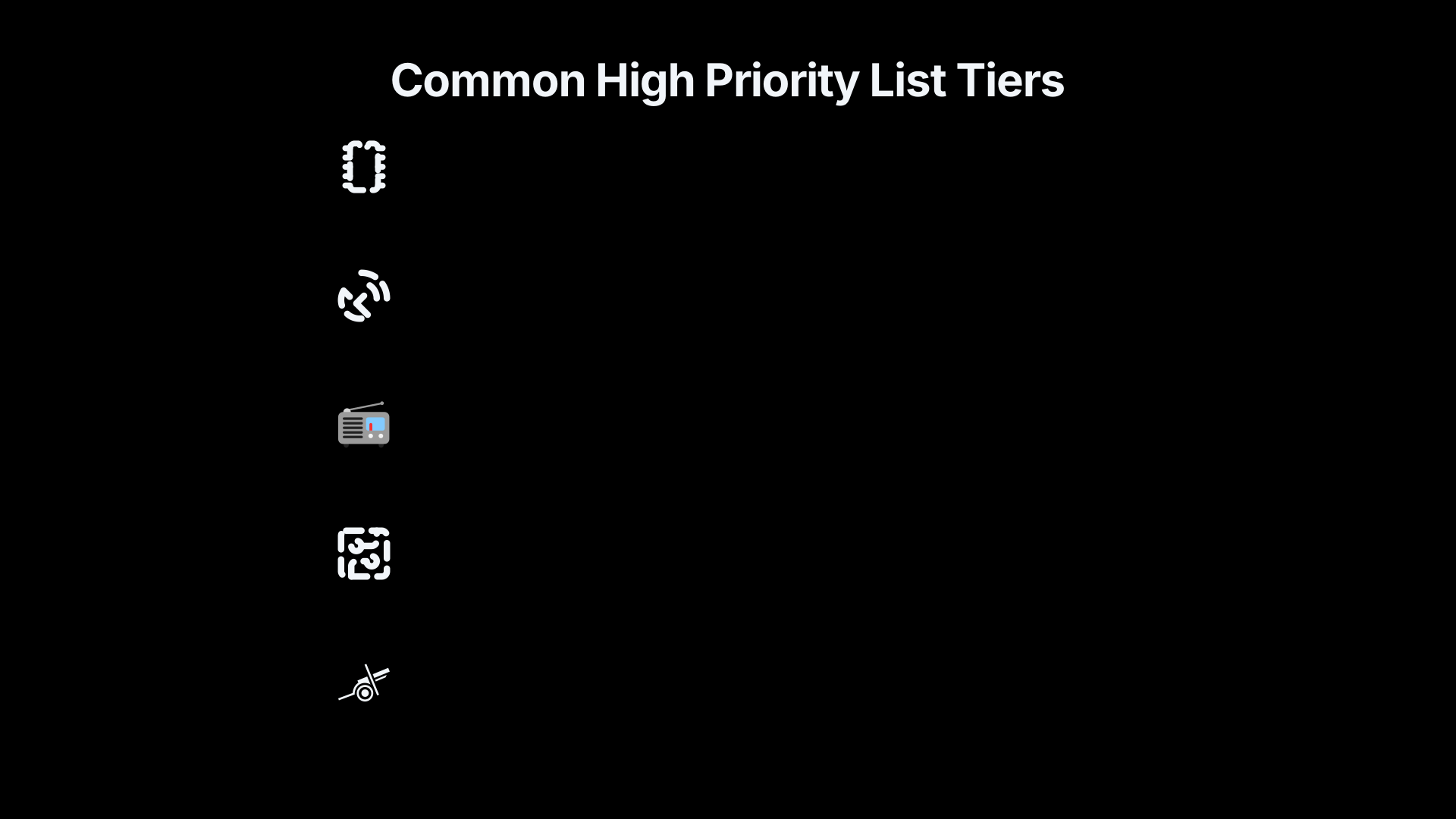
The European Commission’s version makes the battlefield link explicit. It says the list is based on items retrieved from the battlefield, including components in Russian weapons such as the Kalibr cruise missile, Kh-101 cruise missile, Orlan-10 unmanned aerial vehicle and Ka-52 helicopter. It divides 50 Harmonised System codes into tiers, with Tier 1 covering integrated circuits and other tiers covering communications, satellite-navigation, passive electronics, discrete components, electrical items and manufacturing-related goods.[Finance]finance.ec.europa.eulist common high priority items enlist common high priority items en
This is a policy intervention built from reverse engineering. Investigators identify what is inside the weapon; governments translate that into tariff lines, customs alerts and due-diligence expectations. The result is not a perfect ban on every relevant part, but a prioritisation tool. Customs agencies cannot inspect every shipment with equal intensity. Banks cannot scrutinise every invoice as if it were a missile component. The list tells them where to look first.

Enforcement has moved from broad sanctions to named networks
Component tracing also supports designations of specific companies and procurement actors. US Treasury actions in 2023 and 2024 repeatedly targeted entities accused of helping Russia acquire technology and equipment from abroad. Treasury’s May 2024 action said the US and State Department were sanctioning almost 300 targets, including dozens of actors that enabled Russia to acquire needed foreign technology and equipment.[U.S. Department of the Treasury]home.treasury.govOpen source on treasury.gov. Its November 2023 action focused on individuals and entities providing Russia with technology and equipment from third countries.[U.S. Department of the Treasury]home.treasury.govOpen source on treasury.gov.
The US Justice and Commerce Departments have also tried to connect export-control violations to criminal enforcement. The Disruptive Technology Strike Force, launched in February 2023, was designed to combine Justice Department and Commerce Department expertise against efforts by adversaries to acquire advanced technology.[Department of Justice]justice.govand commerce departments announce creation disruptive technology strike forceand commerce departments announce creation disruptive technology strike force A Bureau of Industry and Security fact sheet said that in its first year the Strike Force charged 14 cases involving alleged sanctions and export-control violations, smuggling conspiracies and other offences connected to the unlawful transfer of sensitive goods, information and military-grade technology to Russia, China or Iran.[Bureau of Industry and Security]bis.govOpen source on bis.gov.
This matters because sanctions without enforcement can become a signalling exercise. Component tracing helps move from signalling to cases. It gives investigators leads, helps prosecutors establish materiality, and allows agencies to warn industry about exact products and routes rather than vague risk categories.
What tracing can and cannot prove
Component tracing is powerful, but it has evidentiary limits. A part found in a Russian missile does not automatically establish that the original manufacturer violated sanctions. It may have been produced years earlier, sold through legitimate distributors, incorporated into another product, resold as surplus, counterfeited, relabelled or diverted after leaving the manufacturer’s control. Good enforcement must distinguish between negligence, wilful blindness, criminal conspiracy and unavoidable loss of control in a globalised electronics market.
There is also a substitution problem. Sanctions can push Russia to use lower-quality alternatives, domestic substitutes or suppliers in jurisdictions less aligned with Western controls. Reuters reported in September 2025 that Ukraine was increasingly finding Russian and Belarusian electronics in Iskander missiles, with Vlasiuk saying newer missiles had fewer European and US components and more Russian and Belarusian ones than 2022 versions, although the quality appeared lower.[Reuters]reuters.comUkraine increasingly finds Russian and Belarusian electronics in missilesUkraine increasingly finds Russian and Belarusian electronics in missiles That does not make tracing obsolete; it changes the policy question from “how do we block Western parts?” to “which foreign dependencies remain genuinely constraining, and where is Russia adapting?”
A second limitation is volume. Many electronic components are cheap, small and globally traded. Enforcement agencies may be able to stop high-end machine tools, advanced controllers or specialised sensors more effectively than commodity chips. The Financial Times reported in 2025 that Russian developers of the Oreshnik missile had relied on Western computer numerical control systems from firms such as Siemens, Heidenhain and Fanuc, with CNC devices and components appearing on the common high-priority goods list.[Financial Times]ft.comFinancial Times Russian producers of Oreshnik supermissile used western toolsA third company, Titan Barrikady, was also shown using Fanuc equipment. Although Russia has tried to replace Western tech with Chinese al… Such production equipment may be a more concentrated chokepoint than individual low-cost components inside every drone.
The right lesson, then, is not that every traced part produces a clean sanctions case. It is that the accumulation of traces reveals patterns: repeated models, recurring distributors, suspicious jurisdictions, post-control production dates, common procurement companies and technical bottlenecks. Those patterns are what enforcement can act on.
What stronger enforcement looks like
The governance challenge is to convert battlefield exploitation into faster, more targeted action without treating every manufacturer logo as evidence of guilt. A useful enforcement model has four linked stages.
First, investigators need reliable documentation at the point of recovery: photographs, chain of custody, weapon type, location, markings, date codes and component context. Poor documentation weakens later enforcement because companies and governments need enough detail to search records and distinguish genuine parts from damaged, counterfeit or misidentified ones.
Second, governments need protected channels for serial-number sharing. Ukraine’s July 2026 transfer of hundreds of serial numbers to partner governments is important because manufacturers are often more likely to cooperate with their own national authorities than with public accusation campaigns.[Presidents Office Ukraine]president.gov.uaOpen source on president.gov.ua. Confidential tracing can establish whether a part moved through authorised distributors, brokers or suspicious intermediaries before any public sanction or prosecution is announced.
Third, regulators need to update risk indicators quickly. The Common High Priority List is useful precisely because it converts field evidence into a shared enforcement language based on tariff codes. But lists must be living documents. Ukraine’s Defence Intelligence portal says its component database was updated in May 2026, and the BIS describes its high-priority list as one that may be updated as new information becomes available.[War & Sanctions]war-sanctions.gur.gov.uaWar & SanctionsForeign components in weapons25 May 2026 — Components in the aggressors weapon. The worlds only open database portal of…
Fourth, companies handling high-risk goods need compliance duties proportionate to diversion risk. For ordinary low-risk commerce, basic screening may be enough. For integrated circuits, satellite-navigation modules, precision machine-tool controllers and other goods repeatedly found in weapons, stronger measures are justified: distributor audits, refusal of unexplained third-country spikes, contractual no-re-export clauses, investigation of shared addresses, and rapid cooperation when governments present recovered serial numbers.
Why this subtopic matters inside military reverse engineering
Sanctions enforcement through weapons component tracing is a distinct branch of reverse engineering because the objective is not primarily to copy or defeat the weapon. The objective is to use the weapon as a document. A missile fragment becomes a trade record waiting to be reconstructed. A drone circuit board becomes evidence about procurement routes. A date code becomes a test of whether controls imposed after the invasion are working.
That gives technical exploitation a direct policy payoff. It can identify which commercial technologies are militarily consequential, help governments prioritise export controls, expose third-country evasion networks, and focus companies on the products most likely to be diverted. It can also show when sanctions are being bypassed, when Russia is substituting domestic or allied components, and when enforcement should shift from individual chips to production equipment, logistics providers or financial facilitators.
The most realistic expectation is not that tracing will seal every gap. Modern electronics supply chains are too broad for that. Its value is narrower and more practical: it makes sanctions less generic. Instead of governing by assumption, enforcement agencies can govern from recovered evidence, model numbers, serial numbers, trade flows and repeat patterns found in real weapons used in war.
Amazon book picks
Further Reading
Books and field guides related to How Weapon Parts Trace Sanctions Gaps. Use these as the next step if you want deeper reading beyond the article.
Chip War
Explains global chip supply chains that underpin component-tracing investigations.
The World for Sale
Provides context on opaque international supply chains and intermediaries.
Sandworm
Shows investigative methods used to attribute state-linked activities and networks.
The Box
Helps readers understand how global distribution systems move goods worldwide.
eBay marketplace picks
Marketplace Samples
Live-tested eBay searches with available results related to this page.


Endnotes
1.
Source: war-sanctions.gur.gov.ua
Link:https://war-sanctions.gur.gov.ua/en/components
Source snippet
War & SanctionsForeign components in weapons25 May 2026 — Components in the aggressor`s weapon. The world`s only open database portal of...
Published: May 2026
2.
Source: nazk.gov.ua
Link:https://nazk.gov.ua/en/news/the-nacp-launches-the-world-s-first-open-database-with-over-2k-foreign-components-found-in-russian-and-iranian-weapons/
Source snippet
NABUThe NACP launches the world's first open database with...7 Dec 2023 — The database currently contains information on foreign compone...
3.
Source: president.gov.ua
Link:https://www.president.gov.ua/en/news/ukrayina-peredala-krayinam-partneram-sotni-serijnih-nomeriv-105201
4.
Source: storymaps.arcgis.com
Link:https://storymaps.arcgis.com/stories/239f756e2e6b49a5bec78f5c5248bf3d
5.
Source: storymaps.arcgis.com
Link:https://storymaps.arcgis.com/stories/00594bef40bc4148b16dc7267172d033
6.
Source: static.rusi.org
Title: Silicon Lifeline final web
Link:https://static.rusi.org/RUSI-Silicon-Lifeline-final-web.pdf
7.
Source: reuters.com
Link:https://www.reuters.com/business/aerospace-defense/exclusive-russian-weapons-ukraine-powered-by-hundreds-western-parts-rusi-2022-08-08/
8.
Source: kse.ua
Link:https://kse.ua/about-the-school/news/challenges-of-export-controls-enforcement-how-russia-continues-to-import-components-for-its-military-production/
9.
Source: kse.ua
Title: Challenges of Export Controls Enforcement
Link:https://kse.ua/wp-content/uploads/2024/01/Challenges-of-Export-Controls-Enforcement.pdf
10.
Source: home.treasury.gov
Link:https://home.treasury.gov/news/press-releases/jy2700
11.
Source: home.treasury.gov
Link:https://home.treasury.gov/news/press-releases/jy2404
12.
Source: reuters.com
Link:https://www.reuters.com/business/aerospace-defense/ukraine-imposes-sanctions-foreign-suppliers-components-russian-missiles-2026-02-08/
Source snippet
In recent months, Russia has intensified missile and drone attacks on Ukraine, particularly targeting its energy and logistics infrastruc...
13.
Source: bis.gov
Link:https://www.bis.gov/licensing/country-guidance/common-high-priority-items-list-chpl
14.
Source: GOV.UK
Title: Russia Sanctions – Common High Priority Items List
Link:https://www.gov.uk/government/publications/russia-sanctions-common-high-priority-items-list/russia-sanctions-common-high-priority-items-list
15.
Source: home.treasury.gov
Link:https://home.treasury.gov/news/press-releases/jy2318
16.
Source: home.treasury.gov
Link:https://home.treasury.gov/news/press-releases/jy1871
17.
Source: justice.gov
Title: and commerce departments announce creation disruptive technology strike force
Link:https://www.justice.gov/archives/opa/pr/justice-and-commerce-departments-announce-creation-disruptive-technology-strike-force
18.
Source: bis.gov
Link:https://www.bis.gov/press-release/fact-sheet-disruptive-technology-strike-force-efforts-first-year-prevent-sensitive-technology-being
19.
Source: reuters.com
Title: Ukraine increasingly finds Russian and Belarusian electronics in missiles
Link:https://www.reuters.com/business/aerospace-defense/ukraine-increasingly-finds-russian-belarusian-electronics-missiles-2025-09-12/
20.
Source: justice.gov
Link:https://www.justice.gov/archives/opa/pr/fact-sheet-disruptive-technology-strike-force-efforts-first-year-prevent-sensitive
21.
Source: justice.gov
Link:https://www.justice.gov/
22.
Source: justice.gov
Title: canadian national sentenced 40 months multimillion dollar export control scheme
Link:https://www.justice.gov/archives/opa/pr/canadian-national-sentenced-40-months-multimillion-dollar-export-control-scheme
23.
Source: 2021-2025.state.gov
Title: sanctions to disrupt russias military industrial base and sanctions evasion
Link:https://2021-2025.state.gov/office-of-the-spokesperson/releases/2025/01/sanctions-to-disrupt-russias-military-industrial-base-and-sanctions-evasion/
24.
Source: 2021-2025.state.gov
Title: the impact of sanctions and export controls on the russian federation
Link:https://2021-2025.state.gov/the-impact-of-sanctions-and-export-controls-on-the-russian-federation/
25.
Source: bis.gov
Title: bis export enforcement year review 2024 0
Link:https://www.bis.gov/media/documents/bis-export-enforcement-year-review
26.
Source: bis.gov
Title: all-press-releases | Bureau of Industry and Security Enforcement
Link:https://www.bis.gov/news-updates
27.
Source: bis.gov
Link:https://www.bis.gov/speech/assistant-secretary-commerce-export-administration-thea-d.-rozman-kendler-delivers-remarks-worldecr-forum
28.
Source: bis.gov
Link:https://www.bis.gov/news-updates?countries=&date=&lSfilter=&news=&order=&search=&type=NodeSpeech
29.
Source: bis.gov
Title: bis fiscal year 2023 annual report
Link:https://www.bis.gov/media/documents/bis-fiscal-year-2023-annual-report.pdf
30.
Source: dev.bis.gov
Link:https://dev.bis.gov/sites/default/files/documents/DLTHTY%21_7-1-2024.pdf
31.
Source: president.gov.ua
Title: sankcijna grupa yermaka makfola predstavila novi doslidzhenn 88409
Link:https://www.president.gov.ua/en/news/sankcijna-grupa-yermaka-makfola-predstavila-novi-doslidzhenn-88409
32.
Source: president.gov.ua
Title: v ofisi prezidenta obgovorili pogliblennya spivpraci z dosli 100669
Link:https://www.president.gov.ua/en/news/v-ofisi-prezidenta-obgovorili-pogliblennya-spivpraci-z-dosli-100669
33.
Source: home.treasury.gov
Link:https://home.treasury.gov/news/press-releases/jy1978
34.
Source: home.treasury.gov
Link:https://home.treasury.gov/news/press-releases/jy1494
35.
Source: home.treasury.gov
Link:https://home.treasury.gov/news/press-releases/jy2546
36.
Source: home.treasury.gov
Title: 2026 NPFRA
Link:https://home.treasury.gov/system/files/246/2026-NPFRA.pdf
37.
Source: home.treasury.gov
Link:https://home.treasury.gov/news/press-releases/jy2117
38.
Source: home.treasury.gov
Title: 2024 National Proliferation Financing Risk Assessment
Link:https://home.treasury.gov/system/files/136/2024-National-Proliferation-Financing-Risk-Assessment.pdf
39.
Source: sanctions.kse.ua
Title: sanctions working group russian import of critical components 7 9 2023 final
Link:https://sanctions.kse.ua/wp-content/uploads/2023/09/sanctions_working_group_-_russian_import_of_critical_components-7-9-2023_final.pdf
40.
Source: storymaps.arcgis.com
Link:https://storymaps.arcgis.com/stories/81bc6b71fdc64361a05a21020c3d6d5e
41.
Source: storymaps.arcgis.com
Link:https://storymaps.arcgis.com/collections/29eb0c63b0444572ab0a8740c9c3b3a8
42.
Source: rusi.org
Title: Silicon Lifeline
Link:https://www.rusi.org/explore-our-research/publications/special-resources/silicon-lifeline-western-electronics-heart-russias-war-machine/interactive-summary
43.
Source: GOV.UK
Title: www.gov.uk Countering Russian sanctions evasion
Link:https://www.gov.uk/government/publications/countering-russian-sanctions-evasion-and-circumvention/countering-russian-sanctions-evasion-guidance-for-exporters
44.
Source: nazk.gov.ua
Link:https://nazk.gov.ua/en/nacp-replenished-the-database-of-foreign-components-in-weapons-with-parts-of-the-russian-lancet-strike-uav/
45.
Source: thetimes.com
Title: The Times British hardware found in Russian drones used in Ukraine
Link:https://www.thetimes.com/uk/defence/article/british-hardware-russian-drones-ukraine-tkxcfkb7h
Source snippet
In 2025, Russian drones attacked Ukraine nearly every night, contributing to over 500 civilian deaths. More than 4,000 suicide drones hav...
46.
Source: international.gc.ca
Title: 2024 09 24 advisory conseil.aspx
Link:https://www.international.gc.ca/world-monde/international_relations-relations_internationales/sanctions/2024-09-24-advisory-conseil.aspx?lang=eng
47.
Source: theguardian.com
Link:https://www.theguardian.com/business/2026/feb/09/experts-sound-alarm-over-uk-exports-to-firm-linked-to-russian-war-machine
48.
Source: finance.ec.europa.eu
Title: list common high priority items en
Link:https://finance.ec.europa.eu/system/files/2023-09/list-common-high-priority-items_en.pdf
49.
Source: ft.com
Title: Financial Times Russian producers of Oreshnik supermissile used western tools
Link:https://www.ft.com/content/990bbc2f-6b6f-4990-b022-3bf4cd090686
Source snippet
A third company, Titan Barrikady, was also shown using Fanuc equipment. Although Russia has tried to replace Western tech with Chinese al...
50.
Source: commission.europa.eu
Title: eu Sanctions on dual-use goods
Link:https://commission.europa.eu/topics/eu-solidarity-ukraine/eu-sanctions-against-russia-following-invasion-ukraine/sanctions-dual-use-goods_en
51.
Source: finance.ec.europa.eu
Link:https://finance.ec.europa.eu/document/download/586f9b62-50c3-46e3-9940-de73ae96a24b_en?filename=faqs-sanctions-russia-export-related-restrictions-russia_en.pdf
52.
Source: finance.ec.europa.eu
Link:https://finance.ec.europa.eu/document/download/ae2e63e2-4c4d-4f77-9757-c408ddbcede1_en?filename=240924-preventing-russian-export-control-sanctions-evasion+.pdf
53.
Source: publicnow.com
Title: Vladyslav Vlasiuk
Link:https://www.publicnow.com/view/19E7556237B645A9151B30B1909B9B22E05C5D6C?1783100909=
Additional References
54.
Source: youtube.com
Link:https://www.youtube.com/watch?v=FkVi78aepA0
Source snippet
Conflict Armament Research Ukraine components Conflict Armament Research's 'A Case for Tracing' for the 'Weapon Tracing: Pathways Forward...
55.
Source: youtube.com
Link:https://www.youtube.com/watch?v=nm3GFfZPnyw
Source snippet
German Tech Found On Iranian Drones | Will Russia-Ukraine War Bolster Tehran's Weapons Industry?...
56.
Source: youtube.com
Title: Inside the Lab Exposing U.S. Chips Powering Russia’s Weapons | WSJ
Link:https://www.youtube.com/watch?v=LdWDgonI2yI
Source snippet
Sanctions & Export Control Evasion w/ Conflict Armament Research's Damien Spleeters | EMBARGOED! 90...
57.
Source: youtube.com
Link:https://www.youtube.com/watch?v=RZevYj1W52E
Source snippet
Documentary - Putin's Secret Weapons (1/2)...
58.
Source: youtube.com
Title: ARTE.tv Documentary
Link:https://www.youtube.com/watch?v=U39bEZkSsrY
Source snippet
Ukraine war: Western components found in Iranian-made drones used by Russian army, expert warns...
59.
Source: en.interfax.com.ua
Link:https://en.interfax.com.ua/news/general/1181863.html
Source snippet
12:34, 03.07.Read more...
60.
Source: hsgac.senate.gov
Link:https://www.hsgac.senate.gov/wp-content/uploads/09.10.2024-Majority-Staff-Report-The-U.S.-Technology-Fueling-Russias-War-in-Ukraine.pdf
61.
Source: pravda.com.ua
Link:https://www.pravda.com.ua/eng/news/2026/06/30/8041719/
62.
Source: ground.news
Link:https://ground.news/article/china-has-not-responded-to-ukraine-regarding-its-details-in-russian-weapons
63.
Source: facebook.com
Link:https://www.facebook.com/KyivPost/posts/china-has-yet-to-respond-after-ukraine-presented-serial-number-evidence-linking-/1644147724259816/
Topic Tree