Within Replicas
How real does a fake threat need to be?
The useful question is not whether a replica is fake, but which kinds of realism are worth paying for.
On this page
- Visual realism versus electronic realism
- Maintenance and scarcity pressures
- Choosing realism for the training task
Page outline Jump by section
Introduction
When militaries build replicas of foreign systems for testing and training, the central question is rarely whether the replica is “real”. The practical question is which aspects of reality are worth paying for. A threat replica that perfectly matches an adversary vehicle, radar or missile system can be extraordinarily expensive to build, maintain and update. Yet a much cheaper substitute may produce the same training outcome if it reproduces the specific cues that trainees must recognise and react to. The economics of threat replication therefore revolve around selective realism: investing heavily in the characteristics that drive human or system behaviour while accepting simplifications elsewhere. Evidence from electronic warfare programmes, threat simulator audits and training-system development shows that realism produces diminishing returns once the training objective has been met.[defense.gov]media.defense.govDepartment of War[PDF] DoD Management of Electronic Warfare Threat Simulators for TrainingJuly 15, 1992 — For training scenarios, EW thre…
Within the broader process of reverse engineering foreign military technology, exploitation data helps identify which characteristics matter most. Information extracted from foreign equipment can then be used to build simulators, targets and training systems that reproduce critical effects without reproducing every detail of the original system.[U.S. Department of War]media.defense.govDepartment of War[PDF] DoD Management of Electronic Warfare Threat Simulators for TrainingJuly 15, 1992 — For training scenarios, EW thre…(https://media.defense.gov/1997/Oct/08/2001715489/-1/-1/1/98-005.pdf)
Visual realism versus electronic realism
The most expensive mistake in threat replication is often investing in the wrong kind of realism.
For many ground-force exercises, visual appearance dominates. A vehicle that resembles a foreign armoured system at operational viewing distances may be sufficient for reconnaissance training, target identification drills or tactical manoeuvre exercises. Exact armour composition, engine design or internal layout may contribute little to the learning objective. In such cases, realism is purchased primarily in silhouette, dimensions, camouflage patterns and observable behaviour rather than engineering authenticity.
Air and electronic warfare training often reverses this logic. Pilots may never visually observe the simulated threat. What matters is whether onboard sensors receive realistic radar emissions and engagement cues. Electronic warfare threat simulators are therefore designed to reproduce the signals and behaviours of hostile systems rather than their physical construction. Modern products range from low-cost, low-fidelity stimulators to highly sophisticated digital threats capable of replicating advanced radar behaviour. The deciding factor is whether the aircraft and crew respond as they would against the real system.[Leonardo DRS]leonardodrs.comLeonardo DRSElectronic Warfare (EW) Threat SimulatorsLeonardo DRSEW Threat Simulators prepare combat pilots for missile threats. Our EW threat simulators provide the same indications as the…
This creates a fundamental trade-off:
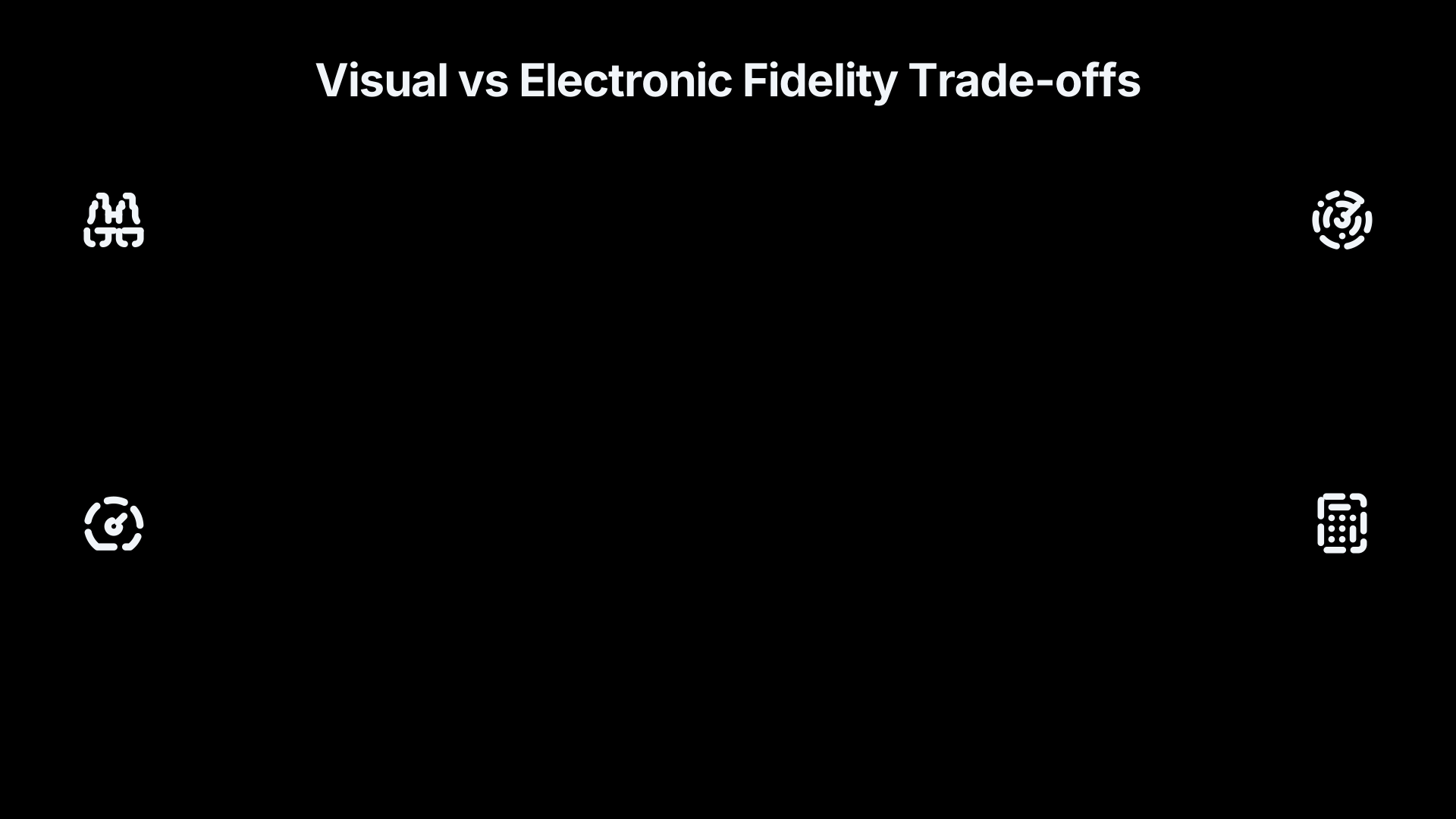
- Visual fidelity helps when recognition, identification and tactical decision-making are the goals.
- Electronic fidelity matters when sensors, warning receivers, jammers and weapons are being tested.
- Combined fidelity becomes necessary only when both humans and technical systems must react realistically.
The highest-cost option is not automatically the most valuable. If a training audience never interacts with a threat electronically, expensive electronic modelling may add little value. Conversely, a perfectly replicated vehicle exterior is of limited use if the objective is testing aircraft survivability systems.
Why realism becomes progressively more expensive
Realism does not increase in a linear fashion. The first 70–80 percent of useful fidelity is often relatively affordable. The final increments are usually the most expensive.
A simplified radar simulator can reproduce basic warning indications at comparatively low cost. Reproducing the exact signal characteristics, mode changes, engagement sequences, antenna behaviour and evolving software logic of a modern air-defence system requires far greater engineering effort and continuous updates. Leonardo DRS explicitly markets products spanning the spectrum from low-cost, low-fidelity stimulators to high-end digital threat systems, illustrating how fidelity itself becomes a major cost driver.[Leonardo DRS]leonardodrs.comLeonardo DRSElectronic Warfare (EW) Threat SimulatorsLeonardo DRSEW Threat Simulators prepare combat pilots for missile threats. Our EW threat simulators provide the same indications as the…
Simulation research outside defence has repeatedly observed similar patterns. Increasing realism generally requires disproportionate increases in hardware, software, maintenance and validation effort. Studies of training simulation have noted diminishing returns beyond the point where additional realism no longer improves learning outcomes.[global-aero.com]sm4.global-aero.comwhat is the real cost of realism in trainingSM4 Safety News from Global AerospaceWhat is the Real Cost of Realism in Training?7 Sept 2017 — The following chart shows a rough price c…
This effect is particularly visible in military environments because realistic threat behaviour changes over time. Adversaries upgrade equipment, modify software, alter tactics and introduce new variants. A highly realistic replica therefore creates a recurring obligation to maintain that realism.

Maintenance and scarcity pressures
The cost of a realistic replica is not limited to acquisition. Long-term sustainment often becomes the dominant expense.
Threat simulators require technical support, calibration, software updates and incorporation of new intelligence. Manufacturers emphasise lifecycle support and ongoing threat-mode updates as essential elements of high-fidelity systems.[Sigma Defense]sigmadefense.comSigma Defense Radar Threat SimulatorsSigma DefenseRadar Threat Simulators - Sigma DefenseSigma Defense delivers high-fidelity radar threat simulators, replicating adversary s…
The problem becomes more severe when realism depends on scarce foreign equipment. Captured systems may be available only in small numbers. Spare parts may be unavailable, politically sensitive or impossible to acquire legally. Engineers may understand the external behaviour of a foreign system but lack sufficient access to reproduce every internal component economically.
Historically, the scale of investment has been substantial. A Department of Defense audit reported that the military services budgeted roughly $1.5 billion for electronic warfare threat simulators across fiscal years 1989–1997, reflecting both the complexity and continuing importance of maintaining realistic training environments.[U.S. Department of War]media.defense.govDepartment of War[PDF] DoD Management of Electronic Warfare Threat Simulators for TrainingJuly 15, 1992 — For training scenarios, EW thre…(https://media.defense.gov/1992/Jul/15/2001714601/-1/-1/1/92-125.pdf)
Cost pressures also appear at programme level. Audits of US threat-simulator development identified duplicated engineering efforts and argued for greater coordination to avoid unnecessary expenditures. The fact that simulator programmes themselves became subjects of cost-control audits illustrates how realism can generate significant institutional overhead.[U.S. Department of War]media.defense.govDepartment of War[PDF] DoD Management of Electronic Warfare Threat Simulators for TrainingJuly 15, 1992 — For training scenarios, EW thre…(https://media.defense.gov/1990/Jun/27/2001714394/-1/-1/1/90-089.pdf)
Choosing realism for the training task
The most effective threat-replication programmes start with the training problem rather than the foreign system.
A useful framework is to ask which trainee behaviour must be produced.
If the goal is recognition training, the replica only needs enough realism for accurate identification. If the goal is electronic warfare training, the simulator must trigger authentic sensor responses. If the goal is operational testing of new equipment, the replica may need extremely accurate performance characteristics because engineering decisions depend on the results.
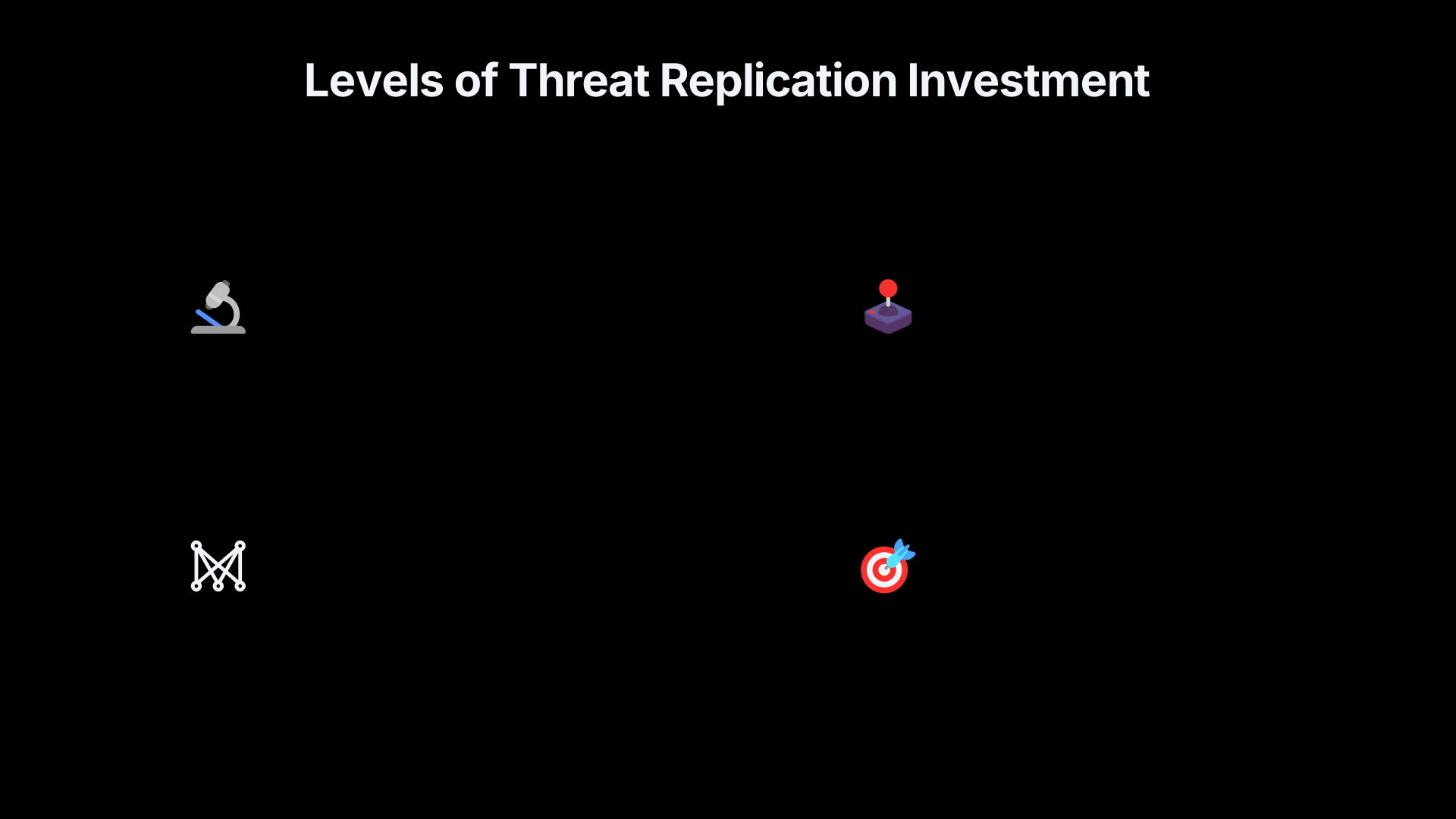
This leads to three broad levels of investment:
Representative realism
- Captures the most obvious observable characteristics.
- Suitable for basic familiarisation and tactical exercises.
- Lowest cost and easiest maintenance burden.
Functional realism
- Reproduces behaviours that affect decisions and system responses.
- Often the most cost-effective level.
- Common in electronic warfare and operational training.
Engineering realism
- Attempts to match performance in detail.
- Necessary for specialised testing, intelligence validation and high-end evaluation.
- Highest acquisition and sustainment costs.
Foreign materiel exploitation programmes support this process by identifying which attributes are operationally significant. Department of Defense guidance and audit findings repeatedly describe exploitation results being used for simulator development, modelling, testing and training rather than simple duplication of foreign equipment. The objective is actionable realism rather than complete replication.[U.S. Department of War]media.defense.govDepartment of War[PDF] DoD Management of Electronic Warfare Threat Simulators for TrainingJuly 15, 1992 — For training scenarios, EW thre…(https://media.defense.gov/1997/Oct/08/2001715489/-1/-1/1/98-005.pdf)
The risk of buying the wrong realism
One of the recurring critiques of threat-replica programmes is that fidelity can become an end in itself.
A simulator may look impressive because it closely resembles a foreign system, yet fail to improve training outcomes. Conversely, a comparatively simple simulator may generate realistic decisions because it reproduces the signals, timings and uncertainties that matter most. Research on simulation effectiveness frequently warns that greater realism does not automatically produce greater learning value.[NATO Publications]publications.sto.nato.intNATO PublicationsModelling and Simulation in the Space Domain Using Sub-…by J Wallace — In training simulations, for instance, users r…
The challenge for military planners is therefore not maximising realism but optimising it. Every increment of fidelity competes with other priorities: more training repetitions, wider deployment, additional scenarios, improved instrumentation or broader force participation. A perfectly replicated threat that can be fielded only rarely may be less useful than a less realistic system that can be used every week.
In the context of reverse engineering foreign military technology, the most valuable exploitation outcome is often not a perfect copy. It is the knowledge required to determine which aspects of the foreign system genuinely influence training, testing and combat performance—and which can safely be approximated.[U.S. Department of War]media.defense.govDepartment of War[PDF] DoD Management of Electronic Warfare Threat Simulators for TrainingJuly 15, 1992 — For training scenarios, EW thre…(https://media.defense.gov/1997/Oct/08/2001715489/-1/-1/1/98-005.pdf)
Amazon book picks
Further Reading
Books and field guides related to How real does a fake threat need to be?. Use these as the next step if you want deeper reading beyond the article.
Systems Engineering Principles and Practice
Addresses trade-offs between performance, realism, and cost.
eBay marketplace picks
Marketplace Samples
Live-tested eBay searches with available results related to this page.



Endnotes
1.
Source: media.defense.gov
Link:https://media.defense.gov/1992/Jul/15/2001714601/-1/-1/1/92-125.pdf
Source snippet
Department of War[PDF] DoD Management of Electronic Warfare Threat Simulators for TrainingJuly 15, 1992 — For training scenarios, EW thre...
Published: July 15, 1992
2.
Source: publications.sto.nato.int
Link:https://publications.sto.nato.int/publications/STO%20Meeting%20Proceedings/STO-MP-MSG-229/MP-MSG-229-08.pdf
Source snippet
NATO PublicationsModelling and Simulation in the Space Domain Using Sub-...by J Wallace — In training simulations, for instance, users r...
3.
Source: media.defense.gov
Link:https://media.defense.gov/1997/Oct/08/2001715489/-1/-1/1/98-005.pdf
Source snippet
Department of WarUse of Foreign Materiel Exploitation ResultsSeptember 22, 2015 — 8 Oct 1997 — Foreign materiel exploitation supports DoD...
Published: September 22, 2015
4.
Source: leonardodrs.com
Title: Leonardo DRSElectronic Warfare (EW) Threat Simulators
Link:https://www.leonardodrs.com/what-we-do/products-and-services/electronic-warfare-ew-threat-simulators/
Source snippet
Leonardo DRSEW Threat Simulators prepare combat pilots for missile threats. Our EW threat simulators provide the same indications as the...
5.
Source: media.defense.gov
Link:https://media.defense.gov/1990/Jun/27/2001714394/-1/-1/1/90-089.pdf
Source snippet
Department of WarDoD Management of Threat SimulatorsJanuary 26, 2015 — 27 Jun 1990 — We recommended that the Deputy. Director charter a J...
Published: January 26, 2015
6.
Source: comptroller.war.gov
Title: FY 2023 DD 1414 Base for Reprogramming Actions
Link:https://comptroller.war.gov/Portals/45/[Documents
Source snippet
Threat Program - Unit Activity Monito. BIOMETRIC ENABLING CAPABILITY (BEC)... Exploitation of Foreign Items. 6,186. 6,186. FY 2023 Appro...
7.
Source: sm4.global-aero.com
Title: what is the real cost of realism in training
Link:https://sm4.global-aero.com/articles/what-is-the-real-cost-of-realism-in-training/
Source snippet
SM4 Safety News from Global AerospaceWhat is the Real Cost of Realism in Training?7 Sept 2017 — The following chart shows a rough price c...
8.
Source: sigmadefense.com
Title: Sigma Defense Radar Threat Simulators
Link:https://sigmadefense.com/capabilities/radar-threat-simulators/
Source snippet
Sigma DefenseRadar Threat Simulators - Sigma DefenseSigma Defense delivers high-fidelity radar threat simulators, replicating adversary s...
Additional References
9.
Source: gao.gov
Link:https://www.gao.gov/products/nsiad
Source snippet
Electronic Warfare: Multiple Developments of Costly Threat SimulatorsThe services are reviewing and revising internal simulator developme...
10.
Source: virtra.com
Link:https://www.virtra.com/how-police-departments-are-using-simulation-to-cut-training-costs-without-cutting-realism/
Source snippet
How Police Departments Are Using Simulation to Cut...3 Nov 2025 — Unlike static range targets, these immersive simulations allow officer...
11.
Source: dodig.mil
Link:https://www.dodig.mil/Reports/Audits-and-Evaluations/?Page=53
Source snippet
About · Contact Us · DoW OIG Careers · Reports · All... 5, 2023. Project Announcement: Evaluation of the Department of Defense...Read more...
12.
Source: gtri.gatech.edu
Title: advanced radar threat system helps aircrews train evade enemy missiles
Link:https://www.gtri.gatech.edu/newsroom/advanced-radar-threat-system-helps-aircrews-train-evade-enemy-missiles
Source snippet
Radar Threat System Helps Aircrews Train to Evade...September 18, 2023 — A 142-ton threat simulator system that shows them how radars bu...
Published: September 18, 2023
13.
Source: defenceiq.com
Title: what are the challenges of simulation in military training
Link:https://www.defenceiq.com/combat-air/articles/what-are-the-challenges-of-simulation-in-military-training
Source snippet
The Challenges of Simulation in Military Training3 Feb 2026 — Q&A-style article offering a rundown of the various challenges associated w...
14.
Source: magaero.com
Title: NAVAI R, JSE & NGTS: Equipping Mission-Ready Warfighters
Link:https://www.magaero.com/navair-next-generation-threat-system-jse/
Source snippet
NAVAIR, JSE & NGTS: Equipping Mission-Ready WarfightersMarch 10, 2026 — The Next Generation Threat System (NGTS) stands out as a pivotal...
Published: March 10, 2026
15.
Source: astj.journals.ekb.eg
Link:https://astj.journals.ekb.eg/article_418382_8b6db54403953cf7c0b775c8eda5ce1f.pdf
Source snippet
Review of Real-time Military Training Simulator Based on...by N Hussen · 2025 · Cited by 6 — The literature review looks at current simu...
16.
Source: nga.mil
Title: GEOSPATIA L INTELLIGENCE (GEOINT) BASIC DOCTRINE
Link:https://www.nga.mil/assets/files/170901-038_GEOINT_Basic_Doctrine_Pub_1.pdf
Source snippet
threat to inhabited areas at the time.... Signals Intelligence (SIGINT): A form of technical intelligence derived from the exploitation...
17.
Source: esd.whs.mil
Title: 08 F 1748 Foreign Materiel Program 10 10 2006
Link:https://www.esd.whs.mil/Portals/54/Documents/FOID/Reading%20Room/Administration_and_Management/08-F-1748_Foreign_Materiel_Program_10-10-2006.pdf?ver=2017-05-15-135556-097
Source snippet
WHS ESDDIRECTIVE10 Oct 2006 — (U) Foreign Materiel Exploitation (FME). FMP... (U) The Department of Defense shall acquire and exploit fo...
18.
Source: youtube.com
Title: Drone Systems Operator Training | Advanced Combat Simulation in Unreal Engine 5
Link:https://www.youtube.com/watch?v=p4kIoT29WUI
Source snippet
Revolutionizing Combat Readiness: Cutting-Edge Live, Virtual, Constructive Training Environments IAI...
Topic Tree