Within Exploit vs Copy
When Copying Becomes Domestic Redesign
The J-11 story shows how licensed production, copying and domestic redesign can blur into long-term military industrial learning.
On this page
- From Su 27 license production to local variants
- Why copied systems rarely stay frozen
- Industrial learning and dependence reduction
Page outline Jump by section
Introduction
The story of China’s J-11 fighter is often presented as a simple example of copying foreign military technology. The reality is more complicated. The J-11 began as a licensed Chinese production programme for Russia’s Su-27 fighter, but over time it evolved into a case study in how reverse engineering, local substitution, and industrial learning can transform a foreign design into the foundation of a domestic aerospace ecosystem. Rather than remaining a frozen replica, the aircraft became a platform through which China reduced dependence on imported subsystems, developed indigenous avionics and engines, and accumulated experience that later supported more advanced aircraft programmes.[Wikipedia]WikipediaShenyang J-11Shenyang J-11
Within the broader debate over foreign materiel exploitation versus copying, the J-11 illustrates an important point: the most significant outcome may not be the copied weapon itself, but the industrial capabilities built during the process.
From Su-27 Licence Production to Local Variants
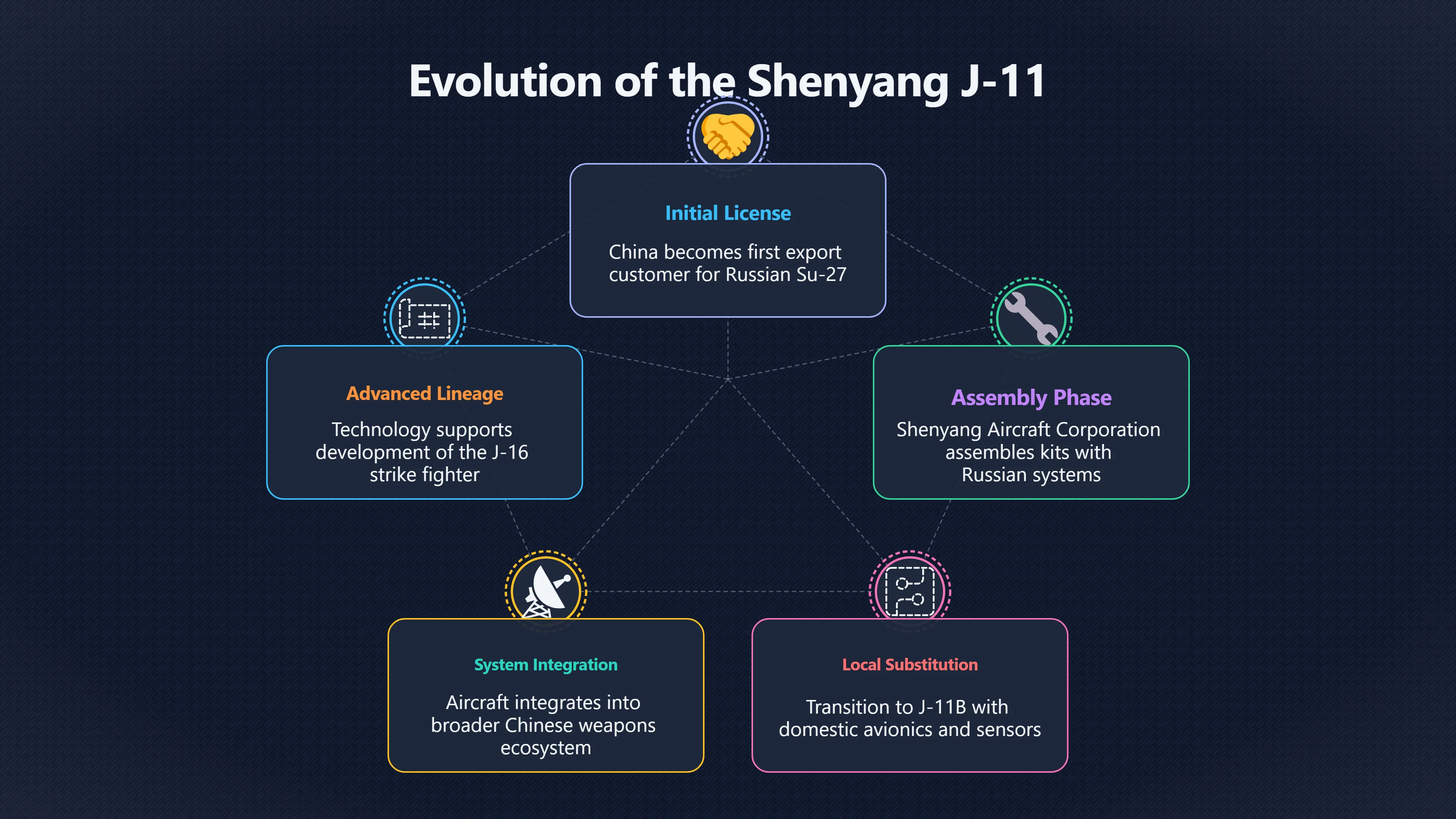
China became the first export customer for the Russian Su-27 in the early 1990s and later negotiated a licence-production arrangement that allowed the Shenyang Aircraft Corporation to assemble up to 200 aircraft in China as the J-11. Under the agreement, major systems such as engines, radar equipment and avionics continued to come from Russia, while Chinese industry gradually increased its role in airframe production and assembly.[Wikipedia]WikipediaShenyang J-11Shenyang J-11
The initial J-11 programme was therefore not reverse engineering in the strict sense. It was a technology-transfer arrangement designed to build manufacturing competence. Chinese factories learned how to assemble a modern fourth-generation fighter, manage quality control, and produce increasingly large portions of the airframe domestically. By the early 2000s, local production quality had improved substantially compared with the first aircraft assembled from Russian kits.[Wikipedia]WikipediaShenyang J-11Shenyang J-11
The turning point came when China concluded that continuing dependence on Russian avionics and propulsion systems limited both operational flexibility and industrial autonomy. Production of the original licensed configuration ended well before the contractual total of 200 aircraft was reached. China then moved toward the J-11B, a variant incorporating domestically developed systems rather than Russian-supplied equipment.[Wikipedia]WikipediaShenyang J-11Shenyang J-11
This shift generated controversy. Russian sources and many analysts argued that replacing licensed Russian systems with Chinese-designed alternatives violated the spirit, and possibly the terms, of the original agreement. Chinese officials and commentators, by contrast, framed the programme as a natural progression from licensed production toward indigenous development.[Hush-Kit Aviation World]hushkit.netwhat we know about chinese flankers andreas rupprechtHush-Kit Aviation WorldWhat we know about Chinese Flankers – Andreas Rupprecht8 Nov 2022 — Based on what is known about the contracts, ev…
Why Copied Systems Rarely Stay Frozen
The J-11B demonstrates why military copies often evolve beyond duplication. Once a country gains manufacturing access to a sophisticated platform, pressures emerge to modify it for local requirements, supply chains and strategic goals.
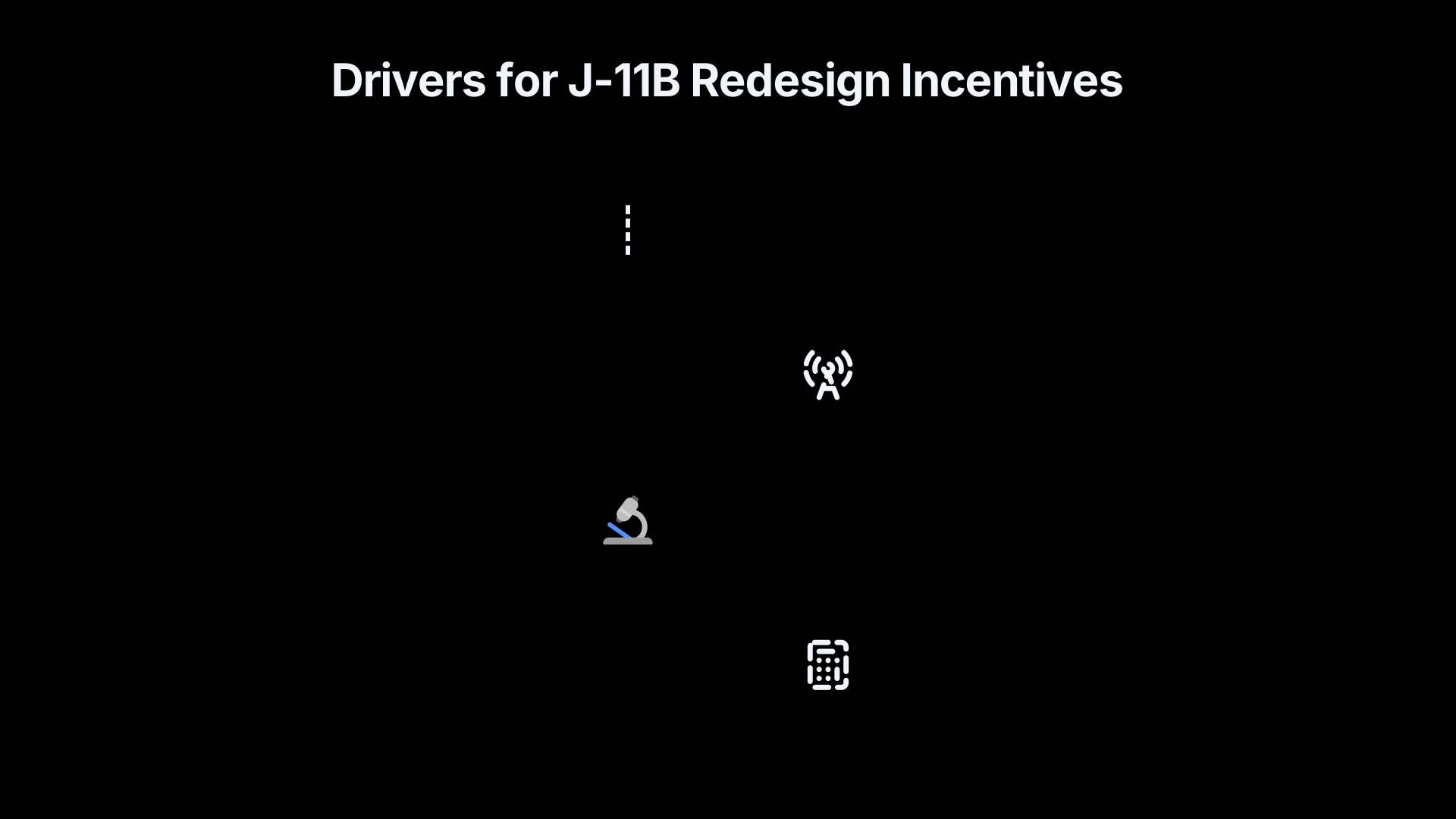
For China, several incentives encouraged redesign:
- Dependence on foreign suppliers created political and logistical vulnerabilities.
- Russian systems did not always align with Chinese weapons and command networks.
- Domestic industry wanted opportunities to develop and test indigenous technologies.
- Long-term costs favoured local production over continued imports.[The National Interest]nationalinterest.orgThe National InterestThe Su-27 Flanker: How an Unexpected Deal Changed…13 Nov 2021 — China then began licensed production of the Su-27…
As a result, the J-11B incorporated a large number of Chinese-developed subsystems. Publicly reported changes included domestic radar systems, digital flight controls, cockpit displays, environmental systems, power systems and weapons integration. By the early 2010s, observers estimated that the overwhelming majority of subsystems in the aircraft were Chinese-designed, although engines remained a particularly challenging area.[Wikipedia]WikipediaShenyang J-11Shenyang J-11
The redesign also expanded the aircraft’s operational flexibility. Instead of relying primarily on Russian missiles and associated electronics, later J-11 variants integrated Chinese weapons and targeting systems. This transformed the aircraft from a locally assembled Russian fighter into a platform compatible with China’s broader aerospace and weapons ecosystem.[The National Interest]nationalinterest.orgOpen source on nationalinterest.org.
The result was not a perfect copy of the Su-27 but an increasingly distinct branch of the same design family.
The Engine Problem Revealed the Real Challenge
The most revealing aspect of the J-11 programme was not the airframe but the engine.
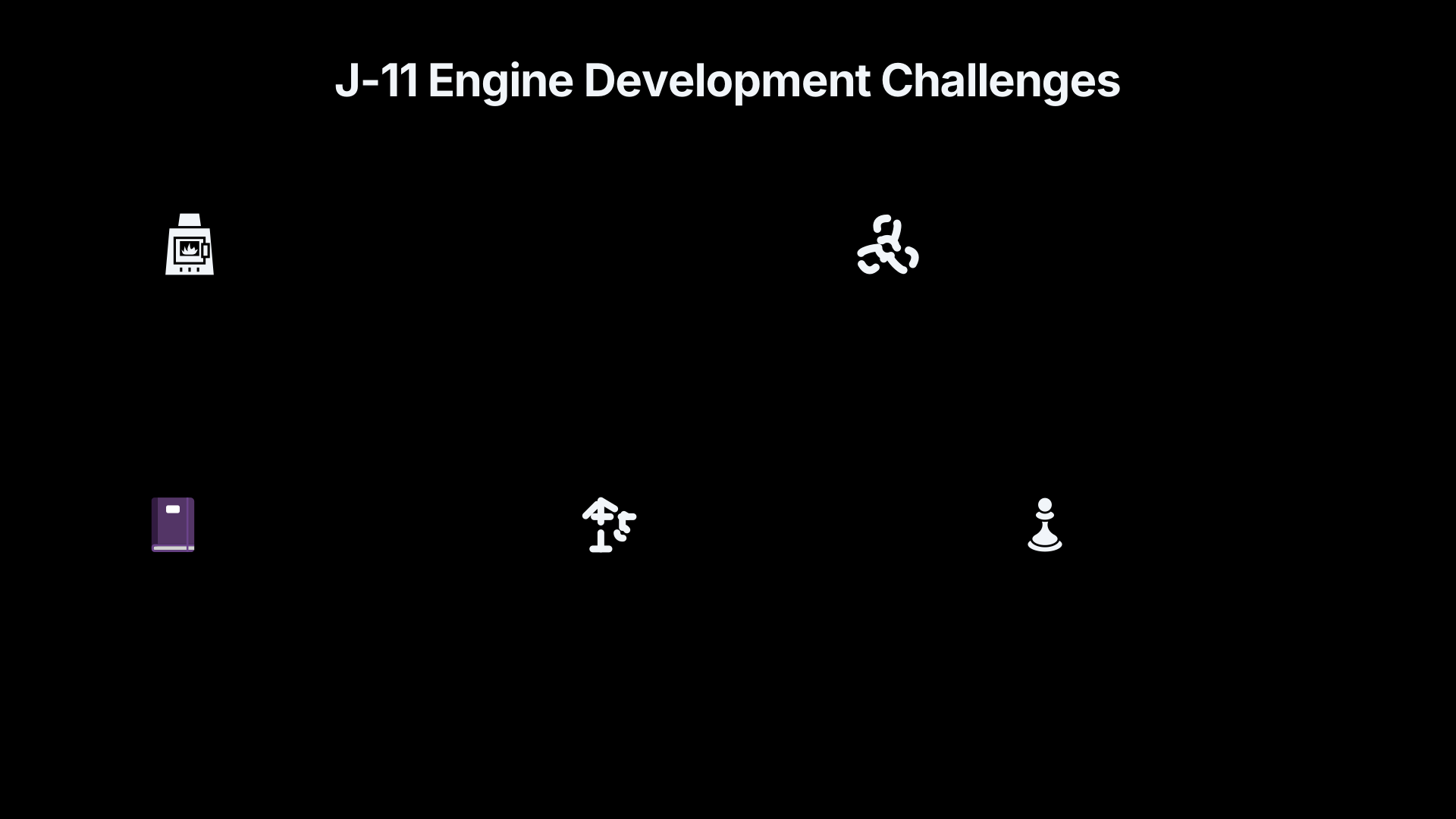
Aircraft structures can often be measured, copied and reproduced with sufficient industrial capacity. High-performance jet engines are far more difficult. They depend on specialised metallurgy, manufacturing tolerances, turbine-blade technology and long-term reliability testing.
China sought to replace Russian AL-31 engines with the domestically developed WS-10. The effort became one of the clearest demonstrations of the limits of reverse engineering. Early WS-10 variants reportedly suffered from reliability and durability problems that required continued dependence on Russian engines for portions of the fleet. Analysts disagreed over the extent of these problems, but the programme clearly required years of refinement before domestic engines reached broader operational acceptance.[The National Interest]nationalinterest.orgOpen source on nationalinterest.org.
From a governance and industrial-policy perspective, however, the setbacks were arguably part of the objective. China accepted short-term performance risks in exchange for building a domestic engine industry. Even imperfect indigenous engines generated manufacturing experience, engineering knowledge and production capacity that could later support newer aircraft programmes.[The National Interest]nationalinterest.orgOpen source on nationalinterest.org.
The engine story therefore highlights a central lesson of foreign technology exploitation: reproducing an artefact is not the same as reproducing the industrial capabilities behind it.
Industrial Learning and Dependence Reduction
The broader significance of the J-11 lies in what it enabled rather than what it copied.
Licensed production exposed Chinese firms to modern fighter-aircraft manufacturing practices. Subsequent redesign efforts forced engineers to develop domestic alternatives to imported systems. Over time, those efforts helped create a larger ecosystem of suppliers, avionics developers, engine manufacturers and systems integrators.[Wikipedia]WikipediaShenyang J-11Shenyang J-11
Evidence of this learning process can be seen in later aircraft derived from the same lineage. The J-16 strike fighter, for example, emerged from the J-11 family but incorporated substantially more Chinese technology, including advanced radar systems, domestic engines and expanded mission capabilities. The progression from licensed Su-27 assembly to aircraft such as the J-16 reflects cumulative industrial development rather than simple replication.[Wikipedia]WikipediaShenyang J-16Shenyang J-16
The programme also reduced China’s vulnerability to foreign supply restrictions. Dependence on imported engines, radars and weapons had given suppliers leverage over capability upgrades and production rates. Replacing those systems with domestic alternatives increased strategic autonomy, even when indigenous substitutes initially lagged behind imported equivalents.[Wikipedia]WikipediaShenyang J-11Shenyang J-11
What the J-11 Teaches About Reverse Engineering
The J-11 occupies an unusual position in discussions of reverse engineering. It was neither a straightforward licensed production programme nor a pure case of unauthorised copying. Instead, it evolved through several stages: acquisition, licensed assembly, local manufacturing, subsystem substitution and eventual redesign.[Wikipedia]WikipediaShenyang J-11Shenyang J-11
That progression makes the aircraft important as a governance and industrial-development case. The most consequential outcome was not the existence of another Su-27-derived fighter. It was the creation of domestic capabilities that reduced reliance on foreign suppliers and supported later generations of Chinese combat aircraft. In that sense, the J-11 illustrates how foreign military technology can serve as a learning platform. What begins as copying can become a pathway to redesign, adaptation and greater industrial independence.[nationalinterest.org]nationalinterest.orgThe National InterestThe Su-27 Flanker: How an Unexpected Deal Changed…13 Nov 2021 — China then began licensed production of the Su-27…
Amazon book picks
Further Reading
Books and field guides related to When Copying Becomes Domestic Redesign. Use these as the next step if you want deeper reading beyond the article.
The Chinese Air Force Evolving Concepts, Roles, and Capabilities
Provides context for China's fighter development and industrial learning.
The Pentagon's Brain
Provides wider context for technology transfer and defense innovation.
Skunk Works
Highlights how aerospace expertise accumulates through industrial learning.
The Chinese Air Force
Provides context for China's fighter development and industrial learning.
eBay marketplace picks
Marketplace Samples
Live-tested eBay searches with available results related to this page.
Endnotes
1.
Source: Wikipedia
Title: Shenyang J-11
Link:https://en.wikipedia.org/wiki/Shenyang_J-11
2.
Source: Wikipedia
Title: Sukhoi Su-27
Link:https://en.wikipedia.org/wiki/Sukhoi_Su-27
Source snippet
Sukhoi Su-27The Shenyang J-11 is a Chinese license-built version of the Su-27.... Since 1998, the export Su-27SK has been produced as...
3.
Source: Wikipedia
Title: Shenyang WS-10
Link:https://en.wikipedia.org/wiki/Shenyang_WS-10
4.
Source: Wikipedia
Title: Shenyang J-16
Link:https://en.wikipedia.org/wiki/Shenyang_J-16
5.
Source: nationalinterest.org
Link:https://nationalinterest.org/blog/reboot/su-27-flanker-how-unexpected-deal-changed-history-196155
Source snippet
The National InterestThe Su-27 Flanker: How an Unexpected Deal Changed...13 Nov 2021 — China then began licensed production of the Su-27...
6.
Source: hushkit.net
Title: what we know about chinese flankers andreas rupprecht
Link:https://hushkit.net/2022/11/08/what-we-know-about-chinese-flankers-andreas-rupprecht/
Source snippet
Hush-Kit Aviation WorldWhat we know about Chinese Flankers – Andreas Rupprecht8 Nov 2022 — Based on what is known about the contracts, ev...
7.
Source: nationalinterest.org
Link:https://nationalinterest.org/blog/reboot/chinas-j-11-fighter-copied-russias-su-27-flanker-182096
Additional References
8.
Source: facebook.com
Link:https://www.facebook.com/militarymechanicsie/posts/the-pl-12-gave-chinese-fighters-their-first-true-fire-and-forget-beyond-visual-r/122300502272191911/
Source snippet
The PL-12 gave Chinese fighters their first true fire-andJ-10 Revolutionized China's Aviation Sector The success of the J-10 stimulated i...
9.
Source: militarywatchmagazine.com
Link:https://militarywatchmagazine.com/article/origins-of-china-s-j-11b-advanced-air-superiority-fighter-how-the-flanker-design-was-drastically-improved
Source snippet
Origins of China's J-11B Air Superiority Fighter13 Apr 2021 — New avionics and sensors also allowed the J-11B to operate much more effect...
10.
Source: youtube.com
Title: China Quietly Upgraded 100 Fighter Jets — The Technology Inside Is Surprising!
Link:https://www.youtube.com/watch?v=seUlgglXcGI
Source snippet
This video explains how China transitioned from assembling Russian kits to independently upgrading the J-11 with domestic avionics and mo...
11.
Source: facebook.com
Link:https://www.facebook.com/NextGenerationWeapons/posts/this-is-the-high-cost-china-is-paying-for-copying-a-stolen-su-33-russian-jet-fig/2728690210499794/
Source snippet
Sukhoi's Flanker series such as the Su-27 and Su-30MKK, which they...Read more...
12.
Source: militaryfactory.com
Link:https://www.militaryfactory.com/aircraft/detail.php?aircraft_id=883
Source snippet
Shenyang (AVIC) J-11 (Flanker B+)J-11 signifies the Chinese-built, Russian-supplied Su-27SK air superiority models...
13.
Source: dvidshub.net
Title: shenyang j 11 front orthographic view redo
Link:https://www.dvidshub.net/image/9081301/shenyang-j-11-front-orthographic-view-redo
Source snippet
Shenyang J-11 Front Orthographic View Redo [Image 1 of 6]6 Mar 2025 — J-11B: First indigenously produced version with significant Chinese...
14.
Source: odin.t2com.army.mil
Link:https://odin.t2com.army.mil/WEG/Asset/68129a9d337deb51e793582d5a97cd7d
Source snippet
army.milJ-11B (Flanker-L) Chinese Air Superiority Fighter3 Jan 2025 — It has new avionics, a glass cockpit, MAWS, and onboard oxygen gene...
15.
Source: caliber.az
Link:https://caliber.az/en/post/j-11-fighter-how-china-copied-russia-s-su-27
16.
Source: secretprojects.co.uk
Title: Secret Projects Forum Shenyang J-11 as an unlawful copy of Su-27
Link:https://www.secretprojects.co.uk/threads/shenyang-j-11-as-an-unlawful-copy-of-su-27-discussion.9496/
Source snippet
Hence the J-11B. This is a clear violation of the original licence agreement...Read more...
17.
Source: youtube.com
Link:https://www.youtube.com/watch?v=uMx80Jqh9s8
Source snippet
China Quietly Upgraded 100 Fighter Jets — The Technology Inside Is Surprising...
Topic Tree