Within Foreign Materiel
Is Reverse Engineering Just Copying?
Military reverse engineering often aims to understand and counter a weapon, not simply reproduce it.
On this page
- What exploitation means
- When replication is the goal
- Why the distinction matters
Page outline Jump by section
Introduction
Reverse engineering foreign military technology is often misunderstood as a race to build a clone. In reality, foreign materiel exploitation usually begins with a different question: what can this captured or acquired weapon teach us before anyone decides whether to copy it? A missile fragment, radar module, drone wreckage, aircraft part or complete captured vehicle can reveal performance limits, vulnerabilities, supply chains, manufacturing quality and maintenance assumptions. That knowledge may support countermeasures, training, sanctions enforcement or procurement decisions without producing a duplicate weapon at all.
The distinction matters because “exploitation” and “copying” lead to different outputs. Exploitation turns foreign materiel into intelligence. Copying turns it into production. The two can overlap, but they are not interchangeable. Official US descriptions of foreign materiel exploitation describe analysts studying air, space and cyberspace-related military systems to understand adversary capabilities and vulnerabilities, not simply to reproduce them.[Nasic]nasic.af.milnasic opens new fme facilityNASIC opens new FME facility27 Oct 2017 — Foreign materiel exploitation is one of the many intelligence production missions at NASIC…
What Exploitation Means
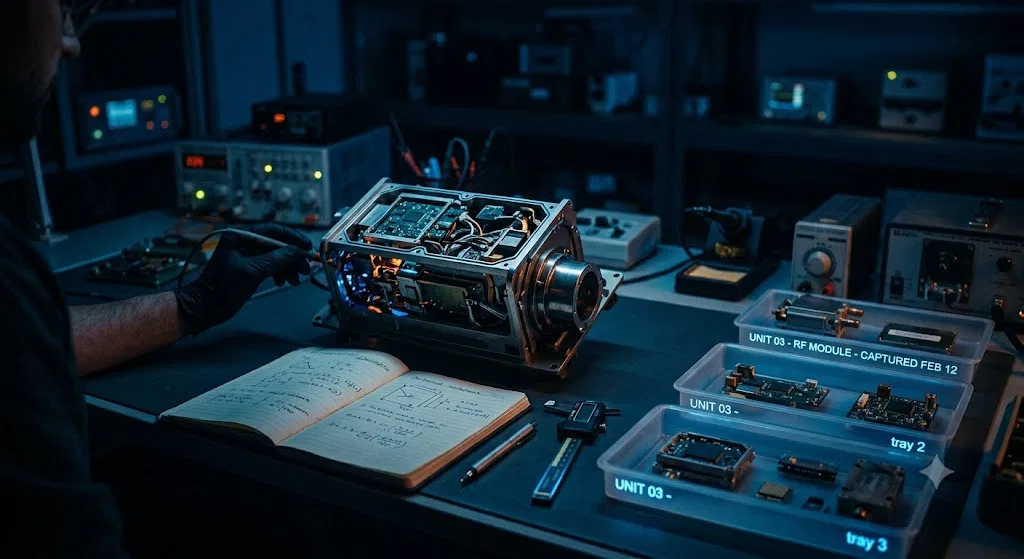
Foreign materiel exploitation is the organised acquisition, handling, testing and analysis of foreign equipment. It can include disassembly, materials testing, electronics analysis, software examination, flight or field testing, and comparison against one’s own systems. The key point is that the object is treated as evidence. The value lies in what it reveals.
The US National Air and Space Intelligence Center has described its foreign materiel exploitation work as a mission in which analysts exploit foreign air, space and cyberspace-related systems to improve understanding of potential adversary capabilities. A 2016 NASIC account described foreign materiel being handed to a specialist squadron of engineers, scientists, contractors and airmen from more than ten areas of expertise; another NASIC article described exploitation as reverse engineering foreign systems in secure facilities.[The Union of Concerned Scientists]ucs.orgThe Union of Concerned ScientistsCountermeasuresApril 4, 2000 — The program's primary task is educating the next generation of scholars a… This is much broader than copying a part. It is an intelligence-production process.
A captured weapon can answer questions that public reporting, export brochures or battlefield observation cannot answer with confidence:
- What does it actually do? Physical testing can show whether advertised ranges, sensor performance or survivability claims are realistic.
- How can it be defeated? Engineers may identify jamming opportunities, blind spots, thermal signatures, armour weaknesses or predictable software behaviour.
- How is it built? Materials, tolerances, chips, adhesives, coatings and manufacturing shortcuts can show the maturity of the producer’s industrial base.
- How is it supplied? Components can be traced back through commercial markets, intermediaries or sanctions-evasion networks.
- How should friendly forces train? Real threat data can improve simulators, exercises, tactics and threat briefings.
This is why exploitation can be strategically valuable even when the recovered object is damaged, obsolete or impossible to reproduce. A broken missile seeker may still reveal frequencies or component sourcing. A charred drone circuit board may still identify suppliers. A captured aircraft may be more useful as a test opponent than as a blueprint.

Exploitation Often Produces Counters, Not Copies
The clearest way to separate exploitation from copying is to look at the output. If the result is a new factory line for a duplicate system, copying is the goal. If the result is a tactics manual, jammer setting, vulnerability assessment, training profile or sanctions case, exploitation is doing something else.
Cold War aircraft exploitation makes the point. In Project Have Doughnut, the United States evaluated a Soviet-built MiG-21 acquired from Israel. The purpose was not to build an American MiG-21. It was to determine how the aircraft performed against US aircraft and how US pilots should fight it. Contemporary accounts and declassified material describe test objectives centred on performance comparison, defensive and offensive manoeuvring, and tactical evaluation.[Wikimedia Commons]upload.wikimedia.orgProject have doughnut area51 49Project have doughnut area51 49
The same pattern appeared in the MiG-17 exploitation efforts known as Have Drill and Have Ferry. The programmes were designed to determine the effectiveness of existing US tactics and weapons against the MiG-17 and to exploit the aircraft tactically. National Security Archive summaries note that these projects generated technical and tactical reports after extensive flying at Groom Lake.[f-106deltadart.com]f-106deltadart.comHave Drill Have Ferry Tactical EvaluationHave Drill Have Ferry Tactical Evaluation Again, the prize was not a copy of the MiG-17. The prize was knowing how to survive and win against it.
That distinction remains relevant in modern wars. Open investigations into Russian missiles, drones and electronic systems used in Ukraine have often focused on component identification and supply-chain tracing rather than replication. RUSI’s “Silicon Lifeline” project examined captured or recovered Russian military systems and concluded that many relied on foreign microelectronics; Ukrainian intelligence now maintains a public database of foreign-produced components found in Russian weapons.[Royal United Services Institute]rusi.orgsilicon lifeline western electronics heart russias war machinesilicon lifeline western electronics heart russias war machine The practical output is pressure on export controls, sanctions enforcement and procurement networks, not a Ukrainian or Western clone of the system.
The International Institute for Strategic Studies and Conflict Armament Research have taken a similar approach, examining debris from Russian, Iranian and North Korean missiles and unmanned aerial vehicles in Ukraine to trace component routes and assess the effectiveness of control regimes.[IISS]iiss.orgTracking the Components of Missiles and UAVs Used byTracking the Components of Missiles and UAVs Used by That is exploitation as forensic intelligence: the weapon is evidence of how an adversary sustains production.
When Replication Is the Goal
Copying does happen, especially when a state needs a capability quickly, lacks the industrial base to design it independently, or wants to avoid dependence on a foreign supplier. But replication is only one possible branch of military reverse engineering, and it carries its own costs.
The Soviet Tu-4 bomber is a classic case. After several US B-29 bombers landed in Soviet territory during the Second World War, the Soviet Union reverse engineered the design into the Tu-4. The result was a near copy, but not a simple act of tracing. Soviet industry had to translate measurements into metric production, recreate materials and components, and adapt systems where exact duplication was impractical. Smithsonian’s Air & Space Magazine notes that myths about mindless copying obscure the engineering difficulty; Air & Space Forces Magazine describes the Tu-4 as a virtual carbon copy, but one produced through a major industrial effort.[Smithsonian Magazine]smithsonianmag.comSmithsonian Magazine Made in the U.S.S.RSmithsonian Magazine Made in the U.S.S.R
Modern examples are more complex because copying often becomes adaptation. China’s J-11 fighter programme began with licensed production of the Russian Su-27, then moved into domestically modified variants. Reporting by USNI News and The Diplomat describes the J-11 as part of a broader pattern in which China absorbed, copied or adapted foreign military technology, especially from Russia, while building a more self-sufficient defence industry.[USNI News]news.usni.orgNews China's Military Built with Cloned WeaponsNews China's Military Built with Cloned Weapons In such cases, “copying” is rarely a frozen duplicate. It becomes a pathway to local substitution, redesign and eventually independent production.
There are also narrower replication cases where the aim is not strategic industrial catch-up but operational convenience. In 2018, reporting on a US Special Operations Command solicitation described interest in domestically manufactured, reverse-engineered foreign-style weapons, including Soviet-pattern small arms, with requirements that production use US territory, US materials and US citizens.[Air Force Times]airforcetimes.comAir Force Times SOCOM solicitation for 'reverse engineered' foreignAir Force Times SOCOM solicitation for 'reverse engineered' foreign That kind of copying serves a different purpose from exploiting a captured radar: it can provide training weapons, partner-force equipment or accountable supply without relying on uncertain foreign sources.
Replication is therefore best understood as a production decision, not the automatic endpoint of exploitation. A state copies when the expected benefit of manufacturing the item outweighs the legal, diplomatic, industrial and technical costs.

Why the Distinction Matters
Treating exploitation and copying as the same thing leads to bad assumptions about military technology. It overstates the ease of reproduction, understates the value of intelligence, and misses the defensive purpose of many exploitation programmes.
First, a weapon is more than its shape. Copying an external form does not automatically reproduce performance. Advanced military systems depend on materials, tolerances, software, sensors, testing culture, production quality, logistics and doctrine. A missile airframe can be measured, but reproducing its seeker, propellant, guidance logic and manufacturing consistency may be a far harder problem. The Tu-4 case is memorable precisely because even a relatively direct copy required extensive industrial mobilisation.[Smithsonian Magazine]smithsonianmag.comSmithsonian Magazine Made in the U.S.S.RSmithsonian Magazine Made in the U.S.S.R
Second, exploitation can be most valuable when it prevents copying from being necessary. If a captured radar reveals exploitable emissions, the better answer may be a countermeasure rather than a duplicate radar. If a drone wreckage reveals imported commercial chips, the better answer may be export-control enforcement rather than building a similar drone. If a captured aircraft reveals a weakness in turning performance, the better answer may be pilot training.
Third, states design weapons with enemy exploitation in mind. US anti-tamper policy explicitly recognises that adversaries may capture, exploit or reverse engineer critical technologies. The Defense Security Cooperation Agency defines anti-tamper as systems engineering intended to prevent or delay exploitation of critical technologies in US weapon systems, while the Department of Defense’s anti-tamper materials describe measures intended to deter reverse engineering, exploitation or countermeasure development.[samm.dsca.mil]samm.dsca.milOpen source on dsca.mil. This defensive bureaucracy exists because exploitation is expected. Modern designers assume that some systems may eventually fall into foreign hands.
Fourth, exploitation changes policy as well as battlefield tactics. Component analysis of Russian systems in Ukraine has generated evidence about sanctions leakage, intermediary networks and the role of commercial electronics in military production. Conflict Armament Research reported post-invasion components found in Russian weapon systems, while the Ukrainian database lists thousands of foreign-produced components across weapon units.[conflictarm.com]conflictarm.comfield dispatchesfield dispatches That kind of finding belongs as much to economic security and export control as to engineering.
A Practical Test: Exploit, Copy, or Both?
A useful way to read any case of military reverse engineering is to ask what the examining state wanted at the end of the process.
If the output is knowledge, the case is primarily exploitation. This includes threat assessments, vulnerability reports, countermeasure development, simulator data, training guidance and supply-chain intelligence. The MiG exploitation projects fit this pattern: the aircraft were flown and studied so US forces could understand and defeat them, not so US factories could build MiGs.[Air & Space Forces Magazine]airandspaceforces.comOpen source on airandspaceforces.com.
If the output is production, the case is primarily copying or derivative development. The Tu-4 and later examples of licensed production turning into indigenous variants fit this pattern. The captured or imported system becomes a template for building something functionally similar, sometimes as a stopgap and sometimes as a bridge to an independent industrial base.[Air & Space Forces Magazine]airandspaceforces.comOpen source on airandspaceforces.com.
If the output is both, exploitation informs selective imitation. A state might copy a subsystem, absorb a manufacturing method, imitate an ergonomic layout, or redesign its own equipment after identifying a foreign advantage. This is common because complete copying is often less attractive than learning from the parts that matter. A captured missile seeker, radar processor or engine component may influence future design without producing a one-for-one replica.
The practical distinction is not semantic. It changes how analysts judge the event. Capturing a weapon does not mean the captor can build it. Building a copy does not mean the copier fully understands the doctrine behind it. And exploiting a system successfully may mean the best outcome is never to copy it at all.

The Core Takeaway
Foreign materiel exploitation is the intelligence side of reverse engineering. Copying is the manufacturing side. They share tools such as disassembly, measurement, testing and technical analysis, but they answer different questions.
Exploitation asks: What does this weapon reveal, and how can that knowledge be used? Copying asks: Can we make our own version, and is it worth the cost? In military practice, the first question is often more urgent and more useful. A captured weapon can change tactics, expose supply chains, improve training, guide countermeasures and shape procurement decisions long before anyone considers building a duplicate.
Amazon book picks
Further Reading
Books and field guides related to Is Reverse Engineering Just Copying?. Use these as the next step if you want deeper reading beyond the article.
The Pentagon's Brain
Shows how analysis and exploitation often matter more than direct copying.
The Craft of Intelligence
Explains intelligence exploitation as a distinct activity from manufacturing.
Skunk Works
Illustrates the difference between understanding technology and creating new systems from it.
Spycraft
Demonstrates how collected technology becomes intelligence rather than production.
eBay marketplace picks
Marketplace Samples
Live-tested eBay searches with available results related to this page.
Endnotes
1.
Source: upload.wikimedia.org
Title: Project have doughnut area51 49
Link:https://upload.wikimedia.org/wikipedia/commons/8/8f/Project_have_doughnut_area51_49.pdf
2.
Source: f-106deltadart.com
Title: Have Drill Have Ferry Tactical Evaluation
Link:https://f-106deltadart.com/pdf-files/Have-Drill-Have-Ferry-Tactical-Evaluation.pdf
3.
Source: rusi.org
Title: silicon lifeline western electronics heart russias war machine
Link:https://www.rusi.org/explore-our-research/publications/special-resources/silicon-lifeline-western-electronics-heart-russias-war-machine
4.
Source: iiss.org
Title: Tracking the Components of Missiles and UAVs Used by
Link:https://www.iiss.org/globalassets/media-library—content–migration/files/research-papers/2025/09/pub25-094-tracking-the-components-of-missiles-and-uavs-used-by-russia-in-ukraine.pdf
5.
Source: iiss.org
Link:https://www.iiss.org/research-paper/2025/09/tracking-the-components-of-missiles-and-uavs-used-by-russia-in-ukraine-what-lessons-for-control-regimes/
6.
Source: news.usni.org
Title: News China’s Military Built with Cloned Weapons
Link:https://news.usni.org/2015/10/27/chinas-military-built-with-cloned-weapons
7.
Source: samm.dsca.mil
Link:https://samm.dsca.mil/policy-memoranda/dsca
8.
Source: conflictarm.com
Title: field dispatches
Link:https://www.conflictarm.com/field-dispatches/
9.
Source: conflictarm.com
Link:https://www.conflictarm.com/wp-content/uploads/2021/11/Weapons-of-the-war-in-Ukraine-low.pdf
10.
Source: f-106deltadart.com
Link:https://www.f-106deltadart.com/pdf-files/Project-Have-Doughnut-Tactical-Project-DIA-Report.pdf
11.
Source: f-106deltadart.com
Link:https://www.f-106deltadart.com/havedoughnut.htm
12.
Source: comptroller.war.gov
Title: PROC OSD PB 2027
Link:https://comptroller.war.gov/Portals/45/[Documents
13.
Source: rusi.org
Title: Silicon Lifeline: Interactive
Link:https://www.rusi.org/explore-our-research/publications/special-resources/silicon-lifeline-interactive-summary-report
14.
Source: media.defense.gov
Link:https://media.defense.gov/1997/Oct/08/2001715489/-1/-1/1/98-005.pdf
15.
Source: nasic.af.mil
Title: nasic opens new fme facility
Link:https://www.nasic.af.mil/News/Article-Display/Article/1356030/nasic-opens-new-fme-facility/
Source snippet
NASIC opens new FME facility27 Oct 2017 — Foreign materiel exploitation is one of the many intelligence production missions at NASIC...
16.
Source: nasic.af.mil
Title: leadership changes hands for the foreign materiel exploitation squadron
Link:https://www.nasic.af.mil/News/Article-Display/Article/3073708/leadership-changes-hands-for-the-foreign-materiel-exploitation-squadron/
Source snippet
Leadership changes hands for the Foreign Materiel...24 Jun 2022 — The Foreign Materiel Exploitation is tasked with delivering uniqu...
17.
Source: ucs.org
Link:https://www.ucs.org/sites/default/files/2019-09/countermeasures.pdf
Source snippet
The Union of Concerned ScientistsCountermeasuresApril 4, 2000 — The program's primary task is educating the next generation of scholars a...
Published: April 4, 2000
18.
Source: nasic.af.mil
Title: acquire assess exploit
Link:https://www.nasic.af.mil/News/Article-Display/Article/1010245/acquire-assess-exploit/
Source snippet
Acquire, Assess, ExploitNov 21, 2016 — Their analysis and reverse engineering is performed in some of the most heavily fortified, co...
19.
Source: airandspaceforces.com
Link:https://www.airandspaceforces.com/article/0610doughnut/
20.
Source: war-sanctions.gur.gov.ua
Link:https://war-sanctions.gur.gov.ua/en/components
21.
Source: smithsonianmag.com
Title: Smithsonian Magazine Made in the U.S.S.R
Link:https://www.smithsonianmag.com/air-space-magazine/made-in-the-ussr-38442437/
22.
Source: airandspaceforces.com
Link:https://www.airandspaceforces.com/article/0609bomber/
23.
Source: airforcetimes.com
Title: Air Force Times SOCOM solicitation for ‘reverse engineered’ foreign
Link:https://www.airforcetimes.com/news/your-air-force/2018/10/16/socom-solicitation-for-reverse-engineered-foreign-weapons-sparks-russian-anger-[warnings
24.
Source: nasic.af.mil
Link:https://www.nasic.af.mil/News/Photos/igphoto/2003342748/
25.
Source: nasic.af.mil
Title: mil Photos
Link:https://www.nasic.af.mil/News/Photos/?igpage=6&igsort=Title
26.
Source: nasic.af.mil
Link:https://www.nasic.af.mil/News/Photos/igphoto/2003146149/
27.
Source: nasic.af.mil
Link:https://www.nasic.af.mil/About-Us/Biographies/Display/Article/2047718/duane-w-harrison/
28.
Source: nasic.af.mil
Link:https://www.nasic.af.mil/News/Photos/igphoto/2001834428/
29.
Source: nasic.af.mil
Link:https://www.nasic.af.mil/News/Photos/igphoto/2003024350/
30.
Source: nasic.af.mil
Title: center breaks ground on fme expansion
Link:https://www.nasic.af.mil/News/Article/611039/center-breaks-ground-on-fme-expansion/
31.
Source: nasic.af.mil
Link:https://www.nasic.af.mil/News/Photos/igphoto/2001834427/
32.
Source: nasic.af.mil
Title: usecaf visits nasic
Link:https://www.nasic.af.mil/News/Article-Display/Article/3266271/usecaf-visits-nasic/
33.
Source: nasic.af.mil
Link:https://www.nasic.af.mil/News/Photos/igphoto/2003024349/
34.
Source: Wikipedia
Title: Have Doughnut
Link:https://en.wikipedia.org/wiki/Have_Doughnut
35.
Source: Wikipedia
Title: Missile defense
Link:https://en.wikipedia.org/wiki/Missile_defense
36.
Source: Wikipedia
Title: Tupolev Tu 4
Link:https://en.wikipedia.org/wiki/Tupolev_Tu-4
37.
Source: waru.edu
Link:https://www.waru.edu/glossary/anti-tamper
38.
Source: airandspaceforces.com
Link:https://www.airandspaceforces.com/PDF/MagazineArchive/Documents/2007/April%202007/0407peg.pdf
Additional References
39.
Source: youtube.com
Title: Shameless Copycat Guns in History
Link:https://www.youtube.com/watch?v=6gxA9veS_3I
Source snippet
"4 The Truth About Captured Weapon Use in WWII. Why Didn't All Troops Use Enemy MGs?[https://www.youtube.com/watch?v=NzVvpk1tVv8..."](https://www.youtube.com/watch?v=NzVvpk1tVv8...")...
40.
Source: gao.gov
Link:https://www.gao.gov/assets/a270978.html
41.
Source: cia.gov
Link:https://www.cia.gov/readingroom/docs/CIA-RDP84B00049R001403390009-8.pdf
42.
Source: hsgac.senate.gov
Link:https://www.hsgac.senate.gov/wp-content/uploads/09.10.2024-Majority-Staff-Report-The-U.S.-Technology-Fueling-Russias-War-in-Ukraine.pdf
43.
Source: waru.edu
Link:https://www.waru.edu/artifact/anti-tamper-reference-documents-available-dod-website
44.
Source: scribd.com
Link:https://www.scribd.com/document/559711698/TD-Barnes-on-UFOS
45.
Source: reddit.com
Link:https://www.reddit.com/r/area51/comments/1k8xa8m/did_the_foreign_materiel_exploitation_squadron/
46.
Source: reddit.com
Link:https://www.reddit.com/r/WarCollege/comments/mtxuex/did_the_us_or_nato_consider_copying_the_rpg7/
47.
Source: leidos.com
Link:https://www.leidos.com/capabilities/cyber/electronic-warfare
48.
Source: facebook.com
Link:https://www.facebook.com/foreign.policy.magazine/posts/electronic-warfare-is-now-a-key-component-of-modern-warfare/1379131237411837/
Topic Tree