Within Foreign Materiel
How Captured Weapons Change Training
Captured or replicated threat systems make exercises more realistic than paper descriptions alone.
On this page
- Realistic threat ranges
- Pilot and crew preparation
- Replicas and simulators
Page outline Jump by section
Introduction
Captured threat equipment changes military training because it turns an abstract adversary into something crews can see, hear, maintain, jam, evade and fight under controlled conditions. In the wider practice of reverse engineering foreign military technology, this is the training branch: not simply learning how a weapon is built, but converting physical access into more realistic ranges, better prepared pilots and crews, and more faithful replicas or simulators. The point is practical. A paper description may say an enemy radar, aircraft or armoured vehicle has certain characteristics; training with an exploited or replicated system shows what those characteristics feel like under stress.
The best-known examples are Cold War air training against Soviet-designed MiGs and ground training centres built around realistic opposing forces. Modern programmes still follow the same logic: acquire or exploit foreign materiel, measure it, feed the findings into threat systems, and update training before combat exposes the gap. The US Army’s budget language is explicit that foreign materiel exploitation provides material for realistic testing and training, while also supporting countermeasure development and force protection.[Army Financial Management]army.milFinancial ManagementArmy Financial Management
Why Real Equipment Beats a Paper Threat
The training value of captured equipment lies in friction. A foreign vehicle may have blind spots that do not show up in a recognition slide. A radar may behave differently when clutter, movement, jamming or crew workload are added. An aircraft may accelerate, turn or lose energy in ways that a friendly pilot does not fully grasp until seeing it from the cockpit. Real or well-replicated equipment compresses those lessons into experience rather than lecture.
This is why foreign materiel exploitation is not confined to laboratories. A 1997 US Department of Defense Inspector General audit described foreign materiel exploitation as analysis, testing and evaluation of foreign materiel, including testing against US equipment. It also stated that exploitation supported acquisition programmes, testing, threat simulator and target development, modelling and simulation, and training and tactics. The same audit found that exploitation results were generally disseminated effectively, but warned that simulated threat systems were not always validated against the latest foreign materiel exploitation data, creating a risk that models and simulators might not accurately represent the real-world threat.[U.S. Department of War]media.defense.govU.S. Department of War Use of Foreign Materiel Exploitation ResultsU.S. Department of War Use of Foreign Materiel Exploitation Results(https://media.defense.gov/1997/Oct/08/2001715489/-1/-1/1/98-005.pdf)
For training organisations, that warning is central. A simulator is only useful if it is kept close enough to the threat it claims to represent. Captured or acquired equipment gives instructors a reference point: it can be measured, flown, driven, disassembled, photographed, instrumented and compared with current training assumptions. Without that feedback loop, “enemy” systems on a range can slowly become folklore.
Realistic Threat Ranges
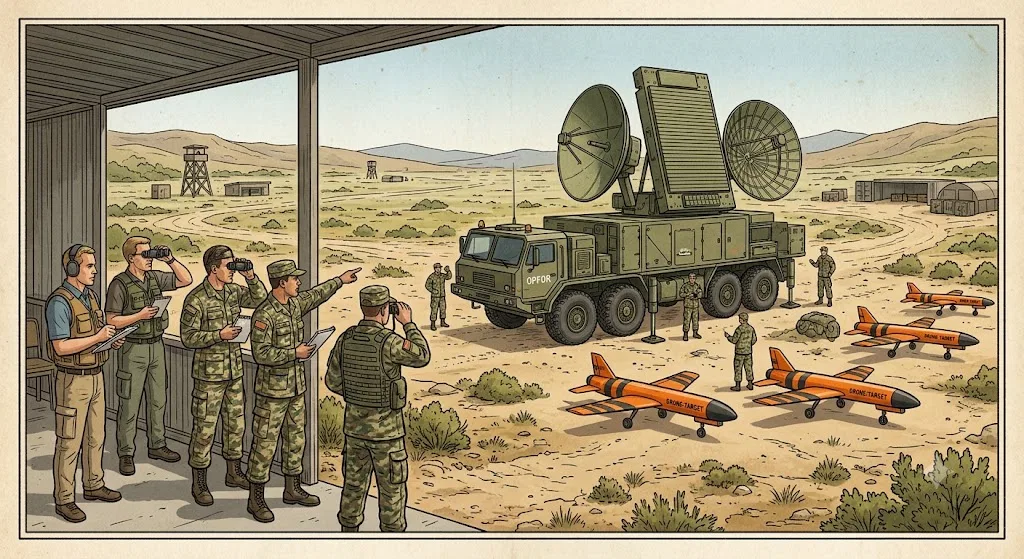
Threat training ranges are where reverse engineering becomes muscle memory. A training range does not need to expose trainees to the exact enemy system in every case, but it does need to reproduce the important effects: signatures, silhouettes, timing, movement, emissions, tactics and operational pressure.
The US Army’s National Training Center at Fort Irwin shows how this evolved. In the early 1980s, the opposing force used Vietnam-era M551 Sheridan armoured vehicles visually modified to resemble Soviet T-72 tanks, BMP infantry fighting vehicles, self-propelled artillery and ZSU-23-4 air-defence vehicles. The official Army history also records that the opposing force used some real Soviet MTLB tracked carriers captured by Israeli forces in Middle East conflicts. This was not museum theatre; it was a way of forcing American units to train against a force that looked, moved and fought more like the expected Warsaw Pact opponent. U.S. Army Center of Military History[history.army.mil]history.army.milU.S. Army Center of Military HistoryThe Origins and Development of the National Training Center, 1976 - 1984…
The same source explains why the shift mattered. Earlier “aggressor” troops had often fought like Americans in strange clothing. By contrast, the modern opposing-force concept sought to present mechanised forces typical of Warsaw Pact or Soviet surrogates, in superior force ratios, using doctrine and equipment cues that made the enemy problem more demanding. That was an implementation choice: build a standing adversary that could punish weak tactics repeatedly, rather than invent a shallow enemy for each exercise. U.S. Army Center of Military History[history.army.mil]history.army.milU.S. Army Center of Military HistoryThe Origins and Development of the National Training Center, 1976 - 1984…
Today, the training-range model is broader than tanks. The US Army’s Threat Systems Management Office describes itself as the lifecycle manager for threat, instrumentation and target capabilities, acquiring and sustaining technologies that provide “threat-faithful” electronic warfare, uncrewed aircraft, cyberspace and information-advantage capabilities for test, assessment, experimentation and training.[cpest3.army.mil]cpest3.army.milPL TSMOProject Lead Threat Systems Management Office (PM SIM) - CPE ST3… Army operational-environment guidance similarly describes opposing forces as a free-thinking, capability-based “sparring partner” designed to produce combat-like conditions across live, virtual, constructive and gaming environments.[T2COM G2 Enterprise]oe.t2com.army.milOpen source on army.mil.
That matters because many modern threats are not visually dramatic. A radar emitter, a jammer, a drone-control link or a spoofed information feed may be more important than a painted vehicle. Captured equipment and exploitation data help range designers decide which behaviours must be physically present, which can be simulated, and which must be updated as adversaries adapt.
Pilot and Crew Preparation
The clearest case of captured threat equipment changing training is Project Constant Peg, the secret US Air Force programme in which the 4477th Test and Evaluation Squadron flew Soviet-designed MiG-17, MiG-21 and MiG-23 aircraft against US Air Force, Navy and Marine Corps aircrews. The National Museum of the United States Air Force states that the programme was designed to train aircrews against Soviet-designed aircraft and that the Red Eagles used both Soviet tactics and the actual MiGs their students might face in combat.[Air Force Museum]nationalmuseum.af.milCONSTANT PEG: Secret MiGs in the Desert > National Museum of the United States Air Force > Display…
The difference from ordinary aggressor training was direct exposure. Aggressor squadrons could imitate Soviet tactics using US aircraft, but Constant Peg added the real aircraft’s size, acceleration, turn performance, visibility, energy behaviour and cockpit-driven limitations. The museum describes a typical “MiG exposure” as beginning with radar intercept and formation work, then moving to basic manoeuvres, one-versus-one offensive and defensive practice, and finally two-versus-two engagements with Soviet tactics. The aim was not to teach pilots to admire the foreign aircraft; it was to remove surprise, reveal strengths and weaknesses, and make the first close encounter less psychologically paralysing.[Air Force Museum]nationalmuseum.af.milCONSTANT PEG: Secret MiGs in the Desert > National Museum of the United States Air Force > Display…
An official Air Force account makes the same point in plainer language. A former 4477th pilot said Constant Peg allowed pilots to learn how to fight enemy aircraft in a controlled, safe environment rather than discovering those lessons in combat. The Air Force linked the programme to the broader post-Vietnam effort that included Red Flag, Top Gun and aggressor squadrons, all intended to reduce the dangerous shock of early combat missions.[U.S. Air Force]af.milAir Force declassifies elite aggressor program > Air Force > Article Display…
The training payoff came with a maintenance cost. The MiGs were scarce, often arrived in poor condition, and needed improvised sustainment because parts and expertise were limited. The National Museum notes that constant flying and unreliable Soviet equipment strained readiness, and that three Red Eagles personnel died in accidents during the programme. That is a reminder that preserving captured or acquired threat equipment for training is not cheap theatre. It requires security, specialist maintainers, safety rules, spare-parts workarounds and a clear judgement that realism is worth the risk.[Air Force Museum]nationalmuseum.af.milCONSTANT PEG: Secret MiGs in the Desert > National Museum of the United States Air Force > Display…
Replicas and Simulators
Most militaries cannot keep a large fleet of captured enemy systems running. Even when they can, they may not want trainees, allies or contractors exposed to the exact hardware and its classified exploitation results. This is why replicas, visual modifications, threat emitters and simulators matter. They let a force spread the training effect of captured equipment without needing the original item on every range.
The Fort Irwin example shows the basic pattern. Some real foreign equipment was used, but many opposing-force vehicles were US platforms modified with kits to resemble Soviet systems. The Army history records fibreglass, wood or plastic visual-modification kits, changes to laser engagement equipment so it could work on the threat vehicles, and other surrogates such as Dodge pickups altered to represent Soviet reconnaissance vehicles. U.S. Army Center of Military History[history.army.mil]history.army.milU.S. Army Center of Military HistoryThe Origins and Development of the National Training Center, 1976 - 1984… The point was not perfect copying; it was enough resemblance, instrumented in the training system, to make friendly troops identify, prioritise and fight the right kind of enemy under pressure.
Air and electronic-warfare training adds another layer. Once exploitation reveals how a foreign radar, missile seeker or electronic attack system behaves, that data can be used to improve emitters, mission simulators and range instrumentation. The 1997 DoD audit is valuable here because it treats exploitation results and simulators as one system: intelligence centres disseminated foreign materiel findings to simulator, target-development, training and tactics communities, but the audit criticised gaps in revalidation when new exploitation data became available.[U.S. Department of War]media.defense.govU.S. Department of War Use of Foreign Materiel Exploitation ResultsU.S. Department of War Use of Foreign Materiel Exploitation Results(https://media.defense.gov/1997/Oct/08/2001715489/-1/-1/1/98-005.pdf)
Modern range development continues this logic. Georgia Tech Research Institute has described the Advanced Radar Threat System Variant 1 as a system used on training ranges to simulate advanced air-defence radar threats so aircrews can train to evade enemy missiles.[GTRI]gtri.gatech.eduadvanced radar threat system helps aircrews train evade enemy missilesadvanced radar threat system helps aircrews train evade enemy missiles The US Army’s Threat Systems Management Office similarly emphasises “threat-faithful” electronic warfare, uncrewed aircraft and cyber capabilities for training and assessment.[cpest3.army.mil]cpest3.army.milPL TSMOProject Lead Threat Systems Management Office (PM SIM) - CPE ST3… These systems may not be captured weapons themselves, but their credibility depends on the same exploitation pipeline: collect data from real threat systems where possible, turn it into safe training representations, then keep those representations current.
What Recent Captures Add
The war in Ukraine has reinforced how quickly captured equipment can become training and adaptation material. Ukrainian forces have captured and reused large quantities of Russian armour; Radio Free Europe/Radio Liberty reported Ukrainian crews training on captured Russian tanks, with estimates that hundreds had been taken into Ukrainian service.[RadioFreeEurope/RadioLiberty]rferl.orgOpen source on rferl.org. For Ukraine, this is partly a force-generation issue: captured tanks can become usable platforms if crews can be trained and maintenance problems solved. But it is also threat familiarisation. Crews who handle a captured vehicle learn its ergonomics, sighting systems, breakdown patterns and limitations in a way that second-hand descriptions cannot fully convey.
Western exploitation of Russian equipment captured in Ukraine has a different training pathway. A UK defence official told Breaking Defense in 2023 that recovered Russian military equipment had been passed to intelligence agencies and industry partners to identify weaknesses and develop defensive aids and countermeasures, while also ensuring Ukrainians benefited from the knowledge.[Breaking Defense]breakingdefense.comOpen source on breakingdefense.com. That flow can affect training indirectly: once weaknesses are identified, armies can update recognition training, countermeasure drills, simulator settings, range scenarios and tactical instruction.
The UK also has existing institutions that can absorb such lessons. The British Army identifies Bovington’s Armoured Fighting Vehicles Schools Regiment as Defence’s reference point for mounted close-combat individual training, teaching soldiers to drive, maintain and operate armoured vehicles and their weapons and communications systems.[British Army]army.mod.ukBritish Army Combat Manoeuvre Centre | The British ArmyBritish Army Combat Manoeuvre Centre | The British Army Captured equipment does not automatically appear on such courses, and many details remain sensitive, but the institutional path is clear: exploitation findings move from intelligence and industry into doctrine, technical training, crew drills and exercise design.
The Implementation Trade-Offs
Training against captured or replicated threat equipment sounds straightforward, but the practical choices are difficult. The first trade-off is authenticity versus scale. A single captured aircraft, radar or tank may be highly authentic but too rare, fragile or classified for routine training. A simulator or replica can train many more people, but only if it preserves the characteristics that matter most.
The second trade-off is secrecy versus shared readiness. Constant Peg worked because the programme was tightly controlled, but secrecy also limited who could benefit and how openly lessons could circulate. The Air Force account notes that many trainees only discovered the true nature of the training at the last moment.[Air Force Museum]nationalmuseum.af.milCONSTANT PEG: Secret MiGs in the Desert > National Museum of the United States Air Force > Display… Modern allied training faces a similar problem: exploitation data may be too sensitive to release widely, yet training value rises when crews, maintainers and planners can practise against realistic threats rather than watered-down versions.
The third trade-off is currency. A captured system is a snapshot. Adversaries modify hardware, update software, change tactics and add field expedients. If a training range preserves the old version too faithfully, it becomes misleading. This is why the DoD audit’s concern about revalidating threat models remains relevant: the problem is not just building a good simulator once, but keeping it aligned with the latest exploited evidence.[U.S. Department of War]media.defense.govU.S. Department of War Use of Foreign Materiel Exploitation ResultsU.S. Department of War Use of Foreign Materiel Exploitation Results(https://media.defense.gov/1997/Oct/08/2001715489/-1/-1/1/98-005.pdf)
Finally, there is a safety and sustainment cost. Operating foreign aircraft or armoured vehicles requires unfamiliar maintenance practices, scarce parts and careful risk control. Constant Peg’s accident history and maintenance burden show the human and organisational cost of making threat equipment flyable rather than merely displayable.[Air Force Museum]nationalmuseum.af.milCONSTANT PEG: Secret MiGs in the Desert > National Museum of the United States Air Force > Display… For many systems, the better answer is to preserve one or two originals for measurement and specialist exposure, then distribute the lesson through replicas, electronic emitters, digital models and instructor training.
What Captured Weapons Change in the Trainee
The deepest effect is psychological. Captured threat equipment reduces the enemy’s mystique. A pilot who has seen a MiG fill the windscreen, a tank crew that has climbed through a captured armoured vehicle, or an aircrew that has trained against a threat-faithful radar emitter is less likely to meet the first real encounter with shock. That does not guarantee victory, but it changes the first seconds of judgement.
It also teaches respect without exaggeration. Real systems usually have strengths and weaknesses. They may be dangerous in one envelope and vulnerable in another, formidable on paper but maintenance-heavy in the field, or easy to recognise visually but difficult to detect electronically. Training with captured or replicated equipment helps crews replace myth with calibrated confidence.
That is why captured weapons are not only trophies or intelligence objects. In the training branch of reverse engineering foreign military technology, they become adversary stand-ins, simulator baselines, range instruments and crew-confidence tools. The hardware matters because it turns knowledge into rehearsal — and rehearsal is where technical intelligence becomes battlefield readiness.
Amazon book picks
Further Reading
Books and field guides related to How Captured Weapons Change Training. Use these as the next step if you want deeper reading beyond the article.
Red Eagles
Directly covers exploitation and training use of Soviet aircraft by U.S. forces.
Boyd
Explains how realistic understanding of adversary capabilities shapes training and combat preparation.
Learning to Eat Soup with a Knife
Examines institutional learning and adaptation from operational experience.
Military Innovation in the Interwar Period
Shows how forces incorporate technical and operational lessons into training and doctrine.
eBay marketplace picks
Marketplace Samples
Live-tested eBay searches with available results related to this page.




Endnotes
1.
Source: asafm.army.mil
Title: Financial Management
Link:https://www.asafm.army.mil/Portals/72/[Documents
Source snippet
Army Financial Management...
2.
Source: media.defense.gov
Title: U.S. Department of War Use of Foreign Materiel Exploitation Results
Link:https://media.defense.gov/1997/Oct/08/2001715489/-1/-1/1/98-005.pdf
3.
Source: history.army.mil
Link:https://history.army.mil/portals/143/Images/Publications/catalog/69-3.pdf
Source snippet
U.S. Army Center of Military HistoryThe Origins and Development of the National Training Center, 1976 - 1984...
4.
Source: cpest3.army.mil
Title: PL TSMO
Link:https://www.cpest3.army.mil/Project-Offices/PL-TSMO/
Source snippet
Project Lead Threat Systems Management Office (PM SIM) - CPE ST3...
5.
Source: oe.t2com.army.mil
Link:https://oe.t2com.army.mil/opfor-opposing-forces-program/
6.
Source: nationalmuseum.af.mil
Title: Air Force Museum
Link:https://www.nationalmuseum.af.mil/Visit/Museum-Exhibits/Fact-Sheets/Display/Article/1682967/constant-peg-secret-migs-in-the-desert/
Source snippet
CONSTANT PEG: Secret MiGs in the Desert > National Museum of the United States Air Force > Display...
7.
Source: af.mil
Title: U.S. Air Force
Link:https://www.af.mil/News/Article-Display/Article/129077/air-force-declassifies-elite-aggressor-program/
Source snippet
Air Force declassifies elite aggressor program > Air Force > Article Display...
8.
Source: gtri.gatech.edu
Title: advanced radar threat system helps aircrews train evade enemy missiles
Link:https://www.gtri.gatech.edu/newsroom/advanced-radar-threat-system-helps-aircrews-train-evade-enemy-missiles
9.
Source: oe.t2com.army.mil
Title: mil Joint ISR
Link:https://oe.t2com.army.mil/jisr-signatures-joint-isr-program/jisr-training-courses/
10.
Source: oe.t2com.army.mil
Link:https://oe.t2com.army.mil/
11.
Source: oe.t2com.army.mil
Link:https://oe.t2com.army.mil/product/russia-continues-to-adapt-training-incorporating-lessons-from-ukraine/
12.
Source: army.mil
Title: training center transformation ensures combat ready troops
Link:https://www.army.mil/article/1615/training_center_transformation_ensures_combat_ready_troops
13.
Source: home.army.mil
Title: FY23 JUNE 2023 NTC EXSOP RELEASEABLE
Link:https://home.army.mil/irwin/application/files/1816/9455/6714/FY23_JUNE_2023_NTC_EXSOP_RELEASEABLE.pdf
Published: JUNE 2023
14.
Source: home.army.mil
Title: FORSCOM Regulation 350 50 1 Training at the National Training Center
Link:https://home.army.mil/irwin/application/files/1815/5112/0491/FORSCOM_Regulation_350-50-1_Training_at_the_National_Training_Center.pdf
15.
Source: media.defense.gov
Link:https://media.defense.gov/1992/Jul/15/2001714601/-1/-1/1/92-125.pdf
16.
Source: media.defense.gov
Title: AER350 220
Link:https://media.defense.gov/2013/Sep/10/2001921939/-1/-1/0/AER350-220.pdf
17.
Source: military.com
Title: ntcs new opfor combat vehicles will look and perform modern enemy battle wagons
Link:https://www.military.com/daily-news/2021/03/17/ntcs-new-opfor-combat-vehicles-will-look-and-perform-modern-enemy-battle-wagons.html
18.
Source: rferl.org
Link:https://www.rferl.org/a/ukraine-trophy-tanks-chernihiv-russia-repair-armor-capture-oryx/32605091.html
19.
Source: breakingdefense.com
Link:https://breakingdefense.com/2023/01/uk-reveals-capture-of-russian-equipment-instructs-industry-to-develop-new-countermeasures/
20.
Source: army.mod.uk
Title: British Army Combat Manoeuvre Centre | The British Army
Link:https://www.army.mod.uk/learn-and-explore/about-the-army/formations-divisions-and-brigades/land-warfare-centre/combat-manoeuvre-centre/
21.
Source: Wikipedia
Title: 4477th Test and Evaluation Squadron
Link:https://en.wikipedia.org/wiki/4477th_Test_and_Evaluation_Squadron
22.
Source: simpleflying.com
Title: us air force secretly flew soviet mig combat jets cold war
Link:https://simpleflying.com/us-air-force-secretly-flew-soviet-mig-combat-jets-cold-war/
Additional References
23.
Source: youtube.com
Title: Advanced Radar Threat System Helps Aircrews Train to Evade Enemy Missiles
Link:https://www.youtube.com/watch?v=1TNLGXpxWUg
Source snippet
Elbit Systems UK / Airborne EW Training and Simulation System...
24.
Source: youtube.com
Title: The Secret Program That Hid an Even More Secret Program
Link:https://www.youtube.com/watch?v=XeBNyPsysiI
Source snippet
Advanced Radar Threat System Helps Aircrews Train to Evade Enemy Missiles...
25.
Source: facebook.com
Link:https://www.facebook.com/GBNewsOnline/posts/a-team-of-just-10-ukrainians-counter-attacked-the-nato-forces-destroying-17-armo/1419977560141973/
26.
Source: imlive.s3.amazonaws.com
Link:https://imlive.s3.amazonaws.com/Federal%20Government/ID92495945983687723239759185652180825001/AEWTTR%20II%20DRAFT%20SOW.docx
27.
Source: facebook.com
Link:https://www.facebook.com/AirZoo/posts/appearances-can-be-deceivingthis-uh-1-huey-underwent-a-unique-modification-to-se/1436275708542552/
28.
Source: teamorlando.org
Link:https://teamorlando.org/army-demonstrated-vanguard-24-capabilities-at-ausa-global-force-symposium-during-warriors-corner/
29.
Source: iiss.org
Link:https://www.iiss.org/globalassets/media-library—content–migration/files/research-papers/iad-report.pdf
30.
Source: leidos.com
Link:https://www.leidos.com/capabilities/cyber/electronic-warfare
31.
Source: greydynamics.com
Link:https://greydynamics.com/fmep-us-foreign-material-exploitation-programs/
32.
Source: cdse.edu
Link:https://www.cdse.edu/Portals/124/Documents/student-guides/GS160-guide.pdf
Topic Tree