Within Foreign Materiel
The Software Hidden Inside Weapons
Modern exploitation often includes code, firmware and digital interfaces as much as metal and engines.
On this page
- Embedded code and settings
- Interfaces and maintenance data
- Cyber and countermeasure value
Page outline Jump by section
Introduction
Software and firmware now sit inside almost every advanced weapon worth exploiting. A captured drone, missile seeker, jammer or armoured vehicle is not only a set of motors, sensors and circuit boards; it is also a record of decisions encoded in memory: guidance logic, radio settings, calibration tables, threat libraries, update routines, debug traces and maintenance data. That hidden layer matters because it can reveal how a system navigates, communicates, resists jamming, recognises targets, fails under stress and can be countered.
In the wider field of reverse engineering foreign military technology, firmware exploitation is the part that turns captured hardware into behavioural knowledge. It helps analysts move from “what is this component?” to “what does the system actually do when it sees a signal, loses satellite navigation, receives a command, or detects a fault?” Official US descriptions of foreign materiel exploitation explicitly include air, space and cyberspace-related military systems, while electronic-warfare reprogramming doctrine depends on updated threat data derived from real systems and tests.[Nasic]nasic.af.milNasic NASIC opens new FME facilityNasicNASIC opens new FME facilityOctober 27, 2017 — FME analysts exploit air, space and cyberspace-related military systems that helps pr…
Why the code layer changes what captured equipment can reveal
Older reverse engineering often centred on visible engineering: metallurgy, engines, optics, explosive trains, radar antennas and mechanical tolerances. Those still matter. But in modern systems, many of the most important behaviours are not visible from the chassis. A missile’s route-following logic, a drone’s lost-link behaviour, a jammer’s signal-processing choices or a radar warning receiver’s threat recognition table may be stored in firmware, configuration files or programmable logic.
This changes the value of battlefield capture in three ways. First, it can expose actual behaviour, not just design intent. A weapon may use commercial chips, but the military value lies in how those chips are wired, timed, configured and instructed. Secondly, it can reveal reusable design patterns across a family of systems. Conflict Armament Research has reported that Russian advanced weapons in Ukraine share sets of components across different systems, including missiles; that matters because the same electronic architecture may imply related firmware, update practices or supply vulnerabilities.[ArcGIS StoryMaps]storymaps.arcgis.comArc GIS Story Maps Component commonalities in advanced Russian weaponArcGIS StoryMapsComponent commonalities in advanced Russian weapon…September 9, 2025 — CAR's most recent investigations indicate that… Thirdly, code and settings can feed directly into countermeasure work: electronic warfare, decoys, defensive software updates, target recognition, training simulators and export-control investigations.
The point is not that analysts simply “copy the software”. In many cases they may not have source code, cryptographic keys, complete hardware, or safe access to a live system. The value often comes from a layered reconstruction: memory dumps, strings, file systems, boot logs, circuit-board tracing, radio measurements, maintenance ports, known component documentation and controlled testing are combined until the system’s practical limits become clearer.

Embedded code and settings
Firmware is the low-level software that makes hardware behave like a weapon system rather than a pile of electronics. It may run on microcontrollers, field-programmable gate arrays, digital signal processors, flight-control boards, navigation modules, seekers, fuzes, radios, power-management units or electronic-warfare receivers. In captured materiel, analysts are often looking for both programme logic and configuration data: the difference between the rules a device follows and the values loaded into those rules.
A captured unmanned aircraft is a good example. The visible airframe gives range, payload and build-quality clues, but the firmware and stored settings may show how it fuses inertial and satellite navigation, what it does when jammed, how it logs missions, how it authenticates a ground-control link, and whether it depends on known commercial modules. RUSI’s 2022 “Silicon Lifeline” report, based on technical inspection of Russian equipment captured in or fired at Ukraine, documented the heavy role of foreign microelectronics in Russian weapons; reporting on the same work noted Orlan-10 elements such as an STM32 microcontroller in the flight-control system and a u-blox GNSS navigation module.[RUSI]static.rusi.orgSilicon Lifeline final webSilicon Lifeline final web
The same logic applies to missiles and one-way attack drones. Public investigations of Russian, Iranian and North Korean missiles and UAV debris in Ukraine have focused heavily on electronics because navigation, timing and control depend on embedded systems. IISS has described its 2025 report as examining the technological make-up of Russian, Iranian and North Korean missile and UAV debris in Ukraine since 2022 and tracing foreign components and procurement routes; Reuters, citing Conflict Armament Research, reported that a North Korean missile used in Ukraine contained navigation-system electronics and that 75% of documented electronic components were linked to US-incorporated companies.[IISS]iiss.orgTracking the Components of Missiles and UAVs Used byTracking the Components of Missiles and UAVs Used by
For firmware exploitation, component identification is only the start. A commercial chip’s data sheet can say what it is capable of, but captured code and settings can show what the weapon designer actually used. Analysts may look for:
- Navigation constants and fallback modes: how the system handles degraded satellite signals, inertial drift, terrain following or preloaded waypoints.
- Radio and datalink parameters: frequencies, modulation choices, pairing logic, encryption use, retry behaviour and command formats.
- Sensor calibration: values that reveal manufacturing tolerances, seeker alignment, thermal compensation or quality-control shortcuts.
- Mission logs and maintenance counters: stored evidence of flight hours, error states, component replacements, battery health or pre-launch tests.
- Target and threat libraries: data used by seekers, radar warning receivers or electronic-warfare systems to classify signals or objects.
- Update mechanisms: how firmware is loaded, whether updates are signed, and whether operators can change parameters in the field.
The deeper lesson is that firmware can expose the doctrine embedded in equipment. A system’s settings may show whether designers prioritised cheap mass production, resistance to jamming, ease of repair, secrecy, export compatibility or rapid battlefield updates.
Interfaces and maintenance data
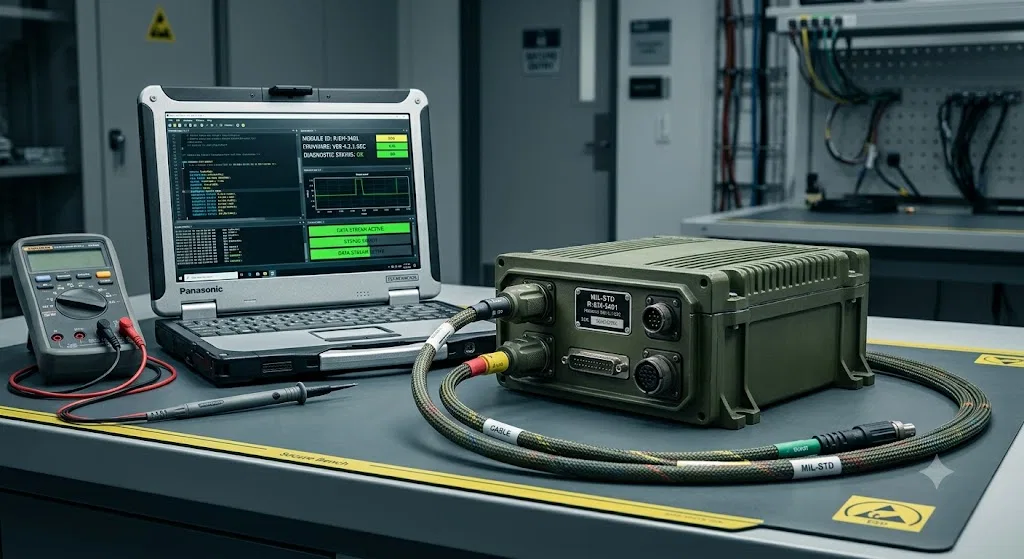
Captured systems often give up their secrets through the interfaces left behind for builders, maintainers and operators. These may include ordinary maintenance connectors, test pads on a printed circuit board, removable memory, diagnostic displays, boot logs, serial consoles, update media, ground-support laptops or ruggedised programming devices. Modern military hardware still has to be manufactured, calibrated, tested and repaired; each of those needs an access path.
In civilian embedded-security research, common routes for acquiring firmware include reading flash memory, using hardware debug interfaces such as JTAG or SWD, observing UART boot messages, and validating whether the resulting image is complete rather than a corrupted or empty dump. A 2026 drone-firmware acquisition study, for example, evaluated SPI flash reading, SWD/JTAG access, UART capture and clip-based contact methods, then used entropy profiling and structural analysis to check whether extracted images were meaningful.[arXiv]arxiv.orgOpen source on arxiv.org. Military exploitation teams do not necessarily use the same public tooling or publish their methods, but the underlying challenge is similar: possession of the object does not automatically mean possession of trustworthy code.
Maintenance data can be as important as executable code. Fault logs may reveal recurring weaknesses. Calibration records may show what components are marginal. Serial numbers and timestamps may connect a battlefield item to production batches and procurement networks. Stored coordinates or mission records may show how a system was used. In the Ukraine war, open investigations of recovered missiles and drones have repeatedly linked physical debris to supply-chain and design questions, rather than treating wreckage as mere battlefield scrap.[IISS]iiss.orgTracking the Components of Missiles and UAVs Used byTracking the Components of Missiles and UAVs Used by
There is also a modelling and simulation payoff. A captured radar, jammer or missile seeker can help build better threat simulators only if the behaviour being modelled is validated against real data. A US Department of Defense Inspector General report on foreign materiel exploitation results noted the importance of revalidating threat models and simulators when threat data or threat-system simulators change.[U.S. Department of War]media.defense.govU.S. Department of War Use of Foreign Materiel Exploitation ResultsU.S. Department of War Use of Foreign Materiel Exploitation Results(https://media.defense.gov/1997/Oct/08/2001715489/-1/-1/1/98-005.pdf) In software-heavy systems, that “threat data” may include firmware revisions, settings, signal libraries and mode logic, not just antenna dimensions or engine performance.
This is why exploitation is often iterative. Analysts may first catalogue chips and boards, then extract memory, then test subsystems, then compare behaviour with battlefield reports, then update electronic-warfare databases or training models. Each step may change the meaning of the previous one. A radio module that looks ordinary on a board may become significant once logs show how it was configured; a low-cost microcontroller may become strategically important if it appears across many weapons and runs similar control logic.

Cyber and countermeasure value
The most direct military value of firmware exploitation is countermeasure development. If analysts understand how a system senses, communicates and decides, defenders can design jamming, spoofing, decoys, hardening, routing changes, software updates or tactical procedures that attack the system’s assumptions rather than merely its armour.
Electronic warfare is the clearest example. The US Air Force’s electronic warfare integrated reprogramming guidance links threat data, foreign materiel exploitation participation and reprogramming support, while the US Defense Security Cooperation Agency explains that electronic-warfare databases are used to create mission data files or libraries for EW systems.[E-Publishing]static.e-publishing.af.mildafman10 703E-Publishingdafman10-703.pdf2 Jun 2021 — Assist the reprogramming center's participation in foreign materiel exploitation…. EWIRDB—ele… In plain terms, aircraft and defensive systems often need updated digital libraries to recognise and respond to changing radars, missiles and jammers. Captured equipment can make those libraries less speculative.
The reported capture of part of a Russian Krasukha-4 electronic-warfare system near Kyiv in March 2022 illustrates why intact or semi-intact digital systems are prized. Public reporting described the system as a sophisticated jammer designed to affect aircraft early-warning sensors, and stated that examination could help Ukraine and Western partners understand how it worked and how to reduce its battlefield value.[Center for Public Integrity]publicintegrity.orgCenter for Public Integrity What to know about the Russian device reportedlyCenter for Public Integrity What to know about the Russian device reportedly For a system like that, the useful secrets are not only metal boxes and antennas; they may include signal-processing settings, control software, emitter libraries, operator interfaces and diagnostic traces.
Cyber value should be understood carefully. Captured firmware might reveal vulnerabilities, weak authentication, unsafe update processes, exposed maintenance services or insecure protocol design. But responsible public discussion should not turn that into a recipe for attacking live systems. At an analytical level, the key point is that software exploitation can create defensive leverage: a state may learn which links to jam, which messages to distrust, which decoys to build, which firmware versions are fielded, and which procurement dependencies to disrupt.
There is also a supply-chain angle. Firmware and board-level analysis can show whether a supposedly domestic weapon depends on foreign commercial components, which suppliers are recurring, and which parts are difficult to replace. Conflict Armament Research’s work on Iranian drones used by Russia reported recently manufactured components produced mostly by companies based in the United States, while IISS’s component-tracking work examines Russian, Iranian and North Korean missile and UAV debris to understand procurement routes and the limits of export-control enforcement.[ArcGIS StoryMaps]storymaps.arcgis.comArc GIS Story Maps Dissecting Iranian drones employed by Russia in UkraineArc GIS Story Maps Dissecting Iranian drones employed by Russia in Ukraine This is not firmware analysis in isolation, but firmware often helps identify what a component is doing and how critical it is.
Ukraine shows how battlefield captures can become shared technical intelligence
The war in Ukraine has made software-bearing battlefield capture unusually visible. Drones, missiles, electronic-warfare equipment and armoured systems have been recovered, dismantled, photographed, catalogued and, in some cases, shared with partners. Ukraine’s Ministry of Defence launched TrophyLab in June 2026 as a platform for studying captured Russian equipment; its public site describes a catalogue with more than 115 samples across categories including UAVs, electronic-warfare assets, aircraft, missiles and armoured vehicles, with technical specifications, blueprints and research results available to approved users.[TrophyLab]trophylab.mod.gov.uaOpen source on mod.gov.ua.
Reporting on the launch described TrophyLab as a way for defence companies, researchers and allied governments to access technical data from captured systems and, in some cases, request physical samples for analysis. Business Insider reported that the portal had 150 registered users in its first week, roughly a third from abroad, and that it included data on Russian and North Korean weapons such as drones, missiles, armoured vehicles and electronic systems.[Tech.eu]tech.euUkraine launches Trophy Lab, turning captured RussianUkraine launches Trophy Lab, turning captured Russian
That matters for software and firmware because digital exploitation benefits from scale. A single lab can learn a great deal from one captured system, but a broader network can compare firmware versions, component substitutions, board revisions, configuration changes and field modifications across many samples. If one drone variant replaces a navigation board, if a missile family shifts from Western to Russian or Belarusian electronics, or if a jammer receives a new software load, the pattern may only become clear when multiple captures are compared. Reuters reported in 2025 that Ukraine was increasingly finding Russian and Belarusian electronics in missile wreckage, a shift that could complicate export-control strategies focused on Western components.[Reuters]reuters.comUkraine increasingly finds Russian and Belarusian electronics in missilesUkraine increasingly finds Russian and Belarusian electronics in missiles
Ukraine’s approach also shows a tension in modern exploitation: secrecy versus speed. Traditional foreign materiel exploitation is often tightly held because the possessor gains advantage from knowing what the adversary does not know has been learned. Ukraine’s partial sharing model reflects a different wartime calculation: when many allies are building counter-drone, air-defence, electronic-warfare and sanctions tools, faster diffusion of technical findings may be worth more than keeping every detail inside a single intelligence compartment.
What makes firmware exploitation difficult
The presence of software does not mean easy access. Captured systems may be damaged, booby-trapped, encrypted, wiped, conformal-coated, potted in resin, locked by secure boot, or dependent on missing external equipment. Some firmware is stored in ordinary flash memory; other logic may live in microcontrollers, programmable logic or chips designed to resist reading. Even when an image is extracted, it may be compressed, encrypted, stripped of symbols, split across processors, or meaningless without sensor inputs and timing context.
Drone-firmware research highlights these limits. A 2023 paper on drone firmware analysis noted that dynamic analysis and fuzzing are hard because drone firmware may be difficult to emulate, with limited input interfaces, encryption and signatures; the authors warned that tools for ordinary IoT firmware do not transfer cleanly to drones.[arXiv]arxiv.orgarXiv Challenges in Drone Firmware Analyses of Drone Firmware and Its SolutionsarXiv Challenges in Drone Firmware Analyses of Drone Firmware and Its Solutions More general embedded-firmware work has also shown that full-system emulation can be powerful but difficult, because firmware expects particular hardware, peripherals and timing.[arXiv]arxiv.orgOpen source on arxiv.org.
There is a second difficulty: code rarely explains itself. A binary can show instructions, but not necessarily the design rationale. Analysts must connect it to physical circuitry, sensor behaviour, operator manuals, battlefield use, radio emissions, procurement records and test results. A navigation routine may look unremarkable until paired with evidence that a specific GNSS module is repeatedly used across drones. A diagnostic flag may matter only when matched to maintenance procedures. A threat library may be valuable only if analysts can correlate its entries with actual emitters.
A third difficulty is legal and ethical handling. Captured military systems may contain personal data, third-country commercial intellectual property, export-controlled technology or live hazards. Public researchers working on analogous civilian devices often publish methods and tooling; state exploitation teams usually have to balance intelligence value, safety, classification and the risk of revealing to the adversary what has been learned.
The practical payoff: better counters, better models, better procurement pressure
The branch-specific value of software and firmware exploitation is that it turns captured systems into living evidence of how an adversary’s digital battlefield works. It can improve a radar-warning library, sharpen a jammer, expose a weak update process, validate a simulator, identify a recurring supplier, or reveal that a supposedly advanced weapon relies on ordinary commercial modules configured in clever but fragile ways.
For countermeasures, the payoff is specificity. Rather than broadly saying that a drone is vulnerable to “jamming”, analysts can ask which navigation source it trusts, how it reacts when signals disagree, whether it records interference, and what fallback path it follows. Rather than broadly saying that a jammer is powerful, analysts can study its modes, libraries and control logic. Rather than broadly saying that sanctions should block “electronics”, investigators can identify which chips, modules and boards appear repeatedly in weapons and how critical they are to guidance or control.
For reverse engineering foreign military technology as a whole, software and firmware exploitation is therefore not an add-on to mechanical teardown. It is one of the main ways captured systems become operational intelligence. The hidden code inside weapons can show not only what an adversary built, but how that adversary expects the machine to behave under pressure.
Amazon book picks
Further Reading
Books and field guides related to The Software Hidden Inside Weapons. Use these as the next step if you want deeper reading beyond the article.
Practical Binary Analysis
Focuses on binary inspection, reverse engineering and behaviour discovery.
Practical Reverse Engineering
Directly covers analysis of binaries, firmware-related code and system internals.
Practical Malware Analysis
Explains reverse engineering of compiled code and system behaviour.
The Hardware Hacker
Shows how hardware and embedded systems can be investigated and understood.
eBay marketplace picks
Marketplace Samples
Live-tested eBay searches with available results related to this page.




Endnotes
1.
Source: storymaps.arcgis.com
Title: Arc GIS Story Maps Component commonalities in advanced Russian weapon
Link:https://storymaps.arcgis.com/stories/239f756e2e6b49a5bec78f5c5248bf3d
Source snippet
ArcGIS StoryMapsComponent commonalities in advanced Russian weapon...September 9, 2025 — CAR's most recent investigations indicate that...
Published: September 9, 2025
2.
Source: static.rusi.org
Title: Silicon Lifeline final web
Link:https://static.rusi.org/RUSI-Silicon-Lifeline-final-web.pdf
3.
Source: iiss.org
Title: Tracking the Components of Missiles and UAVs Used by
Link:https://www.iiss.org/globalassets/media-library—content–migration/files/research-papers/2025/09/pub25-094-tracking-the-components-of-missiles-and-uavs-used-by-russia-in-ukraine.pdf
4.
Source: reuters.com
Link:https://www.reuters.com/world/debris-north-korean-missile-ukraine-could-expose-procurement-networks-2024-02-22/
5.
Source: arxiv.org
Link:https://arxiv.org/abs/2605.11040
6.
Source: media.defense.gov
Title: U.S. Department of War Use of Foreign Materiel Exploitation Results
Link:https://media.defense.gov/1997/Oct/08/2001715489/-1/-1/1/98-005.pdf
7.
Source: storymaps.arcgis.com
Title: Arc GIS Story Maps Dissecting Iranian drones employed by Russia in Ukraine
Link:https://storymaps.arcgis.com/stories/7a394153c87947d8a602c3927609f572
8.
Source: tech.eu
Title: Ukraine launches [Trophy Lab]({{ ‘trophy-lab/’ | relative_url }}), turning captured Russian
Link:https://tech.eu/2026/06/19/ukraine-launches-trophylab-turning-captured-russian-weapons-into-a-battlefield-r-d-platform/
9.
Source: reuters.com
Title: Ukraine increasingly finds Russian and Belarusian electronics in missiles
Link:https://www.reuters.com/business/aerospace-defense/ukraine-increasingly-finds-russian-belarusian-electronics-missiles-2025-09-12/
10.
Source: arxiv.org
Title: arXiv Challenges in Drone Firmware Analyses of Drone Firmware and Its Solutions
Link:https://arxiv.org/abs/2312.16818
11.
Source: arxiv.org
Link:https://arxiv.org/abs/1511.03609
12.
Source: [nasic]({{ ‘nasic/’ | relative_url }}). af.mil
Title: Nasic NASIC opens new FME facility
Link:https://www.nasic.af.mil/News/Article-Display/Article/1356030/nasic-opens-new-fme-facility/
Source snippet
NasicNASIC opens new FME facilityOctober 27, 2017 — FME analysts exploit air, space and cyberspace-related military systems that helps pr...
Published: October 27, 2017
13.
Source: static.e-publishing.af.mil
Title: dafman10 703
Link:https://static.e-publishing.af.mil/production/1/af_a5/publication/dafman10-703/dafman10-703.pdf
Source snippet
E-Publishingdafman10-703.pdf2 Jun 2021 — Assist the reprogramming center's participation in foreign materiel exploitation.... EWIRDB—ele...
14.
Source: publicintegrity.org
Title: Center for Public Integrity What to know about the Russian device reportedly
Link:https://publicintegrity.org/national-security/ukraine-in-crisis/what-to-know-about-the-russian-device-reportedly-captured-in-ukraine/
15.
Source: trophylab.mod.gov.ua
Link:https://trophylab.mod.gov.ua/en/
Additional References
16.
Source: businessinsider.com
Link:https://www.businessinsider.com/inside-ukraine-move-to-spill-russian-north-korean-military-secrets
Source snippet
The initiative aims to facilitate collaboration among Ukraine’s defense manufacturers, NATO members, and foreign research labs by enablin...
17.
Source: businessinsider.com
Title: russian hi tech warfare system seized ukraine hold military secrets 2022 3
Link:https://www.businessinsider.com/russian-hi-tech-warfare-system-seized-ukraine-hold-military-secrets
18.
Source: youtube.com
Link:https://www.youtube.com/watch?v=GIU4yJn2-2A
19.
Source: youtube.com
Link:https://www.youtube.com/watch?v=aRSxyNMcVho
20.
Source: youtube.com
Link:https://www.youtube.com/watch?v=q4CxE5P6RUE
21.
Source: youtube.com
Link:https://www.youtube.com/watch?v=ycRsmldsV5E
22.
Source: youtube.com
Link:https://www.youtube.com/watch?v=zfxKbsLKb3E
23.
Source: eutoday.net
Title: EU Today RUSI report
Link:https://eutoday.net/rusi-report-silicon-lifeline-western-electronics-at-the-heart-of-russias-war-machine/
24.
Source: conflictarm.com
Title: field dispatches
Link:https://www.conflictarm.com/field-dispatches/
25.
Source: samm.dsca.mil
Title: Chapter 3
Link:https://samm.dsca.mil/chapter/chapter-3
Topic Tree
Follow this branch
Parent topic
Foreign MaterielRelated pages 29
- Debug Access The Hidden Connectors That Give Up Firmware
- Drone Logic What Drone Firmware Reveals About Real Flight Behavior
- Service Data Why Maintenance Records Matter as Much as Code
- Threat Libraries How Threat Libraries Reveal What Systems Recognize
- Threat Modeling Why Real Firmware Makes Better Threat Simulators
- +1 more in sidebar