Within Countermeasures
Can a simulator stand in for the enemy?
A threat simulator only proves much if it reproduces enough real enemy behavior for a test result to mean something in combat.
On this page
- Why generic threat models can mislead tests
- How foreign materiel anchors live fire ranges
- Where digital twins and physical surrogates fit
Page outline Jump by section
Introduction
A threat simulator can stand in for the enemy only when it reproduces the behaviours that actually determine combat outcomes. In the context of reverse engineering foreign military technology, the value of captured radars, missiles, communications systems and other materiel is not limited to intelligence collection. Those systems become reference standards against which simulators, surrogates and digital models are checked. A test result obtained against a validated threat representation carries far more weight than one obtained against a generic model because engineers know which aspects of the enemy system have been measured rather than assumed. The central challenge is therefore not simply building a simulator, but proving that its behaviour matches the real threat closely enough for countermeasure testing, operational evaluation and crew training to remain meaningful.[Dote]dote.osd.milDote Test and Evaluation Threat Resource Activity (TETRATest and Evaluation Threat Resource Activity (TETRA)January 30, 2024 — OT&E and LFT&E programs rely on the availability of actual, fo…
Why generic threat models can mislead tests
Military test organisations have long distinguished between a threat representation and a threat-validated representation. A radar, missile seeker or electronic warfare system often contains behaviours that are invisible from external observation alone. Small differences in signal processing, mode switching, target discrimination logic or operator procedures can determine whether a countermeasure succeeds or fails. If those details are missing, a simulator may create a reassuring but misleading picture of performance. Office of the Under Secretary of Defense[war.gov]war.govOffice of the Under Secretary of Defense Operational Test and Evaluation (OT&EOffice of the Under Secretary of DefenseOperational Test and Evaluation (OT&E)March 21, 2023 — As DOT&E's agent, TETRA provides threat re…
The problem is especially acute in electronic warfare. Engineers may know a radar’s nominal frequency range, yet still misunderstand how it behaves under jamming, how rapidly it changes modes, or which signals it rejects as deception. A jammer that defeats a simplified model may perform poorly against the actual system. Conversely, a defensive system that appears ineffective against an unrealistic simulator may in fact work against the fielded threat.
This is why defence testing programmes increasingly require verification, validation and accreditation processes for threat surrogates. The goal is not to replicate every component perfectly but to demonstrate that the simulator reproduces the characteristics that matter for the specific test question being asked. According to the Department of Defense’s Test and Evaluation Threat Resource Activity (TETRA), threat surrogates, models and digital twins are formally subjected to validation processes so that decision-makers understand both their capabilities and their limitations.[Dote]dote.osd.milTest and Evaluation Threat Resource Activity (TETRA)TETRA supported the development and accreditation of threat and target models and…
How foreign materiel anchors live-fire ranges
Captured, acquired or otherwise obtained foreign systems provide the benchmark against which simulators are judged. Operational testing programmes frequently seek access to actual foreign materiel either to test directly against it or to extract the data needed to build realistic substitutes. When the real system cannot be used routinely, measurements from that system become the foundation for physical and digital surrogates.[Dote]dote.osd.milDote Test and Evaluation Threat Resource Activity (TETRATest and Evaluation Threat Resource Activity (TETRA)January 30, 2024 — OT&E and LFT&E programs rely on the availability of actual, fo…
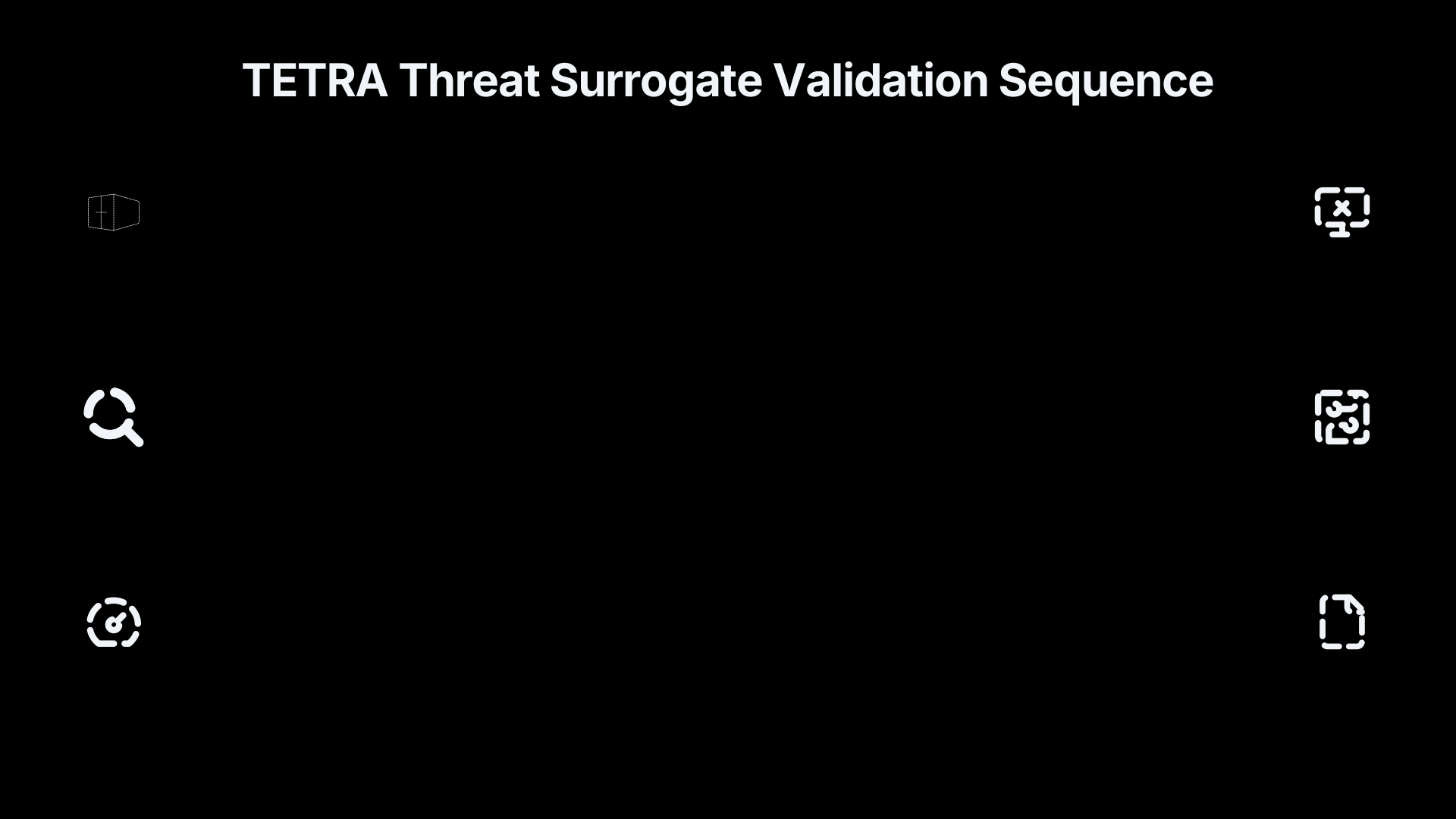
The validation process typically follows a sequence:
- Acquire or access the threat system.
- Measure signatures and behaviour under controlled conditions.
- Identify the characteristics that affect the test objective.
- Build a surrogate or simulator reproducing those characteristics.
- Compare surrogate performance against the real system.
- Document the remaining differences and their operational significance.
This approach matters because live-fire and operational testing often cannot rely on actual enemy equipment in sufficient numbers. A missile defence test range, for example, may need repeated representations of a threat radar or missile profile. Using a validated surrogate allows repeated testing while retaining a defensible connection to measured enemy behaviour. TETRA documentation repeatedly identifies foreign materiel acquisition as a means of supporting the development of both physical and digital threat surrogates and ensuring operationally representative testing.[Dote]dote.osd.milDote Test and Evaluation Threat Resource Activity (TETRATest and Evaluation Threat Resource Activity (TETRA)January 30, 2024 — OT&E and LFT&E programs rely on the availability of actual, fo…
A useful way to understand the relationship is that foreign materiel supplies the ground truth. The simulator supplies repeatability. Without the first, the second becomes increasingly speculative.
Where digital twins and physical surrogates fit
Modern threat simulation increasingly combines physical hardware and software models rather than choosing between them. The result is a spectrum ranging from actual enemy equipment to entirely synthetic representations.
Physical surrogates
A physical surrogate attempts to reproduce the observable behaviour of the threat through real hardware. It may duplicate radar emissions, missile seeker responses, communications signals or vehicle signatures without necessarily reproducing every internal component.
Physical surrogates are often preferred when:
- Electromagnetic interactions must be tested directly.
- Sensors need realistic emissions.
- Live-fire evaluations require real-world environmental effects.
- Human operators must react to authentic-looking threats.
The advantage is realism. The disadvantage is cost, maintenance burden and the difficulty of updating hardware when intelligence about the threat changes.
Digital twins and software representations
A digital twin is a high-fidelity computational representation derived from intelligence, measurements and engineering analysis. Modern defence organisations increasingly use digital twins because they can represent threats that are rare, difficult to obtain or unsafe to deploy repeatedly. TETRA specifically identifies digital twins as part of its portfolio of accredited threat representations.[Dote]dote.osd.milTest and Evaluation Threat Resource Activity (TETRA)TETRA supported the development and accreditation of threat and target models and…
Digital twins offer several advantages:
- Rapid modification when new intelligence emerges.
- Large-scale scenario generation.
- Lower operating costs.
- Easier integration into simulation environments.
However, they remain dependent on validation. A sophisticated model based on incomplete assumptions may be less useful than a simpler model grounded in measured foreign materiel data.
Hybrid approaches
Many contemporary test programmes use hybrid architectures. Real hardware may generate authentic signals while software models provide the broader tactical environment. In such arrangements, the most sensitive or uncertain threat behaviours can remain tied directly to measured enemy-system characteristics, while less critical elements are simulated.
This hybrid model reflects a practical reality: no test organisation possesses unlimited quantities of foreign equipment, yet purely synthetic environments may fail to expose critical weaknesses.
What validation actually looks like
Validation is not a one-time event. Threat systems evolve through upgrades, software revisions, new tactics and field modifications. A simulator validated against a radar version from one decade may become progressively less representative if the adversary introduces new signal-processing techniques or operating modes.
As a result, validation programmes typically focus on questions such as:
- Does the simulator reproduce the threat’s observable signatures?
- Does it react realistically to countermeasures?
- Does it operate within measured performance ranges?
- Do trained analysts agree that it reflects current intelligence?
- Are known deviations documented and acceptable for the intended test?
Defence testing organisations therefore track the status of threat surrogates, including their availability, verification and validation state, rather than treating all simulators as equally representative.[Dote]dote.osd.milTest and Evaluation Threat Resource Activity (TETRA)TETRA also supplies the T&E community with threat and target signatures and chara…
An important implication follows: the phrase “tested against the threat” often means tested against a validated threat representation, not necessarily against the actual enemy system itself. The credibility of the result depends on the quality of that validation chain.

The real measure of a simulator
The most valuable threat simulator is not the one that looks most impressive but the one whose relationship to the real enemy system is understood and documented. Reverse-engineered foreign materiel provides the measurements, signatures and behavioural data that anchor this process. Physical surrogates, digital twins and hybrid simulations all have roles to play, but their usefulness depends on continuous comparison against real-world evidence. When that connection is maintained, a simulator becomes more than a training aid or engineering convenience: it becomes a credible stand-in for the adversary during the development and testing of military countermeasures.[osd.mil]dote.osd.milDote Test and Evaluation Threat Resource Activity (TETRATest and Evaluation Threat Resource Activity (TETRA)January 30, 2024 — OT&E and LFT&E programs rely on the availability of actual, fo…
Amazon book picks
Further Reading
Books and field guides related to Can a simulator stand in for the enemy?. Use these as the next step if you want deeper reading beyond the article.
The Pentagon's Brain
Provides context for test, evaluation and military technology programs.
eBay marketplace picks
Marketplace Samples
Live-tested eBay searches with available results related to this page.


Endnotes
1.
Source: dote.osd.mil
Title: Dote Test and Evaluation Threat Resource Activity (TETRA)
Link:https://www.dote.osd.mil/Portals/97/pub/reports/FY2023/dotemanaged/2023tetra.pdf?ver=a4FiXsVtjPy9ZvCB6tdiEA%3D%3D
Source snippet
Test and Evaluation Threat Resource Activity (TETRA)January 30, 2024 — OT&E and LFT&E programs rely on the availability of actual, fo...
Published: January 30, 2024
2.
Source: dote.osd.mil
Link:https://www.dote.osd.mil/Portals/97/pub/reports/FY2021/other/2021tetra.pdf?ver=GXPGPzuitkDZVfYbWbDw8g%3D%3D
Source snippet
and Evaluation Threat Resources ActivitySpecifically, TETRA: 1) generates products that include intelligence-based analysis of current an...
3.
Source: dote.osd.mil
Link:https://www.dote.osd.mil/Portals/97/pub/reports/FY2025/dotemanaged/2025tetra.pdf?ver=TApqLrSM9VN6ZkHvcbqX6w%3D%3D
Source snippet
Test and Evaluation Threat Resource Activity (TETRA)TETRA supported the development and accreditation of threat and target models and...
4.
Source: comptroller.war.gov
Title: Office of the Under Secretary of Defense Operational Test and Evaluation (OT&E)
Link:https://comptroller.war.gov/Portals/45/[Documents
Source snippet
Office of the Under Secretary of DefenseOperational Test and Evaluation (OT&E)March 21, 2023 — As DOT&E's agent, TETRA provides threat re...
Published: March 21, 2023
5.
Source: dote.osd.mil
Link:https://www.dote.osd.mil/Portals/97/pub/reports/FY2022/dotemanaged/2022tetra.pdf?ver=0dZwlS-h2mFQBq8mvk_Ojg%3D%3D
Source snippet
Test and Evaluation Threat Resource Activity (TETRA)TETRA also supplies the T&E community with threat and target signatures and chara...
6.
Source: dote.osd.mil
Link:https://www.dote.osd.mil/Portals/97/pub/reports/FY2024/dotemanaged/2024tetra.pdf?ver=B0qVxXO9O_MWMbQ3cWW0xw%3D%3D
Source snippet
and Evaluation Threat Resource Activity (TETRA)In FY24, TETRA improved the capabilities of over 50 new and emerging threats and targets t...
7.
Source: asafm.army.mil
Link:https://www.asafm.army.mil/Portals/72/Documents/BudgetMaterial/2027/Discretionary%20Budget/rdte/RDTE%20-%20Vol%204%20-%20Budget%20Activity%206.pdf
Source snippet
RDTE - Vol 4 - Budget Activity 6... foreign ground materiel... Operations have increased the amount of captured threat materiel that req...
8.
Source: dictionary.cambridge.org
Link:https://dictionary.cambridge.org/dictionary/english/threat
Source snippet
English meaning - Cambridge Dictionarya suggestion that something unpleasant or violent will happen, especially if a particular action...
9.
Source: dote.osd.mil
Link:https://www.dote.osd.mil/Portals/97/pub/reports/FY2016/other/2016teresources.pdf?ver=2019-08-22-105132-733
Source snippet
and Evaluation ResourcesTo employ actual threat systems and threat surrogates against satellites for OT&E, in cases where risk or policy...
10.
Source: GOV.UK
Title: from terrorism is severe. There are 5 levels of threat: low
Link:https://www.gov.uk/terrorism-national-emergency
Source snippet
and national emergencies: Terrorism threat levelsThe threat level indicates the likelihood of a terrorist attack in the UK...
11.
Source: mi5.gov.uk
Title: Threat Levels | MI5
Link:https://www.mi5.gov.uk/threats-and-advice/terrorism-threat-levels
Source snippet
The Security ServiceTerrorism threat levels indicate the likelihood of a terrorist attack in the UK. LOW - an attack is highly unlikely M...
12.
Source: comptroller.war.gov
Title: OTE PB2023
Link:https://comptroller.war.gov/Portals/45/Documents/defbudget/fy2023/budget_justification/pdfs/03_RDT_and_E/OTE_PB2023.pdf
Source snippet
Test and Evaluation (OT&E)The primary objective of LFT&E is to assure that the vulnerability and survivability of Department of Defense (...
Additional References
13.
Source: facebook.com
Link:https://www.facebook.com/MalaysiaMilitaryPower/posts/mrtes-mobile-radar-threat-emitter-simulator/3517468661609458/
Source snippet
MRTES (Mobile Radar Threat Emitter Simulator)The radar will have a range of 200km and will provide high-resolution imagery. The first shi...
14.
Source: merriam-webster.com
Link:https://www.merriam-webster.com/dictionary/threat
Source snippet
THREAT Definition & MeaningThe meaning of THREAT is an expression of intention to inflict evil, injury, or damage. How to use threat in a...
15.
Source: publications.sto.nato.int
Link:https://publications.sto.nato.int/publications/STO%20Meeting%20Proceedings/RTO-MP-073/MP-073-%24%24ALL.pdf
Source snippet
Modelling and Simulation ChallengesBut if during that flight the pilot identifies an incoming threat (possibly originating from a paralle...
16.
Source: princeton.edu
Link:https://www.princeton.edu/~ota/disk1/1995/9512/951203.PDF
Source snippet
lses emitted by the eye-safe Iaser mounted on his rifle, which also fires blank.Read more...
17.
Source: riskintelligence.eu
Link:https://www.riskintelligence.eu/background-and-guides/understanding-the-difference-between-risk-and-threat
Source snippet
intention to inflict pain, injury, damage, or other hostile action...
18.
Source: microsoft.com
Link:https://www.microsoft.com/en-gb/security/business/security-101/what-is-threat-detection-response-tdr
Source snippet
rganisation's digital assets and taking steps to mitigate them...
19.
Source: imlive.s3.amazonaws.com
Link:https://imlive.s3.amazonaws.com/Federal%20Government/ID288906478475777950533355863223247763464/SOW%20DRAFT.pdf
Source snippet
Provide support to TETRA in efforts to develop...Read more...
20.
Source: defence-industry-space.ec.europa.eu
Link:https://defence-industry-space.ec.europa.eu/document/download/2cd25753-d14f-4019-8fdf-68cca55b7f17_en?filename=EDF+Call+Topic+Descriptions.pdf
Source snippet
2026 Call Topic Descriptions (PDF)17 Dec 2025 — captures, physical simulations and controlled synthetic samples validated by [experts]({{ 'experts/' | relative_url }})...
21.
Source: youtube.com
Title: Inside HAVELSAN’s Electronic Warfare Testing and Training Range (EWTTR)
Link:https://www.youtube.com/watch?v=7iusTWe5RsM
Source snippet
IAI-ELTA Systems Ltd's Land Based EW-AESA Multi-Threat Emulator Scorpius-T (ELL-8257SB)...
22.
Source: youtube.com
Link:https://www.youtube.com/watch?v=WTntxZCGi3E
Source snippet
EW Threat Simulators for Air Combat Training by Leonardo DRS...
Topic Tree