Within Industrial Learning From Captured Weapon Design
The Missile That Became a Factory Lesson
The recovered AIM-9B showed Soviet engineers that compact, modular and manufacturable missile design could be the real breakthrough.
On this page
- What the captured missile revealed
- Why modular construction mattered
- From copied architecture to adapted variants
Page outline Jump by section
Introduction
The capture of an intact AIM-9B Sidewinder in 1958 became one of the most influential episodes in Cold War reverse engineering. The missile did more than provide Soviet engineers with a foreign weapon to copy. It revealed a design philosophy: advanced performance could be achieved through a compact, modular and highly manufacturable architecture. Soviet accounts later described the recovered missile as a “university course” in missile construction technology, suggesting that the greatest lesson was not the infrared seeker alone but the way the entire weapon had been engineered for efficient production and integration.[Wikipedia]WikipediaK-13 (missileK-13 (missile
Within the broader history of reverse engineering foreign military technology, the Sidewinder stands out because it taught industrial as much as technical lessons. The resulting Soviet K-13 (AA-2 Atoll) was important, but the deeper significance lay in what the original missile revealed about producible weapon design.[Wikipedia]WikipediaK-13 (missileK-13 (missile
The Missile That Became a Factory Lesson
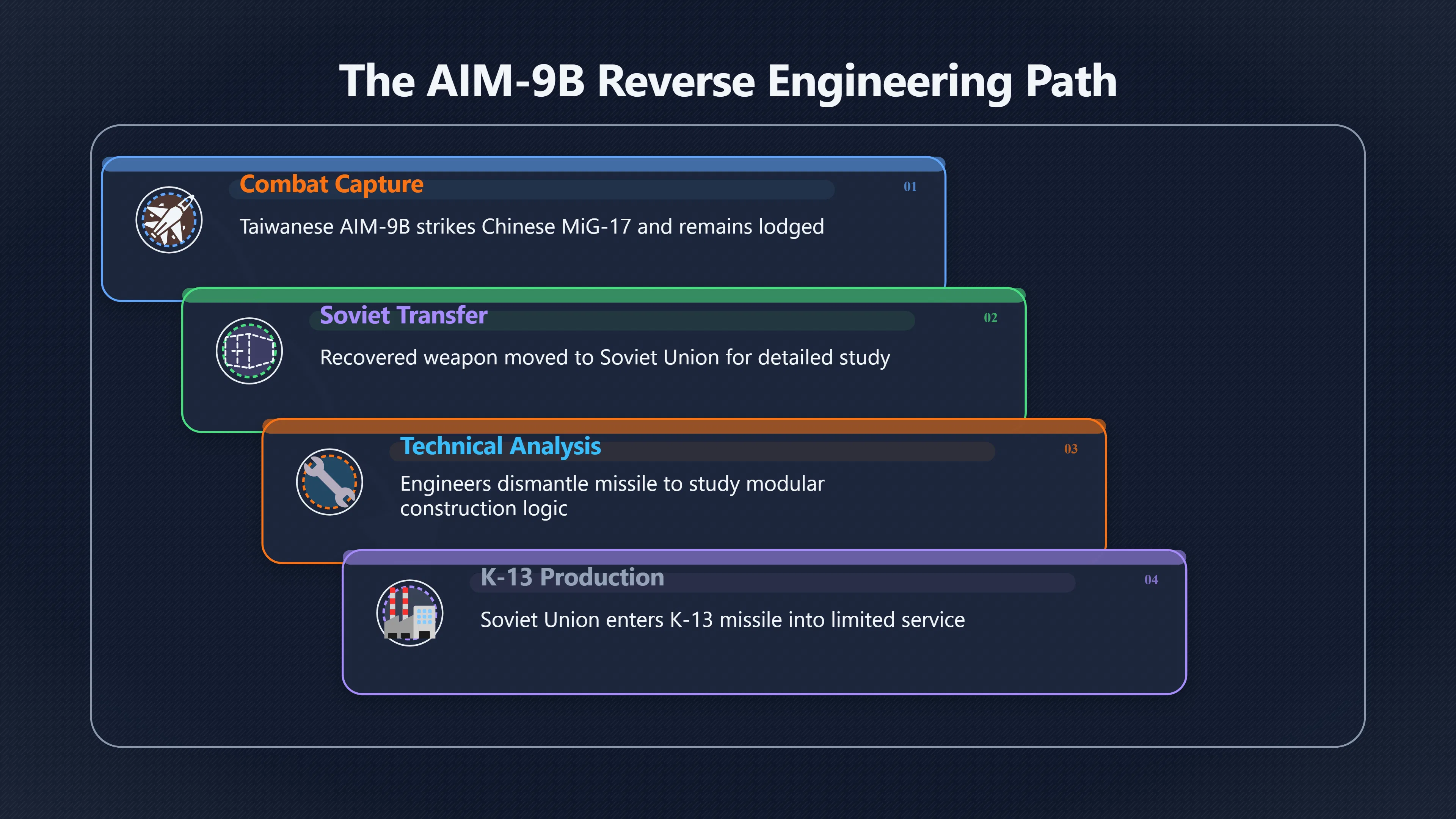
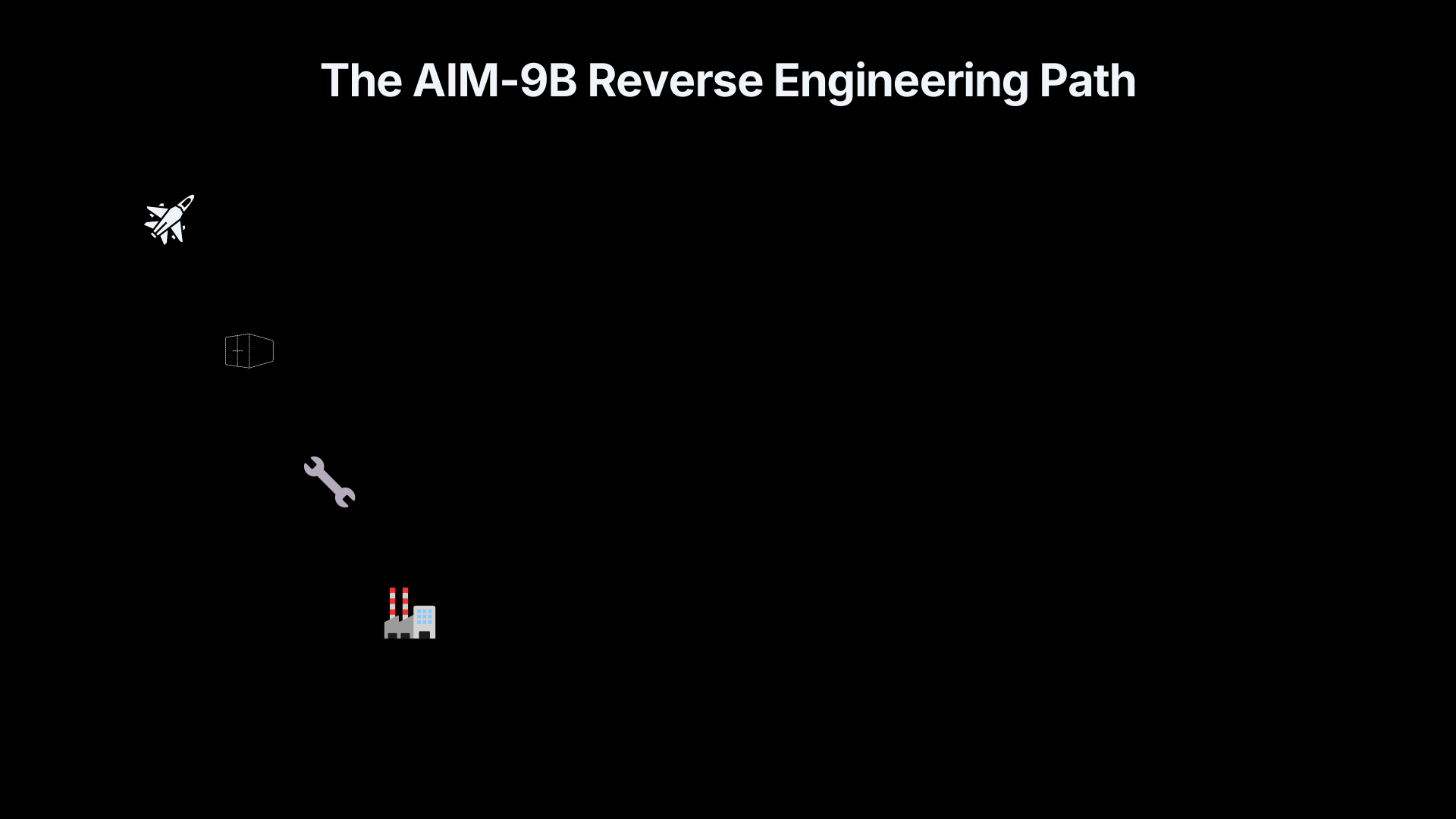
In September 1958, during air combat over the Taiwan Strait, a Taiwanese-fired AIM-9B struck a Chinese MiG-17 but failed to detonate. The aircraft returned to base with the missile lodged in its structure. The recovered weapon was eventually transferred to the Soviet Union, where it was dismantled and studied in detail.[wikipedia.org]WikipediaAIM-9 SidewinderAIM-9 Sidewinder
The importance of this event is often described as a straightforward case of copying. In reality, Soviet engineers encountered something more valuable than a set of dimensions. The Sidewinder embodied a remarkably clean engineering solution. Compared with many contemporary missile programmes, it achieved operational effectiveness with relatively few components, clear subsystem boundaries and a compact arrangement that simplified assembly and maintenance.[Wikipedia]WikipediaK-13 (missileK-13 (missile
Gennadiy Sokolovskiy, later a senior engineer at the Vympel design bureau, recalled that the Sidewinder functioned as a “university offering a course in missile construction technology”. The statement is revealing because it emphasises manufacturing knowledge rather than mere duplication of performance specifications.[Wikipedia]WikipediaK-13 (missileK-13 (missile
What the Captured Missile Revealed
The recovered AIM-9B demonstrated several characteristics that were especially significant from an industrial perspective.
First, the missile showed how guidance, control, propulsion and warhead functions could be organised into relatively self-contained modules. This reduced complexity during assembly and testing while making future modifications easier. The Sidewinder itself had originated from a modular development approach, allowing different seekers and motors to be integrated without redesigning the entire weapon.[Wikipedia]WikipediaAIM-9 SidewinderAIM-9 Sidewinder
Second, the missile demonstrated the value of simplicity. Many Cold War weapons achieved capability through elaborate engineering and large support infrastructures. The Sidewinder instead relied on elegant design choices that minimised part count and manufacturing burden. For engineers seeking to equip large air forces, this was a crucial insight. A weapon that could be built repeatedly and reliably often had greater strategic value than a theoretically superior but difficult-to-produce system.[Wikipedia]WikipediaK-13 (missileK-13 (missile
Third, the missile revealed the importance of standardisation. The arrangement of components, wiring and mechanical interfaces reflected a product designed not only for laboratory success but also for factory production. Reverse engineers could examine how tolerances, packaging and subsystem integration supported repeatable manufacture. This was precisely the kind of information that technical drawings alone might fail to convey.[Wikipedia]WikipediaK-13 (missileK-13 (missile

Why Modular Construction Mattered
For industrial planners, modularity reduces risk. Individual sections can be tested separately, production can be distributed among suppliers, and upgrades can be introduced without rebuilding an entire system.
The Sidewinder demonstrated these advantages in physical form. Its architecture allowed engineers to isolate functional sections and understand how each contributed to the overall weapon. This made the missile unusually transparent to reverse engineering compared with more integrated or bespoke designs.[Wikipedia]WikipediaAIM-9 SidewinderAIM-9 Sidewinder
The lesson extended beyond air-to-air missiles. A modular weapon is generally easier to manufacture at scale because factories can organise production around assemblies rather than complete systems. Quality control becomes more manageable, defective units can be identified earlier, and design improvements can be introduced incrementally. These principles were directly relevant to a Soviet defence industry attempting to equip large numbers of aircraft while maintaining production efficiency.[Wikipedia]WikipediaK-13 (missileK-13 (missile
The significance of the Sidewinder therefore lay in demonstrating that battlefield effectiveness and manufacturability were not competing goals. The missile achieved both simultaneously, providing a practical model of how sophisticated technology could be translated into mass production.[Wikipedia]WikipediaK-13 (missileK-13 (missile
From Copied Architecture to Adapted Variants
The immediate result of the reverse-engineering effort was the K-13, known in NATO terminology as the AA-2 Atoll. Soviet engineers reproduced the basic architecture closely enough that later examinations reported significant compatibility between some Sidewinder and Atoll components. The speed of the programme was striking: the K-13 entered limited service roughly two years after the missile’s recovery.[wikipedia.org]WikipediaK-13 (missileK-13 (missile
Yet the industrial lesson did not end with copying. Once the architecture had been absorbed, Soviet designers began adapting and extending it. Improved variants incorporated revised seekers, propulsion changes and new guidance approaches while retaining the underlying design logic. The copied missile became a foundation from which indigenous development could proceed.[Wikipedia]WikipediaK-13 (missileK-13 (missile
This progression illustrates a broader pattern in military reverse engineering. Successful programmes rarely stop at duplication. The initial copy serves as a bridge that transfers manufacturing knowledge, engineering practices and production methods into the receiving industrial base. The Sidewinder’s influence persisted because it taught Soviet engineers not only how one missile worked, but how an effective missile could be designed for economical and repeatable manufacture.[wikipedia.org]WikipediaK-13 (missileK-13 (missile
Why the Sidewinder Case Remains Important
Many captured weapons reveal individual technologies. The Sidewinder revealed an industrial philosophy. Its compact layout, modular structure and production-friendly engineering demonstrated that military advantage could emerge from manufacturability as much as from scientific breakthroughs.[Wikipedia]WikipediaK-13 (missileK-13 (missile
That is why the episode remains a landmark within the history of industrial learning from captured weapon design. The recovered AIM-9B did not merely help create the K-13. It showed how a sophisticated weapon could be organised so that factories, not just laboratories, could reproduce it reliably and in large numbers. In the context of Cold War reverse engineering, that factory lesson may have been the most valuable part of the missile.[wikipedia.org]WikipediaK-13 (missileK-13 (missile
Amazon book picks
Further Reading
Books and field guides related to The Missile That Became a Factory Lesson. Use these as the next step if you want deeper reading beyond the article.
The Pentagon's Brain
Explains how military technologies are developed, evaluated and exploited.
Skunk Works
Strong fit for missile design, manufacturability and engineering tradeoffs.
The Kill Chain
Provides context for missile systems and military technological competition.
eBay marketplace picks
Marketplace Samples
Live-tested eBay searches with available results related to this page.


Endnotes
1.
Source: Wikipedia
Title: K-13 (missile)
Link:https://en.wikipedia.org/wiki/K-13_%28missile%29
2.
Source: ndupress.ndu.edu
Title: China Strategi C Per SPe Ctive S 4
Link:https://ndupress.ndu.edu/Portals/68/[Documents
Source snippet
K–13. Soviet engineer Gennady...Read more...
3.
Source: Wikipedia
Title: AIM-9 Sidewinder
Link:https://en.wikipedia.org/wiki/AIM-9_Sidewinder
4.
Source: Wikipedia
Title: Soviet Union
Link:https://en.wikipedia.org/wiki/Soviet_Union
Source snippet
Soviet UnionThe Soviet Union was one of the world's two superpowers, with hegemony in Eastern Europe, global diplomacy, ideological in...
5.
Source: Wikipedia
Link:https://en.wikipedia.org/wiki/1958
Source snippet
19581958 (MCMLVIII) was a common year starting on Wednesday of the Gregorian calendar, the 1958th year of the Common Era (CE) and Anno...
6.
Source: Wikipedia
Title: Soviet (council)
Link:https://en.wikipedia.org/wiki/Soviet_%28council%29
Source snippet
Soviet (council)A workers' council that follows a socialist ideology, particularly in the context of the Russian Revolution...
7.
Source: airandspace.si.edu
Link:https://airandspace.si.edu/collection-objects/missile-air-air-atoll-also-designated-k-13-aa-2/nasm_A19930363000
Source snippet
si.eduMissile, Air-to-Air, AA-2 Atoll (Russian: Vympel K-13)Atoll is the NATO code name for the Soviet K-13, a copy of the U.S. Sidewinde...
8.
Source: merriam-webster.com
Link:https://www.merriam-webster.com/dictionary/soviet
Source snippet
an elected governmental council in a Communist country 2. Soviets plural a: bolsheviks b: the people and especially the political and m...
Additional References
9.
Source: reddit.com
Link:https://www.reddit.com/r/todayilearned/comments/1mmni2i/til_during_the_cold_war_an_early_version_of_the/
Source snippet
TIL During the Cold War, an early version of the American...an early version of the American AIM-9 Sidewinder missile lodged itself into...
10.
Source: reddit.com
Link:https://www.reddit.com/r/hoggit/comments/ai7n8o/til_that_the_soviet_aa2_atoll_missile_was_reverse/
Source snippet
TIL that the Soviet AA-2 Atoll missile was reverse...The Soviet AA-2 Atoll missile was reverse engineered from a US AIM-9 Sidewinder aft...
11.
Source: reddit.com
Title: Council is kind of… just a run of the mill word in English. I know Soviet
Link:https://www.reddit.com/r/russian/comments/1bwn1jy/is_soviet_a_unique_word_in_russian_that_refers/
Source snippet
Is “Soviet” a unique word in Russian that refers specifically...Kind of a confusing question maybe, sorry I don’t know how to ask it...
12.
Source: theaviationgeekclub.com
Link:https://theaviationgeekclub.com/how-an-aim-9-sidewinder-that-failed-to-detonate-and-got-embedded-in-a-mig-17-was-reverse-engineered-into-the-soviet-aa-2-atoll/
Source snippet
The Chinese promptly rushed it to the Soviets, who in turn reverse-engineered every single...Read more...
13.
Source: reddit.com
Link:https://www.reddit.com/r/todayilearned/comments/o4dv7o/til_the_soviet_k13_missile_is_almost_an_exact/
Source snippet
On 28 September, 1958, a Chinese MiG-17 was struck with a sidewinder that didn't...Read more...
14.
Source: popularmechanics.com
Title: China Copied Its Way to Building a World-Class Air
Link:https://www.popularmechanics.com/interactive/stories/a61935587/how-china-built-air-to-air-missle-story/
Source snippet
Sidewinder missile embedded in its fuselage. Though China couldn't reverse-engineer it, it gave the missile to the Soviets, who cloned it...
15.
Source: strasam.org
Link:https://strasam.org/en/defense/aerospace-industry/how-the-soviets-were-able-to-copy-the-american-aim-9-sidewinder-airborne-missile-through-reverse-engineering-and-espionage-during-the-cold-war-3362
Source snippet
an-made AIM-9 Sidewinder Airborne Air Missiles through reverse engineering...
16.
Source: facebook.com
Link:https://www.facebook.com/NextGenPHDef/posts/the-soviet-engineers-called-it-a-university-course-in-missile-design-and-they-we/1454199076502338/
Source snippet
and guidance system to the Zuni rocket in the late 1940s.Read more...
17.
Source: theaviationgeekclub.com
Link:https://theaviationgeekclub.com/the-story-of-the-aim-9-sidewinder-that-failed-to-detonate-got-embedded-in-a-mig-17-and-was-reverse-engineered-into-the-soviet-aa-2-atoll/
Source snippet
a MiG-17 and was Reverse-Engineered into the Soviet AA-2 Atoll...
18.
Source: secretprojects.co.uk
Title: the aim 9 sidewinder family.33436
Link:https://www.secretprojects.co.uk/threads/the-aim-9-sidewinder-family.33436/
Source snippet
The AIM-9 Sidewinder family3 Apr 2020 — The program will begin to produce a third variant of the missile labeled the AIM-9X Block II PLUS...
Topic Tree