Within Tu 4 Copy
Was the Tu 4 really an exact copy?
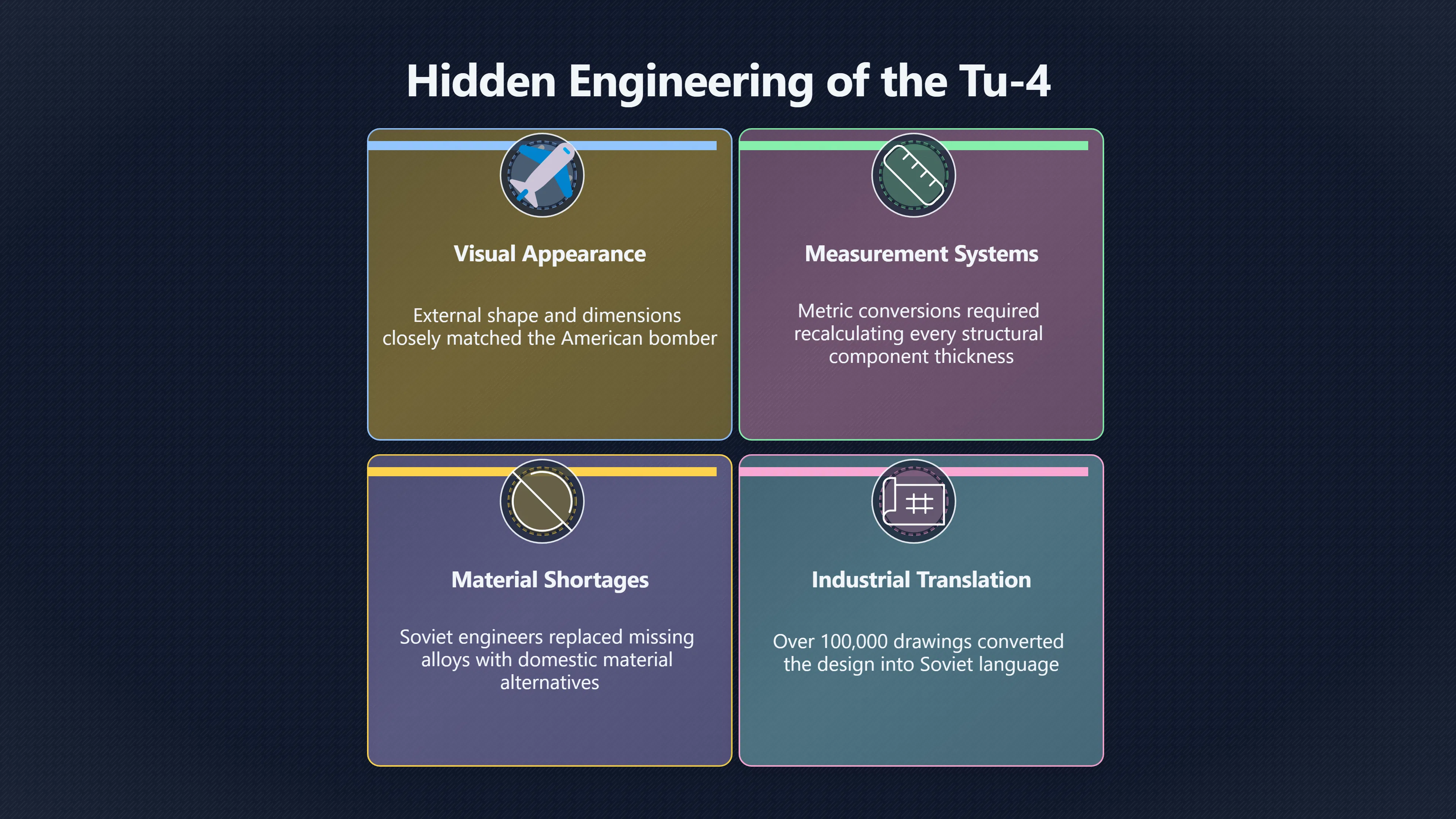
The Tu-4 looked like a B-29, but Soviet engineers had to translate the bomber into a different industrial system.
On this page
- What an exact copy would have required
- Where Soviet substitutions changed the aircraft
- Why visual similarity hid engineering differences
Page outline Jump by section
Introduction
The Tupolev Tu-4 is often described as a direct copy of the Boeing B-29 Superfortress. Visually, that description seems justified: the Soviet bomber closely matched the American aircraft in shape, dimensions and overall layout. Yet the label “copy” can be misleading. Reproducing a complex aircraft is not the same as reproducing the industrial, technical and organisational system that created it. The Soviet Union possessed several captured B-29s, but it did not possess Boeing’s factories, American supply chains, manufacturing standards, materials catalogue or specialised components. As a result, building the Tu-4 required extensive redesign beneath the surface, even while preserving the appearance of an exact clone.[Wikipedia]WikipediaTupolev Tu-4Tupolev Tu-4
The Tu-4 therefore illustrates a central problem in reverse engineering foreign military technology: the closer a nation tries to copy an advanced system, the more it discovers hidden dependencies that must either be recreated or replaced. The aircraft looked like a B-29 because Soviet leaders demanded it. The engineering reality was far more complicated.
What an exact copy would have required
An exact copy of the B-29 would have meant duplicating not only the aircraft’s dimensions but also thousands of individual production decisions. Every sheet-metal thickness, alloy composition, electrical component, hydraulic fitting, radio system and manufacturing tolerance would have had to be reproduced exactly as Boeing had made it.[Wikipedia]WikipediaTupolev Tu-4Tupolev Tu-4
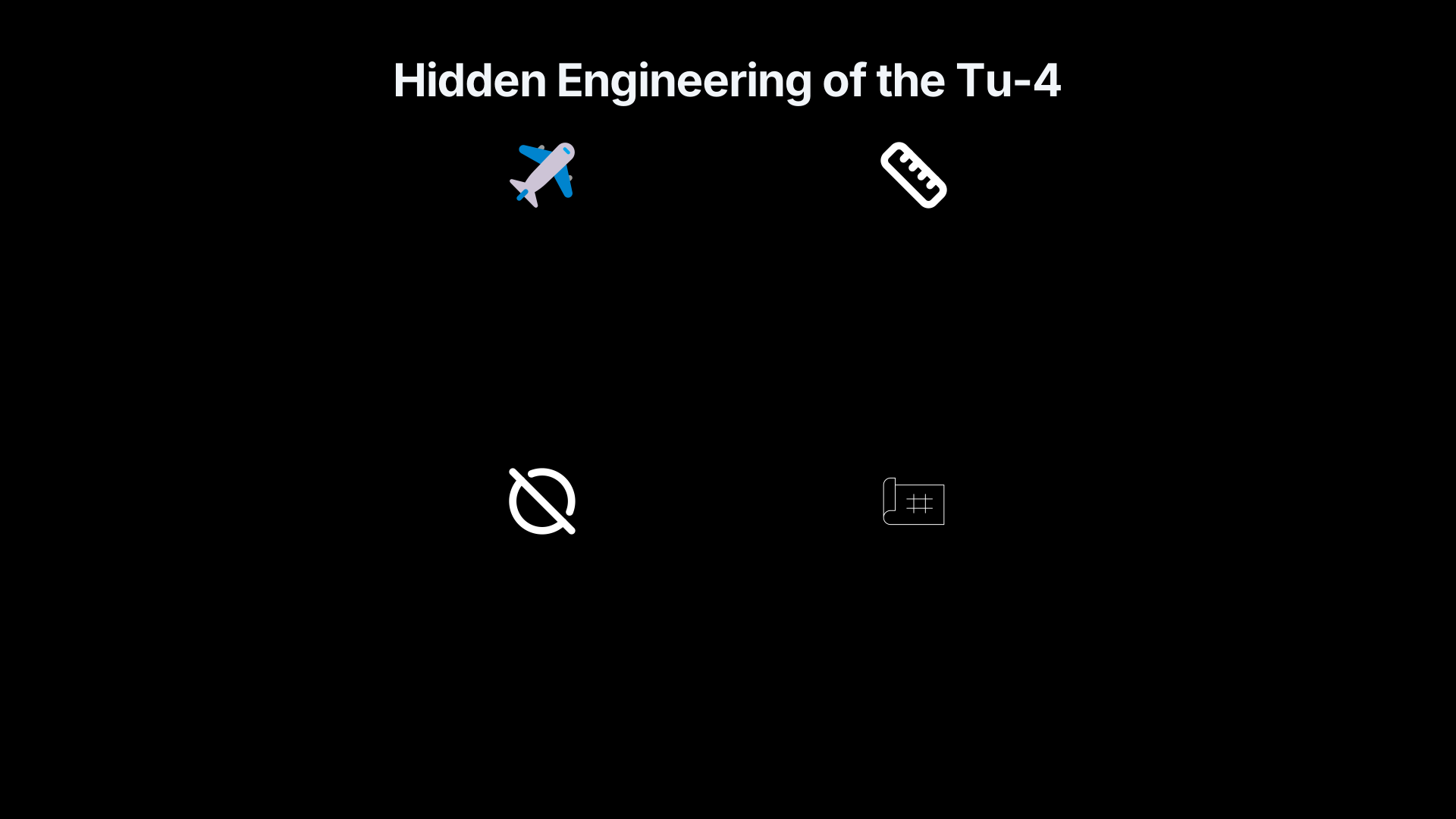
That proved impossible for practical reasons. The United States and the Soviet Union used different measurement systems. Boeing designed the B-29 using imperial dimensions, while Soviet industry operated entirely in metric units. Many aluminium sheet thicknesses used in the B-29 simply did not exist in Soviet production. Engineers therefore had to select the nearest metric equivalents and recalculate the consequences throughout the structure. What appears to be a simple conversion problem became an aircraft-wide engineering challenge because changing one material thickness affects weight, strength and manufacturing methods.[wikipedia.org]WikipediaTupolev Tu-4Tupolev Tu-4
Even where Soviet engineers wanted complete duplication, they often lacked identical materials. Certain alloys and manufacturing techniques used in the American aircraft had no direct Soviet equivalent and had to be developed domestically or replaced with alternatives. This forced redesign decisions that were invisible from the outside but significant inside the aircraft.[Wikipedia]WikipediaTupolev Tu-4Tupolev Tu-4
The scale of the task demonstrates how reverse engineering extends beyond measurement. Soviet sources describe hundreds of factories and research institutes becoming involved in creating the drawings, tooling and industrial processes required to reproduce the bomber. The project generated more than 100,000 technical drawings, effectively translating the B-29 into a Soviet industrial language.[Wikipedia]WikipediaTupolev Tu-4Tupolev Tu-4
Where Soviet substitutions changed the aircraft
The most important redesigns occurred where exact duplication was either impossible or undesirable.
Engines. The B-29 used the Wright R-3350 Duplex-Cyclone engine. Soviet industry did not simply reproduce this powerplant. Instead, the Tu-4 employed the Shvetsov ASh-73, an engine developed within the Soviet engine lineage. Although comparable in role and performance, it was not an identical copy of the American design. Integrating a different engine required associated changes in installation, support systems and maintenance arrangements.[Wikipedia]WikipediaTupolev Tu-4Tupolev Tu-4
Defensive armament. The B-29’s remotely controlled turrets carried.50-calibre machine guns. Soviet doctrine favoured heavier cannon armament. The Tu-4 therefore adopted Nudelman NS-23 cannon in redesigned turret installations. This substitution altered weight distribution, ammunition handling and fire-control integration while preserving the bomber’s overall defensive concept.[Wikipedia]WikipediaTupolev Tu-4Tupolev Tu-4
Electronics and identification systems. American radios, navigation equipment and identification-friend-or-foe systems could not simply be copied unchanged. Some were unsuitable for Soviet operational requirements; others relied on technologies or standards that were unavailable domestically. Soviet equivalents had to be installed, requiring additional engineering adaptation.[Wikipedia]WikipediaTupolev Tu-4Tupolev Tu-4
Bomb bay compatibility. Even when the physical bomb bays resembled those of the B-29, Soviet weapons were designed according to different standards of size and weight. Integrating Soviet ordnance was not a straightforward matter of hanging bombs on existing racks. Internal arrangements had to accommodate a different weapons inventory, demonstrating how military systems are embedded within broader national equipment ecosystems.[wwiiafterwwii]wwiiafterwwii.wordpress.comB-29 to “Bull” - wwiiafterwwii - WordPress.comJun 29, 2019 — In theory, a Tu-4 with an exact copy of the B-29's bomb bays ha…
These substitutions reveal a broader truth: reverse engineering often succeeds not by copying every component but by preserving the desired capability while replacing incompatible elements with domestic alternatives.

Why visual similarity hid engineering differences
One reason the Tu-4 became famous is that it looked astonishingly similar to the B-29. Western observers at the 1947 Tushino air display initially believed they were seeing the original American aircraft. Only when additional bombers appeared did it become clear that the Soviet Union had placed a domestically produced version into flight.[Wikipedia]WikipediaTupolev Tu-4Tupolev Tu-4
That visual resemblance has encouraged a common misconception: if two aircraft look the same, they must have been built the same way. The Tu-4 demonstrates why this assumption is risky.
Aircraft design contains layers of hidden engineering. A bomber’s aerodynamic shape may be visible, but structural margins, manufacturing techniques, metallurgy, electrical architecture and maintenance philosophy are not. Soviet engineers could preserve the external geometry while making numerous internal adjustments required by domestic production realities. In some cases, those changes slightly increased weight or altered performance characteristics. The aircraft remained recognisably a B-29 derivative, but it was no longer identical in engineering terms.[wikipedia.org]WikipediaTupolev Tu-4Tupolev Tu-4
The persistence of stories about copied paint colours, repair patches and other cosmetic details can obscure the more important lesson. While some visible features were reportedly duplicated with remarkable fidelity, the crucial challenge was not copying appearance. It was making an aircraft designed for one industrial system function within another.[Smithsonian Magazine]smithsonianmag.comSmithsonian MagazineMade in the U.S.S.R.Many myths have arisen in the West about how the Soviets built the Tu-4. Over the decades stories…
The real lesson of the Tu-4
The Tu-4 was neither a wholly original bomber nor a perfect duplicate of the B-29. It occupied a middle ground that is common in major reverse-engineering projects. Soviet engineers began with a foreign design and attempted to preserve as much as possible, but every incompatibility between American and Soviet industry forced a redesign decision. Measurement standards, materials, engines, weapons and electronics all required adaptation.[wikipedia.org]WikipediaTupolev Tu-4Tupolev Tu-4
That is why the Tu-4 remains an important case study in reverse engineering foreign military technology. The bomber’s near-identical appearance suggested successful copying, yet the programme’s real achievement was translating a sophisticated American weapon into a form that Soviet factories could actually build. The closer one looks at the process, the less the story resembles simple duplication and the more it resembles large-scale engineering reinterpretation.[Wikipedia]WikipediaTupolev Tu-4Tupolev Tu-4

Amazon book picks
Further Reading
Books and field guides related to Was the Tu-4 really an exact copy?. Use these as the next step if you want deeper reading beyond the article.
The Pentagon's Brain
Highlights the organizational knowledge behind military technology.

Stalin's aviation gulag
Explains the realities of Soviet aircraft development and adaptation.
eBay marketplace picks
Marketplace Samples
Live-tested eBay searches with available results related to this page.


Endnotes
1.
Source: Wikipedia
Title: Tupolev Tu-4
Link:https://en.wikipedia.org/wiki/Tupolev_Tu-4
2.
Source: commons.wikimedia.org
Link:https://commons.wikimedia.org/wiki/File%3ATupolev_Tu-4_%289576250407%29.jpg
Source snippet
Wikimedia CommonsFile:Tupolev Tu-4 (9576250407).jpg - Wikimedia Commons22 Jul 2010 — The Soviet Union used the metric system, thus sheet...
3.
Source: autoevolution.com
Title: tupolev tu 4 the soviet b 29 copycat that made nato s blood boil 181689
Link:https://www.autoevolution.com/news/tupolev-tu-4-the-soviet-b-29-copycat-that-made-nato-s-blood-boil-181689.html
Source snippet
Tupolev TU-4: The Soviet B-29 Copycat That Made NATO's...15 Feb 2022 — Stalin ordered the Tupolev Design Bureau to reverse engineer the...
4.
Source: Wikipedia
Title: Soviet Union
Link:https://en.wikipedia.org/wiki/Soviet_Union
Source snippet
Soviet UnionThe Soviet Union was one of the world's two superpowers, with hegemony in Eastern Europe, global diplomacy, ideological in...
5.
Source: smithsonianmag.com
Link:https://www.smithsonianmag.com/air-space-magazine/made-in-the-ussr-38442437/
Source snippet
Smithsonian MagazineMade in the U.S.S.R.Many myths have arisen in the West about how the Soviets built the Tu-4. Over the decades stories...
6.
Source: wwiiafterwwii.wordpress.com
Link:https://wwiiafterwwii.wordpress.com/2019/06/29/b-29-to-bull/
Source snippet
B-29 to “Bull” - wwiiafterwwii - WordPress.comJun 29, 2019 — In theory, a Tu-4 with an exact copy of the B-29's bomb bays ha...
7.
Source: planehistoria.com
Title: Tupolev Tu-4
Link:https://planehistoria.com/tupolev-tu-4/
Source snippet
The Copy/Paste Bomber19 Jun 2023 — Led by Andrei Tupolev, one of the Soviet Union's foremost aircraft designers, a team was assembled to...
Additional References
8.
Source: airandspaceforces.com
Link:https://www.airandspaceforces.com/article/0609bomber/
Source snippet
Air & Space Forces MagazineCarbon Copy BomberThe Soviet Union had done the impossible: It had reverse engineered and produced flyable B-2...
9.
Source: coldwar.org
Link:https://coldwar.org/RB-29/HTML/03RelatedStories/03.03shortstories/03.03.10contss.htm
Source snippet
Russian B-29 Clone — The TU-4 StoryThe Soviet version would be called the TU-4, NATO code name “BULL”. After the Hap Arnold Special was c...
10.
Source: tudublin.ie
Link:https://www.tudublin.ie/
Source snippet
TU Dublin: Technological University DublinTU Dublin is Ireland's first Technological University, offering diverse courses, research and v...
11.
Source: towson.edu
Link:https://www.towson.edu/
Source snippet
Towson University | Maryland's University of OpportunitiesTU is a powerful anchor institution in the greater Baltimore region leading ent...
12.
Source: tuclothing.sainsburys.co.uk
Link:https://tuclothing.sainsburys.co.uk/
Source snippet
clothing: Womens, Mens, Kids & Baby FashionSainsbury's Tu clothing can be found in selected Sainsbury's stores across the UK. Buy Tu clot...
13.
Source: tu.org
Link:https://www.tu.org/
14.
Source: nationalinterest.org
Title: soviet tu 4 bomber looked like b 29 stratofortress bw
Link:https://nationalinterest.org/blog/buzz/soviet-tu-4-bomber-looked-like-b-29-stratofortress-bw
Source snippet
The Soviet Tu-4 Bomber Looked an Awful Lot Like the B-29...7 Jul 2025 — Stalin ordered the legendary Tupolev Design Bureau, led by icono...
15.
Source: youtube.com
Link:https://www.youtube.com/watch?v=teE2SG2Di8g
Source snippet
Introduction; 01:00 The B-29 Superfortress and its Impact; 02:58 The Emergency Landings; 05:07 Soviet Interest and Reverse Engineering...
16.
Source: facebook.com
Link:https://www.facebook.com/planehistoria/posts/tupolev-tu-4-when-the-soviets-reverse-engineered-the-boeing-b-29-superfortress-1/1048012081072967/
Source snippet
e from combat damage built onto the planes and the control...Read more...
17.
Source: facebook.com
Title: Did you know the Tu-4 was a copy of the B-29?
Link:https://www.facebook.com/BoneyardSafari/posts/did-you-know-the-tu-4-was-a-copy-of-the-b-29-b29-tu4-pimaairandspacemuseum-boney/1354024540089988/
Source snippet
#b29 #tu4...Four were lost to Russia - one crash landed - one was taken apart piece by piece for reverse engineering purposes. By 1947...
Topic Tree