Within Docs vs Hardware
How Captured Manuals Speed Up Exploitation
Technical documents can quickly turn an unfamiliar weapon into a mapped system of parts, tests, faults and expected performance.
On this page
- What firing tables and manuals reveal first
- How documents guide hardware testing
- Where paper intelligence can mislead
Page outline Jump by section
Introduction
In the exploitation of captured foreign military technology, technical documents often provide a faster route to understanding than the hardware itself. A seized artillery piece, missile launcher or mortar may require extensive inspection, measurement and testing before analysts can estimate its capabilities. A captured firing table, operator handbook or maintenance manual can immediately reveal how the original user expected the system to perform, what variables affected accuracy, which components required adjustment, and what faults crews were trained to recognise. Military technical intelligence doctrine has long treated captured documentation as a core exploitation target alongside physical materiel because documents can rapidly transform an unfamiliar weapon from an unknown object into a structured engineering problem.[Public Intelligence |]info.publicintelligence.netUSArmy Document Media ExploitationDOMEX process requires understanding collected, exploited, and processed items. CAPTURED ENEMY…Read more…
Within the broader question of captured documents versus captured hardware, firing tables and manuals are especially valuable because they sit close to operational reality. Unlike promotional claims or high-level specifications, they are working documents created to help crews employ weapons effectively. That practical focus makes them powerful exploitation shortcuts—but also sources that require careful verification.
What Firing Tables and Manuals Reveal First
A firing table is a technical reference that links range, ammunition type, environmental conditions and weapon settings to expected projectile behaviour. Field artillery organisations use such tables to convert a desired target effect into firing data. Modern manuals describe similar relationships through digital fire-control systems, but the underlying information remains the same.[walter.bislins.ch]walter.bislins.ch2020 10 23 Field Artillery Manual Cannon Gunnery tc3 09x81Platoon and Battalion FDC………………………. 2-2. Battalion… Chapter 7 described the use of tabular firing tables (TFT) and…
When captured, these documents can reveal several critical features before any detailed hardware examination begins:
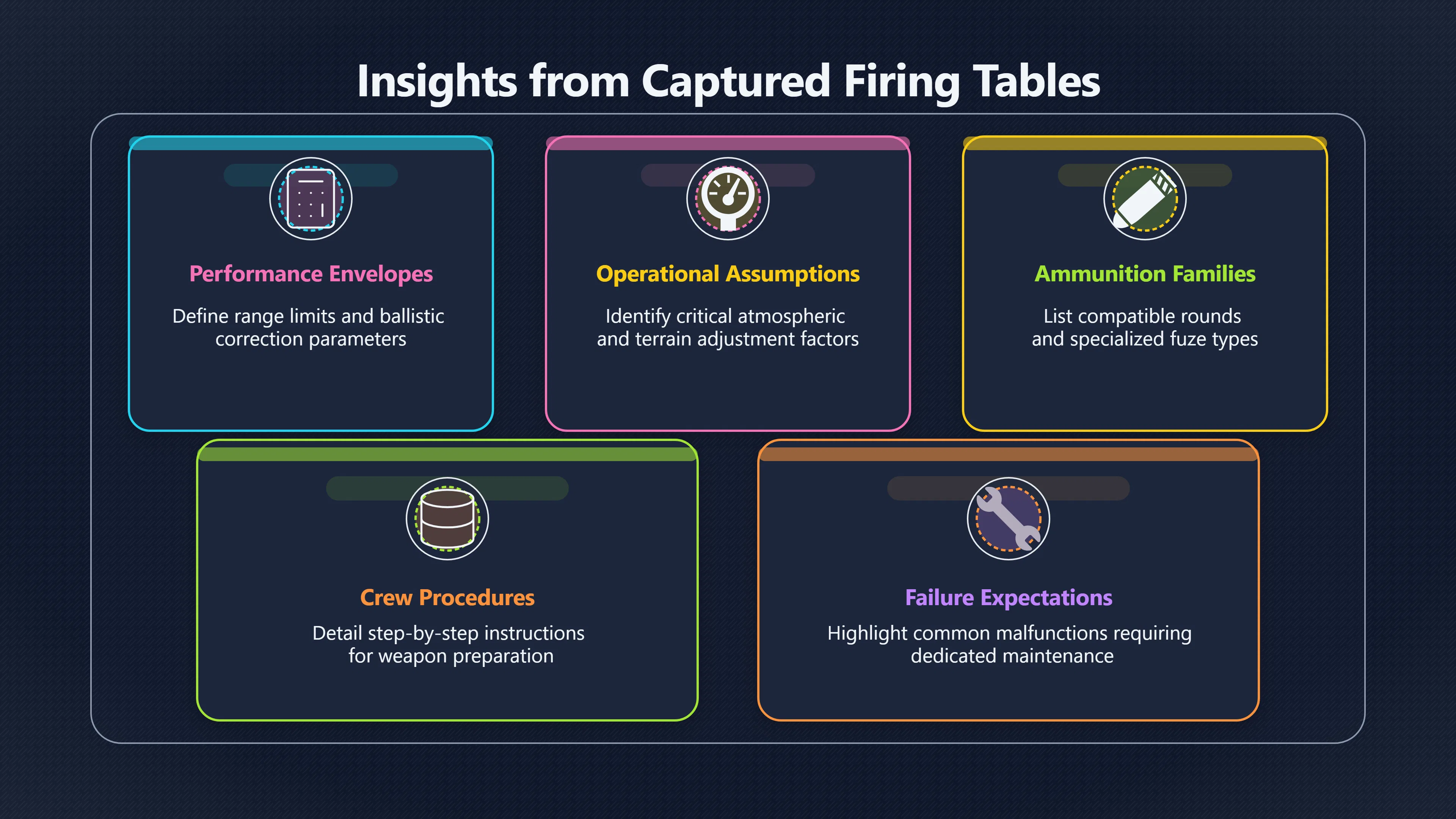
- Expected performance envelopes. Range limits, elevation settings, ballistic corrections and ammunition compatibility can indicate how designers expected the weapon to operate.
- Operational assumptions. Tables often show which atmospheric variables, terrain factors or calibration procedures mattered enough to require routine adjustment.
- Ammunition families and variants. Manuals frequently identify compatible rounds, fuze types and specialised munitions that may not be present with the captured weapon.
- Crew procedures. Step-by-step instructions expose how operators were trained to prepare, fire, maintain and troubleshoot equipment.
- Failure expectations. Maintenance sections reveal which malfunctions were common enough to deserve dedicated procedures.
For intelligence analysts, this information creates an immediate framework for understanding a weapon system. Rather than beginning with a completely unknown device, investigators gain access to the original user’s conceptual map of the system.
How Documents Guide Hardware Testing
Captured manuals do not eliminate the need for physical examination, but they can dramatically reduce the time required to organise testing programmes. Technical intelligence doctrine has consistently treated documentation and materiel as complementary exploitation targets because documents help determine what should be examined first.[bits.de]bits.deFM30 16(1961FM 30-16November 11, 2014 — Commanders at all echelons are responsible for exploitation of captured enemy materiel, - facilities, and…
Turning Unknown Equipment into Known Subsystems
A technical manual commonly identifies assemblies, part relationships and maintenance levels. Analysts can use these descriptions to prioritise inspection of critical components instead of reverse engineering every element from scratch.
For example, a maintenance chapter may identify a particular optical sight, servo mechanism or power subsystem as a frequent source of failure. An exploitation team can then concentrate diagnostic effort on those areas rather than distributing resources evenly across the entire system.
Designing More Efficient Test Programmes
Firing tables provide predicted outputs. Hardware testing can therefore focus on comparing actual behaviour against documented expectations.
Analysts may ask:
- Does the weapon achieve the stated range?
- Are correction factors accurate?
- Do environmental adjustments work as described?
- Are ammunition compatibility claims supported by physical evidence?
Because the manual already states expected performance, testing becomes a process of validation and discrepancy analysis rather than open-ended exploration.
Supporting Translation and Classification
NATO and US technical intelligence doctrine emphasise the role of translators and subject-matter experts in captured materiel exploitation centres. Technical documents provide terminology, component names and procedural language that help analysts classify equipment correctly and compare it with known foreign systems.[NATO JALLC]nllp.jallc.nato.intNATO JALLCAJP-2.5(A) CAPTURED PERSONS, MATERIEL AND…February 20, 2015 — Operations to technically exploit CMAT and ATDs may be conduct…
A weapon that initially appears unique may prove to be a modified version of an already catalogued system once terminology and maintenance instructions are translated.
Historical Evidence of the Shortcut Effect
The value of captured technical documents has been recognised for decades. During and after the Second World War, Allied technical intelligence organisations sought not only enemy weapons but also the manuals, research reports and firing data that explained them. Programmes such as Operation LUSTY explicitly combined aircraft recovery with the collection of scientific and technical documentation because documents accelerated understanding of captured technology.[Wikipedia]WikipediaOperation LUSTYOperation LUSTY
The historical record also shows that technical intelligence organisations produced translated foreign firing tables for their own analysts and troops. The former US Army Ordnance Technical Intelligence Agency compiled and distributed translated firing tables for foreign artillery and armoured weapons, demonstrating that captured ballistic data was considered operationally valuable intelligence in its own right.[Wikipedia]WikipediaUnited States Army Ordnance Technical Intelligence AgencyUnited States Army Ordnance Technical Intelligence Agency
Military technical intelligence guidance likewise stresses preserving documents associated with captured equipment and ammunition because exploitation depends on understanding both the physical object and the information accompanying it. Captured enemy ammunition programmes, for example, treat technical exploitation as a means of identifying capabilities, limitations and countermeasures more rapidly than hardware examination alone would allow.[Global Security]globalsecurity.orgExploitation of CEA and TECHINT…Read more…
Where Paper Intelligence Can Mislead
The speed advantage of manuals and firing tables creates a corresponding risk: analysts may assume the documents accurately describe the captured weapon.
In practice, several factors can undermine that assumption.
Manuals Describe Intent, Not Necessarily Reality
Technical publications often reflect official standards rather than field conditions. A weapon recovered from combat may contain production substitutions, battlefield repairs, worn components or local modifications that never appeared in the original documentation.
A firing table might represent factory-standard ammunition, while the captured stockpile consists of degraded rounds produced under wartime shortages. Hardware testing is necessary to determine whether documented performance remains achievable.
Documents May Belong to Another Variant
Many weapon families evolve through multiple production blocks and upgrade packages. A captured manual may correspond to an earlier or later version than the equipment actually recovered.
Without careful comparison, analysts can misidentify capabilities, ranges or maintenance procedures.
Training Material Can Reflect Doctrine Rather Than Capability
Operator manuals frequently describe ideal employment methods. They show how crews are expected to use a weapon, not necessarily how effectively they can do so under combat conditions.
A system may possess impressive documented accuracy but depend on survey procedures, meteorological inputs or maintenance standards that are rarely achieved in practice.
Deliberate Deception Is Possible
Although less common than simple obsolescence or mismatch, captured documentation can contain misleading information. Intelligence organisations therefore treat documents as evidence to be corroborated rather than accepted uncritically. Modern document exploitation and technical intelligence procedures emphasise cross-checking documentary information against physical examination, operational reporting and other intelligence sources.[publicintelligence.net]info.publicintelligence.netUSArmy Document Media ExploitationDOMEX process requires understanding collected, exploited, and processed items. CAPTURED ENEMY…Read more…
Why Exploitation Teams Still Prioritise Manuals
Despite their limitations, captured firing tables and technical manuals remain among the highest-value documentary finds associated with foreign weapons systems. They compress months of investigative effort into a form already organised by the original designers, maintainers and operators.
A recovered weapon can reveal what exists. A recovered manual can reveal how the system was expected to function, how it was maintained, which performance standards mattered and what limitations its own users anticipated. For exploitation teams working under time pressure, that knowledge often provides the fastest route from possession of a foreign weapon to a meaningful understanding of its capabilities and vulnerabilities.[bits.de]bits.defm2 22.401(06TECHINT9 Jun 2006 — TECHINT includes the identification, assessment, collection, exploitation, and evacuation of captured enemy mater…
Amazon book picks
Further Reading
Books and field guides related to How Captured Manuals Speed Up Exploitation. Use these as the next step if you want deeper reading beyond the article.
Intelligence Analysis
Shows how documentary evidence is turned into structured analysis.
Structured Analytic Techniques for Intelligence Analysis
Useful for validating information found in captured manuals and records.
The Pentagon's Brain
Covers technical intelligence and exploitation of foreign technology.
eBay marketplace picks
Marketplace Samples
Live-tested eBay searches with available results related to this page.


Endnotes
1.
Source: walter.bislins.ch
Title: 2020 10 23 Field Artillery Manual Cannon Gunnery tc3 09x81
Link:https://walter.bislins.ch/blog/media/2020-10-23%20Field%20Artillery%20Manual%20Cannon%20Gunnery%20tc3_09x81.pdf
Source snippet
Platoon and Battalion FDC............................ 2-2. Battalion... Chapter 7 described the use of tabular firing tables (TFT) and...
2.
Source: bits.de
Title: FM30 16(1961)
Link:https://www.bits.de/NRANEU/others/amd-us-archive/FM30-16%281961%29.pdf
Source snippet
FM 30-16November 11, 2014 — Commanders at all echelons are responsible for exploitation of captured enemy materiel, - facilities, and...
Published: November 11, 2014
3.
Source: bits.de
Title: fm2 22.401(06)
Link:https://www.bits.de/NRANEU/others/amd-us-archive/fm2-22.401%2806%29.pdf
Source snippet
TECHINT9 Jun 2006 — TECHINT includes the identification, assessment, collection, exploitation, and evacuation of captured enemy mater...
4.
Source: nllp.jallc.nato.int
Link:https://nllp.jallc.nato.int/cmnt/ciedcoi/CIED%20PUBLICATIONS/Handbooks%20and%20Doctrines/AJP%202.5%28A%29%20Captured%20Persons%2C%20Material%20and%20Documents%20dated%20aug07.pdf
Source snippet
NATO JALLCAJP-2.5(A) CAPTURED PERSONS, MATERIEL AND...February 20, 2015 — Operations to technically exploit CMAT and ATDs may be conduct...
Published: February 20, 2015
5.
Source: Wikipedia
Title: Operation LUSTY
Link:https://en.wikipedia.org/wiki/Operation_LUSTY
6.
Source: Wikipedia
Title: United States Army Ordnance Technical Intelligence Agency
Link:https://en.wikipedia.org/wiki/United_States_Army_Ordnance_Technical_Intelligence_Agency
7.
Source: cyberwar.nl
Title: IT 0606 US Army Interrogation Operations
Link:https://cyberwar.nl/d/fromCryptome/IT%200606%20US%20Army%20Interrogation%20Operations.pdf
Source snippet
pdfCED exploitation provides important data about the enemy and contributes to our tactical situation knowledge. The interrogator can use...
8.
Source: bits.de
Link:https://www.bits.de/NRANEU/others/amd-us-archive/FM30-5C1%2861%29.pdf
Source snippet
and intelligence exploitation of friendly evaders and...Read more...
9.
Source: history.army.mil
Link:https://history.army.mil/portals/143/Images/Publications/catalog/10-9.pdf
Source snippet
Ordnance Department: Planning Munitions for War16 Aug 2025 — Our efforts to develop munitions to the point where our armies could cope on...
10.
Source: home.army.mil
Title: ATP 2 01.3 Intelligence Preparation of the Battlefield
Link:https://home.army.mil/wood/application/files/8915/5751/8365/ATP_2-01.3_Intelligence_Preparation_of_the_Battlefield.pdf
Source snippet
captured enemy medical materiel and for the analysis of any medications... The objective of exploitation is to complete the enemy's.Read...
11.
Source: info.publicintelligence.net
Title: USArmy Document Media Exploitation
Link:https://info.publicintelligence.net/USArmy-DocumentMediaExploitation.pdf
Source snippet
DOMEX process requires understanding collected, exploited, and processed items. CAPTURED ENEMY...Read more...
12.
Source: fas.org
Title: dod manual on technical intell
Link:https://fas.org/publication/dod_manual_on_technical_intell/
Source snippet
igence28 Jul 2006 — Technical intelligence here refers to the collection, analysis and exploitation of captured enemy materiel and docume...
13.
Source: globalsecurity.org
Link:https://www.globalsecurity.org/military/library/policy/army/fm/4-30-13/ch12.htm
Source snippet
Exploitation of CEA and TECHINT...Read more...
14.
Source: pdf.textfiles.com
Link:https://pdf.textfiles.com/manuals/MILITARY/united_states_army_fm_4-30x13%20-%201_march_2001%20-%20part04.pdf
Source snippet
Textfiles PDFCaptured Enemy AmmunitionEvaluation of CEA provides valuable data to the commander that helps in countering the enemy's tech...
Additional References
15.
Source: marines.mil
Link:https://www.marines.mil/Portals/1/Publications/MCWP%203-16.1%20Artillery%20Operations.pdf
Source snippet
Corps' warfighting philosophy as established in Marine Corps Doctrinal Publication. (MCDP) 1, Warfighting, and...Read more...
16.
Source: revista-artilharia.pt
Link:https://www.revista-artilharia.pt/admin/upload/ficheiros/ficheirosMultimedia/fm-3-09-fire-support-and-field-artillery-operations.pdf
Source snippet
30 Apr 2020 — A surveyed firing chart is a chart on which the location of all required points (battery or platoon positions, known points...
17.
Source: nsarchive2.gwu.edu
Title: Tactical Site Exploitation
Link:https://nsarchive2.gwu.edu/NSAEBB/NSAEBB410/docs/Tactical%20Site%20Exploitation.pdf
Source snippet
Site Exploitation.pdfTactical site exploitation (TSE) is the action taken to ensure that documents, material, and personnel are identifie...
18.
Source: digitalcommons.unl.edu
Link:https://digitalcommons.unl.edu/context/dodmilintel/article/1069/viewcontent/_FM_30_16_53.pdf
Source snippet
30-16, Technical Intelligence, 29 June 1953The exploitation of captured enemy materiel done by the communications zone is normally beyond...
19.
Source: youtube.com
Link:https://www.youtube.com/watch?v=QDNxrmLCyns
Source snippet
Why German Mechanics Couldn't Copy US Field Repair Methods...
20.
Source: youtube.com
Title: Why German Mechanics Couldn’t Copy US Field Repair Methods
Link:https://www.youtube.com/watch?v=xdz9Z8WP6U4
Source snippet
How American Artillery's 'Invisible' Innovation Made Germans Fear Every Grid Square...
21.
Source: youtube.com
Title: National Ground Intelligence Center | Wikipedia audio article
Link:https://www.youtube.com/watch?v=7AaVn7szkMw
Source snippet
Aviation Historian Peter Merlin talks about the Russian MiGs at AREA 51...
22.
Source: epa.gov
Link:https://www.epa.gov/sites/default/files/2015-05/documents/9530611.pdf
Source snippet
AMMUNITION HANDBOOK: TACTICS, TECHNIQUES...1 Mar 2001 — Captured materiel exploitation center. The CMEC is formed from the assets of or...
23.
Source: 2009-2017.state.gov
Link:https://2009-2017.state.gov/documents/organization/150085.pdf
Source snippet
2-22.3 (FM 34-52) - Human Intelligence Collector Operations6 Sept 2006 — Interrogation, the HUMINT subdiscipline responsible for MI explo...
24.
Source: digitalcommons.unl.edu
Link:https://digitalcommons.unl.edu/cgi/viewcontent.cgi?article=1059&context=dodmilintel&httpsredir=1&referer=
Source snippet
of Ordnance Technical Intelligence in World War II, Part 1captured enemy Ilw.tel'iel for [training]({{ 'training/' | relative_url }}) and display I)\lI'I.)Oses will be direc...
Topic Tree