Within Foreign Materiel
What Factories Learn From Enemy Weapons
Foreign equipment can reveal materials, tolerances and manufacturing shortcuts that influence domestic defense industries.
On this page
- Materials and production quality
- Design shortcuts and tradeoffs
- When copying fails
Page outline Jump by section
Introduction
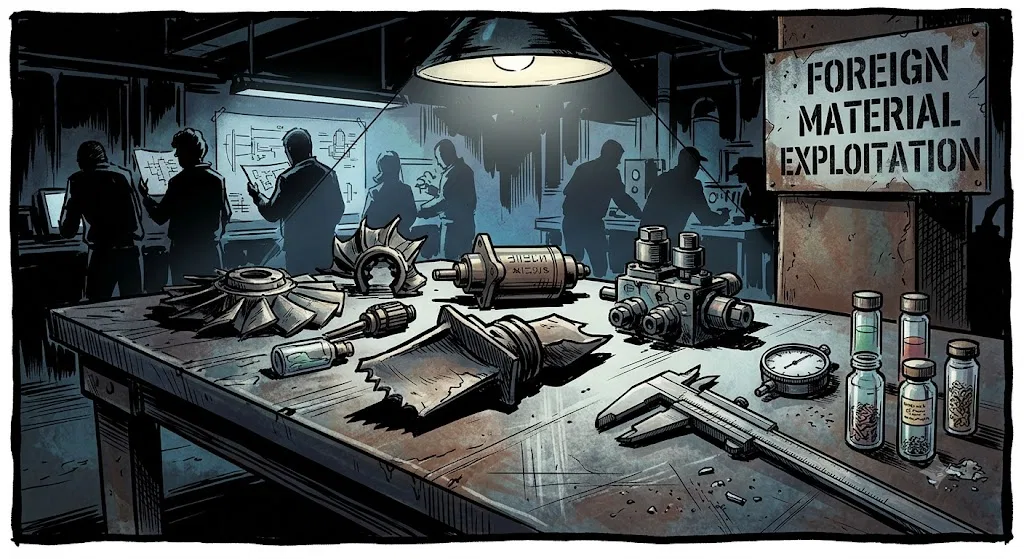
Industrial learning from captured weapon design is the part of military reverse engineering where wreckage, trophies and seized systems are translated into factory knowledge. The main prize is not a museum exhibit or a perfect clone. It is insight into how an adversary actually makes weapons: what materials they choose, how tight their tolerances are, which parts are costly or improvised, where quality control is strong, and where production has been simplified under pressure. That matters because a weapon’s battlefield performance is often inseparable from its manufacturability. A missile seeker, tank hull or drone airframe may reveal not just a design idea, but a production system behind it. Official US descriptions of foreign materiel exploitation show that captured systems are used to support acquisition, testing, target development, modelling, training and tactics, while modern examples from Ukraine show recovered weapons being turned into structured engineering databases for defence partners.[U.S. Department of War]media.defense.govU.S. Department of War Use of Foreign Materiel Exploitation ResultsU.S. Department of War Use of Foreign Materiel Exploitation Results(https://media.defense.gov/1997/Oct/08/2001715489/-1/-1/1/98-005.pdf)
The central lesson is that reverse engineering only becomes strategically useful when a country can absorb what it finds into its own industrial base. Some captured designs teach elegant shortcuts that are easy to copy. Others expose a gap between knowing how something is built and being able to build it at scale. The difference is not intelligence alone; it is metallurgy, tooling, machine capacity, skilled labour, supplier depth, testing discipline and the willingness to redesign rather than copy blindly.
Materials Tell Factories What the Enemy Can Afford
A captured weapon is a physical ledger of industrial choices. Engineers can cut into armour plate, inspect welds, sample propellants, identify alloys, trace circuit boards, test adhesives, examine bearings and measure how parts wear. The point is not simply to ask whether the weapon is “advanced”. It is to ask what level of production quality the adversary can repeat, how much performance is being bought through expensive materials, and where cheaper substitutions have been accepted.
This is especially clear in armoured vehicles. The Soviet T-34 became famous for its sloped armour and mass production, but foreign examination also revealed uneven manufacturing quality. Testing of T-34s at Aberdeen Proving Ground in the United States found problems in armour joins, welds, water sealing and some heat-treatment choices, even though the broader design remained militarily influential. The useful industrial lesson was not “copy the T-34 exactly”. It was that sloped armour, a powerful gun and a production-friendly design could shift the tank-design balance, while poor ergonomics, optics and finishing still imposed real battlefield costs.[Wikipedia]WikipediaOpen source on wikipedia.org.
That distinction matters because captured weapons often reveal a trade between ideal engineering and wartime output. A rough weld is not always a failure if the vehicle lasts long enough for its expected combat life. A simplified turret may be tactically inferior but faster to build. A less elegant component may be good enough when factories are under bombing, blockade or sanction. For domestic industry, the lesson is to separate the enemy’s clever simplifications from the enemy’s forced compromises.
Modern missile and drone exploitation adds a supply-chain layer to the same question. The International Institute for Strategic Studies reported that analysis of missile and uncrewed aerial vehicle debris in Ukraine can reveal component origins and procurement routes, and that Russian, Iranian and North Korean systems used in Ukraine have relied heavily on foreign commercial components despite sanctions. Conflict Armament Research has documented battlefield debris showing recent production markings, component commonalities and design changes across Russian weapons.[IISS]iiss.orgpub25 094 tracking the components of missiles and uavs used by russia in ukrainepub25 094 tracking the components of missiles and uavs used by russia in ukraine
For factories, this kind of evidence is powerful because it turns wreckage into a map of industrial stress. If a missile batch begins using lower-grade electronics, revised assemblies or different suppliers, analysts may infer sanctions pressure, bottlenecks or successful substitution. Reuters reported in 2025 that Ukraine was increasingly finding Russian and Belarusian electronics in Iskander missile wreckage, suggesting a shift away from some smuggled Western components; the same report noted Ukrainian assessments that the chips were poorer in quality but did not appear to reduce missile performance significantly.[Reuters]reuters.comOpen source on reuters.com.
Design Shortcuts Are Often the Real Technology
The most valuable thing inside a captured weapon may be a shortcut rather than a breakthrough. Good military design is not only about maximum performance; it is about making the required performance repeatable under pressure. Captured equipment can show how an adversary simplifies assembly, reduces part counts, accepts looser tolerances, uses modular sections, protects fragile components, or designs for repair by ordinary units rather than specialist workshops.
The German jerrycan is a famous low-technology example. Its pressed-steel body, three-handle layout, air pocket, cam lever cap and pourability made it far better suited to military logistics than many earlier Allied fuel containers, which could leak, require tools or need funnels. Its capture and copying showed that industrial learning from enemy equipment is not limited to aircraft, missiles and tanks. A humble container could teach a production and logistics lesson: the best battlefield design may be the one that saves labour, fuel and time every day.[Wikipedia]WikipediaOpen source on wikipedia.org.
The AIM-9 Sidewinder case shows the same principle in a more advanced weapon. After an AIM-9B failed to explode during the 1958 Taiwan Strait fighting and was recovered via China, the Soviet Union developed the K-13, known to NATO as the AA-2 Atoll. The K-13 was not just a copy of an external shape; the captured missile taught Soviet engineers about compact infrared homing, modular construction and practical missile architecture. Accounts of the programme record Soviet engineer Gennadiy Sokolovskiy describing the Sidewinder as a “university” in missile construction technology.[Wikipedia]WikipediaK-13 (missileK-13 (missile
The lesson for industry was that simplicity can be strategically disruptive. The Sidewinder was effective partly because it was compact and producible, not because every part represented unattainable science. Soviet copying of the basic pattern helped spread a short-range heat-seeking missile design through Soviet and aligned air forces. Later variants evolved beyond the original model, which is often how useful reverse engineering works: first close the gap, then adapt the design to domestic doctrine, aircraft interfaces, manufacturing habits and later technical improvements.[Wikipedia]WikipediaAIM-9 SidewinderAIM-9 Sidewinder
Captured design shortcuts can also teach what not to copy. A weapon may be optimised for a doctrine, climate, maintenance culture or supply chain that does not match the copying country. A tank built for huge Soviet production runs may not suit a smaller industrial base. A missile that assumes access to a certain class of sensor, propellant or cooling technology may be hard to reproduce safely. A drone built from commercial electronics may be easy to imitate in outline but difficult to harden against jamming or scale reliably.
Tolerances Turn Drawings Into a Production Problem
The gap between a captured object and a working production line is often measured in tolerances. Engineers can disassemble a weapon and draw every part, but factories still need machine tools, gauges, alloys, heat treatment, inspection methods and suppliers capable of producing those parts repeatedly. Reverse engineering is therefore a test of the copier’s whole industrial ecosystem.
The Soviet Tu-4 bomber, copied from interned American B-29s after the Second World War, is the classic case. The Soviet Union produced a flyable copy in roughly two years, and the programme forced a large share of the aircraft industry into modern long-range bomber production. Air & Space Forces Magazine describes the Tu-4 as a virtual carbon copy that brought Soviet aviation suppliers into the modern airpower age. Other accounts note that the effort involved hundreds of factories and research institutes, with the Soviet metric system and domestic material availability requiring re-engineering rather than simple duplication.[Air & Space Forces Magazine]airandspaceforces.comAir & Space Forces Magazine Carbon Copy Bomber | Air & Space Forces MagazineAir & Space Forces Magazine Carbon Copy Bomber | Air & Space Forces Magazine
The metric problem is more than a curiosity. If an American airframe uses sheet metal in imperial thicknesses, a Soviet factory cannot simply wish identical stock into existence. It must choose a nearest metric gauge, alter strength calculations, compensate for weight changes and validate the result. The same problem appears with fasteners, wiring, radio equipment, engines and production tooling. Exact copying may look disciplined, but it can become inefficient when the copier’s factories are organised around different standards.
The Tu-4 demonstrates the best-case version of this difficulty: the Soviet Union had a large, coercively mobilised industrial system capable of turning captured design into mass production. Many states cannot do that. A country may capture an advanced radar, missile or aircraft engine and still lack the metallurgical base, precision casting, semiconductor access, turbine-blade technology, clean-room capacity or testing infrastructure needed to reproduce it. In those cases, the industrial lesson may be partial: copy the layout, imitate a subsystem, build a training surrogate, or use the intelligence to design countermeasures rather than pursue a full clone.
The Rolls-Royce Nene and Soviet VK-1 engine story sits between copying and industrial upgrading. The Soviet Union obtained British Nene jet engines after the Second World War and developed the Klimov VK-1, which powered aircraft including the MiG-15. Public technical summaries describe the VK-1 as derived from the Nene but modified with larger combustion chambers, a larger turbine and increased airflow. That pattern is important: reverse engineering gave Soviet industry a working technological baseline, but domestic production still required adaptation to local materials, manufacturing practices and aircraft needs.[Wikipedia]WikipediaKlimov VK-1Klimov VK-1

Copying Fails When the Factory Cannot Copy the System
The common myth is that possession of a captured weapon equals possession of the technology. In reality, a weapon is the visible tip of a system. Behind it are design bureaus, supplier networks, skilled technicians, quality-control routines, test ranges, software tools, classified production recipes and years of failure data. Capturing the object gives clues to that system, not the system itself.
This is why foreign materiel exploitation often feeds many outputs besides replication. A US Department of Defense audit described foreign materiel exploitation as analysis, testing and evaluation of foreign materiel, including testing against US equipment, and said it supported acquisition programmes, testing, threat simulator and target development, modelling and simulation, training and tactics. That institutional framing is revealing: the exploited system may produce better simulators, better targets or better countermeasures long before it produces a domestic copy.[U.S. Department of War]media.defense.govU.S. Department of War Use of Foreign Materiel Exploitation ResultsU.S. Department of War Use of Foreign Materiel Exploitation Results(https://media.defense.gov/1997/Oct/08/2001715489/-1/-1/1/98-005.pdf)
The same caution applies to modern electronics-heavy weapons. Hardware reverse engineering of chips and circuit boards can be technically difficult, time-consuming and dependent on specialised expertise. Research on hardware reverse engineering stresses that complexity comes from both technical and human factors, and that even when reverse engineering is common in practice, quantifying its difficulty remains challenging. In military terms, identifying a foreign field-programmable gate array, processor or navigation module is not the same as reproducing its manufacturing chain.[arXiv]arxiv.orgarXiv Hardware Reverse Engineering: Overview and Open ChallengesarXiv Hardware Reverse Engineering: Overview and Open Challenges
Battle damage and provenance add further limits. A missile fragment may be burned, deformed or missing the most valuable sections. A captured tank may have field repairs that do not reflect factory standards. A drone recovered from one batch may not represent later production. Ukraine’s TrophyLab concept addresses this by organising many captured samples, technical reports and possible physical access into a controlled platform, but even its strongest descriptions acknowledge that a database cannot replace expert testing, chain of custody and laboratory analysis.[IN Defence]indefencemag.comIN Defence Ukraine turns captured weapons into an engineering databaseIN DefenceUkraine turns captured weapons into an engineering database - IN Defence…
Copying also fails when the original design is tied to an enemy’s industrial abundance. A system that uses high-grade alloys, sophisticated bearings or large numbers of precision-machined parts may be logical for a country that already has those suppliers. For a copier without them, the clone may become heavier, less reliable or too expensive to produce in quantity. In such cases, the smarter industrial lesson is selective borrowing: copy the manufacturable principle, not the exact object.
Captured Weapons Now Feed Faster Design Loops
The industrial value of captured weapon design has accelerated because modern weapons evolve quickly in combat. Missiles, drones and electronic-warfare systems can change across batches as producers respond to sanctions, battlefield losses and countermeasures. That makes exploitation less like a one-time autopsy and more like continuous industrial intelligence.
Ukraine’s handling of Russian equipment shows this shift. TrophyLab is described as an access-controlled platform giving approved defence users technical data, drawings, component analysis, research findings, schematics, test results and possible physical samples from recovered Russian systems. Its purpose is not only to understand Russian weapons, but to shorten development cycles for countermeasures, electronic warfare, armour, sensors and allied manufacturing decisions.[IN Defence]indefencemag.comIN Defence Ukraine turns captured weapons into an engineering databaseIN DefenceUkraine turns captured weapons into an engineering database - IN Defence…
The broader Ukrainian defence-industrial context makes that especially significant. SIPRI notes that Ukraine’s domestic arms industry has expanded and diversified during the war, with major revenue growth at its largest arms producer and many smaller producers and joint ventures emerging. In such an environment, captured enemy designs are not passive intelligence; they become inputs to active production choices, from drone components and electronic warfare to survivability improvements and procurement priorities.[SIPRI]sipri.orgThe transformation of Ukraine’s arms industry amid war with Russia | SIPRIThe transformation of Ukraine’s arms industry amid war with Russia | SIPRI
This does not mean every factory should try to build enemy weapons. The more realistic industrial uses are narrower and often more valuable:
- Materials benchmarking: testing armour, composites, propellants, castings, adhesives and electronics packaging against domestic equivalents.
- Tolerance mapping: identifying which parts are precision-critical and which are deliberately rough or cheap.
- Supplier intelligence: tracing chips, sensors, engines, bearings and machine-tool clues to understand production dependencies.
- Design-for-production learning: spotting modularity, simplified assembly, field repair features and part-count reduction.
- Countermeasure engineering: using real signatures, warhead construction, fuze design and guidance architecture to improve jammers, decoys, armour or interceptors.
The strongest lesson is that captured weapons teach factories to think comparatively. They reveal not only what an adversary can design, but what it can repeatedly make, substitute, repair and improve. That is why industrial learning from captured weapon design belongs at the heart of reverse engineering foreign military technology: it connects battlefield debris to production reality, and production reality is where copied ideas either become weapons or remain interesting fragments on a laboratory bench.
Amazon book picks
Further Reading
Books and field guides related to What Factories Learn From Enemy Weapons. Use these as the next step if you want deeper reading beyond the article.
The Innovator's Dilemma
Useful for understanding why organisations absorb or fail to absorb new technical lessons.
The Pentagon's Brain
Covers defence innovation, exploitation of foreign technology and military R&D systems.
Skunk Works
Explains how advanced systems are designed, built and adapted under real production constraints.
The Second Machine Age
Explores how production capabilities and technological diffusion shape competitiveness.
eBay marketplace picks
Marketplace Samples
Live-tested eBay searches with available results related to this page.



Endnotes
1.
Source: media.defense.gov
Title: U.S. Department of War Use of Foreign Materiel Exploitation Results
Link:https://media.defense.gov/1997/Oct/08/2001715489/-1/-1/1/98-005.pdf
2.
Source: Wikipedia
Link:https://en.wikipedia.org/wiki/T-34
3.
Source: iiss.org
Title: pub25 094 tracking the components of missiles and uavs used by russia in ukraine
Link:https://www.iiss.org/globalassets/media-library—content–migration/files/research-papers/2025/09/pub25-094-tracking-the-components-of-missiles-and-uavs-used-by-russia-in-ukraine.pdf
4.
Source: reuters.com
Link:https://www.reuters.com/business/aerospace-defense/ukraine-increasingly-finds-russian-belarusian-electronics-missiles-2025-09-12/
5.
Source: Wikipedia
Link:https://en.wikipedia.org/wiki/Jerrycan
6.
Source: Wikipedia
Title: K-13 (missile)
Link:https://en.wikipedia.org/wiki/K-13_%28missile%29
7.
Source: Wikipedia
Title: AIM-9 Sidewinder
Link:https://en.wikipedia.org/wiki/AIM-9_Sidewinder
8.
Source: Wikipedia
Title: Tupolev Tu-4
Link:https://en.wikipedia.org/wiki/Tupolev_Tu-4
9.
Source: Wikipedia
Title: Klimov VK-1
Link:https://en.wikipedia.org/wiki/Klimov_VK-1
10.
Source: arxiv.org
Title: arXiv Hardware Reverse Engineering: Overview and Open Challenges
Link:https://arxiv.org/abs/1910.01518
11.
Source: arxiv.org
Link:https://arxiv.org/abs/2002.04210
12.
Source: sipri.org
Title: The transformation of Ukraine’s arms industry amid war with Russia | SIPRI
Link:https://www.sipri.org/commentary/topical-backgrounder/2025/transformation-ukraines-arms-industry-amid-war-russia
13.
Source: Wikipedia
Title: Reverse engineering
Link:https://en.wikipedia.org/wiki/Reverse_engineering
14.
Source: indefencemag.com
Title: IN Defence Ukraine turns captured weapons into an engineering database
Link:https://indefencemag.com/ukraine-turns-captured-weapons-into-an-engineering-database/
Source snippet
IN DefenceUkraine turns captured weapons into an engineering database - IN Defence...
15.
Source: conflictarm.com
Title: Conflict Armament Research
Link:https://www.conflictarm.com/field-dispatches/
16.
Source: airandspaceforces.com
Title: Air & Space Forces Magazine Carbon Copy Bomber | Air & Space Forces Magazine
Link:https://www.airandspaceforces.com/article/0609bomber/
17.
Source: dst.defence.gov.au
Title: DST Group GD 1022
Link:https://www.dst.defence.gov.au/sites/default/files/publications/[documents
18.
Source: remosince1988.com
Link:https://remosince1988.com/blogs/stories/jerrycan
19.
Source: davetrott.co.uk
Title: reverse engineering
Link:https://davetrott.co.uk/2014/07/reverse-engineering/
Additional References
20.
Source: youtube.com
Link:https://www.youtube.com/watch?v=qzkJ9_8A0F4
Source snippet
Russia & Iran Are Rebuilding Western Weapons Cheaper...
21.
Source: youtube.com
Title: R&D NIGHTMARE? Russia’s Biggest Military Secrets Exposed By Ukraine
Link:https://www.youtube.com/watch?v=7nVyQHYF95g
Source snippet
Ukraine exposes Putin's military secrets after cracking Russian weapon tech...
22.
Source: youtube.com
Title: Ukraine’s [Trophy Lab]({{ ‘trophy-lab/’ | relative_url }}): How UK could be handed Russia’s weapons secrets
Link:https://www.youtube.com/watch?v=yYvrqQflLuA
Source snippet
R&D NIGHTMARE? Russia's Biggest Military Secrets Exposed By Ukraine...
23.
Source: united24media.com
Link:https://united24media.com/war-in-ukraine/35000-foreign-made-components-identified-in-russian-missiles-and-drones-used-in-latest-kyiv-strike-20382
24.
Source: x.com
Link:https://x.com/RealAirPower1/status/2039010992009429101?lang=en
25.
Source: tooled-up.com
Link:https://www.tooled-up.com/blog/all-about-jerry-cans/?srsltid=AfmBOoqIIpJ40uSy_yUYmyF8QVRtgg6jcBIyu3X3yEOSfCQAN4USbXXx
26.
Source: linkedin.com
Link:https://www.linkedin.com/posts/conflict-armament-research_powering-the-houthis-activity-7459575304051904512-mEvb
27.
Source: reddit.com
Link:https://www.reddit.com/r/WarCollege/comments/dysq9a/could_the_soviets_have_produced_a_powerful_jet/
28.
Source: amazon.de
Link:https://www.amazon.de/Early-Russian-Jet-Engines-Evolution/dp/1872922252?tag=searcht-20
29.
Source: facebook.com
Link:https://www.facebook.com/groups/wotcfb/posts/4638733986192862/
Topic Tree