Within Industrial Learning From Captured Weapon Design
How Wreckage Maps Industrial Pressure
Recovered missile and drone parts can show when suppliers change, components decline or sanctions force redesigns.
On this page
- Component markings and production dates
- Supplier shifts in recovered debris
- What substitutions do and do not prove
Page outline Jump by section
Introduction
Missile and drone wreckage is more than forensic evidence of a single attack. When collected systematically over months or years, debris becomes a record of industrial adaptation under sanctions. Component markings, date codes, serial numbers, circuit boards and manufacturing changes allow investigators to track whether producers are maintaining access to foreign technology, switching suppliers, redesigning subsystems or consuming older inventories. In the context of reverse engineering foreign military technology, this makes battlefield debris a valuable sanctions stress map: a way of observing how pressure on supply chains appears inside finished weapons rather than in official statistics.

The most useful insight is often not whether a weapon works, but how its internal composition changes over time. Recovered missiles and drones can reveal production bottlenecks, substitution strategies, procurement networks and the limits of export controls. Evidence from Ukraine has made this process unusually visible because large numbers of missile and UAV remnants have been documented, catalogued and compared across multiple production batches.[IISS]iiss.orgIt examines the technological make-up of Russian.Read moreTracking the Components of Missiles and UAVs Used by…September 24, 2025 — This IISS research report is based partly on field inves…
Component Markings and Production Dates
One of the strongest indicators of industrial pressure is the relationship between production dates and battlefield use. Modern weapons frequently contain manufacturing marks on airframes, electronics, wiring assemblies or individual components. These markings help investigators estimate how quickly a weapon moved from factory to combat.
Conflict Armament Research (CAR) documented a Russian Kh-101 cruise missile whose production markings indicated manufacture fewer than twenty days before deployment. Such findings suggest that production lines remain active but may also indicate limited stockpiling and a rapid factory-to-front cycle, characteristics often associated with wartime production pressure.[Conflict Armament Research]conflictarm.comfield dispatchesConflict Armament ResearchFIELD DISPATCHESIn January 2026, CAR field investigators documented the remnants of a Russian-manufactured Kh-1…
Date codes can also reveal whether producers are relying on newly acquired parts or older inventories. Analysis of Russian Oreshnik missile debris presented by Ukrainian investigators found components manufactured before 2016, challenging claims that the weapon represented an entirely new technological generation. Instead, the evidence suggested significant reuse of older industrial resources and legacy designs.[The Kyiv Independent]kyivindependent.comThe Kyiv Independent Oreshnik missile 'isn't cutting-edge' as Russia claimsThe Kyiv IndependentOreshnik missile 'isn't cutting-edge' as Russia claims…May 29, 2026 — 29 May 2026 — An examination of the wreckage…
Production markings become particularly valuable when compared across multiple recovered examples. If weapons recovered in different months contain increasingly recent components, investigators can infer continuing access to supply channels. If newer missiles contain older components, analysts may suspect inventory drawdowns, stockpile consumption or difficulties obtaining replacements.
Supplier Shifts in Recovered Debris
Sanctions rarely stop production immediately. More often, they force manufacturers to alter sourcing patterns. Debris analysis is one of the few ways to observe these changes directly.
Investigations of missiles and UAVs used in Ukraine have repeatedly identified foreign commercial electronics despite extensive export controls. Studies by CAR and the International Institute for Strategic Studies (IISS) found continuing reliance on internationally sourced commercial components in Russian, Iranian and North Korean systems. The resulting component inventories help reconstruct procurement routes and identify which technologies remain accessible despite sanctions.[IISS]iiss.orgIt examines the technological make-up of Russian.Read moreTracking the Components of Missiles and UAVs Used by…September 24, 2025 — This IISS research report is based partly on field inves…
The shift from imported to domestic alternatives can also be observed in recovered wreckage. Ukrainian officials reported finding increasing numbers of Russian- and Belarusian-made electronic components in some missile systems, particularly compared with earlier stages of the war. This pattern suggests efforts to reduce dependence on Western electronics that have become harder to obtain under sanctions.[Reuters]reuters.comUkraine increasingly finds Russian and Belarusian electronics in missilesThis development suggests that Russia is becoming less dependent on smuggled Western components, instead relying more on domestic and Bel…
Drone debris provides another illustration. CAR’s examination of Russian-produced Geran-2 drones, derived from the Iranian Shahed design, identified major differences from earlier examples. Investigators found altered airframe construction, newly dated components and increasing incorporation of Russian-produced subsystems. These changes indicate not only localisation of production but also adaptation to evolving supply constraints.[Conflict Armament Research]conflictarm.comfield dispatchesConflict Armament ResearchFIELD DISPATCHESIn January 2026, CAR field investigators documented the remnants of a Russian-manufactured Kh-1…
A similar pattern appears in North Korean missiles recovered in Ukraine. CAR documented missiles containing large numbers of foreign electronic components, many linked to American firms. More importantly for sanctions analysis, some recovered missiles carried production markings indicating manufacture shortly before battlefield use, demonstrating an active supply chain capable of acquiring necessary components despite longstanding restrictions.[Conflict Armament Research]conflictarm.comfield dispatchesConflict Armament ResearchFIELD DISPATCHESIn January 2026, CAR field investigators documented the remnants of a Russian-manufactured Kh-1…

What Substitutions Do and Do Not Prove
Recovered components can show that substitution has occurred, but they do not automatically reveal why.
A change from one microcontroller to another may indicate sanctions pressure, but it could also reflect cost reduction, design modernisation, supplier availability or efforts to improve performance. Analysts therefore avoid treating any single component change as definitive evidence of sanctions success or failure.
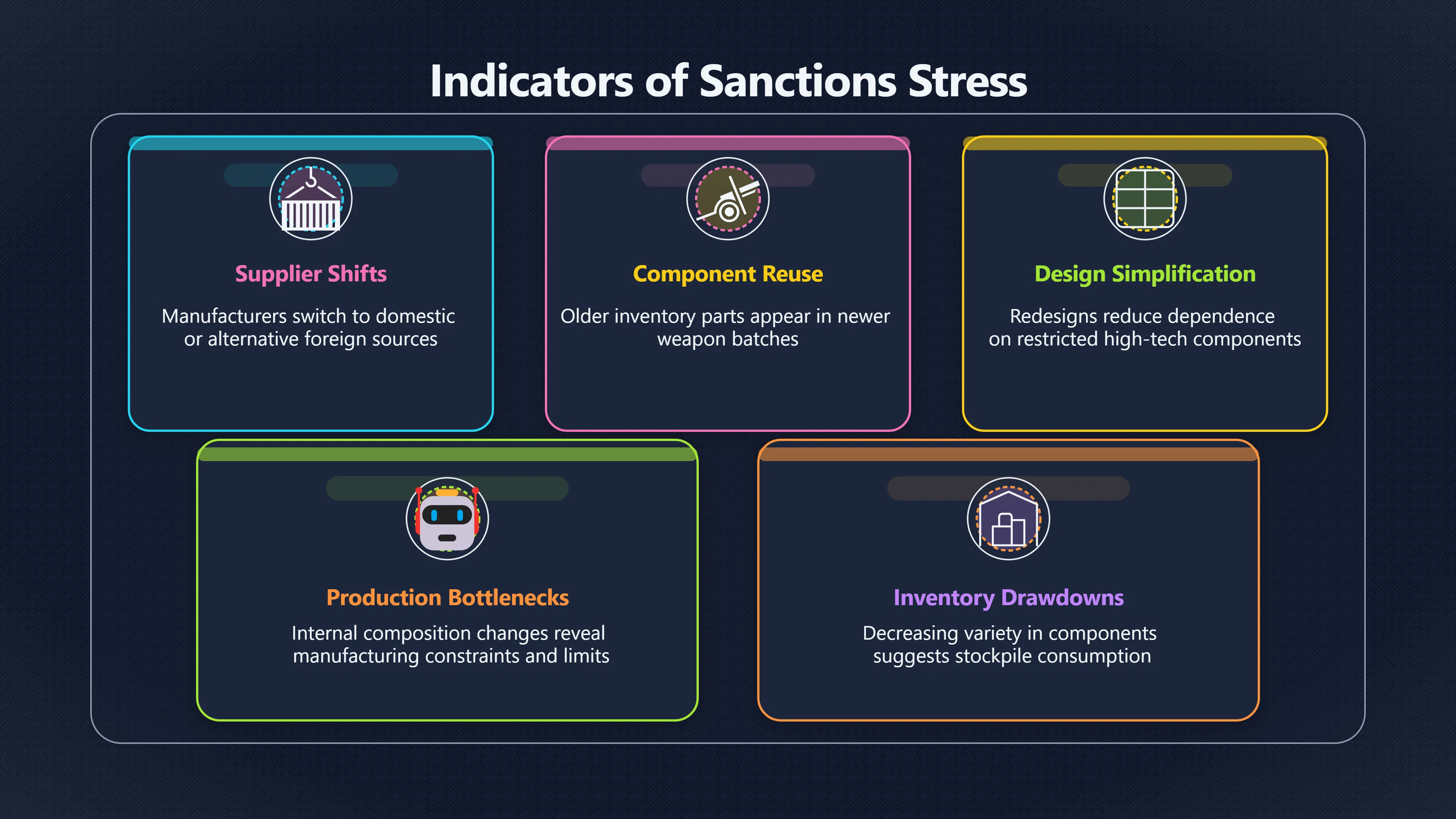
The strongest conclusions emerge when multiple indicators point in the same direction. For example:
- Repeated appearance of alternative suppliers across several weapon batches.
- Growing use of domestic components where imported parts were previously common.
- Redesigns that simplify manufacturing or reduce dependence on restricted technologies.
- Increased variation between otherwise identical weapons.
- Evidence that older stockpiled components are being incorporated into new production runs.
When several of these trends appear together, the case for sanctions-driven adaptation becomes stronger.[IISS]iiss.orgIt examines the technological make-up of Russian.Read moreTracking the Components of Missiles and UAVs Used by…September 24, 2025 — This IISS research report is based partly on field inves…
At the same time, substitution does not necessarily mean declining capability. Ukrainian officials have noted that some domestically sourced Russian and Belarusian electronics may be lower quality than Western equivalents, yet still adequate for operational use. Industrial resilience can therefore coexist with technological degradation. A weapon may become harder or more expensive to produce without becoming ineffective.[Reuters]reuters.comUkraine increasingly finds Russian and Belarusian electronics in missilesThis development suggests that Russia is becoming less dependent on smuggled Western components, instead relying more on domestic and Bel…
Debris Databases as Industrial Intelligence
The real value of missile debris emerges when individual recoveries are turned into longitudinal datasets. Modern investigations increasingly catalogue thousands of components across hundreds of recovered weapons, allowing analysts to observe industrial trends rather than isolated artefacts.
Open databases of foreign-produced components found in weapons now contain thousands of documented items linked to hundreds of weapon systems. Combined with battlefield recovery programmes, these repositories allow governments and researchers to identify recurring suppliers, detect newly introduced components and monitor changes in procurement behaviour over time.[War & Sanctions]war-sanctions.gur.gov.uaWar & SanctionsForeign components in weapons25 May 2026 — The world`s only open database portal of foreign-produced weapon components…
This transforms wreckage into a governance tool. Export-control authorities can identify which technologies continue to reach sanctioned programmes. Customs agencies can focus on high-risk components. Manufacturers can be alerted when their products repeatedly appear in prohibited end uses. Rather than treating sanctions as an abstract policy instrument, debris analysis provides physical evidence of where controls are working, where they are being bypassed and where adaptation is occurring.[IISS]iiss.orgIt examines the technological make-up of Russian.Read moreTracking the Components of Missiles and UAVs Used by…September 24, 2025 — This IISS research report is based partly on field inves…

Why Wreckage Reveals More Than Official Claims
Governments and manufacturers often describe weapons programmes in terms of capability, innovation and strategic messaging. Debris offers a different perspective because it records what was actually built.
A missile casing may reveal when a production batch was completed. A circuit board may identify a new supplier. A guidance unit may expose dependence on commercial technology. A redesigned airframe may indicate efforts to conserve scarce materials. These observations are difficult to conceal once the weapon has been fired and recovered.
For analysts studying foreign military technology, missile debris therefore serves as a practical measure of industrial pressure. It does not merely reveal how a weapon functions. It reveals how factories respond when sanctions, procurement constraints and wartime demands force design choices that eventually become visible in the wreckage left behind.[conflictarm.com]conflictarm.comfield dispatchesConflict Armament ResearchFIELD DISPATCHESIn January 2026, CAR field investigators documented the remnants of a Russian-manufactured Kh-1…
eBay marketplace picks
Marketplace Samples
Live-tested eBay searches with available results related to this page.

Endnotes
1.
Source: iiss.org
Title: It examines the technological make-up of Russian.Read more
Link:https://www.iiss.org/globalassets/media-library—content–migration/files/research-papers/2025/09/pub25-094-tracking-the-components-of-missiles-and-uavs-used-by-russia-in-ukraine.pdf
Source snippet
Tracking the Components of Missiles and UAVs Used by...September 24, 2025 — This IISS research report is based partly on field inves...
Published: September 24, 2025
2.
Source: iiss.org
Link:https://www.iiss.org/research-paper/2025/09/tracking-the-components-of-missiles-and-uavs-used-by-russia-in-ukraine-what-lessons-for-control-regimes/
Source snippet
Tracking the Components of Missiles and UAVs Used by...25 Sept 2025 — Debris from weapons used by Russia in Ukraine shows a continued re...
3.
Source: reuters.com
Link:https://www.reuters.com/business/aerospace-defense/russian-oreshnik-missile-fired-january-was-nine-years-old-ukrainian-[experts
Source snippet
Initially deployed by Russia in 2024, the Oreshnik is a nuclear-capable ballistic missile with a range exceeding 5,000 kilometers. While...
4.
Source: reuters.com
Title: Ukraine increasingly finds Russian and Belarusian electronics in missiles
Link:https://www.reuters.com/business/aerospace-defense/ukraine-increasingly-finds-russian-belarusian-electronics-missiles-2025-09-12/
Source snippet
This development suggests that Russia is becoming less dependent on smuggled Western components, instead relying more on domestic and Bel...
5.
Source: youtube.com
Link:https://www.youtube.com/watch?v=nm3GFfZPnyw
Source snippet
Conflict Armament Research Ukraine components sanctions Sanctions & Export Control Evasion w/ Conflict Armament Research's Damien Spleete...
6.
Source: conflictarm.com
Title: field dispatches
Link:https://www.conflictarm.com/field-dispatches/
Source snippet
Conflict Armament ResearchFIELD DISPATCHESIn January 2026, CAR field investigators documented the remnants of a Russian-manufactured Kh-1...
Published: January 2026
7.
Source: kyivindependent.com
Title: The Kyiv Independent Oreshnik missile ‘isn’t cutting-edge’ as Russia claims
Link:https://kyivindependent.com/russias-oreshnik-isnt-cutting-edge-weapons-ukraine-says-after-components-analysis/
Source snippet
The Kyiv IndependentOreshnik missile 'isn't cutting-edge' as Russia claims...May 29, 2026 — 29 May 2026 — An examination of the wreckage...
Published: May 29, 2026
8.
Source: war-sanctions.gur.gov.ua
Link:https://war-sanctions.gur.gov.ua/en/components
Source snippet
War & SanctionsForeign components in weapons25 May 2026 — The world`s only open database portal of foreign-produced weapon components...
Published: May 2026
9.
Source: ft.com
Link:https://www.ft.com/content/c48c2190-f0f3-485d-a0bb-da56fe8c094d
Source snippet
Despite international sanctions, Russia has circumvented restrictions and continues to use Western microelectronics, some with serial num...
Additional References
10.
Source: businessinsider.com
Link:https://www.businessinsider.com/russia-new-north-korean-missiles-made-this-year-ukraine
Source snippet
Este descubrimiento marca la primera evidencia pública de que misiles de producción reciente en Corea del Norte están siendo usados en Uc...
11.
Source: instagram.com
Link:https://www.instagram.com/p/DY7zR9dlsDs/
Source snippet
Kyiv Independent on InstagramAn examination of the wreckage of a Russian Oreshnik missile shows it contains crucial components manufactur...
12.
Source: undp.org
Link:https://www.undp.org/ukraine/press-releases/ukraine-could-recover-82-million-tonnes-secondary-raw-materials-war-generated-debris-undp-study-reveals
Source snippet
Ukraine could recover up to 8.2 million tonnes of...9 Jun 2026 — Ukraine could recover up to 8.2 million tonnes of secondary raw materia...
13.
Source: popups.uliege.be
Link:https://popups.uliege.be/2952-7597/index.php?id=188
Source snippet
DPRK missile in Ukraine: results of an inspection by UN...by S Sue — For example, the markings were not typical of Russian weapons, the...
14.
Source: euractiv.com
Title: ukraine studies debris from new russian ballistic missile
Link:https://www.euractiv.com/news/ukraine-studies-debris-from-new-russian-ballistic-missile/
Source snippet
25 Nov 2024 — Ukrainian experts study such debris to gain insight into Russian military supply chains, production and how to develop coun...
15.
Source: hsgac.senate.gov
Title: 2024 02 27 hearing record [documents]({{ ‘documents/’ | relative_url }})
Link:https://www.hsgac.senate.gov/subcommittees/investigations/library/files/2024-02-27-hearing-record-documents/
Source snippet
Russian missiles manufacturers - II. Foreign components...Most of foreign-made electronic components used by Russia in missile manufactu...
16.
Source: facebook.com
Link:https://www.facebook.com/100066688483552/posts/%F0%9D%97%95%F0%9D%97%A5%F0%9D%97%98%F0%9D%97%94%F0%9D%97%9E%F0%9D%97%9C%F0%9D%97%A1%F0%9D%97%9A-ukraine-exposes-new-russian-missile-using-western-tech-despite-sanction/1298314565734814/
Source snippet
anctions February 10, 2025 – Recent forensic investigations...Read more...
Published: February 10, 2025
17.
Source: storymaps.arcgis.com
Title: This is the first discovery of post-invasion
Link:https://storymaps.arcgis.com/stories/00594bef40bc4148b16dc7267172d033
Source snippet
post-invasion components in Russian weaponsIn March 2023, CAR investigators observed components manufactured after the Russian invasion o...
Published: March 2023
18.
Source: youtube.com
Link:https://www.youtube.com/watch?v=uI7bLXLzyPI
Source snippet
Ukraine war: Western components found in Iranian-made drones used by Russian army, expert warns...
19.
Source: hudoc.echr.coe.int
Title: int UKRAIN E AND THE NETHERLANDS v. RUSSIA
Link:https://hudoc.echr.coe.int/fre
Source snippet
AND THE NETHERLANDS v. RUSSIA - HUDOCThe dismantling of the Buk missiles allowed investigators to compare the parts of the Buk missiles t...
Topic Tree