Within Threat Myths
When Impressive Specs Hide Weaknesses
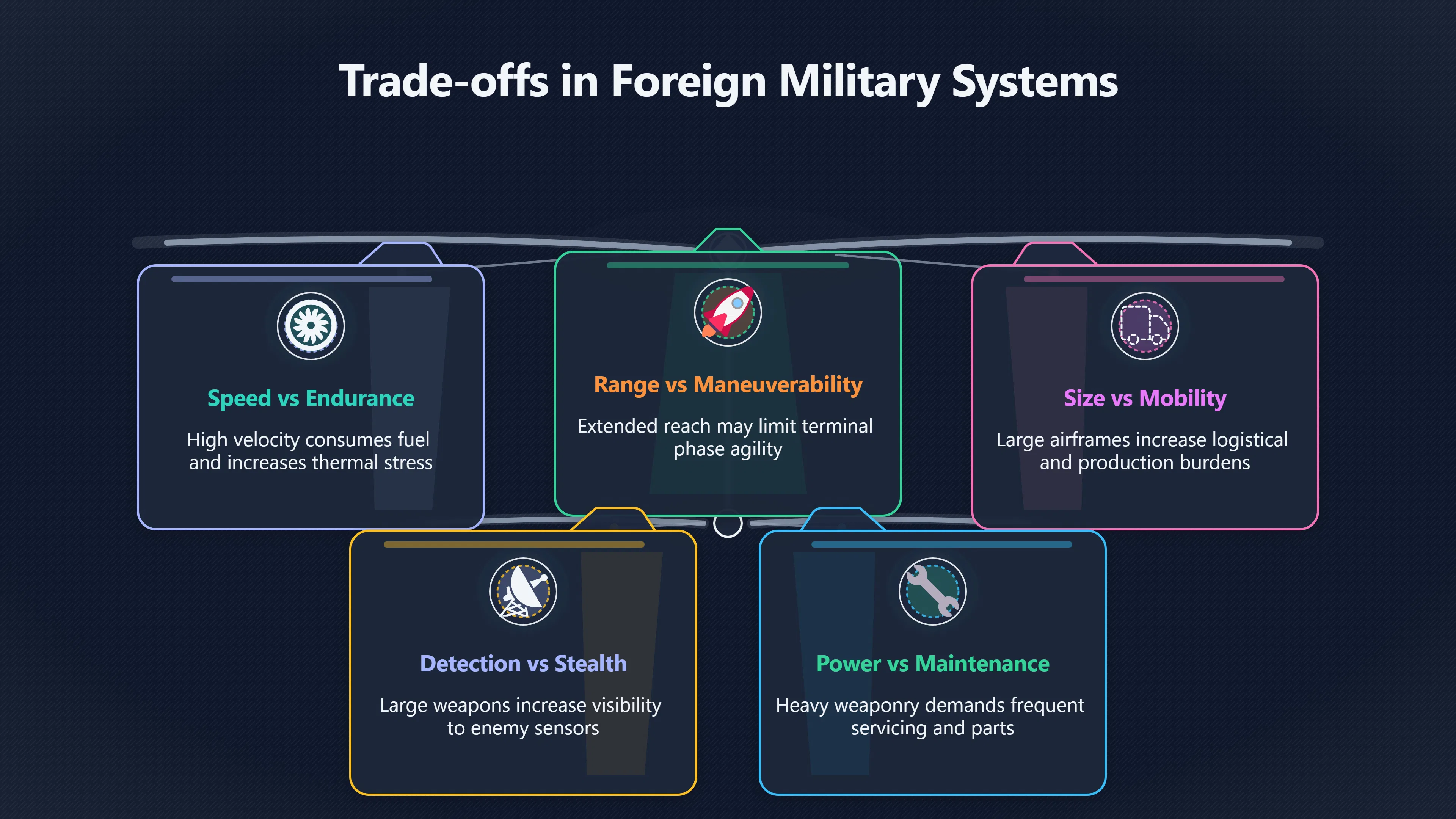
Speed, range or missile size can be real while masking sacrifices in reliability, endurance, sensors or maintainability.
On this page
- Headline performance versus usable combat performance
- The hidden costs of speed, range and size
- How inspection finds the trade off behind the boast
Page outline Jump by section
Introduction
One of the most common errors in assessing foreign military technology is to mistake a visible advantage for overall superiority. A fighter aircraft may be exceptionally fast, a missile may have impressive range, or a tank may carry an unusually large gun. Those strengths can be real and dangerous. Yet reverse engineering and physical inspection repeatedly show that headline specifications are often achieved through trade-offs that are harder to see from photographs, intelligence reports, parade displays, or combat rumours.

This matters because threat inflation frequently begins with what is most visible. Before engineers can inspect a captured weapon, analysts tend to focus on measurable features such as speed, size, altitude, range, or payload. Foreign materiel exploitation programmes exist partly to uncover what those figures conceal: reliability limits, maintenance burdens, sensor shortcomings, production constraints, electronic vulnerabilities, or logistical weaknesses that shape actual battlefield performance.[Army Financial Management]army.milvol6Army Financial ManagementDESCRIPTIVE SUMMARIES OF THEMarch 25, 2010 — by A Appropriation · 2010 — This is a continuing project for acquis…
Headline Performance Versus Usable Combat Performance
Military systems are collections of compromises rather than collections of maximum values. Engineers rarely gain one capability without paying a price elsewhere.
A missile advertised with exceptional range may require a flight profile that reduces manoeuvrability during its terminal phase. A combat aircraft optimised for speed may sacrifice endurance or payload flexibility. A radar with impressive theoretical detection distance may perform less effectively against low-observable targets or under heavy electronic warfare conditions.
The problem for outside observers is that visible characteristics are easier to estimate than hidden ones. Satellite imagery can reveal missile length. Airshow demonstrations can reveal speed. Public claims can advertise range. Reliability, software robustness, maintenance requirements, spare-parts consumption, and sensor integration are much harder to observe remotely.
As a result, threat assessments made before physical inspection often overweight the characteristics that can be measured from afar and underweight the characteristics that determine sustained combat effectiveness.
The Hidden Costs of Speed, Range and Size
Speed Often Consumes Endurance
High speed is among the most impressive military specifications because it is easy to understand and easy to advertise. Yet speed frequently requires larger engines, higher fuel consumption, greater thermal stress, and more demanding maintenance.
A fast interceptor may excel at brief engagements while remaining dependent on extensive ground support and frequent servicing. Without access to the aircraft itself, observers may see the speed but not the logistical burden that enables it.
Captured equipment has repeatedly shown that propulsion systems can be less durable than foreign analysts assumed. The visible achievement—high performance—can coexist with reduced operational availability once maintenance realities are taken into account.
Long Range Often Comes With Operational Conditions
Range figures are particularly vulnerable to misunderstanding because they are usually measured under specific test conditions.
Missiles may achieve advertised ranges only when launched at high altitude, at high speed, or against non-manoeuvring targets. Aircraft combat radii may assume ideal fuel loads and mission profiles. Ground systems may require support vehicles, prepared infrastructure, or favourable environmental conditions.
The specification itself may be accurate while the practical combat interpretation is exaggerated. Reverse engineering helps distinguish between maximum theoretical capability and routinely achievable battlefield performance.
Larger Weapons Create Their Own Constraints
Size conveys power. Large missiles, large guns, and large airframes often generate concern because they visibly suggest greater destructive potential.
However, increased size can create penalties:
- Greater logistical demands.
- Reduced mobility.
- Higher production costs.
- Lower ammunition carriage.
- More demanding maintenance.
- Increased detectability.
Inspection often reveals whether designers accepted these penalties willingly or were forced into them by limitations elsewhere in the system. A large missile may compensate for less efficient propulsion. A large airframe may compensate for sensor or engine constraints rather than represent pure technological superiority.

How Inspection Finds the Trade-Off Behind the Boast
Physical access changes the nature of analysis because engineers can move beyond observed performance and examine the design choices that produced it.
Foreign materiel exploitation programmes are specifically intended to reduce uncertainty about the capabilities and limitations of foreign systems. Rather than asking what a weapon appears able to do, inspectors can ask how it does it and what compromises were necessary to achieve that result.[Army Financial Management]army.milvol6Army Financial ManagementDESCRIPTIVE SUMMARIES OF THEMarch 25, 2010 — by A Appropriation · 2010 — This is a continuing project for acquis…
Inspection commonly focuses on questions such as:
- How reliable are critical components?
- How difficult is field maintenance?
- How sophisticated are sensors and processors?
- Which subsystems depend on imported parts?
- How resistant is the system to damage or electronic attack?
- How quickly can damaged equipment return to service?
These questions often reveal weaknesses invisible in performance demonstrations.
A weapon that appears technologically advanced may rely heavily on foreign-sourced electronics, creating supply vulnerabilities. Recent investigations into Russian military production have highlighted continued dependence on imported components despite efforts at technological self-sufficiency, illustrating how externally visible capability can conceal industrial weaknesses.[Kyiv School of Economics]kse.uaKyiv School of EconomicsChallenges of Export Controls Enforcement: How Russia…11 Jan 2024 — Russia imported more than $22 billion in c…
Battlefield Experience Often Exposes What Specifications Miss
Combat can reveal hidden weaknesses before engineers ever acquire a captured example, but physical inspection is usually needed to explain why those weaknesses appeared.
The war in Ukraine has provided numerous examples of systems whose existence and specifications generated significant concern before the conflict, yet whose operational performance exposed issues involving logistics, maintenance, coordination, sustainment, and battlefield adaptation. Analysts examining Russian military performance have pointed to shortcomings in equipment support, logistics, and operational execution that were not obvious from inventories or published specifications alone.[Taylor & Francis Online]tandfonline.comTaylor & Francis OnlineA Brutal Examination: Russian Military Capability in Light of…by R Dalsjö · 2022 · Cited by 168 — Russian armed…
Importantly, this does not mean the systems were harmless or ineffective. The more useful lesson is that dangerous weapons can still be overestimated in the wrong context.
A missile can remain lethal while being less reliable than assumed.
A combat aircraft can remain formidable while requiring more maintenance than expected.
A tank can remain heavily armed while suffering from sustainment or survivability limitations.
The correction is not from “strong” to “weak.” It is from vague reputation to measured understanding.
Why This Matters for Threat Assessment
The central risk is not merely technical misunderstanding but strategic distortion.
When visible strengths dominate analysis, governments may invest in countering the wrong aspect of a threat. Resources can be directed toward headline capabilities while neglecting the actual constraints that shape battlefield performance.
Reverse engineering provides a safeguard against this error. By exposing the trade-offs behind impressive specifications, it converts an adversary weapon from a symbol into an engineering problem. The resulting assessment is often more nuanced: the system remains dangerous, but its strengths, limitations, and optimal employment become clearer.
That shift—from appearance to mechanism—is one of the most important ways hardware inspection reduces threat inflation. Visible strengths rarely disappear under scrutiny. What changes is the understanding of what had to be sacrificed to achieve them.
eBay marketplace picks
Marketplace Samples
Live-tested eBay searches with available results related to this page.




Endnotes
1.
Source: asafm.army.mil
Link:https://www.asafm.army.mil/Portals/72/[Documents
Source snippet
Army Financial ManagementDESCRIPTIVE SUMMARIES OF THEMarch 25, 2010 — by A Appropriation · 2010 — This is a continuing project for acquis...
Published: March 25, 2010
2.
Source: army.mil
Title: 2020 2021 Weapon Systems Handbook
Link:https://www.army.mil/e2/downloads/rv7/2020-2021_Weapon_Systems_Handbook.pdf
Source snippet
Weapon Systems Handbook 2020-2021Details within this handbook include program descriptions, status and specifications, projected activiti...
3.
Source: sciencedirect.com
Title: ScienceDirect Reverse Engineering
Link:https://www.sciencedirect.com/topics/engineering/reverse-engineering
Source snippet
Reverse Engineering - an overviewReverse engineering (RE) is defined as an engineering methodology that involves excavating the design in...
4.
Source: kse.ua
Link:https://kse.ua/about-the-school/news/challenges-of-export-controls-enforcement-how-russia-continues-to-import-components-for-its-military-production/
Source snippet
Kyiv School of EconomicsChallenges of Export Controls Enforcement: How Russia...11 Jan 2024 — Russia imported more than $22 billion in c...
5.
Source: tandfonline.com
Link:https://www.tandfonline.com/doi/full/10.1080/00396338.2022.2078044
Source snippet
Taylor & Francis OnlineA Brutal Examination: Russian Military Capability in Light of...by R Dalsjö · 2022 · Cited by 168 — Russian armed...
Additional References
6.
Source: reddit.com
Link:https://www.reddit.com/r/Mechwarrior5/comments/10rfxh9/rating_every_weapon_with_minimal_but_useful/
Source snippet
Rating Every Weapon with Minimal but Useful ExplanationSmall Laser: Great weapon. dealing damage over a period, short range, hardpoint li...
7.
Source: researchgate.net
Link:https://www.researchgate.net/publication/372787054_Reverse_Engineering_Past_Present_and_Future_Prospects
Source snippet
Reverse Engineering: Past, Present, and Future ProspectsThis chapter starts with the definition of reverse engineering, followed by why t...
8.
Source: ftp.idu.ac.id
Link:https://ftp.idu.ac.id/wp-content/uploads/ebook/tdg/MILITARY%20REFERENCE%20AND%20REVERSE%20ENGINEERING/epdf.pub_reverse-engineering-technology-of-reinvention.pdf
Source snippet
Engineering: Technology of ReinventionOne of the widely cited reverse engineering examples in the military is the Soviet Tupolve Tu-4 (Bu...
9.
Source: assets.publishing.service.gov.uk
Link:https://assets.publishing.service.gov.uk/media/5a7ebee940f0b6230268b464/20140808_MOD_Acronyms_and_Abbreviations.pdf
Source snippet
of Defence acronyms and abbreviationsMinistry of Defence acronyms. Weapons System – Heavy. Battlefield Computer Simulation ABACUS Artille...
10.
Source: raf.mod.uk
Link:https://www.raf.mod.uk/what-we-do/centre-for-air-and-space-power-studies/aspr/apr-vol9-iss1-3-pdf/
Source snippet
missiles carrying carbon...These examples highlight the potential of non-lethal technology in reducing the strategic impact of kinetic w...
11.
Source: csis.org
Link:https://www.csis.org/analysis/ukraines-future-vision-and-current-capabilities-waging-ai-enabled-autonomous-warfare
Source snippet
Ukraine's Future Vision and Current Capabilities for...6 Mar 2025 — This paper examines how Ukraine is advancing AI-driven unmanned syst...
12.
Source: csis-website-prod.s3.amazonaws.com
Link:https://csis-website-prod.s3.amazonaws.com/s3fs-public/160628_GW-6_Air_Defense_10-1-94.pdf
Source snippet
GW-6 Struggle for Air SupremacyThis table not only provides an overview of how many sorties a given allied air force flew during the war...
13.
Source: tnsr.org
Link:https://tnsr.org/roundtable/on-optimism-about-new-military-technologies/
Source snippet
actors that drive optimism about emerging military technologies.Read more...
14.
Source: mynavyhr.navy.mil
Title: milrating community and career field nec codes
Link:https://www.mynavyhr.navy.mil/Portals/55/Reference/NEOCS/Vol2/NEC_Chap_4_Apr_26_508.pdf?ver=ejyQcGEJuUpO2KLRs_dJGA%3D%3D
Source snippet
Analysis. 4. Member must be NSA Adjunct Faculty certified. 5. Member must obliserve for six years. C20A - Ship's Signal Exploitation Equi...
15.
Source: cna.org
Title: Russian Combat Air Strengths and Limitations
Link:https://www.cna.org/reports/2023/04/Russian-Combat-Air-Strengths-and-Limitations.pdf
Source snippet
J Bronk · 2023 · Cited by 26 — Examples of visible weakness include the VKS's inability to effectively conduct suppression...
Topic Tree