Within Ground Systems
Why Real Enemy Hardware Changes Training
Captured weapons and vehicles make training targets, recognition drills and crew instincts more realistic than generic replicas alone.
On this page
- Turning captured systems into recognition aids
- Testing drills against actual threat features
- When replicas still beat rare captured hardware
Page outline Jump by section
Introduction
Captured foreign weapons, vehicles and battlefield equipment do more than reveal how an adversary fights. Once they have been examined for intelligence value, they often become training assets that help soldiers recognise threats faster, understand enemy strengths and weaknesses, and practise against equipment that behaves differently from friendly systems. Within ground materiel exploitation programmes, real enemy hardware bridges the gap between intelligence analysis and battlefield performance. Instead of relying solely on photographs, manuals or mock-ups, troops can learn from the actual dimensions, signatures, controls, armour layouts and vulnerabilities of foreign systems. This produces a form of realism that is difficult to replicate through generic training aids alone.[Intelligence Resource Program]irp.fas.orgIntelligence Resource ProgramAR 381-26 Army Foreign Material Exploitation ProgramThis regulation covers the Army Foreign Material Exploit…
The value is especially important for force protection. A soldier who can immediately identify a hostile vehicle silhouette, recognise a weapon system’s firing characteristics, or understand where an enemy crew is likely to observe from gains practical advantages that can reduce confusion and shorten decision times under pressure. Captured materiel therefore becomes part of a broader cycle in which foreign technology is recovered, exploited, tested and then incorporated into training.[Wikipedia]Wikipedia203rd Military Intelligence Battalion203rd Military Intelligence Battalion
Turning Captured Systems into Recognition Aids
One of the simplest but most valuable uses of captured materiel is visual and technical familiarisation. Soldiers are often required to distinguish between friendly, neutral and hostile equipment in seconds. Photographs and classroom instruction help, but physical exposure provides a more complete understanding of size, shape, thermal characteristics, crew positions and distinctive features.
Technical intelligence organisations have long incorporated foreign weapons and vehicle familiarisation into training events. US Army technical intelligence exercises, for example, have included foreign weapons familiarisation ranges and foreign vehicle exploitation tasks designed to expose personnel to equipment they may encounter in operations.[Army]army.milReserve MI Battalion Conducts Training ExerciseReserve MI Battalion Conducts Training ExerciseMay 19, 2011 — 19 May 2011 — Training opportunities included a foreign weapons familia…
Physical access allows trainees to examine details that are difficult to appreciate in manuals:
- How a vehicle appears from different angles and distances.
- Distinguishing features that separate similar vehicle families.
- Likely crew locations and observation points.
- External indicators of weapon readiness or damage.
- The appearance of ammunition, components and accessories associated with a system.
This kind of recognition training is particularly valuable when adversaries use export variants, upgraded legacy systems or equipment that differs subtly from standard reference images. Real hardware exposes soldiers to those variations in a way that static diagrams cannot.
Testing Drills Against Actual Threat Features
The greatest training value often emerges when troops interact with foreign equipment during realistic exercises rather than merely inspecting it.
Captured vehicles and weapons allow trainers to build drills around authentic threat characteristics. Soldiers can practise observation, target acquisition and reporting against equipment whose dimensions, mobility and visual signatures match real adversary systems. Vehicle crews can learn where enemy armour is strongest or weakest. Infantry can train to identify vulnerable areas, likely fields of fire and blind spots.
Army foreign materiel exploitation policy has specifically identified support for developmental testing, operational testing and simulator development as major uses of acquired foreign systems. The same equipment that informs intelligence assessments can therefore be used to validate tactics and training methods.[Intelligence Resource Program]irp.fas.orgIntelligence Resource ProgramAR 381-26 Army Foreign Material Exploitation ProgramThis regulation covers the Army Foreign Material Exploit…
Training against actual hardware also reveals practical details that intelligence reports alone may not fully communicate:
- How quickly a vehicle can reposition.
- What crews can and cannot see from inside the platform.
- How equipment behaves in dust, mud or urban terrain.
- The maintenance weaknesses that affect operational readiness.
- The physical constraints imposed by armour design, hatches and sensors.
These insights help convert technical knowledge into instinctive battlefield understanding.
Building Better Opposing Forces
Modern military training centres attempt to recreate realistic opponents through dedicated opposing force (OPFOR) units. Historically, these organisations drew heavily on intelligence about foreign doctrine and equipment. During the Cold War, the US National Training Center built its threat portrayal around Soviet and Warsaw Pact capabilities, using intelligence-derived knowledge and, where available, representative equipment to create more realistic exercises. U.S. Army Center of Military History[history.army.mil]history.army.milArmy Center of Military HistoryThe Origins and Development of the National Training…December 20, 2010 — by AW Chapman · Cited by 5 — t…
The principle remains the same today: the more accurately a training enemy reflects a real adversary’s equipment and behaviour, the more valuable the exercise becomes. Real threat materiel helps trainers move beyond generic “enemy” representations and recreate specific battlefield problems that soldiers may actually face.[CIMSEC]cimsec.orginsights from the national training centers opposing force pt 1Insights from the National Training Center's Opposing…6 Aug 2018 — The OPFOR has achieved the combat potential residing in its d…
Why Handling the Real Equipment Changes Soldier Behaviour
Training realism matters because soldiers often develop habits based on what they repeatedly encounter. If training targets are simplified or inaccurate, personnel may unconsciously build expectations that fail under operational conditions.
Real equipment frequently challenges assumptions. A captured armoured vehicle may appear larger, smaller or differently shaped than expected. A foreign weapon may have a distinctive firing signature or loading procedure. Crew layouts may create observation patterns that differ from friendly vehicles.
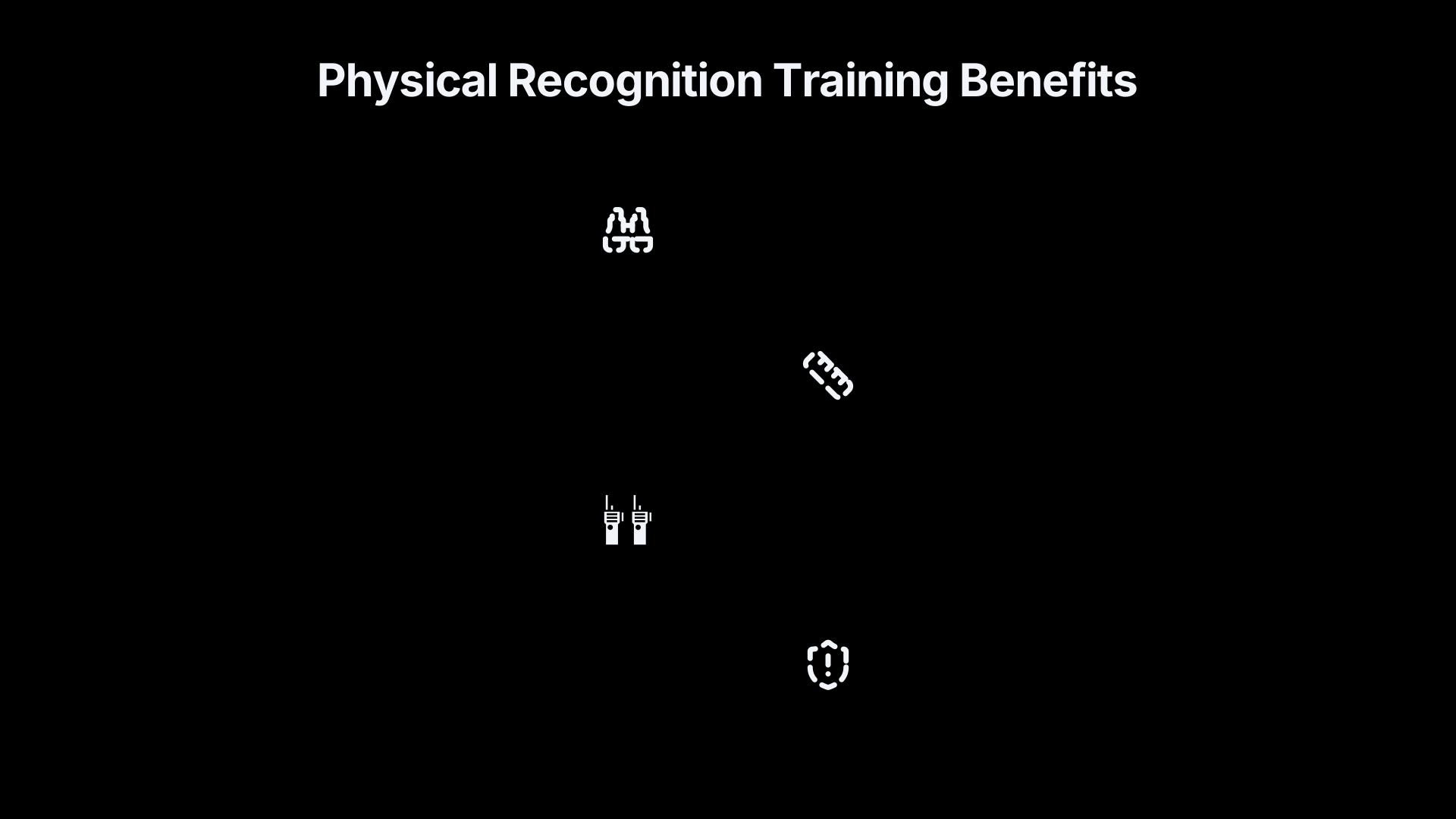
Physical interaction creates memory in several ways:
- Visual memory: recognising shapes, silhouettes and external features.
- Spatial memory: understanding scale, distance and crew positioning.
- Procedural memory: rehearsing reporting, identification and engagement drills.
- Threat perception: developing realistic expectations about enemy capabilities and limitations.
Because these lessons are grounded in tangible experience, they tend to persist longer than classroom instruction alone.
Lessons from Technical Intelligence and Exploitation Units
Technical intelligence organisations often serve as the link between exploitation and training. Their mission is not merely to analyse captured equipment but also to disseminate findings that improve operational readiness. Technical intelligence doctrine identifies captured enemy materiel as a source of both immediate tactical insights and longer-term training value.[Bits]bits.defm2 22.401(06TECHINT9 Jun 2006 — TECHINT includes the identification, assessment, collection, exploitation, and evacuation of captured enemy mater…
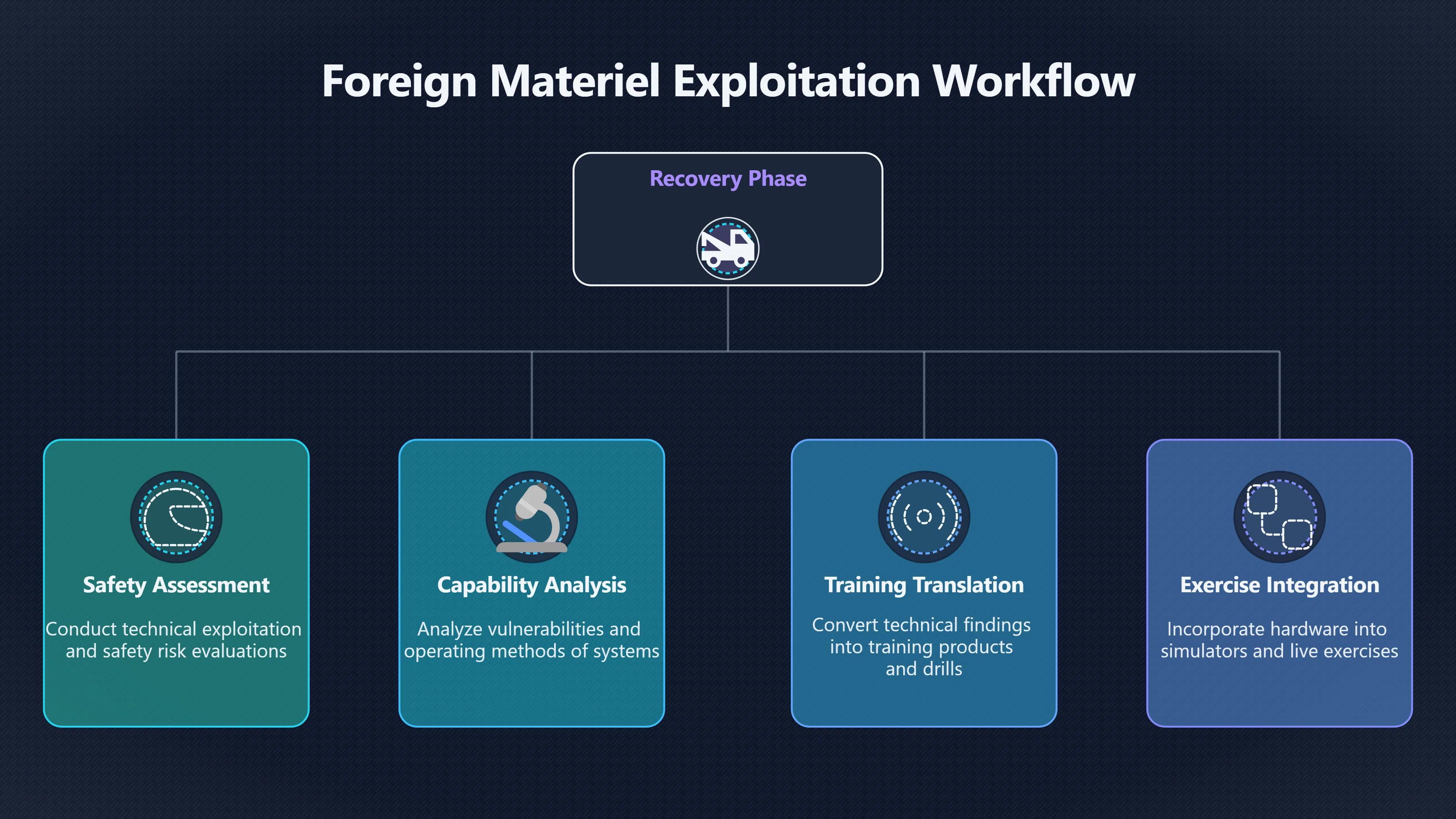
The process generally follows a sequence:
- Recovery and identification of foreign equipment.
- Safety assessment and technical exploitation.
- Analysis of capabilities, vulnerabilities and operating methods.
- Translation of findings into training products.
- Integration into exercises, simulators and familiarisation programmes.
This approach ensures that knowledge derived from battlefield recovery reaches the soldiers most likely to encounter similar threats in future operations.
When Replicas Still Beat Rare Captured Hardware
Real enemy equipment is valuable, but it is not always the best training solution. Captured systems are often scarce, damaged, difficult to maintain or legally restricted. Some exist in such small numbers that routine training use would risk destroying an irreplaceable intelligence asset.
For that reason, many militaries combine authentic materiel with replicas, simulators and visually modified vehicles. Training centres have long employed modified friendly vehicles that resemble foreign armour when genuine systems are unavailable. These substitutes can be fielded in larger numbers, repaired more easily and adapted as threat environments change.[nationaldefensemagazine.org]nationaldefensemagazine.orgAdditionally, the OPFOR has home…Read more…
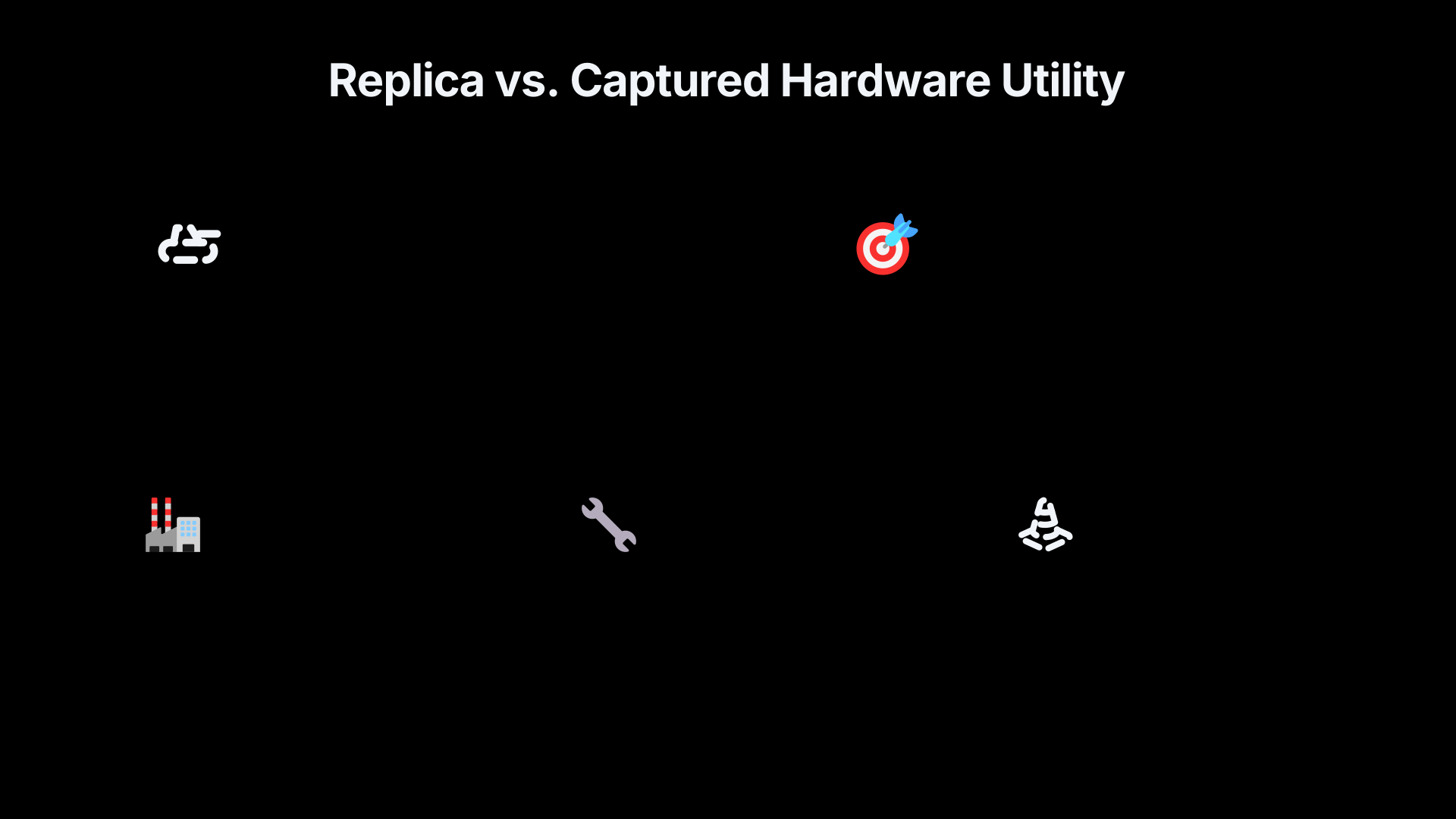
Replicas may outperform genuine captured equipment when:
- Large-scale exercises require dozens of representative vehicles.
- The original system is too rare or fragile.
- Safety concerns limit live operation.
- New threat variants emerge faster than acquisition programmes can obtain examples.
- Trainers need repeatable and low-cost scenarios.
The strongest training programmes therefore use both approaches. Authentic materiel provides accuracy and credibility, while replicas provide scale and availability.
The Force-Protection Payoff
Within ground materiel exploitation, the training value of captured equipment is often as important as the intelligence value. Real foreign hardware turns abstract threat assessments into practical soldier experience. It sharpens recognition skills, validates tactics, improves opposing-force realism and exposes troops to the physical realities of enemy systems before they encounter them in combat.
The result is not simply better technical knowledge. It is faster recognition, more accurate judgement and stronger battlefield instincts—outcomes that directly support force protection and help translate reverse-engineered understanding of foreign military technology into operational readiness.[fas.org]irp.fas.orgIntelligence Resource ProgramAR 381-26 Army Foreign Material Exploitation ProgramThis regulation covers the Army Foreign Material Exploit…
Amazon book picks
Further Reading
Books and field guides related to Why Real Enemy Hardware Changes Training. Use these as the next step if you want deeper reading beyond the article.
On Combat
Focuses on realistic preparation and performance under operational conditions.
Learning to Eat Soup with a Knife
Explains adaptation and learning from real operational experience.
The Defence of Duffer's Drift
Highlights the value of learning from realistic battlefield conditions.
eBay marketplace picks
Marketplace Samples
Live-tested eBay searches with available results related to this page.




Endnotes
1.
Source: bits.de
Title: fm2 22.401(06)
Link:https://www.bits.de/NRANEU/others/amd-us-archive/fm2-22.401%2806%29.pdf
Source snippet
TECHINT9 Jun 2006 — TECHINT includes the identification, assessment, collection, exploitation, and evacuation of captured enemy mater...
2.
Source: Wikipedia
Title: 203rd Military Intelligence Battalion
Link:https://en.wikipedia.org/wiki/203rd_Military_Intelligence_Battalion
3.
Source: army.mil
Title: Reserve MI Battalion Conducts Training Exercise
Link:https://www.army.mil/article/56806/reserve_mi_battalion_conducts_training_exercise
Source snippet
Reserve MI Battalion Conducts Training ExerciseMay 19, 2011 — 19 May 2011 — Training opportunities included a foreign weapons familia...
Published: May 19, 2011
4.
Source: history.army.mil
Link:https://history.army.mil/portals/143/Images/Publications/catalog/69-3.pdf
Source snippet
Army Center of Military HistoryThe Origins and Development of the National Training...December 20, 2010 — by AW Chapman · Cited by 5 — t...
Published: December 20, 2010
5.
Source: cimsec.org
Title: insights from the national training centers opposing force pt 1
Link:https://cimsec.org/insights-from-the-national-training-centers-opposing-force-pt-1/
Source snippet
Insights from the National Training Center's Opposing...6 Aug 2018 — The OPFOR has achieved the combat potential residing in its d...
6.
Source: Wikipedia
Title: Opposing force
Link:https://en.wikipedia.org/wiki/Opposing_force
7.
Source: Wikipedia
Title: [Fort Irwin]({{ ‘fort-irwin/’ | relative_url }}) National Training Center
Link:https://en.wikipedia.org/wiki/Fort_Irwin_National_Training_Center
8.
Source: Wikipedia
Link:https://en.wikipedia.org/wiki/Vismod
9.
Source: irp.fas.org
Link:https://irp.fas.org/doddir/army/ar381-26.htm
Source snippet
Intelligence Resource ProgramAR 381-26 Army Foreign Material Exploitation ProgramThis regulation covers the Army Foreign Material Exploit...
10.
Source: nationaldefensemagazine.org
Link:https://www.nationaldefensemagazine.org/articles/2002/10/31/2002november-homeland-defenders-lack-proper-training
Source snippet
Additionally, the OPFOR has home...Read more...
Additional References
11.
Source: facebook.com
Link:https://www.facebook.com/NATO.JFTC/posts/opposing-force-or-opfor-is-a-training-tool-that-allows-nato-to-train-against-a-c/1925880090952630/
Source snippet
"Opposing Force, or OPFOR, is a training tool that allows...OPFOR is a training tool that allows NATO to train against a challenging and...
12.
Source: greydynamics.com
Link:https://greydynamics.com/fmep-us-foreign-material-exploitation-programs/
Source snippet
FMEP: US Foreign Material Exploitation ProgramsUS Foreign Material Exploitation Programs (FMEPs) covertly and overtly acquire and analyse...
13.
Source: battlefieldvegastraining.com
Link:https://battlefieldvegastraining.com/weapons-and-familiarization-training
Source snippet
Foreign Weapons Familiarization CourseThis five-day class consists of in-depth small arms training that would likely be encountered throu...
14.
Source: balticdefenseinitiative.com
Link:https://balticdefenseinitiative.com/programs/technical-intelligence-training/
Source snippet
Technical Intelligence Exploitation Training ProgramTrain 80+ technical intelligence specialists in equipment exploitation, document anal...
15.
Source: gulflink.health.mil
Link:https://gulflink.health.mil/bw_ii/bw_s02.htm
Source snippet
IIThe JCMEC's technical intelligence mission was to conduct battlefield exploitation of captured enemy equipment to determine its capabil...
16.
Source: coemed.org
Title: 0458 4 20230103 NU NATO EDUCATION TRAINING EXERCISES AND EVALUATION POLICY
Link:https://www.coemed.org/files/Branches/DH/0458-4_20230103_NU_NATO_EDUCATION_TRAINING_EXERCISES_AND_EVALUATION_POLICY.pdf
Source snippet
nato unclassified3 Jan 2023 — Realistic: The MIoP requires effective education and realistic training and exercises to be prepared for fu...
17.
Source: usni.org
Link:https://www.usni.org/magazines/proceedings/2022/may/enhance-maritime-capability-exploit-foreign-threat-systems
Source snippet
In competition below the level of armed conflict, technical and forensic exploitation...Read more...
18.
Source: scribd.com
Link:https://www.scribd.com/document/548921893/Aircrew-Intel
Source snippet
It emphasizes developing and administering training according to the Instructional System Development...Read more...
19.
Source: medium.com
Link:https://medium.com/%40carbonemd/chapter-26-joining-the-soviet-32nd-guards-motorized-rifle-regiment-opfor-at-fort-irwin-d01d8567de5f
Source snippet
enter was the most realistic, intense combat training...Read more...
20.
Source: dtic.minsky.ai
Title: ai Exploitation of Foreign Items
Link:https://dtic.minsky.ai/C28_0605709A_6_2040_PB_2022/text
Source snippet
of Foreign Items - Minsky DTICThis Project provides for the acquisition, exploitation, and inventory of foreign ground materiel with pote...
Topic Tree