Within Intel Centers
How Foreign Armor Becomes Threat Realism
The Army program links foreign ground equipment to threat assessments, simulator development and realistic testing against adversary systems.
On this page
- What the Army program manages across the life cycle
- How ground materiel supports testing and simulators
- Why design features matter beyond simple copying
Page outline Jump by section
Introduction
Army ground-system exploitation is the part of foreign materiel exploitation that turns captured or acquired tanks, armoured vehicles, anti-tank weapons, sights, sensors, communications equipment and other battlefield systems into practical military knowledge. Its purpose is not simply to discover how foreign equipment works. The larger goal is to make training, testing, modelling and operational planning reflect the capabilities of real adversary systems rather than assumptions about them. In the United States, this mission has been centred on the Army Foreign Materiel Program and the National Ground Intelligence Center (NGIC), which acquire, analyse and disseminate information on foreign ground-force technology. The resulting intelligence feeds threat assessments, simulator development, operational testing, force modernisation and countermeasure design.[fas.org]fas.orgIntelligence Resource Program Chapter 8 National Ground Intelligence Center (NGIC)NGIC is the Army's executive agent for acquisition andIntelligence Resource ProgramChapter 8 National Ground Intelligence Center (NGIC)NGIC is the Army's executive agent for acquisition and e…

Within the broader field of reverse engineering foreign military technology, the Army’s contribution is distinctive because it focuses on how ground forces actually fight. A captured vehicle or weapon system is valuable not merely as an engineering specimen but as evidence about how an opposing force detects targets, survives on the battlefield, communicates, manoeuvres and employs firepower. Exploitation therefore becomes a foundation for realistic threat representation across the Army’s training and testing enterprise.[Intelligence Resource Program]fas.orgIntelligence Resource Program Chapter 8 National Ground Intelligence Center (NGIC)NGIC is the Army's executive agent for acquisition andIntelligence Resource ProgramChapter 8 National Ground Intelligence Center (NGIC)NGIC is the Army's executive agent for acquisition and e…
What the Army Program Manages Across the Life Cycle
The Army’s foreign materiel effort extends far beyond the moment a foreign system is obtained. Official programme descriptions describe a cycle that includes acquisition, exploitation, inventory management, scientific and technical intelligence production, support to training and assistance to force-development organisations. The programme is intended to reduce uncertainty about advanced foreign threats and provide material for realistic testing, training and countermeasure development.[army.mil]army.milFinancial Management RDTEArmy's capability and capacity to provide realistic … exploitation, and inventory of foreign ground materiel with potential advanced te…
NGIC has long served as the Army’s executive agent for foreign ground-system exploitation. Its role includes establishing priorities, coordinating acquisition, working with intelligence collectors, and exploiting foreign systems to understand strengths, vulnerabilities and technological implications for US forces. The centre’s customers are not limited to intelligence analysts. Research laboratories, test organisations, programme managers and operational commanders all depend on the information generated from exploited materiel.[Intelligence Resource Program]fas.orgIntelligence Resource Program Chapter 8 National Ground Intelligence Center (NGIC)NGIC is the Army's executive agent for acquisition andIntelligence Resource ProgramChapter 8 National Ground Intelligence Center (NGIC)NGIC is the Army's executive agent for acquisition and e…
This life-cycle approach reflects an important institutional choice. Ground systems are rarely examined only once. As new intelligence emerges, additional components become available, or battlefield experience accumulates, assessments may change. Maintaining a permanent exploitation capability allows the Army to revisit earlier conclusions and integrate new findings into threat databases, modelling efforts and operational guidance.[U.S. Department of War]dodig.milAbout · Contact Us · DoW OIG Careers · Reports · All… 5, 2023. Project Announcement: Evaluation of the Department of Defense…Read more…(https://media.defense.gov/1997/Oct/08/2001715489/-1/-1/1/98-005.pdf)
How Captured Equipment Becomes Threat Realism
The most visible outcome of Army exploitation is threat realism. Military testing and training depend on representing foreign systems as accurately as possible. If a simulator, target or threat model is based on outdated assumptions, the resulting test results may be misleading.
A Department of Defense Inspector General review found that foreign materiel exploitation data played a direct role in modifying simulators, supporting target development and informing training and tactics communities. The same review warned that when threat systems are not validated against the latest exploitation findings, simulators and models can diverge from real-world threats.[U.S. Department of War]dodig.milAbout · Contact Us · DoW OIG Careers · Reports · All… 5, 2023. Project Announcement: Evaluation of the Department of Defense…Read more…(https://media.defense.gov/1997/Oct/08/2001715489/-1/-1/1/98-005.pdf)
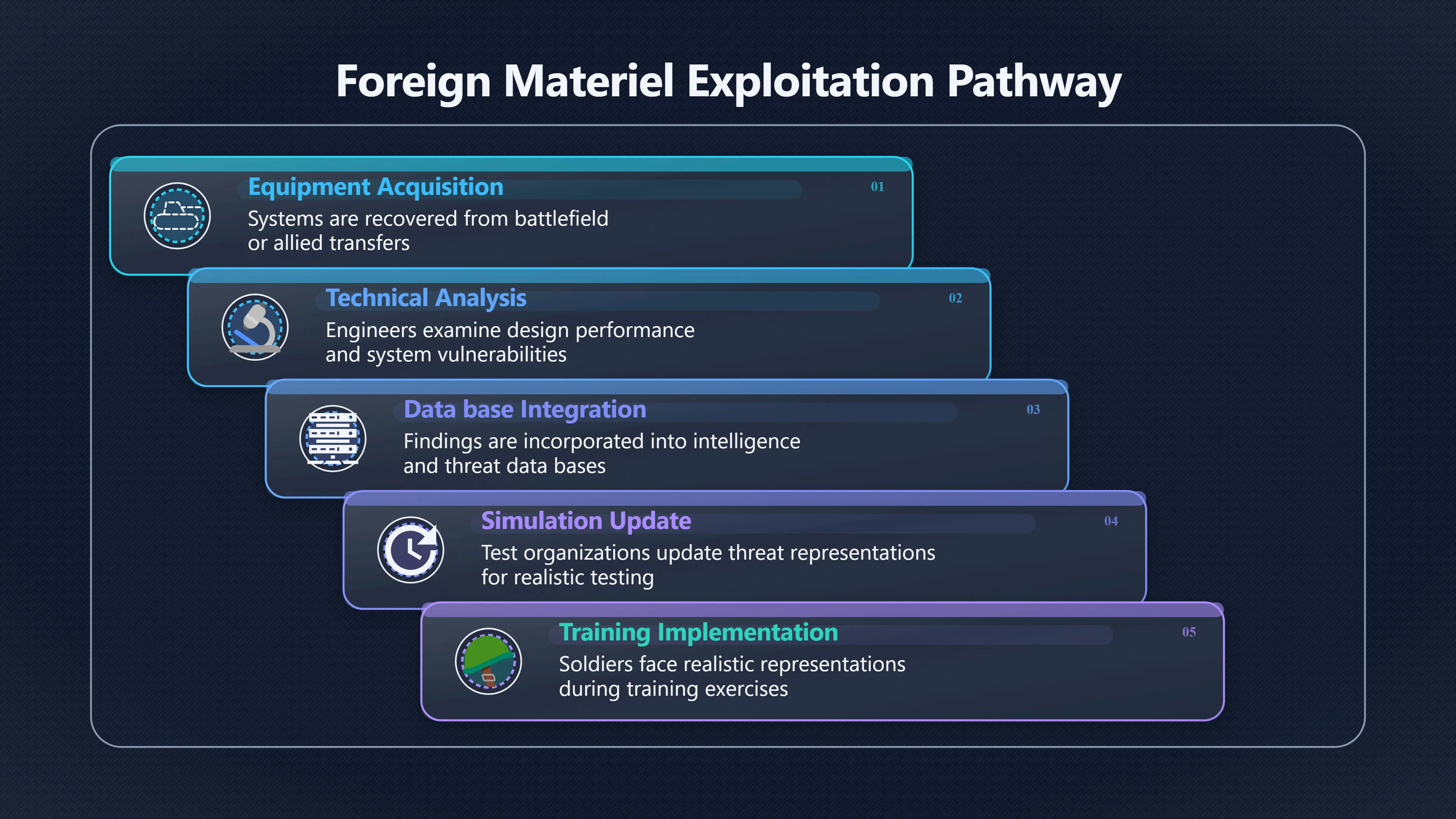
The practical pathway usually works as follows:

- Foreign equipment is acquired through intelligence collection, battlefield recovery, allied transfers or other authorised channels.
- Engineers and analysts examine the system’s design, performance and vulnerabilities.
- Technical findings are incorporated into intelligence products and threat databases.
- Test organisations update threat representations used during developmental and operational testing.
- Training centres and simulation systems incorporate revised threat characteristics.
- Operators encounter a more realistic representation of potential adversaries during exercises and evaluations. Intelligence Resource Program+2U.S. Department of War
The value of this process is that it links physical evidence to operational realism. Instead of training against a generic tank, missile launcher or sensor, soldiers can face a representation informed by actual measurements and technical analysis.
Why Training Centres Need Real Adversary Systems
The Army’s emphasis on realistic threats is closely tied to its “train as you fight” philosophy. NGIC has historically supported major training environments such as the National Training Center and Joint Readiness Training Center by providing intelligence products and threat information used in exercises. Intelligence Resource Program
For commanders and trainers, the critical question is not whether a foreign system exists but how it behaves under realistic conditions. Exploited materiel helps answer questions such as:
- How far can a sensor detect vehicles under different conditions?
- How quickly can a fire-control system engage targets?
- What signatures are visible to opposing reconnaissance assets?
- Which vulnerabilities can be exploited by friendly forces?
- Which assumptions about adversary capabilities are incorrect? Intelligence Resource Program
These details influence exercise design, opposing-force tactics and battlefield decision-making. A realistic threat environment is often more valuable than a simple catalogue of enemy equipment because it exposes units to the practical consequences of adversary technology.
Why Design Features Matter Beyond Simple Copying
A common misconception is that exploitation exists primarily to enable copying of foreign equipment. For Army ground systems, the more important objective is understanding why particular design choices matter operationally.
A captured armoured vehicle, for example, may reveal more than armour thickness or engine performance. Analysts can study sensor placement, crew layout, communication architecture, maintenance requirements and integration with wider battlefield systems. These features influence survivability, logistics burdens, tactical flexibility and combat effectiveness. Intelligence Resource Program
The Army’s exploitation programmes are explicitly intended to support force and materiel development by reducing uncertainty about foreign capabilities. Understanding an adversary’s engineering decisions can inform future US requirements, identify technological trends and reveal where countermeasures may be most effective. Army Financial Management
This is why exploitation often focuses as much on system integration as on individual components. A sight, sensor or communication device may appear unremarkable in isolation, yet become significant when analysed as part of a larger combat system.
The Link Between Exploitation and Testing
One of the strongest institutional connections is between foreign materiel exploitation and formal test and evaluation activities. Modern military testing depends on realistic threat representations. If the threat model is wrong, a weapon, vehicle or sensor may appear more effective than it would be against an actual adversary.
DoD reviews have repeatedly highlighted the importance of keeping threat simulators aligned with current intelligence and exploitation findings. Threat models, target systems and simulation environments must be updated as new information becomes available. Otherwise, testing risks measuring performance against a fictional opponent rather than a real one. U.S. Department of War+2U.S. Department of War
This connection explains why exploitation organisations work closely with testing communities. The goal is not merely to produce reports but to ensure that evaluations of new equipment occur against credible representations of foreign capabilities.
From Battlefield Artefact to Institutional Knowledge
The enduring significance of Army ground-system exploitation lies in its ability to convert isolated pieces of equipment into long-term institutional knowledge. A captured vehicle, weapon or sensor becomes more than a technical curiosity once its characteristics are incorporated into intelligence assessments, threat databases, training environments and testing programmes.
NGIC’s role as the Department of Defense’s primary producer of ground-force intelligence reflects this broader purpose. Exploitation is valuable because it connects physical evidence to operational understanding. The final product is not a dismantled vehicle or a laboratory report but a more realistic picture of how foreign ground forces fight and how friendly forces should prepare to face them. U.S. Army ISCOM+2JTAPIC
Amazon book picks
Further Reading
Books and field guides related to How Foreign Armor Becomes Threat Realism. Use these as the next step if you want deeper reading beyond the article.
The Kill Chain
Explains how understanding adversary capabilities shapes modern military planning and force development.
The Pentagon's Brain
Covers military technology exploitation, testing, and innovation ecosystems.
Spycraft
Shows how technical intelligence collection turns foreign systems into actionable knowledge.
Armored Cav
Focuses on armored warfare and the practical realities of ground-force capabilities.
eBay marketplace picks
Marketplace Samples
Live-tested eBay searches with available results related to this page.

Endnotes
1.
Source: usainscom.army.mil
Link:https://www.usainscom.army.mil/MSCs/NGIC/
Source snippet
U.S. Army ISCOMNational Ground Intelligence CenterWe produce intelligence on foreign ground forces to enable U.S. decision advantage thro...
2.
Source: dtic.minsky.ai
Link:https://dtic.minsky.ai/index/d1307cd699990a0702f802bf6c5e0875
Source snippet
Minsky DTICArmy Foreign Materiel Program (FMP) Exploitation1 Oct 2023 — This effort provides for the exploitation and inventory of foreig...
3.
Source: jtapic.health.mil
Link:https://jtapic.health.mil/index.cfm/partners/ngic
Source snippet
Ground Intelligence Center (NGIC)NGIC produces scientific and technical intelligence and military capabilities analysis on foreign ground...
4.
Source: asafm.army.mil
Title: Financial Management RDTE
Link:https://www.asafm.army.mil/Portals/72/[Documents
Source snippet
Army's capability and capacity to provide realistic... exploitation, and inventory of foreign ground materiel with potential advanced te...
5.
Source: media.defense.gov
Link:https://media.defense.gov/1997/Oct/08/2001715489/-1/-1/1/98-005.pdf
Source snippet
Department of WarUse of Foreign Materiel Exploitation ResultsSeptember 22, 2015 — 8 Oct 1997 — The National Ground Intelligence Center di...
Published: September 22, 2015
6.
Source: media.defense.gov
Link:https://media.defense.gov/1990/Jun/27/2001714394/-1/-1/1/90-089.pdf
Source snippet
Department of WarDoD Management of Threat Simulators27 Jun 1990 — We recommended that the Deputy. Director charter a Joint Threat Simulat...
7.
Source: comptroller.war.gov
Title: FY 2023 DD 1414 Base for Reprogramming Actions
Link:https://comptroller.war.gov/Portals/45/Documents/execution/FY_2023_DD_1414_Base_for_Reprogramming_Actions.pdf
Source snippet
Threat Program - Unit Activity Monito. BIOMETRIC ENABLING CAPABILITY (BEC)... Exploitation of Foreign Items. 6,186. 6,186. FY 2023 Appro...
8.
Source: youtube.com
Title: TECHINT on Russian T-80 Tank’s Radio/Comms Electronics
Link:https://www.youtube.com/watch?v=GSi-WX4nchU
Source snippet
National Ground Intelligence Center | Wikipedia audio article...
9.
Source: youtube.com
Title: National Ground Intelligence Center | Wikipedia audio article
Link:https://www.youtube.com/watch?v=7AaVn7szkMw
Source snippet
Opposing Force: U.S. Soldiers and Romanian Tank OPFOR...
11.
Source: Wikipedia
Title: National Ground Intelligence Center
Link:https://en.wikipedia.org/wiki/National_Ground_Intelligence_Center
Source snippet
National Ground Intelligence CenterThe NGIC also manages the Army's Foreign Materiel Exploitation Program and foreign material... Arm...
Additional References
12.
Source: dodig.mil
Link:https://www.dodig.mil/Reports/Audits-and-Evaluations/?Page=53
Source snippet
About · Contact Us · DoW OIG Careers · Reports · All... 5, 2023. Project Announcement: Evaluation of the Department of Defense...Read more...
13.
Source: greydynamics.com
Link:https://greydynamics.com/fmep-us-foreign-material-exploitation-programs/
Source snippet
A core mission of the NGIC is to run the US Army's Foreign Materiel Exploitation...Read more...
14.
Source: nga.mil
Title: GEOSPATIA L INTELLIGENCE (GEOINT) BASIC DOCTRINE
Link:https://www.nga.mil/assets/files/170901-038_GEOINT_Basic_Doctrine_Pub_1.pdf
Source snippet
threat to inhabited areas at the time.... [Signals]({{ 'signals/' | relative_url }}) Intelligence (SIGINT): A form of technical intelligence derived from the exploitation...
15.
Source: esd.whs.mil
Title: 08 F 1748 Foreign Materiel Program 10 10 2006
Link:https://www.esd.whs.mil/Portals/54/Documents/FOID/Reading%20Room/Administration_and_Management/08-F-1748_Foreign_Materiel_Program_10-10-2006.pdf?ver=2017-05-15-135556-097
Source snippet
WHS ESDDIRECTIVE10 Oct 2006 — (U) Foreign Materiel Exploitation (FME). FMP... (U) The Department of Defense shall acquire and exploit fo...
16.
Source: Wikipedia
Title: National Air and Space Intelligence Center
Link:https://en.wikipedia.org/wiki/National_Air_and_Space_Intelligence_Center
Source snippet
National Air and Space Intelligence CenterThe National Air and Space Intelligence Center (NASIC) is the United States Air Force unit f...
17.
Source: info.publicintelligence.net
Title: USArmy Unified Exploitation
Link:https://info.publicintelligence.net/USArmy-UnifiedExploitation.pdf
Source snippet
Unified Exploitation Concept of Operations 2012-...19 Jun 2012 — Threat characterization and exploitation, development of specific Jamme...
18.
Source: nasic.af.mil
Title: acquire assess exploit
Link:https://www.nasic.af.mil/News/Article-Display/Article/1010245/acquire-assess-exploit/
Source snippet
af.milAcquire, Assess, Exploit21 Nov 2016 — The Department of Defense's foreign materiel acquisition and exploitation programs continue t...
19.
Source: dote.osd.mil
Link:https://www.dote.osd.mil/Portals/97/pub/reports/FY2025/dotemanaged/2025tetra.pdf?ver=TApqLrSM9VN6ZkHvcbqX6w%3D%3D
Source snippet
Test and Evaluation Threat Resource Activity (TETRA)Produces intelligence-driven artifacts, analysis, models, and simulations analyzi...
20.
Source: youtube.com
Title: M113A3 OPFOR Surrogate Vehicle: The Armored Trainer Built for Modern Warfare
Link:https://www.youtube.com/watch?v=3BBS6RMgyxc
Source snippet
TECHINT on Russian T-80 Tank's Radio/Comms Electronics...
21.
Source: youtube.com
Title: Opposing Force: U.S. Soldiers and Romanian Tank OPFOR
Link:https://www.youtube.com/watch?v=SHMgZHXJTiA
Source snippet
U.S. Soldiers Conduct OPFOR, React To Contact - CR26-05...
Topic Tree