Within Threat Training
How Threat Training Goes Stale
Exploitation data matters only if ranges, simulators and threat models are updated before old assumptions become training folklore.
On this page
- The danger of outdated simulators
- Why validation against real materiel matters
- How stale assumptions mislead crews
Page outline Jump by section
Introduction
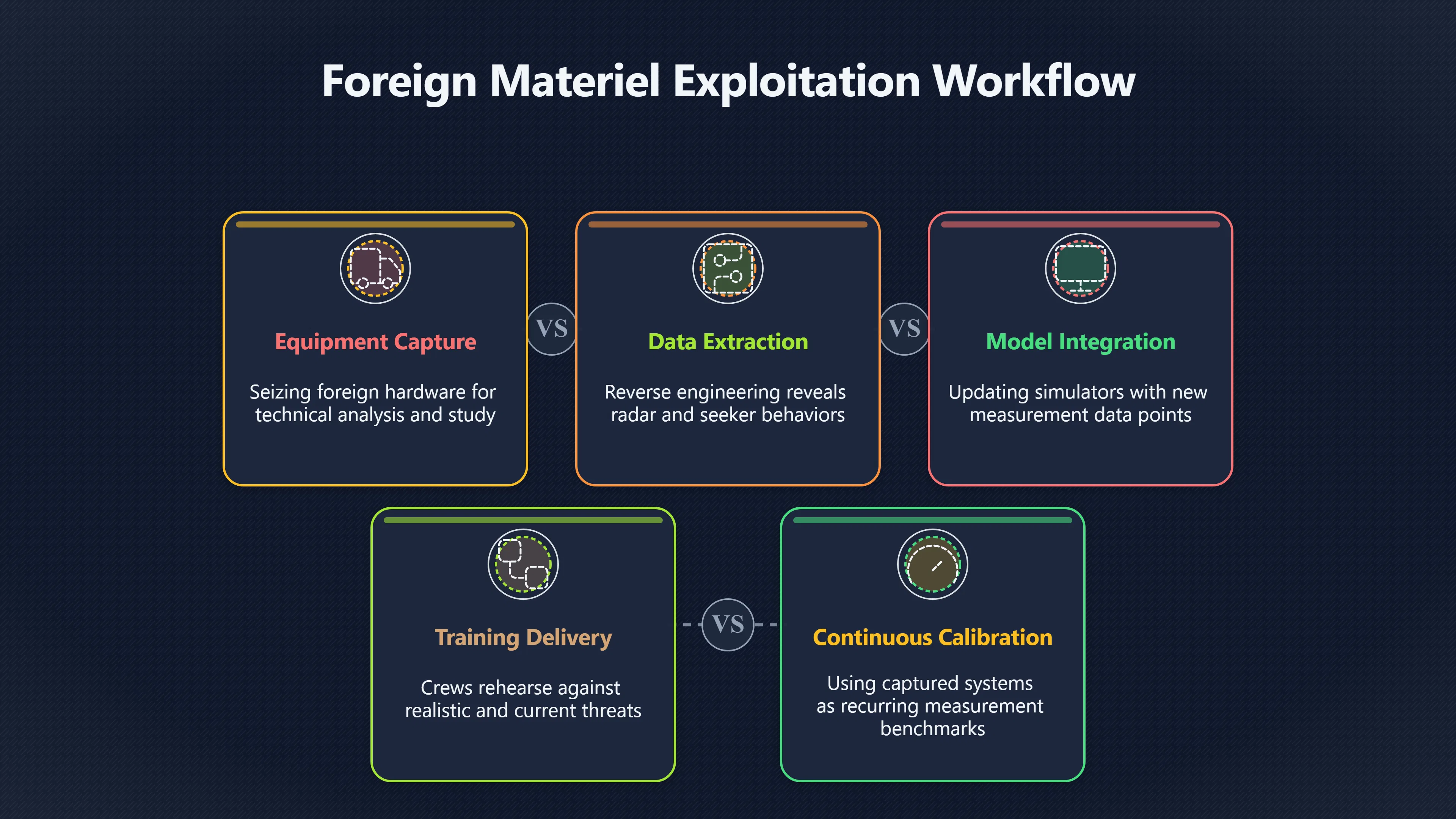
Captured foreign equipment improves military training only when the information extracted from that equipment reaches the ranges, simulators and threat databases used by trainees. Reverse engineering can reveal how a radar actually tracks targets, how a missile seeker behaves under interference, or how a vehicle performs under operational conditions. Yet those insights lose value if training systems continue to rely on older assumptions. The central risk is not a lack of data but a failure to refresh training models after new measurements become available. Historical audits of defence exploitation programmes repeatedly identified this gap: intelligence organisations often produced useful foreign materiel data, while training and simulation systems lagged behind. The result is training against a threat that no longer matches reality.[U.S. Department of War]media.defense.govDepartment of WarUse of Foreign Materiel Exploitation ResultsSeptember 22, 2015 — 8 Oct 1997 — However, the Military Departments did not…
How Threat Training Goes Stale
Training systems are built around assumptions. Radar simulators assume detection ranges, electronic warfare trainers assume emitter behaviour, and opposing-force exercises assume certain vehicle capabilities. Over time those assumptions can become institutional knowledge that survives long after the underlying threat has changed.
The problem becomes especially acute when foreign materiel exploitation produces new measurements that contradict established beliefs. If the updated data are not incorporated into training systems, crews continue rehearsing against outdated representations. They may learn the wrong engagement distances, expect incorrect warning times, or misunderstand how an adversary system reacts under stress. What begins as a small modelling discrepancy can become a systematic training error repeated across thousands of simulator hours.[U.S. Department of War]media.defense.govDepartment of WarUse of Foreign Materiel Exploitation ResultsSeptember 22, 2015 — 8 Oct 1997 — However, the Military Departments did not…
The danger is amplified because simulators are often trusted precisely because they appear realistic. An inaccurate simulator can therefore reinforce false confidence more effectively than an acknowledged knowledge gap.
The Danger of Outdated Simulators
A significant Department of Defense Inspector General review in 1997 examined how foreign materiel exploitation results were disseminated and used. The audit concluded that exploitation findings generally reached relevant communities, but it also found that military departments did not always validate simulated threat systems against the latest exploitation data. According to the report, this created a risk that threat models and simulators no longer accurately represented real-world threats.[U.S. Department of War]media.defense.govDepartment of WarUse of Foreign Materiel Exploitation ResultsSeptember 22, 2015 — 8 Oct 1997 — However, the Military Departments did not…
The finding was important because the problem was not intelligence collection. The exploitation system was generating information. The weakness lay in updating the training infrastructure that depended on that information. The audit specifically highlighted shortcomings in revalidation processes, including inconsistent criteria for determining when a simulator should be reviewed after new foreign materiel data became available.[U.S. Department of War]media.defense.govDepartment of WarUse of Foreign Materiel Exploitation ResultsSeptember 22, 2015 — 8 Oct 1997 — However, the Military Departments did not…
This distinction matters. A simulator can remain technically functional while becoming operationally obsolete. Crews may still receive extensive training, but the threat representation embedded in the software, hardware replica or range emitter may reflect assumptions that are years old.
Why Validation Against Real Materiel Matters
Foreign materiel provides a rare benchmark against which training systems can be tested. Rather than relying entirely on intelligence estimates, engineers can compare a simulator’s behaviour with measured performance from actual equipment.
Validation typically asks a straightforward question: does the simulator still behave like the threat it claims to represent? The answer can change as new exploitation programmes uncover previously unknown characteristics. Captured or acquired systems may reveal differences in sensor performance, electronic signatures, guidance logic, communications behaviour or operational limitations. Those discoveries can require adjustments across multiple training systems simultaneously.[U.S. Department of War]media.defense.govDepartment of WarUse of Foreign Materiel Exploitation ResultsSeptember 22, 2015 — 8 Oct 1997 — However, the Military Departments did not…
The value of validation is not merely technical accuracy. It prevents training organisations from treating legacy assumptions as facts. Once a threat model has been used for years, instructors and trainees may begin to regard its behaviour as authoritative. Validation against real materiel acts as a corrective mechanism, forcing organisations to test whether long-standing beliefs still match observed reality.[U.S. Department of War]media.defense.govDepartment of WarUse of Foreign Materiel Exploitation ResultsSeptember 22, 2015 — 8 Oct 1997 — However, the Military Departments did not…
How Stale Assumptions Mislead Crews
The most serious consequence of stale threat data is behavioural. Crews train repeatedly until responses become instinctive. If the underlying threat model is wrong, those instincts can be wrong as well.
Several forms of distortion are common:
- Incorrect timing expectations. Operators may expect more warning time than a real threat would allow.
- Misjudged effectiveness. Countermeasures may appear more successful in simulation than they would be against actual equipment.
- Faulty tactical choices. Aircrews or ground forces may adopt manoeuvres optimised for an outdated threat profile.
- False confidence in detection and identification. Systems may be trained against simplified or inaccurate signatures rather than real-world behaviour.
Because these lessons are reinforced through repetition, correcting them later can be difficult. The issue is not merely that training becomes less realistic; it can shape decision-making in combat around assumptions already disproved by exploitation data.[U.S. Department of War]media.defense.govDepartment of WarUse of Foreign Materiel Exploitation ResultsSeptember 22, 2015 — 8 Oct 1997 — However, the Military Departments did not…

The Real Challenge Is the Update Cycle
The lesson from foreign materiel exploitation programmes is that collecting data is only the first step. The lasting value comes from maintaining a continuous update cycle linking exploitation laboratories, intelligence analysts, simulator developers, range operators and training commands.
Army budget documents describing foreign materiel exploitation emphasise that the programme provides materiel for realistic testing and training, not simply for technical study. The implication is that exploitation succeeds only when discoveries are converted into operationally useful representations for trainees.[Army Financial Management]asafm.army.milArmy Financial ManagementBudget Activity 6Conducted Foreign Materiel Exploitation (FME) of threat related foreign ground materiel systems…
Viewed through that lens, captured equipment is not a one-time intelligence prize. It is a recurring calibration tool. Every new measurement offers a chance to test whether existing training systems still reflect reality. Without that feedback loop, threat training gradually drifts from observation toward tradition, and tradition eventually hardens into folklore. The practical value of foreign materiel therefore lies not only in what it reveals about an adversary, but in its ability to keep training aligned with the adversary that actually exists rather than the one remembered from older models.[U.S. Department of War]media.defense.govDepartment of WarUse of Foreign Materiel Exploitation ResultsSeptember 22, 2015 — 8 Oct 1997 — However, the Military Departments did not…
Amazon book picks
Further Reading
Books and field guides related to How Threat Training Goes Stale. Use these as the next step if you want deeper reading beyond the article.
Military Misfortunes
Explains how institutions fail to adapt and update assumptions, mirroring stale threat-training problems.
The Kill Chain
Examines the consequences of preparing for outdated threat environments.
Team of Teams
Addresses information flow and institutional responsiveness when conditions change.
Military Adaptation in War
Focuses on adapting to changing threats and avoiding outdated assumptions.
eBay marketplace picks
Marketplace Samples
Live-tested eBay searches with available results related to this page.



Endnotes
1.
Source: media.defense.gov
Link:https://media.defense.gov/1997/Oct/08/2001715489/-1/-1/1/98-005.pdf
Source snippet
Department of WarUse of Foreign Materiel Exploitation ResultsSeptember 22, 2015 — 8 Oct 1997 — However, the Military Departments did not...
Published: September 22, 2015
2.
Source: asafm.army.mil
Link:https://www.asafm.army.mil/Portals/72/Documents/BudgetMaterial/2016/base%20budget/rdte/Budget%20Activity%206.pdf
Source snippet
Army Financial ManagementBudget Activity 6Conducted Foreign Materiel Exploitation (FME) of threat related foreign ground materiel systems...
3.
Source: media.defense.gov
Link:https://media.defense.gov/1990/Jun/27/2001714394/-1/-1/1/90-089.pdf
Source snippet
U.S. Department of WarDoD Management of Threat Simulators27 Jun 1990 — This is our final report on the Audit of the DoD Management of Thr...
Additional References
4.
Source: dodig.mil
Link:https://www.dodig.mil/reports.html/Article/1118218/use-of-foreign-materiel-exploitation-results/
Source snippet
Use of Foreign Materiel Exploitation ResultsUse of Foreign Materiel Exploitation Results. 98-005. SHARE · PRINT. Related Documents. Use o...
5.
Source: ieis.eu
Link:https://ieis.eu/category/training/
Source snippet
Training – Institute for European Intelligence & SecurityThe Intelligence Academy brings advanced tools, techniques and expertise to envi...
6.
Source: cto.mil
Title: NAT O STANDARD AOP-52 GUIDANCE ON SOFTWARE
Link:https://www.cto.mil/wp-content/uploads/2025/08/AOP-52-EDB-V1E.pdf
Source snippet
assumptions about data values are violated in the foreign language code that might not be detected upon returning to the Ada code (e.g...
7.
Source: dcsa.mil
Title: JSIG 2016April11 Final (53Rev4)
Link:https://www.dcsa.mil/portals/91/documents/ctp/nao/JSIG_2016April11Final%2853Rev4%29.pdf
Source snippet
department of defense (dod)11 Apr 2016 — This document provides standardized security policies and procedures for use in the management o...
8.
Source: mscoe.org
Title: nato modelling and simulation
Link:https://www.mscoe.org/content/uploads/2023/09/Agenda-CF23-3.11.pdf
Source snippet
Abstract: Current NATO planning relies on expert assumptions and historic data, but recent studies have shown the benefits of simulation...
9.
Source: gao.gov
Title: gao 25 107569
Link:https://www.gao.gov/assets/gao-25-107569.pdf
Source snippet
Weapon Systems Annual Assessment11 Jun 2025 — What GAO Found. The Department of Defense (DOD) continues to struggle with delivering innov...
10.
Source: youtube.com
Title: Aviation Historian Peter Merlin talks about the Russian Mi Gs at AREA 51
Link:https://www.youtube.com/watch?v=t79ndKspdvQ
Source snippet
Elbit Systems UK / Airborne EW Training and Simulation System...
11.
Source: nvlpubs.nist.gov
Link:https://nvlpubs.nist.gov/nistpubs/Legacy/IR/nistir7826.pdf
Source snippet
nist.govDHS/NIST Workshop on Homeland Security Modeling...by C McLean · 2011 · Cited by 4 — • Develop, protect, and maintain data system...
12.
Source: youtube.com
Title: Elbit Systems UK / Airborne EW Training and Simulation System
Link:https://www.youtube.com/watch?v=DV4dLFEBJF8
Source snippet
Advanced Radar Threat System Helps Aircrews Train to Evade Enemy Missiles...
13.
Source: youtube.com
Title: Advanced Radar Threat System Helps Aircrews Train to Evade Enemy Missiles
Link:https://www.youtube.com/watch?v=1TNLGXpxWUg
Source snippet
Flight Ready: Next generation threat system...
Topic Tree