Within Foreign Materiel
Why Copying a Bomber Was Hard
The Soviet Tu-4 shows that duplicating an aircraft still requires redesign, industrial capacity and tradeoffs.
On this page
- B 29 aircraft in Soviet hands
- Metric and material challenges
- What replication proved
Page outline Jump by section
Introduction
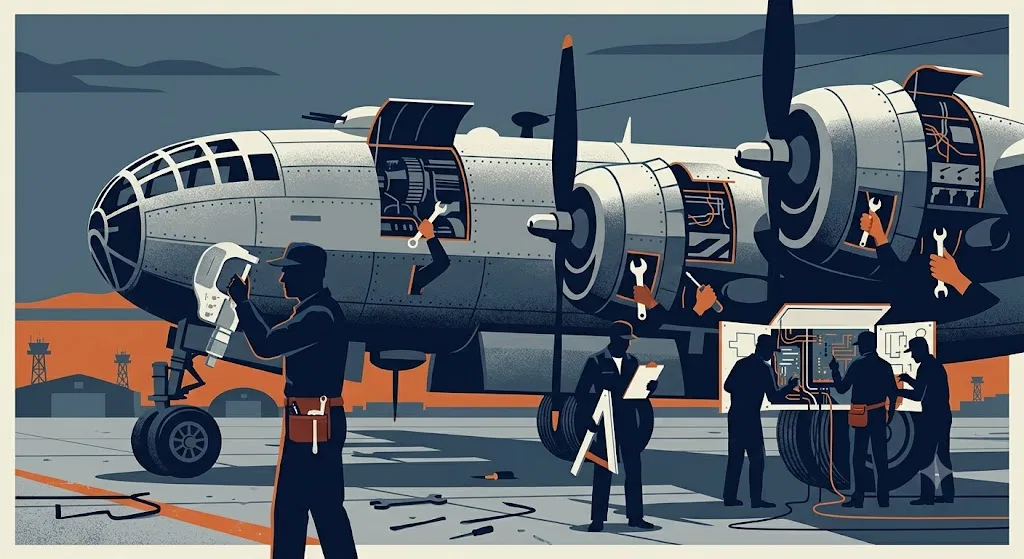
The Tupolev Tu-4 is one of the clearest cases in military history where “copying” a foreign weapon turned out to be much harder than tracing its outline. The Soviet Union obtained American B-29 Superfortress bombers that had landed in Soviet territory during the Second World War, then ordered Tupolev’s design bureau to reproduce the aircraft at speed. The result looked so much like a B-29 that Western observers at first mistook it for the original aircraft, but making it fly required far more than dismantling, measuring and rebuilding. Soviet engineers had to translate an American industrial product into Soviet materials, metric standards, production habits, engines, weapons, electronics and quality-control systems. The Tu-4 therefore matters less as a story of theft than as a lesson in reverse engineering: a state can copy a captured aircraft only if it can also copy, adapt or replace the industrial ecosystem that made the aircraft possible.[smithsonianmag.com]smithsonianmag.comSmithsonian Magazine Made in the U.S.S.ROf course they copied it. The two airplanes could have been twins. But was the Soviets' Tu-4 truly an exact duplicate of the Boeing B-29?…
B-29 Aircraft in Soviet Hands
The Tu-4 story began because the Soviet Union did not receive the B-29 through normal wartime supply. The United States had refused to provide the Superfortress under Lend-Lease, while the Soviet Union remained neutral in the Pacific war against Japan until August 1945. In 1944, several damaged B-29s returning from missions against Japan landed or crashed in Soviet-controlled territory. Their crews were eventually repatriated, but the aircraft were retained, giving Soviet engineers a rare physical example of the most advanced American bomber of the period.[Wikipedia]WikipediaTupolev Tu-4Tupolev Tu-4
The aircraft were not just useful as airframes. The B-29 was a whole system: pressurised crew compartments, long-range structure, powerful engines, remote-controlled defensive turrets, advanced fire-control equipment, radios, electrical systems and production details that reflected the enormous American wartime aircraft industry. The Smithsonian’s National Air and Space Museum describes the B-29 as the most sophisticated propeller-driven bomber of the Second World War and the first bomber to house its crew in pressurised compartments; its defensive system and avionics made it especially difficult to duplicate.[National Air and Space Museum]airandspace.si.eduNational Air and Space MuseumBoeing B-29 Superfortress Enola GayBoeing's B-29 Superfortress was the most sophisticated propeller-driven b…
Stalin’s order was not simply to learn from the B-29 but to reproduce it quickly. Tupolev had other bomber design work under way, yet the Soviet leadership wanted a proven long-range bomber rather than a slower indigenous development path. That political decision shaped the engineering problem. A normal design bureau might alter a foreign design freely to suit domestic factories. The Tu-4 programme, by contrast, began with the demand that the aircraft remain visibly and functionally as close as possible to the B-29, because any large redesign risked delay.[Wikipedia]WikipediaTupolev Tu-4Tupolev Tu-4
This is why the 1947 public debut was so startling. At the Tushino Aviation Day display on 3 August 1947, Western observers initially thought the aircraft overhead might simply be the known interned B-29s. The appearance of additional aircraft showed that the Soviet Union had not merely repaired captured bombers; it had produced its own version. Air & Space Forces Magazine later summarised the shock bluntly: the Soviet Union had produced flyable B-29 replicas in roughly two years, giving it a credible strategic bomber much sooner than many outside observers had expected.[Wikipedia]WikipediaTupolev Tu-4Tupolev Tu-4

Metric and Material Challenges
The phrase “copy of the B-29” hides the most important difficulty: aircraft are not just shapes. They are assemblies of thousands of parts made to particular tolerances, from particular alloys, in particular thicknesses, using particular fasteners, tools, inspection methods and production routines. A captured aircraft can tell engineers what the finished object looks like, but it does not automatically provide the factory system that produced it.
The documentation burden alone was immense. The Smithsonian account says Soviet reverse engineering involved analysing and photographing around 105,000 parts, while Tupolev’s team produced about 40,000 detailed drawings with the help of roughly a thousand draftsmen. That was not clerical excess; it was the practical work of turning a finished American aircraft back into a Soviet-manufacturable design package.[Smithsonian Magazine]smithsonianmag.comSmithsonian Magazine Made in the U.S.S.ROf course they copied it. The two airplanes could have been twins. But was the Soviets' Tu-4 truly an exact duplicate of the Boeing B-29?…
The metric problem was one of the most famous examples. The B-29 had been designed and built using American customary measurements. Soviet industry worked in metric standards, and Soviet factories did not necessarily have aluminium sheet, tubing, wire, bearings or fasteners in the exact imperial sizes found on the original aircraft. A skin panel that looked like a simple piece of aluminium could become a design decision: use the nearest metric thickness and change weight or strength, create a new production standard, or redesign surrounding parts to compensate.[Wikipedia]WikipediaTupolev Tu-4Tupolev Tu-4
That mattered because aircraft design is unforgiving. A bomber is a weight budget with wings. Slightly thicker metal may improve strength but add mass; slightly thinner metal may save weight but reduce safety margins; substituting another alloy can change fatigue behaviour, corrosion resistance, forming methods and repair practice. The Tu-4 was therefore not a photocopy in the ordinary sense. It was a translation from one industrial language into another, and every translation introduced the possibility of weight gain, production delay or performance loss.[Wikipedia]WikipediaTupolev Tu-4Tupolev Tu-4
The same was true of equipment. Soviet designers had to decide when to copy, when to substitute and when to redesign. The B-29’s defensive guns, for example, could not simply be reproduced as an American armament package. Soviet versions used domestic weapons, including redesigned turrets adapted for Soviet cannon rather than the original American machine-gun installation. Radios, identification equipment and other avionics also had to be replaced or adapted because some American systems were unsuitable, unavailable or politically impossible to reproduce exactly.[Wikipedia]WikipediaTupolev Tu-4Tupolev Tu-4
The engines show the same pattern. The B-29’s Wright R-3350 engines were advanced and troublesome even for the United States, and the Soviet aircraft used the Shvetsov ASh-73 family rather than a simple one-for-one American engine copy. Engine and propeller problems continued during testing and service, which underlines a broader point about reverse engineering aircraft: copying the airframe geometry does not guarantee equal reliability, because powerplants depend on metallurgy, cooling, fuel, oil, manufacturing precision and maintenance experience.[Wikipedia]WikipediaTupolev Tu-4Tupolev Tu-4
The Myth of the Exact Copy
The Tu-4 is often described through colourful stories: that Soviet engineers copied patches, defects, odd holes or even misplaced objects because Stalin had demanded an exact duplicate. These anecdotes capture the pressure on the programme, but they can also mislead. The Smithsonian article explicitly frames the Tu-4 story around the question of whether it was truly an exact duplicate, noting that many myths grew up in the West around the copying process. The aircraft looked like a twin, but the engineering record points to a more complicated mixture of fidelity, substitution and redesign.[Smithsonian Magazine]smithsonianmag.comSmithsonian Magazine Made in the U.S.S.ROf course they copied it. The two airplanes could have been twins. But was the Soviets' Tu-4 truly an exact duplicate of the Boeing B-29?…
That distinction is important for understanding reverse engineering. A literal copy would mean reproducing the same dimensions, materials, systems and behaviour. The Tu-4 could not do that perfectly because Soviet industry did not have the same supply chain as Boeing, Bell, Martin, General Electric, Wright and the thousands of American subcontractors behind the B-29. The Soviet Union could measure the bomber, but it still had to manufacture it inside a different economic and technical system.
The result was close enough to alarm Western observers, yet not identical in every meaningful sense. The Tu-4 was generally heavier and slightly different in performance, with Soviet armament and modified systems. Some changes were deliberate; others were forced by materials, tooling or availability. Even where the aircraft was visually indistinguishable, the hidden details could differ.[Wikipedia]WikipediaTupolev Tu-4Tupolev Tu-4
The pressure to keep changes small also created bureaucratic friction. Accounts of the programme describe engineers and suppliers being pushed to justify deviations from the original design, even when a Soviet component was available or a local solution made more production sense. That is a distinctive reverse-engineering problem: the more politically important “exact copying” becomes, the more engineering judgement can be constrained by fear that sensible adaptation will be treated as disobedience or delay.[Wikipedia]WikipediaTupolev Tu-4Tupolev Tu-4

What the Tu-4 Proved
The Tu-4 proved that reverse engineering a foreign aircraft could compress development time, but not eliminate development work. The Soviet Union gained a strategic bomber far faster than it likely would have through a clean-sheet domestic programme alone. The aircraft first flew on 19 May 1947, entered large-scale service by 1949, and eventually hundreds were built. That was a remarkable mobilisation of design bureaus, factories, research institutes and state authority.[Wikipedia]WikipediaTupolev Tu-4Tupolev Tu-4
It also proved that copying can be an industrial education. The Tu-4 forced Soviet aviation to confront pressurisation, long-range bomber structures, complex electrical systems, remote defensive armament and high-volume precision production. Air & Space Forces Magazine argues that the programme helped bring the wider Soviet aircraft industry into the modern airpower age, not because the Tu-4 itself remained dominant for long, but because the effort trained institutions, suppliers and engineers in the problems of building a large modern bomber.[Air & Space Forces Magazine]airandspaceforces.comOpen source on airandspaceforces.com.
At the strategic level, the Tu-4 mattered because it gave the Soviet Union an interim nuclear-delivery aircraft. A Tu-4A was used in the first Soviet air-dropped atomic bomb test in 1951, and the existence of the bomber complicated American assumptions about the Soviet ability to threaten distant targets. Yet the aircraft was also transitional: Soviet service moved on to more advanced bombers such as the Tu-16 and Tu-95, while later Tu-4-derived projects explored longer-range or specialised roles without turning the basic copy into a permanent solution.[Wikipedia]WikipediaTupolev Tu-4Tupolev Tu-4
The case therefore cuts both ways. Reverse engineering gave the Soviet Union a shortcut, but it was an expensive shortcut. It required captured examples, political priority, design talent, industrial discipline and the willingness to remake parts of the supply base. The Tu-4 was not a cheap imitation produced by simply taking measurements; it was a national crash programme hidden behind the word “copy”.
Why Aircraft Are Especially Hard to Copy
Aircraft are among the most difficult military systems to reverse engineer because their performance depends on interactions rather than isolated parts. A radar set, gun or engine can be studied as a component, but an aircraft is a flying compromise between lift, drag, weight, structure, heat, vibration, crew workload, fuel, weapons and maintainability. Changing one part can force changes elsewhere.
The Tu-4 illustrates several aircraft-specific obstacles:
- Weight sensitivity: small material substitutions across thousands of parts can alter range, climb, payload and structural margins.
- Manufacturing tolerance: an aircraft that looks correct externally may still fail if factories cannot reproduce surface finish, riveting quality, balancing, seals or fit.
- Systems integration: pressurisation, electrical power, fire control, radios, engines and defensive weapons must work together, not merely exist as copied objects.
- Supply-chain depth: a bomber requires tyres, glass, bearings, instruments, alloys, cables, engines, propellers and fasteners at scale.
- Testing burden: even a faithful copy must be flown, stressed, maintained and modified after failures appear.
These are not abstract cautions. They were the daily reality of the Tu-4 programme. Soviet engineers could inspect the B-29’s remote turret system, but they still had to reproduce or replace its sensors, drives, sights, wiring, guns and control logic. They could measure the pressurised fuselage, but they still had to build seals, ducts and structures that worked reliably under Soviet production conditions. They could see the aircraft’s smooth external form, but they still had to make factories deliver it repeatedly, not once.[si.edu]airandspace.si.edudefending superbomber b 29s central fire control systemdefending superbomber b 29s central fire control system
That is why the Tu-4 remains such a useful case in the wider history of reverse engineering foreign military technology. It shows that possession of the hardware is only the opening advantage. The decisive question is whether the copying state can convert the captured object into drawings, materials, processes, trained labour, test routines and production discipline. In the Tu-4 case, the Soviet Union could do that — but only by treating the “copy” as a major industrial campaign.
The Real Lesson of the Tu-4 Copy
The Tu-4 was both a success and a warning. It succeeded because the Soviet Union turned a handful of captured American bombers into a usable strategic aircraft fleet in a very short period. It was a warning because the effort exposed how much invisible knowledge sits inside a modern aircraft: standards, tooling, supplier capability, metallurgy, quality control and practical experience that cannot be removed from a captured machine like a spare part.
For reverse engineering foreign military technology, the Tu-4’s lesson is precise. Copying a weapon is easiest when the copied state already has a comparable industrial base, and hardest when the captured system embodies production methods the copier has not yet mastered. The Soviet Union did not merely duplicate the B-29; it had to force Soviet industry to become capable of building something B-29-like. That is why the Tu-4 was not just a bomber. It was a test of whether a state could turn foreign hardware into domestic capability under pressure.
Amazon book picks
Further Reading
Books and field guides related to Why Copying a Bomber Was Hard. Use these as the next step if you want deeper reading beyond the article.

Stalin's aviation gulag
Offers insight into Soviet aircraft-development culture and institutions.
eBay marketplace picks
Marketplace Samples
Live-tested eBay searches with available results related to this page.
Endnotes
1.
Source: Wikipedia
Title: Tupolev Tu-4
Link:https://en.wikipedia.org/wiki/Tupolev_Tu-4
2.
Source: Wikipedia
Title: Boeing B-29 Superfortress variants
Link:https://en.wikipedia.org/wiki/Boeing_B-29_Superfortress_variants
3.
Source: Wikipedia
Title: Boeing B 29 Superfortress
Link:https://en.wikipedia.org/wiki/Boeing_B-29_Superfortress
4.
Source: smithsonianmag.com
Title: Smithsonian Magazine Made in the U.S.S.R
Link:https://www.smithsonianmag.com/air-space-magazine/made-in-the-ussr-38442437/
Source snippet
Of course they copied it. The two airplanes could have been twins. But was the Soviets' Tu-4 truly an exact duplicate of the Boeing B-29?...
5.
Source: airandspace.si.edu
Link:https://airandspace.si.edu/collection-objects/boeing-b-29-superfortress-enola-gay/nasm_A19500100000
Source snippet
National Air and Space MuseumBoeing B-29 Superfortress Enola GayBoeing's B-29 Superfortress was the most sophisticated propeller-driven b...
6.
Source: airandspaceforces.com
Link:https://www.airandspaceforces.com/article/0609bomber/
7.
Source: airandspace.si.edu
Title: defending superbomber b 29s central fire control system
Link:https://airandspace.si.edu/stories/editorial/defending-superbomber-b-29s-central-fire-control-system
8.
Source: aeronauticsmagazine.com
Title: Boeing B-29 Superfortress
Link:https://aeronauticsmagazine.com/wwii-aviation/boeing-b-29-superfortress
9.
Source: neam.org
Link:https://neam.org/pages/boeing-b-29-superfortress
10.
Source: de.scribd.com
Title: Boeing B 29 Super Fortress
Link:https://de.scribd.com/doc/81336551/Boeing-B-29-Super-Fortress
11.
Source: bomberaircraft.fandom.com
Title: Tupolev Tu 4
Link:https://bomberaircraft.fandom.com/wiki/Tupolev_Tu-4
12.
Source: museumofflight.org
Title: boeing b 29 superfortress
Link:https://www.museumofflight.org/exhibits-and-events/aircraft/boeing-b-29-superfortress
13.
Source: ospreypublishing.com
Title: B-29 Superfortress
Link:https://www.ospreypublishing.com/ca/discover/osprey-publishing/machine-of-the-month/b-29-superfortress/
14.
Source: ospreypublishing.com
Title: B-29 Superfortress
Link:https://www.ospreypublishing.com/uk/discover/osprey-publishing/machine-of-the-month/b-29-superfortress/
15.
Source: planehistoria.com
Title: Tupolev Tu-4
Link:https://planehistoria.com/tupolev-tu-4/
16.
Source: ilovewwiiplanes.com
Title: tupolev tu 4
Link:https://www.ilovewwiiplanes.com/2020/11/23/tupolev-tu-4/
Additional References
17.
Source: youtube.com
Title: Victor Belenko | The Pilot Who Stole the Soviet Union’s Greatest Secret
Link:https://www.youtube.com/watch?v=_sAvkr4LbWw
Source snippet
F-15 Eagle vs MiG-25 Foxbat: The Cold War Dogfight That Changed Everything...
18.
Source: youtube.com
Title: F-15 Eagle vs [Mi G-25]({{ ‘mi-g-25/’ | relative_url }}) Foxbat: The Cold War Dogfight That Changed Everything
Link:https://www.youtube.com/watch?v=Urczy9qBT8M
Source snippet
He Stole the MiG-25 to Escape the Soviet Union...
19.
Source: youtube.com
Title: The Soviet Pilot Who Stole A Mi G-25 Interceptor Jet | Viktor Belenko
Link:https://www.youtube.com/watch?v=4xUDH9IN-rI
Source snippet
The Mach 3 Monster with a Drinking Problem...
20.
Source: youtube.com
Title: He Stole the Mi G-25 to Escape the Soviet Union
Link:https://www.youtube.com/watch?v=S_ecrZ7eD48
Source snippet
The Soviet Pilot Who Stole A MiG-25 Interceptor Jet | Viktor Belenko...
21.
Source: facebook.com
Link:https://www.facebook.com/groups/coloradoaviationphotography/posts/10158836410326051/
22.
Source: facebook.com
Link:https://www.facebook.com/AFmuseum/posts/boeing-b-29-superfortresstail-sectionthe-b-29-on-display-bockscar-dropped-the-fa/1155864129906804/
23.
Source: coldwar.org
Link:https://coldwar.org/RB-29/HTML/03RelatedStories/03.03shortstories/03.03.10contss.htm
24.
Source: facebook.com
Link:https://www.facebook.com/WIONews/posts/discover-why-the-boeing-b-29-superfortress-became-the-most-expensive-weapon-of-w/1130312522541254/
25.
Source: dayton247now.com
Link:https://dayton247now.com/news/local/historic-b-29-to-visit-national-museum-of-the-us-air-force
26.
Source: reddit.com
Link:https://www.reddit.com/r/aviation/comments/1qml959/one_of_three_surviving_tupolev_tu4_a_soviet_copy/
Topic Tree