Within Paperclip
Who Managed Paperclip's Imported Scientists?
Paperclip turned enemy scientists into screened, contracted and managed assets inside American national security institutions.
On this page
- From Overcast to Paperclip administration
- Dossiers, contracts and custody rules
- How governance shaped technical exploitation
Page outline Jump by section
Introduction
Project Paperclip is often remembered for the scientists it brought to the United States, but its success depended just as heavily on a less visible system of governance. The key institution was the Joint Intelligence Objectives Agency (JIOA), an inter-agency body that determined which foreign specialists could be recruited, how they would be screened, where they would work, what restrictions would apply to them, and whether they could eventually become permanent residents. In practice, the JIOA transformed captured expertise into a managed national-security resource. Its administrative decisions shaped not only who entered American laboratories, but also how foreign technical knowledge could be exploited for missile, aviation, weapons and industrial programmes linked to the broader effort of understanding and adapting advanced wartime technology.[National Archives]archives.govrg 330 defense secretaryNational ArchivesRecords of the Secretary of Defense (RG 330)11 Oct 2016 — Joint Intelligence Objectives Agency Notice to Researchers in…

From Overcast to Paperclip Administration
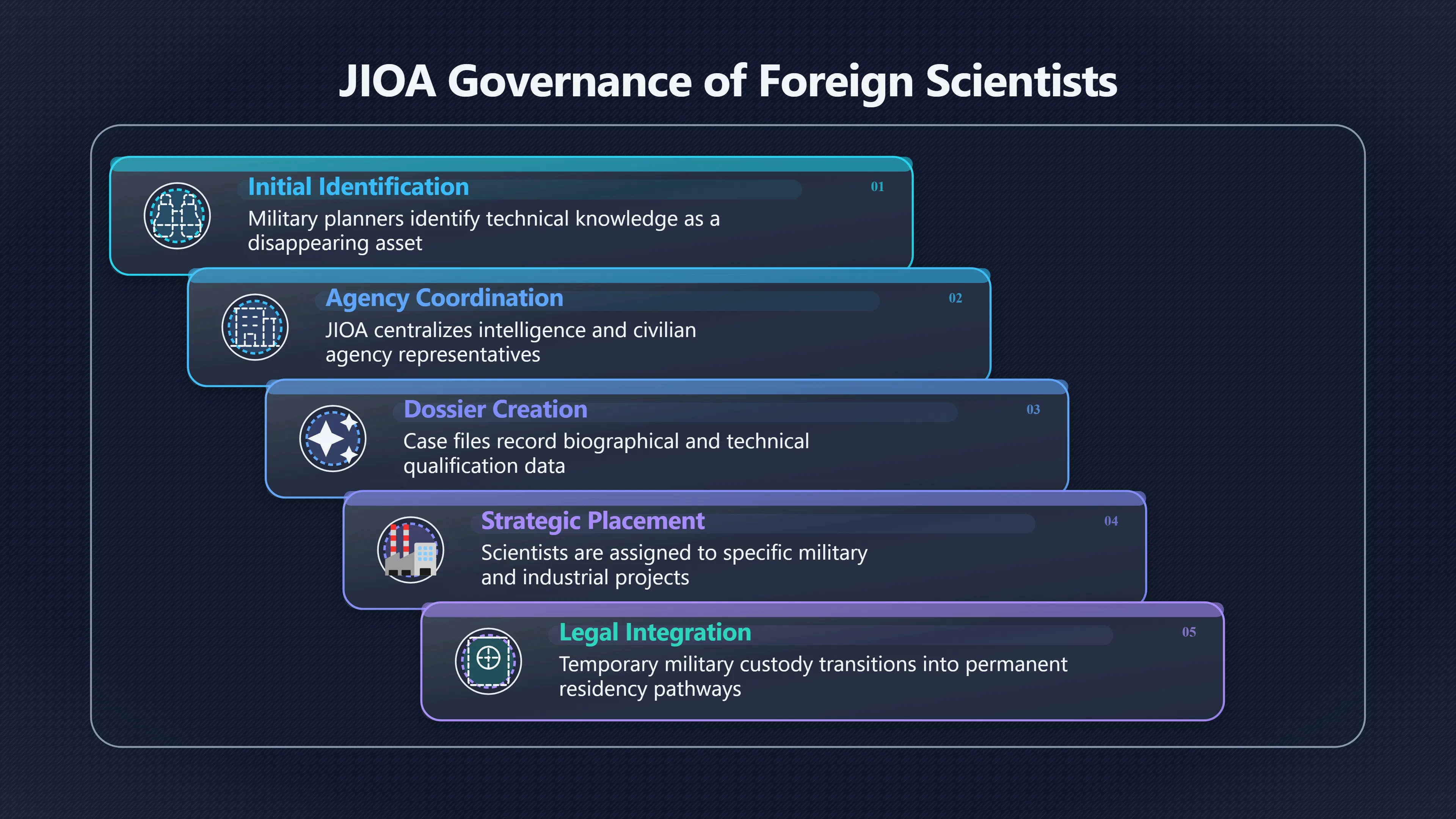
The governance framework emerged from Project Overcast, the predecessor to Paperclip. As American forces occupied Germany, military planners recognised that technical knowledge could disappear as quickly as physical equipment. Scientists could be recruited by rival powers, move into private industry, or simply become inaccessible. The solution was not merely to interrogate them but to place them under a controlled administrative regime.[Office of the Historian]history.state.govOffice of the Historian Historical DocumentsOffice of the HistorianHistorical Documents - Office of the Historiana project known as “Paperclip,” under which selected German scientis…
The JIOA became the central coordinating authority for this effort. It drew representatives from military intelligence, naval intelligence, air intelligence and civilian agencies. Rather than functioning as a research laboratory, it acted as a governance hub. It evaluated candidates, managed transfers between Germany and the United States, coordinated security reviews and supervised the broader foreign-scientist programme. National Archives records identify the JIOA as the agency directly responsible for operating the programme and administering the associated intelligence and personnel systems.[National Archives]archives.govrg 330 defense secretaryNational ArchivesRecords of the Secretary of Defense (RG 330)11 Oct 2016 — Joint Intelligence Objectives Agency Notice to Researchers in…
This administrative role mattered because imported expertise was viewed simultaneously as an opportunity and a risk. Scientists possessed valuable technical knowledge, but many had worked for the Nazi state or military-industrial system. The challenge for the JIOA was therefore not simply recruitment. It was deciding whether a specialist could be politically, legally and strategically managed within the American national-security establishment.[National Archives]archives.govrg 330 defense secretaryNational ArchivesRecords of the Secretary of Defense (RG 330)11 Oct 2016 — Joint Intelligence Objectives Agency Notice to Researchers in…
Dossiers, Contracts and Custody Rules
Paperclip relied on extensive documentation. Each candidate generated a case file containing biographical information, technical qualifications, intelligence assessments, employment history and security evaluations. The surviving Foreign Scientist Case Files held by the National Archives demonstrate the scale of this record-keeping system, which covered hundreds of imported specialists across multiple scientific fields.[National Archives]archives.govNational Archives11/30/2010 Foreign Scientist Case Files 1945-1958November 30, 2010 — 30 Nov 2010 — Foreign Scientist Case Files 1945-195…
The dossier process served several purposes at once:
- Technical assessment: determining whether a scientist possessed knowledge useful to American military or industrial programmes.
- Security evaluation: examining political affiliations, wartime activities and potential intelligence risks.
- Administrative tracking: recording movements, assignments, family status and contractual arrangements.
- Policy justification: providing documentation for agencies seeking permission to employ particular specialists.[National Archives]archives.govrg 330 defense secretaryNational ArchivesRecords of the Secretary of Defense (RG 330)11 Oct 2016 — Joint Intelligence Objectives Agency Notice to Researchers in…
Initially, many recruits entered the United States under military custody rather than through ordinary immigration channels. Official State Department correspondence described German scientists being brought to America under military control for temporary exploitation. This arrangement allowed the government to access expertise quickly while delaying more permanent decisions about legal status and residency.[Office of the Historian]history.state.govOffice of the Historian Historical DocumentsOffice of the HistorianHistorical Documents - Office of the Historiana project known as “Paperclip,” under which selected German scientis…
Over time, however, the programme evolved. Policy discussions in 1946 contemplated larger numbers of scientists, longer stays, family reunification and more stable employment arrangements. Contracts increasingly resembled conventional professional appointments rather than short-term intelligence exploitation. Families could be brought to the United States, salaries became more standardised and pathways toward permanent residence gradually emerged.[Office of the Historian]history.state.govOffice of the Historian Historical DocumentsOffice of the HistorianHistorical Documents - Office of the Historiana project known as “Paperclip,” under which selected German scientis…
The result was a layered governance structure. Scientists were neither ordinary immigrants nor traditional prisoners. They occupied a unique administrative category created specifically for strategic technical personnel. Their movement, employment and legal status remained closely managed by federal authorities even as many became integrated into American research institutions.[Office of the Historian]history.state.govOffice of the Historian Historical DocumentsOffice of the HistorianHistorical Documents - Office of the Historiana project known as “Paperclip,” under which selected German scientis…
The Screening Problem: Expertise Versus Political Liability
The most controversial aspect of JIOA governance concerned screening standards. Officially, American policy sought to exclude committed Nazis and individuals implicated in serious abuses. In practice, however, technical value frequently competed with political concerns. Historians have documented tensions between security screening requirements and military agencies eager to retain specialists regarded as strategically important.[JSTOR]jstor.orgGerman Scientists, American Policy, and the Cold Warby J GIMBEL · 1990 · Cited by 36 — The American program to bring German scientis…
The issue was not merely whether an individual had held Nazi Party membership. Wartime Germany often linked scientific careers to state institutions, making simple membership tests inadequate. Administrators therefore confronted a spectrum of cases ranging from nominal affiliation to deeper involvement with military or political organisations. Decisions often depended on judgments about future utility, available evidence and perceived national-security priorities.[JSTOR]jstor.orgGerman Scientists, American Policy, and the Cold Warby J GIMBEL · 1990 · Cited by 36 — The American program to bring German scientis…
Declassified records released under the Nazi War Crimes Disclosure Act later revealed the extent to which personnel files, background investigations and intelligence reports became central tools in these decisions. The existence of extensive case documentation demonstrates that recruitment was not an uncontrolled influx of specialists. Rather, it was a highly bureaucratic process in which technical value, political risk and strategic competition were repeatedly weighed against one another.[National Archives]archives.govrg 330 defense secretaryNational ArchivesRecords of the Secretary of Defense (RG 330)11 Oct 2016 — Joint Intelligence Objectives Agency Notice to Researchers in…
Critics argue that the screening process was often bent to accommodate desired recruits. Supporters of the programme countered that the emerging Cold War made rapid exploitation of German expertise a strategic necessity. Regardless of interpretation, the controversy highlights the central governance question of Paperclip: who was considered useful enough to justify exceptional treatment?[jstor.org]jstor.orgGerman Scientists, American Policy, and the Cold Warby J GIMBEL · 1990 · Cited by 36 — The American program to bring German scientis…
How Governance Shaped Technical Exploitation
The JIOA’s significance extended beyond personnel management. Its administrative system directly affected how foreign expertise could be used in the exploitation of military technology.
Captured hardware could be inspected, measured and tested, but scientists supplied information that physical artefacts often could not. They explained design assumptions, manufacturing methods, operational limitations and future development possibilities. To obtain this knowledge consistently, the government needed more than access to individuals. It needed mechanisms for assigning them to projects, controlling information flows and integrating them into existing research organisations.[Office of the Historian]history.state.govOffice of the Historian Historical DocumentsOffice of the HistorianHistorical Documents - Office of the Historiana project known as “Paperclip,” under which selected German scientis…
Governance therefore became an enabling technology in its own right. Through contracts, security clearances, placement decisions and oversight procedures, the JIOA converted technical specialists from intelligence targets into productive contributors. The agency determined whether expertise would remain isolated in temporary interrogation programmes or become embedded within long-term military and scientific institutions.[National Archives]archives.govrg 330 defense secretaryNational ArchivesRecords of the Secretary of Defense (RG 330)11 Oct 2016 — Joint Intelligence Objectives Agency Notice to Researchers in…
This administrative architecture also influenced which fields received attention. Scientists judged most valuable for rocketry, aeronautics, weapons development and related military technologies were prioritised because their knowledge could accelerate American programmes and aid understanding of foreign systems. Governance choices therefore helped direct the flow of imported expertise toward areas considered most important for national defence and technological competition.[Wikipedia]WikipediaOperation PaperclipOperation Paperclip

Why JIOA Control Matters to the History of Reverse Engineering
Paperclip is frequently portrayed as a story of individual scientists, but the programme’s broader significance lies in the institutional machinery behind them. The JIOA created a framework that treated specialised knowledge as a strategic asset requiring selection, supervision and controlled integration. Through screening procedures, custody arrangements, dossiers and employment policies, it established rules for converting foreign expertise into usable state capacity.[National Archives]archives.govrg 330 defense secretaryNational ArchivesRecords of the Secretary of Defense (RG 330)11 Oct 2016 — Joint Intelligence Objectives Agency Notice to Researchers in…
In the context of reverse engineering foreign military technology, this governance system was crucial. Captured machines and documents revealed what Germany had built. Imported experts helped explain how and why those systems worked. The JIOA’s role was to make that transfer of knowledge administratively possible, deciding who could be moved, employed, trusted and ultimately absorbed into American institutions. The history of Paperclip therefore rests not only on technical talent, but on the bureaucratic structures that managed and legitimised its exploitation.[archives.gov]archives.govrg 330 defense secretaryNational ArchivesRecords of the Secretary of Defense (RG 330)11 Oct 2016 — Joint Intelligence Objectives Agency Notice to Researchers in…
Amazon book picks
Further Reading
Books and field guides related to Who Managed Paperclip's Imported Scientists?. Use these as the next step if you want deeper reading beyond the article.
Operation Paperclip
Directly addresses selection, screening and management structures.
eBay marketplace picks
Marketplace Samples
Live-tested eBay searches with available results related to this page.


Endnotes
1.
Source: archives.gov
Title: rg 330 defense secretary
Link:https://www.archives.gov/iwg/declassified-records/rg-330-defense-secretary
Source snippet
National ArchivesRecords of the Secretary of Defense (RG 330)11 Oct 2016 — Joint Intelligence Objectives Agency Notice to Researchers in...
2.
Source: history.state.gov
Title: Office of the Historian Historical Documents
Link:https://history.state.gov/historicaldocuments/frus1946v05/d448
Source snippet
Office of the HistorianHistorical Documents - Office of the Historiana project known as “Paperclip,” under which selected German scientis...
3.
Source: Wikipedia
Title: Operation Paperclip
Link:https://en.wikipedia.org/wiki/Operation_Paperclip
4.
Source: jstor.org
Link:https://www.jstor.org/stable/24911848
Source snippet
German Scientists, American Policy, and the Cold Warby J GIMBEL · 1990 · Cited by 36 — The American program to bring German scientis...
5.
Source: archives.gov
Link:https://www.archives.gov/files/iwg/declassified-records/rg-330-defense-secretary/foreign-scientist-case-files.pdf
Source snippet
National Archives11/30/2010 Foreign Scientist Case Files 1945-1958November 30, 2010 — 30 Nov 2010 — Foreign Scientist Case Files 1945-195...
Published: November 30, 2010
6.
Source: history.state.gov
Title: Office of the Historian Historical Documents
Link:https://history.state.gov/historicaldocuments/frus1946v05/d446
Source snippet
Office of the HistorianHistorical Documents - Office of the HistorianIncluded in matters under consideration is an expansion of Paperclip...
7.
Source: jstor.org
Link:https://www.jstor.org/stable/2151624
Source snippet
Policy and German Scientists: The Early Cold Warby J Gimbel · 1986 · Cited by 55 — Late in February 1946, the JCS and SWNCC approved a pr...
Published: February 1946
8.
Source: Wikipedia
Title: Joint Intelligence Objectives Agency
Link:https://en.wikipedia.org/wiki/Joint_Intelligence_Objectives_Agency
Source snippet
Joint Intelligence Objectives AgencyThe duties of the JIOA included: administrating the Operation Paperclip policies, compiling dossie...
9.
Source: nationalgeographic.com
Title: operation paperclip
Link:https://www.nationalgeographic.com/history/article/operation-paperclip
Source snippet
more...
10.
Source: digital.wpi.edu
Link:https://digital.wpi.edu/downloads/n296x222n
Source snippet
Paperclip - Digital WPIby HR Perry — Towards the end of WWII, the United States and Britain were actively searching Nazi. Germany for any...
Additional References
11.
Source: cia.gov
Link:https://www.cia.gov/readingroom/document/00010786
Source snippet
DOCUMENTS FOR PROJECT PAPERCLIP INCLUDES...According to one source, though he allegedly did not believe in the Nazi... Affiliation N...
12.
Source: m.thewire.in
Title: us defence atmanirbhar nazi scientists operation paperclip
Link:https://m.thewire.in/article/history/us-defence-atmanirbhar-nazi-scientists-operation-paperclip
Source snippet
Did the US Achieve Defence 'Atmanirbharta'? Partly...28 Mar 2025 — How Did the US Achieve Defence 'Atmanirbharta'? Partly By Hiring Nazi...
13.
Source: etd.ohiolink.edu
Title: Utilizing some of the same resources
Link:https://etd.ohiolink.edu/acprod/odb_etd/ws/send_file/send?accession=bgsu1510914308951993&disposition=inline
Source snippet
paperclip and the contrasting fates ofby A Eldridge-Nelson · 2017 · Cited by 3 — Paperclip's implementation, specifically the changing of...
14.
Source: youtube.com
Link:https://www.youtube.com/watch?v=0SoaehnAqoI
Source snippet
Book TV: Annie Jacobsen, "Operation Paperclip."...
15.
Source: youtube.com
Title: When the U.S. recruited Nazis for ‘Operation Paperclip’
Link:https://www.youtube.com/watch?v=wDZc-fO8pHc
Source snippet
Operation Paperclip: The Hidden Program That Brought Nazi Scientists to NASA | Full Documentary...
16.
Source: digitalcommons.chapman.edu
Link:https://digitalcommons.chapman.edu/cgi/viewcontent.cgi?article=1050&context=war_and_society_theses
Source snippet
Paperclip and the Use of National Securityby K Hawkins · 2025 — Paperclip was not the first operation by the United States enacted during...
17.
Source: scholar.umw.edu
Link:https://scholar.umw.edu/cgi/viewcontent.cgi?article=1722&context=student_research
Source snippet
Denazification, Operation Paperclip, and the Cold Warby OLB Marcel · 2026 — This essay examines how Operation Paperclip and the postwar r...
18.
Source: rex.libraries.wsu.edu
Title: pdf Cover Page
Link:https://rex.libraries.wsu.edu/view/pdfCoverPage?download=true&filePid=13338246580001842&instCode=01ALLIANCE_WSU
Source snippet
of denial: unlocking the gates to skilled immigrationby JE SCHROEDER · 2019 — JIOA Meetings, These collections contain critical informati...
19.
Source: youtube.com
Link:https://www.youtube.com/watch?v=lfHjsY_Dtvs
20.
Source: youtube.com
Title: Annie Jacobsen, “Operation Paperclip”
Link:https://www.youtube.com/watch?v=HHs5M3pyd3Q
Source snippet
Music...
Topic Tree