Within Foreign Materiel
When Enemy Weapons Look Stronger Than They Are
The gap between feared and measured performance can reshape military planning after a captured system is examined.
On this page
- Why estimates drift upward
- What inspection corrects
- Risks of overcorrection
Page outline Jump by section
Introduction
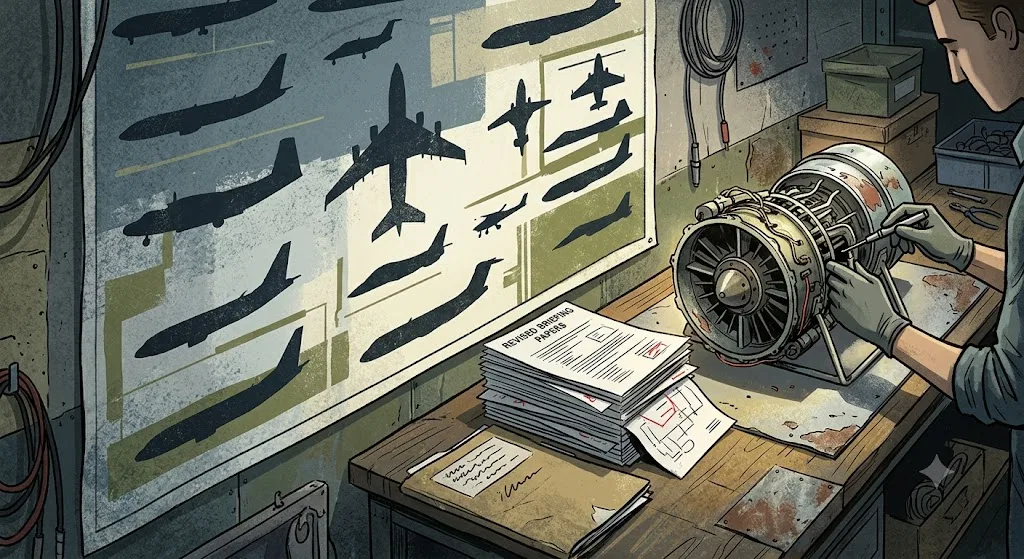
Threat inflation before hardware inspection is the tendency to treat an enemy weapon as more capable than it later proves to be once engineers, pilots or analysts can examine the actual system. In reverse engineering foreign military technology, this matters because physical access can puncture both propaganda and worst-case intelligence assumptions. A radar cross-section, engine layout, cockpit visibility problem, software dependency or crude repair is often more revealing than a parade photograph or an export brochure.
The core lesson is not that adversary systems are usually weak. It is that uncertainty encourages planners to fill gaps with the most dangerous plausible interpretation. Sometimes that caution is prudent. Sometimes it distorts procurement, training and public debate. The examination of captured or defected systems, from Cold War aircraft to Russian weapons recovered in Ukraine, shows how physical inspection can convert a feared object into a measured one: still dangerous, but dangerous in a more specific and usable way. Foreign materiel exploitation exists partly for exactly this reason: to reduce uncertainty about threat systems, support realistic testing, and develop countermeasures based on evidence rather than reputation.[Army Financial Management]asafm.army.milFinancial Management RDTEFinancial Management RDTE
Why estimates drift upward before inspection
Threat inflation usually begins with an information problem. Before a state can inspect a rival’s equipment, it may have only fragments: satellite images, radar tracks, parade appearances, combat anecdotes, defectors’ descriptions, propaganda claims, fragments of manuals, or observed effects in a narrow situation. Those fragments are rarely neutral. They are interpreted through fear of surprise, institutional incentives, and the need to prepare for worst cases.
A large airframe may be read as evidence of high manoeuvrability rather than high-altitude fuel and engine requirements. A missile’s claimed range may be treated as a usable combat envelope rather than an ideal test figure. A sophisticated-looking electronic system may be assumed to indicate domestic technological independence when it may in fact depend on imported commercial microelectronics. The gap between appearance and performance is where threat myths grow.
Several mechanisms push estimates upward:
- Worst-case planning feels safer than underestimation. Defence organisations are punished more visibly for being surprised than for buying insurance against a threat that later looks exaggerated.
- Mirror-imaging fills gaps. Analysts may assume a rival made the same design trade-offs their own engineers would make, rather than asking what compromises fit the rival’s industry, doctrine and maintenance system. The 1976 Team B report itself criticised “mirror-imaging” in strategic intelligence, although the broader Team B episode also shows how competitive threat assessment can become politically and methodologically loaded.[Office of the Historian]history.state.govOffice of the Historian Historical DocumentsOffice of the Historian Historical Documents
- Propaganda and secrecy reinforce each other. A state has incentives to exaggerate its equipment, while secrecy prevents outsiders from checking the details.
- Visible strengths hide hidden costs. Speed, range or missile size may be real, but achieved by sacrificing endurance, reliability, sensor quality, turn performance, maintainability or production scalability.
- Budget politics reward alarming interpretations. A threatening system can become an argument for new aircraft, missiles, sensors, jammers or training ranges before anyone has measured the original threat in full.
This is why physical exploitation is not just a technical curiosity. It is a correction mechanism for strategy. The US Government’s Cold War exploitation system treated foreign materiel as one of several key sources for scientific and technical intelligence, alongside photography, telemetry, documents and human sources. It was specifically concerned with the characteristics, capabilities and limitations of foreign military systems, not merely their existence.[National Security Archive]nsarchive.gwu.eduOpen source on gwu.edu.
The MiG-25: the classic warning against judging from shape and speed
The Soviet MiG-25 Foxbat is the clearest example of threat inflation before inspection. When the aircraft appeared to the West, its size, speed and high-altitude performance made it look like a possible super-fighter. It could fly extremely fast, had large intakes, a large wing and a formidable public image. In the absence of full access, Western observers had to infer design purpose from outward signs.
That changed in September 1976, when Soviet pilot Viktor Belenko defected to Japan in a MiG-25. The CIA’s own public museum account notes that the flight gave Western military and civilian specialists a rare first-hand look at the aircraft and a chance to debrief the pilot, though Japan limited US access before the aircraft was disassembled and returned to the Soviet Union in 30 crates.[CIA]cia.govFormer Soviet Pilot Viktor Belenko's Knee Pad Notebook with Flight DataFormer Soviet Pilot Viktor Belenko's Knee Pad Notebook with Flight Data
The inspection did not reveal a useless aircraft. It revealed a narrower and more industrially pragmatic one. Contemporary reporting after the inspection described the aircraft as equipped with obsolescent electronic targeting and radar systems, shorter in range than the US F-4 Phantom in the comparison then being made, and visibly rough in places, while still noting impressive Tumansky engines and sophisticated Soviet forging techniques.[Time]time.comOpen source on time.com.
The important correction was conceptual. The MiG-25 was not best understood as a nimble air-superiority fighter built to dominate turning combat. It was a high-speed, high-altitude interceptor designed around specific Soviet air-defence requirements. That distinction mattered because a weapon can be excellent at its intended mission while poor at the mission outsiders fear most. The Foxbat was dangerous, but not in all the ways its image suggested.
The F-15 story shows the risk of simplifying the lesson. The US Air Force fact sheet describes the F-15 as an all-weather, highly manoeuvrable tactical fighter designed to gain and maintain air supremacy, with unusual acceleration, range, avionics and radar capability.[U.S. Air Force]af.milF-15 Eagle > Air Force > Fact Sheet Display… The MiG-25 threat helped shape the environment in which such performance was valued, but it is too crude to say the West built the F-15 only because it “fell for” a myth. Threat inflation can contribute to a good capability decision. The problem is not always waste; it is the difficulty of knowing, before inspection, whether the response is proportionate to the actual system.
What inspection corrects that observation cannot
Hardware inspection changes the question from “what might this system be?” to “what trade-offs did its designers actually make?” That shift is the heart of foreign materiel exploitation.
The Have Doughnut evaluation of a MiG-21 illustrates the difference. The project’s stated purpose was not simply to admire or copy the aircraft. It was to evaluate US and Navy tactics against it, exploit its air-to-air capabilities, optimise existing tactics, develop new ones where necessary, and assess its design, performance and operational characteristics.[National Security Archive]nsarchive2.gwu.eduNational Security Archive Once tested, the MiG-21’s reputation could be broken down into specific strengths and exploitable weaknesses.
The findings were practical rather than abstract. US evaluators identified poor forward and rearward visibility, a 50-degree rear blind cone, low-altitude airspeed limits, severe buffeting near those limits, limited cannon ammunition, sight problems, and radar vulnerability to chaff and jamming.[National Security Archive]nsarchive2.gwu.eduNational Security Archive Air & Space Forces Magazine’s later summary of the declassified evaluation emphasised the same point: below 15,000 feet, severe buffeting prevented the MiG-21 from exceeding roughly Mach 0.98, and its slow engine acceleration from idle to military power created another exploitable limitation.[Air & Space Forces Magazine]airandspaceforces.comAir & Space Forces Magazine Have Doughnut | Air & Space Forces MagazineAir & Space Forces Magazine Have Doughnut | Air & Space Forces Magazine
That kind of inspection corrects several things at once:
It separates headline performance from usable performance. A system may have impressive maximum figures but only under conditions that are tactically awkward, mechanically punishing or rarely available.
It turns fear into tactics. “The enemy fighter is dangerous” becomes “avoid prolonged turning fights here”, “exploit this blind cone”, “force this altitude band”, or “use chaff against this radar mode”.
It exposes manufacturing reality. Materials, welds, repairs, electronics, cable routing and component choices reveal industrial capacity and design priorities.
It improves simulators and training. A model built on assumptions can train pilots or crews against the wrong enemy. A model updated with exploitation data can make exercises more realistic.
This last point is not theoretical. A 1997 US Department of Defense Inspector General audit found that foreign materiel exploitation supports acquisition, testing, threat-simulator development, modelling, training and tactics. It also warned that threat models and simulators may fail to represent real-world threats if they are not validated against the latest exploitation data.[U.S. Department of War]media.defense.govU.S. Department of War Use of Foreign Materiel Exploitation ResultsU.S. Department of War Use of Foreign Materiel Exploitation Results(https://media.defense.gov/1997/Oct/08/2001715489/-1/-1/1/98-005.pdf)
Modern captures can deflate myths in a different way
Cold War examples often focus on aircraft performance: speed, climb, turn rate, radar, visibility and weapons employment. Modern exploitation still includes those questions, but it also corrects assumptions about supply chains, software, electronics and production resilience.
The Russian invasion of Ukraine has produced a large stream of recovered or captured weapons. RUSI’s 2022 report on Russian systems examined the components and functioning of 27 modern Russian military systems, including cruise missiles, communications systems and electronic warfare complexes. Its central finding was not that these weapons were harmless, but that Russia’s war machine relied heavily on Western electronics.[Royal United Services Institute]rusi.orgOpen source on rusi.org.
Reuters, reporting on the same RUSI research, stated that more than 450 foreign-made components were found in Russian weapons recovered in Ukraine. The disassembled systems ranged from cruise missiles to air-defence equipment, and about two-thirds of the components identified in the recovered weapons were made by US-based companies.[Reuters]reuters.comOpen source on reuters.com.
This kind of inspection corrects a different kind of myth: the myth of autonomous sophistication. A weapon may look like a sealed product of a self-sufficient defence industry, but disassembly can reveal dependence on global commercial supply chains. That matters for sanctions, export controls, production forecasts and assessments of whether battlefield losses can be replaced quickly.
It also prevents a lazy counter-myth. Finding commercial or foreign parts inside a weapon does not mean the weapon is crude or ineffective. Many modern systems use dual-use electronics because the civilian electronics market is advanced, cheap and globally distributed. The more precise lesson is that hardware inspection can identify where an adversary is strong, where it is dependent, and where outside policy may affect replenishment.
Risks of overcorrection after the myth breaks
The danger after inspection is to swing too far the other way. Once a feared system is shown to be less impressive than advertised, analysts and commentators may dismiss it as junk. That is often as misleading as the original inflation.
The MiG-25 was not the agile super-fighter some feared, but it remained a serious high-speed interceptor. The MiG-21 had exploitable limitations, but it also had qualities that made it lethal in the right envelope. Russian weapons recovered in Ukraine may reveal foreign dependencies and production vulnerabilities, but they have still caused large-scale harm and impose real defensive costs.
Overcorrection usually takes three forms.
First, confusing narrowness with uselessness. A system designed for one mission may look poor when judged by another. The MiG-25 was less frightening once judged as a dogfighter, but its speed and altitude still mattered for interception.
Second, confusing crude design with poor operational effect. Ruggedness, older electronics or rough finishing may be rational choices if they suit doctrine, production capacity, conscript maintenance or expected combat life.
Third, assuming the inspected sample represents the whole fleet. A captured aircraft may be an early variant, a damaged example, an export model, a poorly maintained unit or a stripped training configuration. TIME’s 1976 reporting on Belenko’s MiG-25 noted that the aircraft lacked the four air-to-air missiles normally carried, limiting what experts could infer about its full combat capability.[Time]time.comOpen source on time.com.
Good exploitation therefore corrects both fear and contempt. It replaces myth with bounded confidence: what was measured, under what conditions, on which variant, and with what remaining unknowns.
How threat myths reshape planning before anyone opens the casing
The practical harm of threat inflation is not just intellectual embarrassment. It can change real planning. A feared system may drive urgent procurement, alter training priorities, influence alliance politics, shape public arguments for defence spending, or push engineers to overmatch a capability that was never actually present in the assumed form.
Sometimes that produces useful insurance. The perceived Soviet air threat helped justify Western investment in aircraft, radars, missiles and tactics that proved valuable beyond the original fear. A mistaken interpretation can still push a force towards resilience. The problem is that such decisions are expensive and path-dependent. Once a programme, doctrine or training culture is built around an inflated threat picture, later evidence may not fully undo it.
This is why exploitation results must move quickly into the organisations that build models, simulators, tactics and countermeasures. NASIC describes foreign materiel exploitation as work that includes getting hold of aircraft, surface-to-air missiles and radars in order to learn how to evade them and keep future systems effective.[NASIC]nasic.af.milAcquire, Assess, Exploit > National Air and Space Intelligence Center > Article Display… The DoD Inspector General similarly found that exploitation results were used across testing, modelling, threat simulators, training and tactics, while warning that validation must keep pace with new data.[U.S. Department of War]media.defense.govU.S. Department of War Use of Foreign Materiel Exploitation ResultsU.S. Department of War Use of Foreign Materiel Exploitation Results(https://media.defense.gov/1997/Oct/08/2001715489/-1/-1/1/98-005.pdf)
The best planning use of captured hardware is therefore not a dramatic declaration that the enemy was overrated. It is a disciplined update:
- Which feared capability is confirmed?
- Which claimed capability is absent, conditional or exaggerated?
- Which weakness is exploitable in combat?
- Which weakness is irrelevant because doctrine avoids it?
- Which finding applies only to this variant or sample?
- Which procurement, training or modelling assumption should now change?
The durable lesson for reverse engineering foreign military technology
Threat inflation before inspection is a recurring feature of military competition because hidden weapons invite imagination. States have to plan under uncertainty, and caution often means assuming that the enemy’s system may be better than it looks. Physical access changes the evidentiary standard. It allows analysts to move from silhouette, rumour and worst-case inference to measured performance, component choice, manufacturing quality, maintenance burden and exploitable weakness.
The strongest lesson is not “enemy weapons are usually worse than feared”. It is “enemy weapons are usually more specific than feared”. They are bundles of trade-offs. Speed may cost manoeuvrability. Range may cost payload. Hardening may require older electronics. Precision may depend on imported chips. A frightening public image may conceal a narrow mission, while a crude-looking system may remain deadly inside that mission.
Reverse engineering foreign military technology is valuable because it disciplines imagination. It does not eliminate uncertainty, and it should not license complacency. But it can stop threat myths from doing the work that measurement should do.
Amazon book picks
Further Reading
Books and field guides related to When Enemy Weapons Look Stronger Than They Are. Use these as the next step if you want deeper reading beyond the article.
Psychology of Intelligence Analysis
Explains cognitive biases that drive threat inflation.
Skunk Works
Demonstrates the value of hands-on technical understanding over assumptions.
eBay marketplace picks
Marketplace Samples
Live-tested eBay searches with available results related to this page.


Endnotes
1.
Source: asafm.army.mil
Title: Financial Management RDTE
Link:https://www.asafm.army.mil/Portals/72/Documents/BudgetMaterial/2027/Discretionary%20Budget/rdte/RDTE%20-%20Vol%204%20-%20Budget%20Activity%206.pdf
2.
Source: media.defense.gov
Title: U.S. Department of War Use of Foreign Materiel Exploitation Results
Link:https://media.defense.gov/1997/Oct/08/2001715489/-1/-1/1/98-005.pdf
3.
Source: history.state.gov
Title: Office of the Historian Historical Documents
Link:https://history.state.gov/historicaldocuments/frus1969-76v35/d171
4.
Source: cia.gov
Title: Former Soviet Pilot Viktor Belenko’s Knee Pad Notebook with Flight Data
Link:https://cia.gov/legacy/museum/artifact/former-soviet-pilot-viktor-belenkos-knee-pad-notebook-with-flight-data/
5.
Source: time.com
Link:https://time.com/archive/6848376/intelligence-bonanza-or-bust/
6.
Source: af.mil
Title: U.S. Air Force
Link:https://www.af.mil/About-Us/Fact-Sheets/Display/Article/104501/f-15-eagle/
Source snippet
F-15 Eagle > Air Force > Fact Sheet Display...
7.
Source: nsarchive2.gwu.edu
Title: National Security Archive
Link:https://nsarchive2.gwu.edu/NSAEBB/NSAEBB443/docs/area51_48.PDF
8.
Source: rusi.org
Link:https://www.rusi.org/explore-our-research/publications/special-resources/silicon-lifeline-western-electronics-heart-russias-war-machine
9.
Source: reuters.com
Link:https://www.reuters.com/business/aerospace-defense/exclusive-russian-weapons-ukraine-powered-by-hundreds-western-parts-rusi-2022-08-08/
10.
Source: nasic.af.mil
Link:https://www.nasic.af.mil/News/Article-Display/Article/1010245/acquire-assess-exploit/
Source snippet
Acquire, Assess, Exploit > National Air and Space Intelligence Center > Article Display...
11.
Source: cia.gov
Link:https://www.cia.gov/readingroom/docs/CIA-RDP90-00806R000100140073-5.pdf
12.
Source: cia.gov
Title: NEW S, VIEWS, AND ISSUES[SANITIZED]
Link:https://www.cia.gov/readingroom/document/02623720
13.
Source: cia.gov
Link:https://www.cia.gov/readingroom/document/loc-hak
14.
Source: cia.gov
Link:https://www.cia.gov/resources/csi/static/Watching-the-Bear-5-Chap5-Mil-Intentions-Capabilities.pdf
15.
Source: cia.gov
Title: Tradecraft Primer apr09
Link:https://www.cia.gov/resources/csi/static/Tradecraft-Primer-apr09.pdf
16.
Source: rusi.org
Title: hundreds western components found russian weapons ukraine
Link:https://www.rusi.org/news-and-comment/in-the-news/hundreds-western-components-found-russian-weapons-ukraine
17.
Source: static.rusi.org
Title: Silicon Lifeline final web
Link:https://static.rusi.org/RUSI-Silicon-Lifeline-final-web.pdf
18.
Source: rusi.org
Link:https://www.rusi.org/explore-our-research/publications/special-resources/silicon-lifeline-western-electronics-heart-russias-war-machine/interactive-summary
19.
Source: comptroller.war.gov
Title: RDTE DTRA PB 2027
Link:https://comptroller.war.gov/Portals/45/Documents/defbudget/FY2027/budget_justification/pdfs/03_RDT_and_E/RDTE_DTRA_PB_2027.pdf
20.
Source: comptroller.war.gov
Title: RDTE OSW PB 2027
Link:https://comptroller.war.gov/Portals/45/Documents/defbudget/FY2027/budget_justification/pdfs/03_RDT_and_E/RDTE_OSW_PB_2027.pdf
21.
Source: media.defense.gov
Title: AFD 120516 036
Link:https://media.defense.gov/2012/May/16/2001330012/-1/-1/0/AFD-120516-036.pdf
22.
Source: asafm.army.mil
Title: mil Justification Book The purpose of this document is to provide
Link:https://www.asafm.army.mil/Portals/72/Documents/BudgetMaterial/2027/Discretionary%20Budget/rdte/RDTE%20-%20Vol%201%20-%20Budget%20Activity%202.pdf
23.
Source: odin.t2com.army.mil
Title: [Mi G 25]({{ ‘mi-g-25/’ | relative_url }}) (Foxbat) Russian Interceptor and Strike Reconnaissance Aircraft
Link:https://odin.t2com.army.mil/WEG/Asset/MiG-25_%28Foxbat%29_Russian_Interceptor_and_Strike-Reconnaissance_Aircraft
24.
Source: nsarchive.gwu.edu
Link:https://nsarchive.gwu.edu/briefing-book/intelligence/2018-01-31/scavenging-intelligence-us-governments-secret-search-foreign-objects-during-cold-war
25.
Source: airandspaceforces.com
Title: Air & Space Forces Magazine Have Doughnut | Air & Space Forces Magazine
Link:https://www.airandspaceforces.com/article/0610doughnut/
26.
Source: nasic.af.mil
Title: leadership changes hands for the foreign materiel exploitation squadron
Link:https://www.nasic.af.mil/News/Article-Display/Article/3073708/leadership-changes-hands-for-the-foreign-materiel-exploitation-squadron/
27.
Source: Wikipedia
Title: Have Doughnut
Link:https://en.wikipedia.org/wiki/Have_Doughnut
28.
Source: Wikipedia
Title: Viktor Belenko
Link:https://en.wikipedia.org/wiki/Viktor_Belenko
29.
Source: Wikipedia
Title: Team B
Link:https://en.wikipedia.org/wiki/Team_B
30.
Source: nsarchive.gwu.edu
Link:https://nsarchive.gwu.edu/search?op=Search&page=285&s=The+Cold+War
31.
Source: nsarchive2.gwu.edu
Link:https://nsarchive2.gwu.edu/NSAEBB/NSAEBB139/nitze10.pdf
32.
Source: airandspaceforces.com
Link:https://www.airandspaceforces.com/PDF/MagazineArchive/Documents/2011/March%202011/0311MiGs.pdf
33.
Source: airandspaceforces.com
Title: team b tackles the cia
Link:https://www.airandspaceforces.com/article/team-b-tackles-the-cia/
34.
Source: war-sanctions.gur.gov.ua
Link:https://war-sanctions.gur.gov.ua/en/components
35.
Source: youtube.com
Link:https://www.youtube.com/watch?v=V3QkqGWVrkg
36.
Source: historynet.com
Title: mig 25
Link:https://historynet.com/mig-25/
37.
Source: fordlibrarymuseum.gov
Link:https://www.fordlibrarymuseum.gov/library/document/0324/1553702.pdf
Additional References
38.
Source: youtube.com
Link:https://www.youtube.com/watch?v=xxvEHCJXgc4
Source snippet
This Jet Terrified the West: The MiG-25 Foxbat...
39.
Source: youtube.com
Title: Victor Belenko | The Pilot Who Stole the Soviet Union’s Greatest Secret
Link:https://www.youtube.com/watch?v=_sAvkr4LbWw
Source snippet
The Mach 3 Monster with a Drinking Problem...
40.
Source: youtube.com
Title: The Mach 3 Monster with a Drinking Problem
Link:https://www.youtube.com/watch?v=YmAimkXikWI
Source snippet
What US Engineers Found Inside the MiG-25 After Belenko Defected With It in 1976...
41.
Source: youtube.com
Title: STREAK EAGLE: How the F-15 beat Russia’s Mi G-25
Link:https://www.youtube.com/watch?v=Ny_dtNOc4e4
Source snippet
Aviation Historian Peter Merlin talks about the Russian MiGs at AREA 51...
42.
Source: instagram.com
Link:https://www.instagram.com/reel/DNTct1_RnlZ/?hl=en
43.
Source: facebook.com
Link:https://www.facebook.com/TimesofIndia/posts/a-report-by-conflict-armament-research-revealed-that-a-north-korean-missile-reco/782049360635920/
44.
Source: facebook.com
Link:https://www.facebook.com/100071924734346/posts/artwork-of-fairchild-fx-fx-fighter-experimental-concept-chasing-a-mig-25/917915307282619/
45.
Source: natcen.ac.uk
Link:https://natcen.ac.uk/publications/bsa-42-security-threats-and-military-spending
46.
Source: facebook.com
Link:https://www.facebook.com/avpayltd/posts/built-for-speed-not-style-the-mig-25-foxbat-shocked-the-west-with-its-raw-perfor/1568760608592438/
47.
Source: facebook.com
Link:https://www.facebook.com/euromaidanpress.en/posts/conflict-armament-research-investigation-reveals-that-a-north-korean-missile-fir/819148583561167/
Topic Tree