Within Foreign Materiel
Why Exploitation Became an Institution
Specialized intelligence centers keep foreign materiel exploitation as a standing mission rather than an ad hoc curiosity.
On this page
- Standing missions
- Specialist facilities
- Links to operators and engineers
Page outline Jump by section
Introduction
Foreign materiel exploitation became an intelligence institution because modern weapons cannot be understood reliably through photographs, defectors’ reports or public specifications alone. States need permanent organisations that can acquire foreign equipment, protect it, test it, compare results across services, and turn findings into intelligence for operators, engineers and policymakers. In the United States, that mission is visible in standing centres such as the National Air and Space Intelligence Center, the Missile and Space Intelligence Center and the National Ground Intelligence Center, as well as in formal Department of Defense governance for the Foreign Materiel Program. These bodies make exploitation a managed cycle: requirements are set, items are acquired, laboratories test them, analysts document results, and users receive outputs for tactics, training, modelling, countermeasures and force development.[whs.mil]esd.whs.mil08 F 1748 Foreign Materiel Program08 F 1748 Foreign Materiel Program
The institutional point is important. Reverse engineering foreign military technology is not just a dramatic moment when a captured missile, radar or aircraft is taken apart. The harder problem is keeping a standing system ready before the next item appears: secure facilities, scientists and engineers, reporting channels, budgets, databases, legal authorities and customers who know how to use the results.
Why exploitation moved from opportunity to standing mission
Foreign materiel exploitation, often shortened to FME, is the analysis, testing, evaluation and documentation of foreign equipment to extract scientific and technical intelligence. A declassified DoD directive defines FME as activities that analyse, test, evaluate and document the scientific and technical intelligence characteristics of foreign materiel. The same directive makes acquisition and exploitation a recurring programme function rather than a one-off wartime improvisation: it assigns oversight, funding, requirements, reporting, databases and dissemination responsibilities across the defence intelligence system.[WHS ESD]esd.whs.mil08 F 1748 Foreign Materiel Program08 F 1748 Foreign Materiel Program
That structure exists because foreign systems are rarely useful as isolated trophies. A surface-to-air missile, radar, armoured vehicle sight, guidance package or communications unit only becomes operationally valuable once specialists can answer practical questions: what does it detect, how accurately, under what conditions, with which weaknesses, and how should friendly forces adapt? The 1997 DoD Inspector General audit described FME as supporting acquisition programmes, testing, threat simulator and target development, modelling and simulation, training and tactics; it also recorded about $117 million in estimated Military Department spending on FME projects in fiscal year 1996.[U.S. Department of War]media.defense.govU.S. Department of War Use of Foreign Materiel Exploitation ResultsU.S. Department of War Use of Foreign Materiel Exploitation Results(https://media.defense.gov/1997/Oct/08/2001715489/-1/-1/1/98-005.pdf)
The institutional form also solves a coordination problem. Different users want different things from the same object. An intelligence analyst may want a capability estimate, an electronic warfare engineer may want signal characteristics, a test organisation may want a realistic threat representation, and an operational unit may want tactics. The DoD directive therefore gives the Director of the Defense Intelligence Agency an executive-agent role for coordinating Foreign Materiel Program activities, while also requiring prioritised acquisition and exploitation requirements, a comprehensive foreign materiel database and timely dissemination of results.[WHS ESD]esd.whs.mil08 F 1748 Foreign Materiel Program08 F 1748 Foreign Materiel Program

Standing missions create memory, not just reports
A standing exploitation institution preserves knowledge across wars, crises and technology cycles. That matters because foreign equipment arrives unpredictably: a captured system from a battlefield, an export item obtained through a partner, debris from a missile strike, or components recovered after a malfunction. Without a permanent centre, each case would require a new scramble for secure space, relevant experts, test equipment, legal authorities and customers.
NASIC’s public material shows how the air and space side of this mission is institutionalised. The centre describes itself as a source of air and space intelligence for the Department of Defense, producing integrated and predictive intelligence to enable military operations, force modernisation and policy. Its FME squadron is presented not as a temporary project office but as part of an enduring intelligence production mission, with analysts exploiting air, space and cyberspace-related military systems to improve understanding of potential adversary capabilities.[NASIC]nasic.af.milOpen source on af.mil.
The Army’s approach shows the same institutional logic for ground systems. Army Regulation 381-26 describes the Army Foreign Materiel Exploitation Program as life-cycle management of foreign ground-force systems, related materiel and commercial items with military relevance. Its stated purposes include producing scientific and technical intelligence, assessing foreign technology and design features, supporting US system testing with adversary systems, and developing simulator systems.[Intelligence Resource Program]irp.fas.orgOpen source on fas.org.
This is why the word “centre” matters. A centre can maintain historical files, compare a new variant with earlier models, keep test methods consistent, and translate exploitation findings into durable threat databases. The 1997 audit found that the National Ground Intelligence Center assigned an intelligence analyst to every foreign system under its executive agency, combined exploitation data with other intelligence sources, and made updated threat-system information available to interested users without tying the data to a single source.[U.S. Department of War]media.defense.govU.S. Department of War Use of Foreign Materiel Exploitation ResultsU.S. Department of War Use of Foreign Materiel Exploitation Results(https://media.defense.gov/1997/Oct/08/2001715489/-1/-1/1/98-005.pdf)
Specialist facilities turn captured hardware into measured intelligence
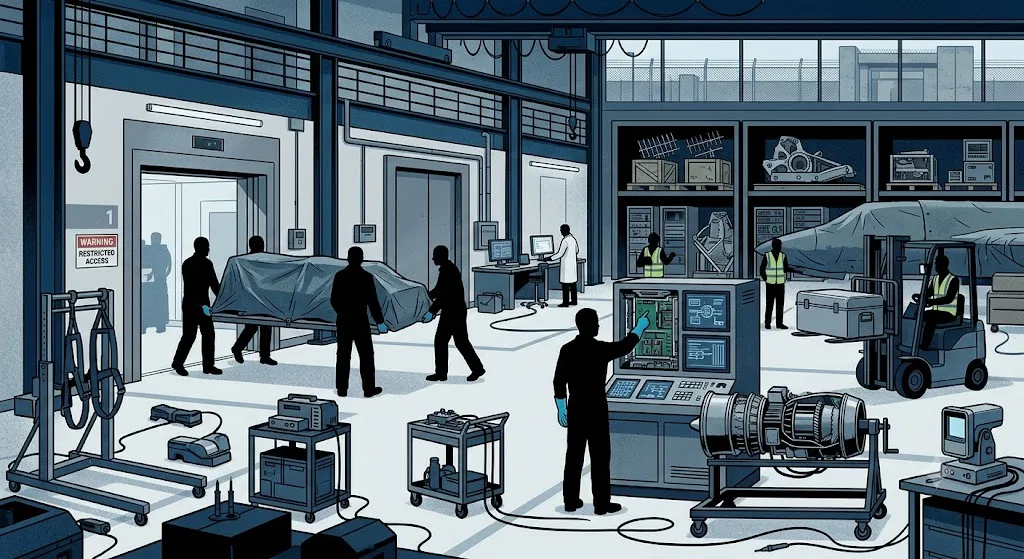
Modern FME needs laboratories, controlled test areas, secure storage, instrumentation, modelling tools and people who can work across engineering and intelligence. A captured object is often incomplete, damaged, booby-trap suspect, software-dependent, electronically sensitive or classified because the way it was obtained must be protected. Permanent facilities reduce the time between acquisition and useful analysis.
NASIC’s FME infrastructure is a clear example. In 2015, the centre broke ground on a 50,000-square-foot addition for its foreign materiel exploitation mission at Wright-Patterson Air Force Base; in 2017, it opened the new FME facility and described foreign materiel exploitation as one of its intelligence production missions. The public explanation was not simply that analysts needed more room, but that the facility would support exploitation of air, space and cyberspace-related military systems to improve understanding of potential adversary capabilities.[NASIC]nasic.af.milNASICCenter breaks ground on FME expansionNASICCenter breaks ground on FME expansion
MSIC shows the same pattern for missiles and related systems. DIA describes MSIC as a centre of excellence focused on analysis and assessment of foreign air and missile defence systems, ballistic missiles, anti-tank guided missiles, anti-satellite missile systems and directed-energy weapons, with intelligence assessments intended to support strategic and tactical advantage. In 2025, DIA announced a Phase II facility at MSIC’s Advanced Analysis Complex, following a Phase I Materiel Exploitation Center, to add simulation capacity, dedicated analysis space and a high-performance supercomputing centre.[Defense Intelligence Agency]dia.milOpen source on dia.mil.
Facilities also indicate how exploitation has changed. Earlier FME could be imagined as taking apart metal objects; today it increasingly means combining physical examination with modelling, simulation, computing, software analysis, signatures intelligence and system-level assessment. DIA’s description of the 2025 MSIC expansion emphasised supercomputing modelling and simulation for complex future threat systems, while MSIC’s mission remains framed around scientific and technical intelligence on foreign weapons systems.[Defense Intelligence Agency]dia.mils missile and space intelligence center breaks ground on advanced analysis fs missile and space intelligence center breaks ground on advanced analysis f
Governance decides what gets exploited first
Institutional FME is partly a prioritisation system. Foreign equipment is scarce, access may be temporary, transport can be politically sensitive, and laboratory time is limited. A standing institution therefore needs a way to decide which objects matter most and which customers should shape the exploitation plan.
The DoD directive makes this explicit. It requires the DIA executive agent to designate organisations responsible for acquisition and exploitation based on intelligence, operational, and test and evaluation requirements; to maintain prioritised acquisition and exploitation requirements; and to prepare an annual Foreign Materiel Program plan and report. It also requires military departments and combatant commanders to report acquisition opportunities and provide requirements to help establish priorities.[WHS ESD]esd.whs.mil08 F 1748 Foreign Materiel Program08 F 1748 Foreign Materiel Program
The Army version is more specific to ground forces. NGIC is described in an Army field manual chapter as the Army’s executive agent for acquisition and exploitation of foreign ground systems under the DoD Foreign Materiel Acquisition and Exploitation Program. It works with Army and DoD customers to set priorities, with collectors to obtain high-priority items, and with research, development, test and evaluation communities to exploit foreign threat systems for strengths, vulnerabilities and possible improvements to US systems.[Intelligence Resource Program]irp.fas.orgOpen source on fas.org.
Governance also protects against a common failure mode: collecting interesting objects that do not answer urgent questions. The 1997 DoD Inspector General report noted that DoD components had solicited exploitation requirements from customers for incorporation into exploitation plans, while also identifying continuing programme issues such as improving acquisition processes, supporting test and evaluation needs, and developing a complete and accurate inventory database.[U.S. Department of War]media.defense.govU.S. Department of War Use of Foreign Materiel Exploitation ResultsU.S. Department of War Use of Foreign Materiel Exploitation Results(https://media.defense.gov/1997/Oct/08/2001715489/-1/-1/1/98-005.pdf)

The useful output is a chain from lab bench to user
The institutional value of FME is not the mere possession of foreign hardware. It is the conversion of physical access into usable knowledge for people who must make decisions. The DoD directive therefore requires timely dissemination of results, and it directs acquisition, technology and logistics officials to develop procedures so that useful foreign technology or design features can be incorporated into US weapons and countermeasures systems.[WHS ESD]esd.whs.mil08 F 1748 Foreign Materiel Program08 F 1748 Foreign Materiel Program
The 1997 audit gives a rare public picture of how that dissemination worked across institutions. MSIC used symposiums, electronic messages, interim reports after exploitation phases and final reports. NGIC used written test and FME reports, electronic and magnetic media, databases, photographs and videos, and published a quarterly list of FME reports. The Office of Naval Intelligence used FME reports, message traffic and the DIA Intelligence Production Program, while the Air Force’s National Air Intelligence Center used electronic messages, interim and final reports, and recurring aerospace reporting.[U.S. Department of War]media.defense.govU.S. Department of War Use of Foreign Materiel Exploitation ResultsU.S. Department of War Use of Foreign Materiel Exploitation Results(https://media.defense.gov/1997/Oct/08/2001715489/-1/-1/1/98-005.pdf)
That variety of formats matters because different users consume intelligence differently. A pilot or air-defence planner may need a short operational warning. A simulator developer may need measured parameters. A procurement office may need evidence that a countermeasure requirement is real. A modelling team may need data structured for a digital representation. A policymaker may need an assessment of whether an adversary system changes a regional balance. A mature FME institution keeps those outputs connected rather than letting each user rebuild the same picture independently.
Links to operators and engineers keep exploitation from becoming museum work
Foreign materiel can easily become a technical curiosity if it is not tied to military users. The best evidence that FME is institutionalised is therefore not just the existence of labs, but the formal linkage to operators, testers, trainers and system developers.
NASIC’s public account of its FME squadron makes the operational link explicit: information gained by FME personnel is described as being used to make operations safer and more effective, to prepare for future air, space and cyberspace weapons, and to develop next-generation Air Force systems. That description places FME between intelligence production, operational risk reduction and future force design.[NASIC]nasic.af.milNASICAcquire, Assess, ExploitNASICAcquire, Assess, Exploit
The Army regulation makes the engineering link equally clear. It defines FME as supporting scientific and technical intelligence, force and materiel development, testing against adversary systems, and simulator development. In other words, the same exploited object can inform a threat estimate, a weapon upgrade, a test range target, a training aid and a synthetic model.[Intelligence Resource Program]irp.fas.orgOpen source on fas.org.
MSIC’s role connects operators and engineers through scientific and technical assessment of missile and air-defence threats. DIA says MSIC provides warfighters, weapons developers and policymakers with intelligence assessments of foreign weapons systems; the 2025 facility expansion was justified in terms of increased simulation capability, analysis space and supercomputing for future threat systems.[Defense Intelligence Agency]dia.milOpen source on dia.mil.
Contractors and budgets show the mission is sustained
Another sign of institutionalisation is the existence of recurring budgets and contractor support. FME requires niche engineering labour, specialised tools, secure facilities and surge capacity when new materiel becomes available. Public procurement records and announcements reveal a continuing support ecosystem around government centres, even though many operational details remain classified.
A 2018 announcement by MacAulay-Brown, then an Alion company, described a $92 million contract from NASIC’s Foreign Materiel Exploitation Squadron to support timely exploitation of foreign aerospace and electronic systems for the Global Exploitation Intelligence Group. While contractor announcements should be read carefully because they are company communications, the award still illustrates the scale and durability of the support base around a standing FME unit.[GlobeNewswire]globenewswire.comGlobe Newswire Mac B Awarded $92M Foreign Materiel Exploitation ContractGlobe Newswire Mac B Awarded $92M Foreign Materiel Exploitation Contract
The DoD directive also treats funding as a governance issue, not a side detail. It calls for an OSD Foreign Materiel Acquisition and Exploitation fund, requires the DIA executive agent to coordinate allocations, and directs military departments to plan, programme and budget for acquisition and exploitation needed to fulfil intelligence production requirements.[WHS ESD]esd.whs.mil08 F 1748 Foreign Materiel Program08 F 1748 Foreign Materiel Program
Recent MSIC infrastructure planning reinforces the same point. DIA’s 2025 announcement described a multi-phase expansion, including the Materiel Exploitation Center and a follow-on modelling, analysis and computing facility. Such construction is not a response to a single captured item; it is a bet that foreign weapons exploitation will remain a recurring intelligence requirement.[Defense Intelligence Agency]dia.mils missile and space intelligence center breaks ground on advanced analysis fs missile and space intelligence center breaks ground on advanced analysis f
What makes FME an intelligence institution rather than ordinary engineering
Foreign materiel exploitation overlaps with engineering, test and evaluation, and reverse engineering, but it is not identical to any of them. Its institutional home in defence intelligence changes the questions being asked and the controls around the answers.
First, FME is requirement-driven. The object is examined because it can answer priority intelligence, operational or test questions. A laboratory may discover interesting design features, but the programme exists to serve warfighters, force developers, policymakers and acquisition users.[Intelligence Resource Program]irp.fas.orgOpen source on fas.org.
Second, FME is multi-source. Physical examination is combined with signals intelligence, imagery, human reporting, open sources, test data and previous exploitation results. The 1997 audit’s description of NGIC analysts maintaining threat-system data for the DIA Intelligence Production Program shows that exploited materiel becomes part of a broader intelligence picture rather than a stand-alone engineering file.[U.S. Department of War]media.defense.govU.S. Department of War Use of Foreign Materiel Exploitation ResultsU.S. Department of War Use of Foreign Materiel Exploitation Results(https://media.defense.gov/1997/Oct/08/2001715489/-1/-1/1/98-005.pdf)
Third, FME is controlled. The same item may reveal sensitive collection methods, partner relationships, technical vulnerabilities or countermeasure opportunities. That is why formal authorities, databases, reporting rules and special access arrangements appear in programme governance. The DoD directive assigns oversight to senior defence intelligence authorities and gives DIA a coordinating executive-agent role across components.[WHS ESD]esd.whs.mil08 F 1748 Foreign Materiel Program08 F 1748 Foreign Materiel Program
Finally, FME is action-oriented. The desired result is not simply “we now know how it works”, but “we can train against it, model it, defeat it, design around it, brief it accurately, or avoid surprise”. That is the institutional bridge between reverse engineering foreign military technology and the practical defence enterprise that must use the knowledge.
Amazon book picks
Further Reading
Books and field guides related to Why Exploitation Became an Institution. Use these as the next step if you want deeper reading beyond the article.
The Pentagon's Brain
Explains how U.S. military R&D and intelligence institutions became permanent systems for exploiting advanced technology.
The Dead Hand
Connects secret weapons programmes, intelligence collection and institutional systems for understanding adversary capabilities.
Skunk Works
Shows how specialist facilities, engineers and operators turn secret technology into operational capability.
The Wizards of Armageddon
Explains the institutionalisation of weapons analysis, doctrine and technical assessment inside U.S. defence policy.
eBay marketplace picks
Marketplace Samples
Live-tested eBay searches with available results related to this page.


Endnotes
1.
Source: esd.whs.mil
Title: 08 F 1748 Foreign Materiel Program 10 10 2006
Link:https://www.esd.whs.mil/Portals/54/Documents/FOID/Reading%20Room/Administration_and_Management/08-F-1748_Foreign_Materiel_Program_10-10-2006.pdf?ver=2017-05-15-135556-097
2.
Source: media.defense.gov
Title: U.S. Department of War Use of Foreign Materiel Exploitation Results
Link:https://media.defense.gov/1997/Oct/08/2001715489/-1/-1/1/98-005.pdf
3.
Source: nasic.af.mil
Link:https://www.nasic.af.mil/About-Us/Fact-Sheets/Article/611728/national-air-and-space-intelligence-center-heritage/
4.
Source: nasic.af.mil
Title: NASICCenter breaks ground on FME expansion
Link:https://www.nasic.af.mil/News/Article/611039/center-breaks-ground-on-fme-expansion/
5.
Source: dia.mil
Link:https://www.dia.mil/About/Organization/MSIC/
6.
Source: dia.mil
Title: s missile and space intelligence center breaks ground on advanced analysis f
Link:https://www.dia.mil/Articles/Press-Release/Article/4288602/dias-missile-and-space-intelligence-center-breaks-ground-on-advanced-analysis-f/
7.
Source: nasic.af.mil
Title: NASICAcquire, Assess, Exploit
Link:https://www.nasic.af.mil/News/Article-Display/Article/1010245/acquire-assess-exploit/
8.
Source: globenewswire.com
Title: Globe Newswire Mac B Awarded $92M Foreign Materiel Exploitation Contract
Link:https://www.globenewswire.com/news-release/2018/09/24/1575122/16222/en/macb-awarded-92m-foreign-materiel-exploitation-contract-for-nasic.html
9.
Source: acq.osd.mil
Title: DoDI 5210.65 Security Standards for Safeguarding Chemical Agent
Link:https://www.acq.osd.mil/ncbdp/cbd/docs/DoDI%205210.65%20Security%20Standards%20for%20Safeguarding%20Chemical%20Agent.PDF
10.
Source: acq.osd.mil
Link:https://www.acq.osd.mil/dpap/policy/policyvault/USA004095-16-DPAP.pdf
11.
Source: acq.osd.mil
Title: Do D Supply Chain Terms and Definitions
Link:https://www.acq.osd.mil/asds/log/docs/DoD_Supply_Chain_Terms_and_Definitions.pdf
12.
Source: acq.osd.mil
Link:https://www.acq.osd.mil/asda/dpc/cp/cc/docs/io/[ethics
13.
Source: acq.osd.mil
Title: Do D GPC Guidebook
Link:https://www.acq.osd.mil/asda/dpc/ce/pc/docs/guides-docs/DoD_GPC_Guidebook.pdf
14.
Source: acq.osd.mil
Link:https://www.acq.osd.mil/eie/imr/mc/Downloads/2011-FINAL-DoD-Rpt-to-Congr-on-Relocatable-Facs-%28Compl-Pkg%29-12-Sep-2011-USA004557-11.pdf
15.
Source: acq.osd.mil
Title: Posted Do D Govt Charge Card Guide 03 23 23
Link:https://www.acq.osd.mil/asda/dpc/ce/pc/docs/guides-docs/Posted_DoD_Govt_Charge_Card_Guide_03-23-23.pdf
16.
Source: acq.osd.mil
Title: 2026 O0041 TAB A Deviation Memo Part 225
Link:https://www.acq.osd.mil/dpap/dars/classdev/DFARS_RFO/Part-225/2026-O0041_TAB_A_Deviation_Memo_Part_225.pdf
17.
Source: acq.osd.mil
Title: Do D SCRM Framework Report Phase I
Link:https://www.acq.osd.mil/asds/log/docs/DoD_SCRM_Framework_Report_Phase_I.pdf
18.
Source: acq.osd.mil
Title: dfars changes 20171228
Link:https://www.acq.osd.mil/dpap/dars/dfars/changenotice/2018/20171228/dfars-changes-20171228.pdf
19.
Source: acq.osd.mil
Title: Q2 FY2025 Unawarded Military Construction Projects Report
Link:https://www.acq.osd.mil/eie/imr/mc/Downloads/Q2-FY2025-Unawarded-Military-Construction-Projects-Report.pdf
20.
Source: asafm.army.mil
Title: mil RDT E
Link:https://www.asafm.army.mil/Portals/72/Documents/BudgetMaterial/2026/Discretionary%20Budget/rdte/RDTE%20-%20Vol%204%20-%20Budget%20Activity%206.pdf
21.
Source: asafm.army.mil
Title: mil Justification Book The purpose of this document is to provide
Link:https://www.asafm.army.mil/Portals/72/Documents/BudgetMaterial/2027/Discretionary%20Budget/rdte/RDTE%20-%20Vol%201%20-%20Budget%20Activity%202.pdf
22.
Source: usainscom.army.mil
Link:https://www.usainscom.army.mil/MSCs/NGIC/
23.
Source: comptroller.war.gov
Title: PROC OSD PB 2027
Link:https://comptroller.war.gov/Portals/45/Documents/defbudget/FY2027/budget_justification/pdfs/02_Procurement/PROC_OSD_PB_2027.pdf
24.
Source: comptroller.war.gov
Title: RDTE OTE PB 2027
Link:https://comptroller.war.gov/Portals/45/Documents/defbudget/FY2027/budget_justification/pdfs/03_RDT_and_E/RDTE_OTE_PB_2027.pdf
25.
Source: oversight.gov
Title: DODIG 2023 078
Link:https://www.oversight.gov/sites/default/files/documents/reports/2023-07/DODIG-2023-078.pdf
26.
Source: irp.fas.org
Link:https://irp.fas.org/doddir/army/ar381-26.htm
27.
Source: dvidshub.net
Title: nasic opens new fme facility
Link:https://www.dvidshub.net/image/4061595/nasic-opens-new-fme-facility
28.
Source: nasic.af.mil
Title: nasic opens new fme facility
Link:https://www.nasic.af.mil/News/Article-Display/Article/1356030/nasic-opens-new-fme-facility/
29.
Source: defence-industry.eu
Link:https://defence-industry.eu/defense-intelligence-agency-breaks-ground-on-new-facility-to-boost-missile-and-space-defence-analysis/
30.
Source: irp.fas.org
Link:https://irp.fas.org/doddir/army/fm34-37_97/8-chap.htm
31.
Source: Wikipedia
Title: Missile and Space Intelligence Center
Link:https://en.wikipedia.org/wiki/Missile_and_Space_Intelligence_Center
32.
Source: Wikipedia
Title: National Air and Space Intelligence Center
Link:https://en.wikipedia.org/wiki/National_Air_and_Space_Intelligence_Center
33.
Source: Wikipedia
Title: National Ground Intelligence Center
Link:https://en.wikipedia.org/wiki/National_Ground_Intelligence_Center
34.
Source: hsvchamber.org
Link:https://hsvchamber.org/wp-content/uploads/2025/12/DIA-MSIC-Redstone-Update-2025.pdf
35.
Source: sam.gov
Link:https://sam.gov/opp/b3a78dc3504b4a8fa46253f507cb10bb/view
36.
Source: intelligencecommunitynews.com
Title: missile and space intelligence center
Link:https://intelligencecommunitynews.com/tag/missile-and-space-intelligence-center/
37.
Source: cvillepedia.org
Title: National Ground Intelligence Center
Link:https://www.cvillepedia.org/National_Ground_Intelligence_Center
38.
Source: usafunithistory.com
Title: NATIONAL AIR AND SPACE INTELLIGENCE CENTER
Link:https://usafunithistory.com/PDF/F-S/NATIONAL%20AIR%20AND%20SPACE%20INTELLIGENCE%20CENTER.pdf
39.
Source: sosi.com
Link:https://www.sosi.com/software/artificial-intelligence-machine-learning-ai-ml/defense-intelligence-agency-dia-missile-and-space-intelligence-center-msic/
Additional References
40.
Source: youtube.com
Link:https://www.youtube.com/watch?v=fRSFRnUU54M
Source snippet
Thoughts with Director of DIA's Missile and Space Intelligence Center Steven Rush | Mock IT Podcast...
41.
Source: youtube.com
Link:https://www.youtube.com/watch?v=TssFK6So1Y4
Source snippet
Aviation Historian Peter Merlin talks about the Russian MiGs at AREA 51...
42.
Source: usa.gov
Link:https://www.usa.gov/agencies/defense-technical-information-center
43.
Source: youtube.com
Title: Beyond the Beltway: DIA’s Missile and Space Intelligence Center (MSIC)
Link:https://www.youtube.com/watch?v=wdHa3XKwIWM
Source snippet
North Korea ICBM Animation (Unclassified)...
44.
Source: youtube.com
Title: North Korea ICBM Animation (Unclassified)
Link:https://www.youtube.com/watch?v=PuLUpun4gmo
Source snippet
Groundbreaking Held for New MSIC Advanced Analysis Complex | Feb. 24, 2023...
45.
Source: jmu.edu
Link:https://www.jmu.edu/cisr/research/gmar/search/national-ground-intelligence-center-ngic.shtml
46.
Source: bwcoconsulting.com
Link:https://www.bwcoconsulting.com/fod/dia-comet
47.
Source: dodcui.mil
Link:https://www.dodcui.mil/Limited-Dissemination-Controls/
48.
Source: copernical.com
Link:https://www.copernical.com/news-public/item/53513
49.
Source: spacewar.com
Link:https://www.spacewar.com/reports/DIA_expands_missile_and_space_intelligence_campus_with_groundbreaking_for_Phase_II_analysis_facility_999.html
Topic Tree
Follow this branch
Parent topic
Foreign MaterielRelated pages 29
- Do D Governance Who Decides What Captured Weapons Teach
- Ground Systems How Foreign Armor Becomes Threat Realism
- MSIC Computing When Missile Exploitation Needs Supercomputers
- NASIC Mission Inside the Air and Space Exploitation Mission
- Permanent Centers Why Captured Weapons Need Permanent Homes
- +1 more in sidebar