Within Foreign Materiel
How Captured Hardware Reaches the Lab
Recovering enemy hardware is a race to preserve technical evidence before damage, looting or contamination spreads.
On this page
- Securing the site
- Preserving fragile parts
- Moving evidence to specialists
Page outline Jump by section
Introduction
Battlefield recovery is the unglamorous first link in the chain that turns captured foreign military hardware into useful technical intelligence. A tank, missile fragment, radar module or drone is only as valuable as the information preserved with it: where it was found, how it was damaged, what markings it carried, which documents or accessories were nearby, and whether anyone altered it before specialists arrived. In reverse engineering, this early handling can decide whether analysts receive a coherent system or a pile of interesting but ambiguous parts.
The core problem is speed under pressure. Recovery teams must secure dangerous equipment, stop looting or souvenir-taking, document the find, protect fragile electronics and markings, and move the item into an exploitation system without destroying the context that makes it meaningful. US technical intelligence doctrine describes this as the identification, assessment, collection, exploitation and evacuation of captured enemy materiel, with the Captured Materiel Exploitation Centre acting as the theatre hub for safeguarding, reporting and onward movement.[Bits]bits.deOpen source on bits.de.
Securing the site before the evidence disappears
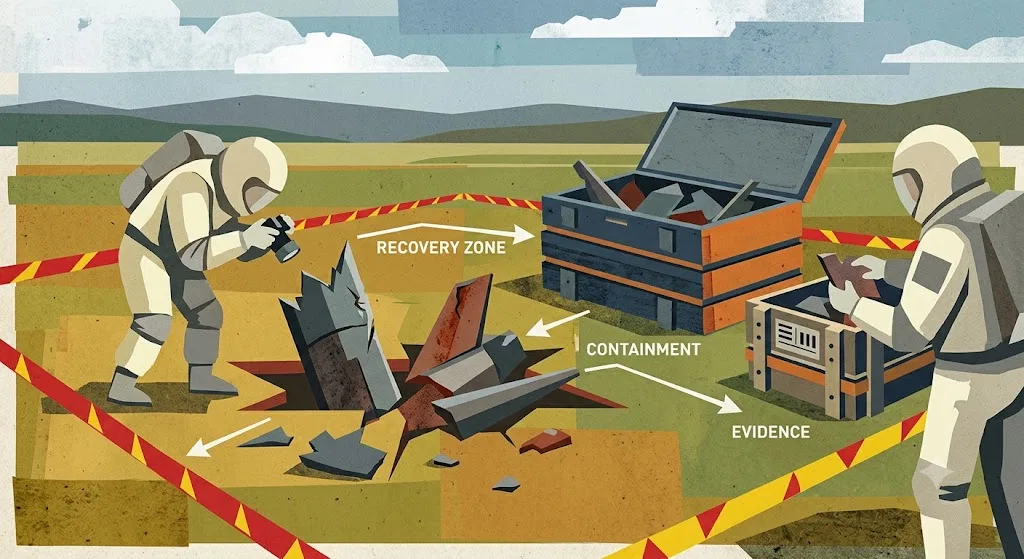
Captured hardware rarely arrives in a clean laboratory condition. It may be burning, booby-trapped, contaminated, half-submerged, stripped by soldiers, photographed by civilians, or sitting in terrain still covered by artillery and drones. The first implementation choice is therefore not “analyse it” but “stabilise the scene enough that analysis remains possible”.
Military doctrine gives explosive ordnance disposal teams a central role because many attractive intelligence targets are also lethal hazards. US technical intelligence guidance assigns EOD units responsibility for assessment, identification, disposal and render-safe work on conventional, improvised and chemical, biological, radiological and nuclear devices; it also notes their role in movement, packaging and hazardous-material certification.[Bits]bits.deOpen source on bits.de. That matters because a recovery team that rushes to open a missile seeker, drone warhead or armoured vehicle compartment can destroy the item, injure personnel or contaminate the very evidence it is trying to preserve.
A useful recovery operation treats the site as both a military problem and an evidence problem. The immediate priorities are usually:
- Safety first: explosive, toxic, radiological, fuel, battery and structural hazards must be assessed before exploitation personnel enter.
- Security against loss: the item should be protected from pilferage, cannibalisation and souvenir-taking until technical personnel screen it. US doctrine explicitly warns that captured enemy materiel must be protected from pilferage, cannibalising and souvenir hunters.[Bits]bits.deOpen source on bits.de.
- Context capture: if the item cannot be moved, teams should still record photographs, grid coordinates, factory markings and serial numbers. Doctrine specifically directs units to obtain photos, grid coordinates and factory markings or serial numbers when materiel has to be destroyed or left in place.[Bits]bits.deOpen source on bits.de.
- Triage against intelligence requirements: not every captured item deserves scarce transport, guard space and laboratory time. Liaison officers compare reports against standing technical requirements before deciding whether a team should go forward, whether the capturing unit can evacuate the item, or whether normal logistics disposal is enough.[Bits]bits.deOpen source on bits.de.
The tension is that tactical units often want the same item for other reasons: reuse, repair, battlefield display, proof of success, or spare parts. Vietnam-era US experience shows how quickly this becomes an organisational issue rather than a purely technical one. The Combined Materiel Exploitation Centre evolved from a weak, part-time capability into a structured system for collecting and exploiting captured materiel, with teams working at corps and division support-area collection points and items evacuated to the centre through logistics channels where possible.[Webdoc]webdoc.sub.gwdg.deWebdoc Chapter II: Combined IntelligenceWebdoc Chapter II: Combined Intelligence
Preserving fragile parts, markings and context
The most important evidence on captured hardware is often small and easy to damage. A serial number, circuit board marking, production lot code, software storage device, optical coating, connector type or improvised repair can say more than the visible wreckage. For reverse engineering, the difference between “a recovered drone” and “this specific recovered drone, with these components, found at this location, after this attack” is decisive.
The tag is part of the intelligence product
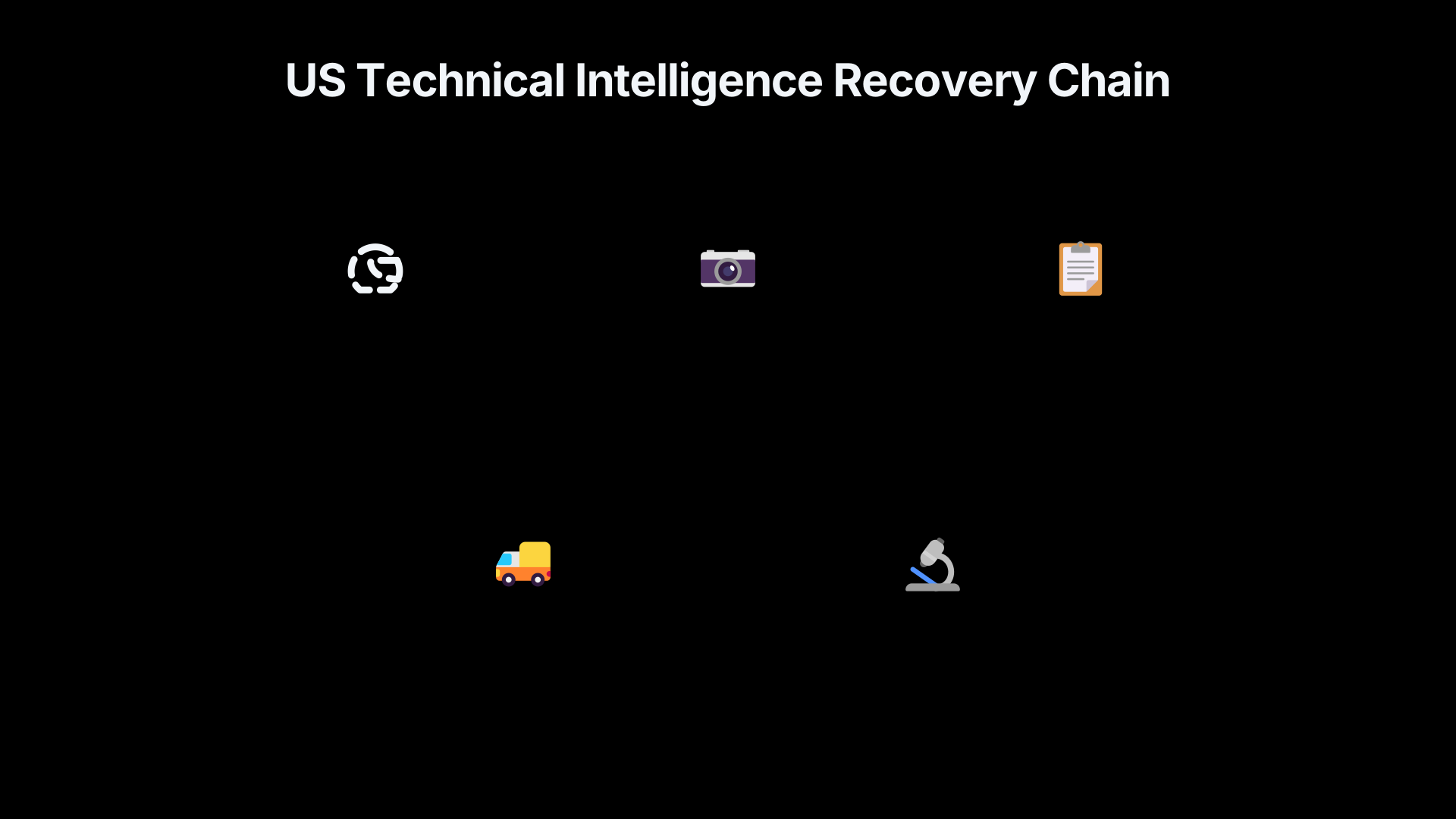
Marking and tagging are not clerical afterthoughts. They are what allow laboratory specialists to reconstruct the story of an item after it has passed through soldiers, logisticians, EOD personnel, intelligence staff and transport handlers. US technical intelligence doctrine says the capturing unit is responsible for properly marking and tagging captured enemy materiel, that tags should accompany the item to its final destination, and that training should stress preserving original markings on the materiel at the time of capture.[Bits]bits.deOpen source on bits.de.
The same guidance explains why this matters operationally: proper labelling gives analysts the information needed for timely exploitation and can allow interrogators or technical intelligence elements to match knowledgeable prisoners with the equipment from which they were separated during evacuation.[Bits]bits.deOpen source on bits.de. In plain terms, a captured radio, launcher or control unit may become more valuable if analysts know who operated it, which formation used it, and what documents or accessories were found with it.
Photography has a similar function. The technical intelligence photolog described in US doctrine records the date and time, subject, location, distance, bearing, naming convention and environmental conditions for images. It also places baseline photographs, measurements and specific exploitation steps inside the initial on-site workflow after EOD has established safe entry and exit points.[Bits]bits.deOpen source on bits.de. That is a practical safeguard against later confusion: a close-up of a circuit board is less useful if no one can prove which wreckage it came from or how it sat in the original site.
Fragility is not only physical
Fragile evidence includes more than broken electronics. Software can be lost if power is applied carelessly. Memory modules can be damaged by weather or static. Radio-frequency equipment can be altered if antennas, cables or filters are removed without documentation. Documents can become separated from the hardware they explain. Even dirt, paint, scorch marks and impact damage may tell analysts how the system was transported, fired, hit or modified.
This is why field exploitation must be limited and disciplined. The field team may need enough information to produce a rapid tactical report, but deep disassembly usually belongs in a better-equipped exploitation centre. The doctrinal model reflects that division of labour: the Captured Materiel Exploitation Centre is the theatre-level location for collection, safeguarding, battlefield exploitation, reporting and evacuation of captured materiel of intelligence value.[Bits]bits.deOpen source on bits.de.
Conflict Armament Research’s public methodology shows how similar principles appear in non-governmental weapons documentation. Its field teams inspect materiel in conflict-affected locations, photographically document items, date and geo-reference documentation sites, and avoid basing investigations primarily on social-media photographs because provenance is difficult to verify.[conflictarm.com]conflictarm.comConflict Armament ResearchConflict Armament Research For military reverse engineering, the same lesson applies with higher stakes: provenance is not decoration. It is what lets analysts distinguish a real supply-chain clue from a misleading fragment.
Moving evidence to specialists without losing the story
Once the site is safe and the item is documented, the next decision is where it should go. The answer depends on rarity, danger, size, exploitation priority and whether local commanders need an immediate answer. A small intact guidance unit may be flown quickly to a national laboratory; a damaged armoured vehicle may go first to a theatre collection point; a suspected chemical or biological sample may require specialist packaging, escort and transport.
US Gulf War records show how specialised this could become. In 1991, the Joint Captured Materiel Exploitation Centre’s mission included battlefield exploitation of captured Iraqi equipment to determine capabilities, limitations and vulnerabilities, as well as biological and chemical sampling to support decisions on countermeasures. The centre drew on technical intelligence personnel from several US services, the United Kingdom and specialist chemical and technical escort units.[GulfLINK]gulflink.health.milGulf LINKSection IIGulf LINKSection II The same account notes that a US Army Technical Escort Unit detachment was attached to provide packaging and transport capability for hazardous samples and to train in-theatre technical intelligence teams on proper packaging techniques.[GulfLINK]gulflink.health.milGulf LINKSection IIGulf LINKSection II
Modern Ukraine shows the same chain in a contemporary conflict. Reports on Ukraine’s TrophyLab describe a system in which captured Russian equipment is examined by scientific institutions, laboratories and engineering centres, then turned into technical specifications, blueprints, component analyses and studies shared with vetted users. Defence News reported that the platform catalogued more than 115 samples across 79 categories, with access to more than 225 studies, while Forces News described the material as a shared research pool for defence companies, scientists and partner governments.[Defense News]defensenews.comOpen source on defensenews.com.
That public-facing platform is downstream of battlefield recovery. A database entry for a missile, drone or tank can only be trusted if the physical sample and its accompanying records survived the journey from impact site or capture point to laboratory. The Ukrainian example also highlights a modern implementation shift: exploitation is no longer only a closed national process. In a coalition war, the recovered item may feed domestic repair units, intelligence agencies, sanctions investigators, allied laboratories and defence companies seeking countermeasures.
What good handling changes in reverse engineering
The value of good recovery work is that it turns wreckage into evidence and evidence into decisions. A laboratory can measure metallurgy, chips, software, optics and radio-frequency behaviour, but the field record tells analysts what those findings mean.
For example, component tracing in Ukraine depends on recovered weapons being documented well enough to connect parts to a specific system and event. Reuters reported in 2022 that a RUSI-linked investigation found more than 450 foreign-made components in Russian weapons recovered in Ukraine, while later US Senate reporting cited repeated findings by organisations such as RUSI and Conflict Armament Research that US-manufactured semiconductors continued to appear in Russian weapons recovered on the battlefield.[Reuters]reuters.comOpen source on reuters.com. Those findings are not just technical curiosities. They inform export-control enforcement, sanctions policy and procurement-route investigations.
Good evidence handling also protects analysts from false confidence. A component found in a weapons depot does not prove the same thing as a component recovered from a recently fired missile. A circuit board removed from a wreck without a documented location may still be technically interesting, but it loses value for tracing production batches, battlefield use and supply routes. CAR’s methodology addresses this problem by combining physical evidence from weapons with documents and interviews, while retaining supporting records in secure form.[conflictarm.com]conflictarm.comConflict Armament ResearchConflict Armament Research
The best recovery systems therefore create a chain of interpretation:
- The site record shows where and under what circumstances the item was found.
- The safety and handling record shows what was moved, opened, destroyed or left in place.
- The tag and photograph record preserves identity, markings and association with documents or personnel.
- The exploitation record links laboratory findings back to the original battlefield context.
- The dissemination record turns the findings into countermeasures, training, sanctions evidence or design lessons.
This is why “battlefield recovery” should not be treated as a low-status logistics task. It is the point at which technical intelligence is either protected or quietly weakened.
Common failure points in the recovery chain
The same mistakes recur across conflicts because recovery happens under stress. The most damaging failures are often mundane rather than dramatic.
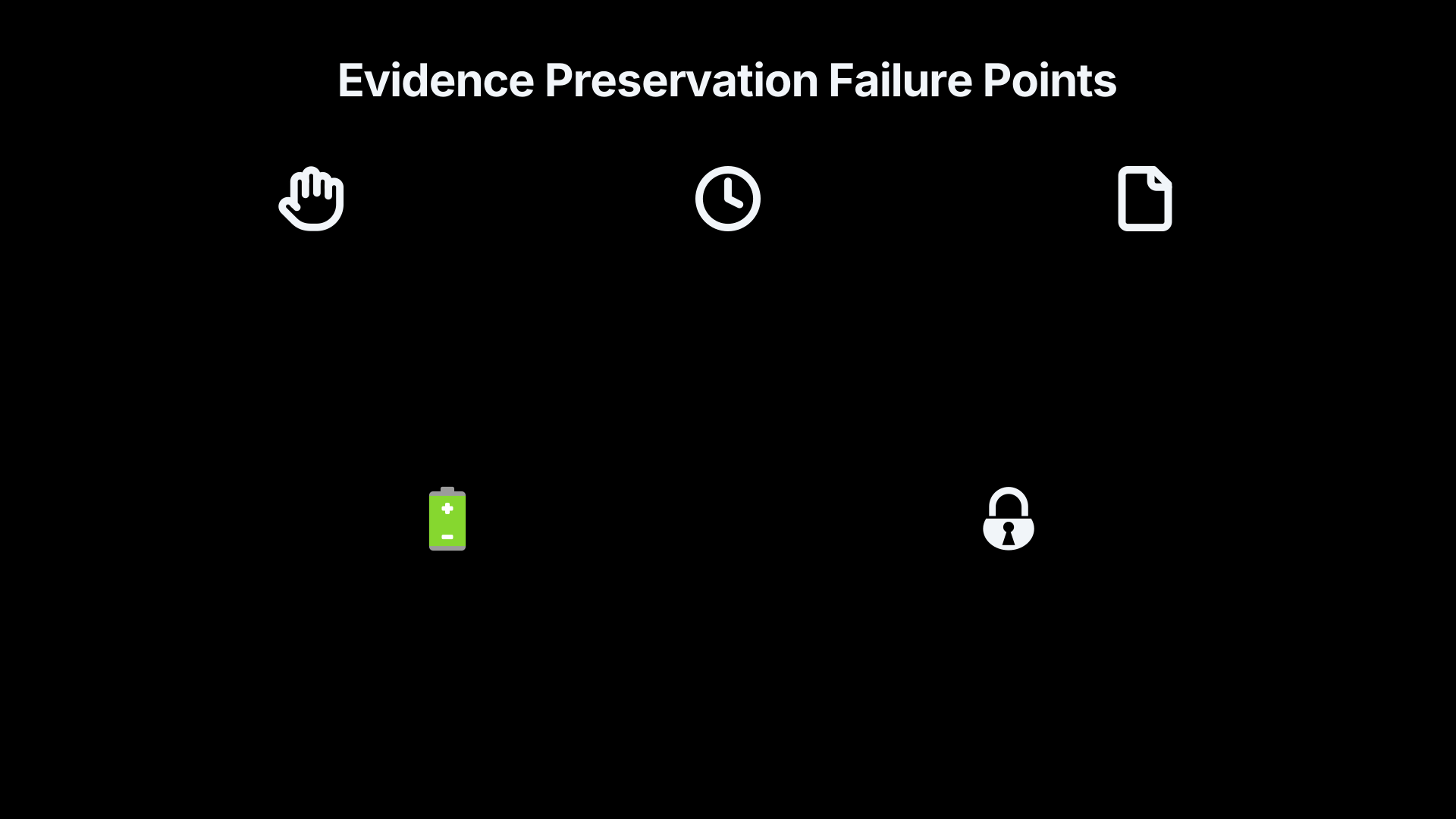
Souvenir-taking and cannibalisation can remove the very parts analysts need most. A missing radio module, data plate or sensor head may look insignificant to a soldier but be central to identifying a variant or production batch. US doctrine’s warning against pilferage, cannibalising and souvenir hunters reflects this practical problem.[Bits]bits.deOpen source on bits.de.
Local exploitation can delay specialist exploitation. Vietnam-era document handling offers a close parallel: some units delayed sending captured documents to the central exploitation centre while they conducted local work, prompting the procurement of duplicating machines so units could retain copies while sending originals onward.[Webdoc]webdoc.sub.gwdg.deWebdoc Chapter II: Combined IntelligenceWebdoc Chapter II: Combined Intelligence The same tension applies to hardware. Commanders need fast local answers, but holding rare equipment too long can slow higher-quality analysis.
Poor association separates systems from their evidence. A launcher without its missile can still be useful; a launcher with its documents, cables, power source, operator notes and captured crew information is far better. Doctrine recognises this by requiring technical documents associated with captured equipment to be collected and sent through intelligence channels to the exploitation centre.[Bits]bits.deOpen source on bits.de.
Unsafe movement can destroy the sample. Batteries, fuel, explosives, chemical residues and damaged structures create hazards for both personnel and evidence. Gulf War arrangements for technical escort and chemical sampling show why specialist packaging and transport are part of the exploitation system, not a peripheral support service.[GulfLINK]gulflink.health.milGulf LINKSection IIGulf LINKSection II
Over-classification or poor sharing can limit practical benefit. Captured hardware often contains lessons useful to more than one organisation: frontline troops, electronic warfare units, defence laboratories, sanctions investigators and allied engineers. Ukraine’s TrophyLab reflects one response to that problem by creating vetted access to research on captured Russian systems rather than leaving every partner to rediscover the same lessons separately.[Defense News]defensenews.comOpen source on defensenews.com.

The implementation choice that matters most
The hardest policy choice is how much capability to push forward and how much to centralise. Forward teams can reach fragile equipment before it is damaged, looted or moved, and they can give commanders quick warnings about hazards or vulnerabilities. Central laboratories can perform deeper, safer and more repeatable exploitation. The strongest systems combine both: trained capturing units, EOD-led safety, deployable technical intelligence teams, disciplined tagging, secure transport and specialist exploitation centres.
The US doctrinal model explicitly links these layers. It describes technical intelligence as beginning with identification and assessment in the field and continuing through collection, exploitation and evacuation; it also places the CMEC near related document, interrogation and ammunition facilities to support movement, safeguarding and exploitation of captured personnel, equipment and materiel.[Bits]bits.deOpen source on bits.de. Historical practice in Vietnam, the Gulf War and Ukraine points to the same conclusion: reverse engineering does not begin at the workbench. It begins when the first person on the battlefield decides whether a captured object is evidence, scrap, a trophy or a hazard.
For foreign military technology, that decision has strategic consequences. A well-handled fragment can reveal a supply chain, a weakness, a production change or a countermeasure. A badly handled one may still look impressive in a photograph, but its intelligence value has already been lost.
Amazon book picks
Further Reading
Books and field guides related to How Captured Hardware Reaches the Lab. Use these as the next step if you want deeper reading beyond the article.
The Pentagon's Brain
Explains how military technology and intelligence systems are collected, studied and exploited.
Skunk Works
Shows how advanced military systems are evaluated and understood by specialists.
Military Intelligence Blunders
Provides context for why accurate collection and handling of evidence matters.
Book of camouflage
Covers battlefield identification and observation themes related to materiel recovery.
eBay marketplace picks
Marketplace Samples
Live-tested eBay searches with available results related to this page.

Endnotes
1.
Source: bits.de
Link:https://www.bits.de/NRANEU/others/amd-us-archive/fm2-22.401%2806%29.pdf
2.
Source: conflictarm.com
Title: Conflict Armament Research
Link:https://www.conflictarm.com/methodology/
3.
Source: reuters.com
Link:https://www.reuters.com/business/aerospace-defense/exclusive-russian-weapons-ukraine-powered-by-hundreds-western-parts-rusi-2022-08-08/
4.
Source: hsgac.senate.gov
Link:https://www.hsgac.senate.gov/wp-content/uploads/09.10.2024-Majority-Staff-Report-The-U.S.-Technology-Fueling-Russias-War-in-Ukraine.pdf
5.
Source: api.army.mil
Title: fy25 mission command training program key observations
Link:https://api.army.mil/e2/c/downloads/2026/02/13/f6b2aa2f/fy25-mission-command-training-program-key-observations.pdf
6.
Source: rusi.org
Link:https://www.rusi.org/news-and-comment/in-the-news/hundreds-western-components-found-russian-weapons-ukraine
7.
Source: mipb.ikn.army.mil
Title: mil[PDF] Moments in MI History
Link:https://mipb.ikn.army.mil/media/emuo1how/mipb-2020-07-09-full-issue.pdf
8.
Source: armyupress.army.mil
Link:https://www.armyupress.army.mil/Journals/Military-Review/English-Edition-Archives/March-2024/Russia-Ukraine-Conflict-Laboratory/
9.
Source: history.army.mil
Link:https://history.army.mil/portals/143/Images/Publications/catalog/90-19.pdf
10.
Source: history.army.mil
Link:https://history.army.mil/portals/143/Images/Publications/catalog/45-5.pdf
11.
Source: history.army.mil
Link:https://history.army.mil/portals/143/Images/Publications/catalog/60-13.pdf
12.
Source: asafm.army.mil
Title: mil[PDF] RDTE Budget Activity Documents
Link:https://www.asafm.army.mil/Portals/72/Documents/BudgetMaterial/2027/Discretionary%20Budget/rdte/RDTE%20-%20Vol%201%20-%20Budget%20Activity%203.pdf
13.
Source: mipb.ikn.army.mil
Title: mipb 2024 07 12 full collection
Link:https://mipb.ikn.army.mil/media/fyjlmvq1/mipb-2024-07-12-full-collection.pdf
14.
Source: hnc.usace.army.mil
Link:https://www.hnc.usace.army.mil/Portals/65/docs/History/CMCHistory.pdf
15.
Source: usanca.army.mil
Title: mil[PDF] Countering WMD
Link:https://www.usanca.army.mil/Portals/114/CWMD_Journal/CWMD%20Journal%20Issue%2019.pdf?ver=lPzFWihrKCsM6MoQiFBcHQ%3D%3D
16.
Source: armyupress.army.mil
Link:https://www.armyupress.army.mil/Journals/Military-Review/English-Edition-Archives/May-June-2024/MJ-24-Army-Medicine-AI/
17.
Source: conflictarm.com
Title: PUBLICATION S
Link:https://www.conflictarm.com/publications/
18.
Source: conflictarm.com
Title: FIEL D DISPATCHES
Link:https://www.conflictarm.com/field-dispatches/
19.
Source: conflictarm.com
Title: [PDF] WEAPONS OF THE WAR IN UKRAINE
Link:https://www.conflictarm.com/wp-content/uploads/2021/11/Weapons-of-the-war-in-Ukraine-low.pdf
20.
Source: conflictarm.com
Title: WEAPON S OF THE WAR IN UKRAINE
Link:https://www.conflictarm.com/reports/weapons-of-the-war-in-ukraine/
21.
Source: portal.battlefield.com
Link:https://portal.battlefield.com/
22.
Source: webdoc.sub.gwdg.de
Title: Webdoc Chapter II: Combined Intelligence
Link:https://webdoc.sub.gwdg.de/ebook/p/2005/CMH_2/www.army.mil/cmh-pg/books/vietnam/mi/ch02.htm
23.
Source: gulflink.health.mil
Title: Gulf LINKSection II
Link:https://gulflink.health.mil/bw_ii/bw_s02.htm
24.
Source: defensenews.com
Link:https://www.defensenews.com/global/europe/2026/06/22/ukraine-launches-trophylab-platform-to-share-captured-russian-weapons-with-allies/
25.
Source: reddit.com
Link:https://www.reddit.com/r/Battlefield/
26.
Source: youtube.com
Link:https://www.youtube.com/Battlefield
Additional References
27.
Source: youtube.com
Title: Improvised Explosive Devices “Weapons Intelligence Team” Course
Link:https://www.youtube.com/watch?v=igrGOsRDdNk
Source snippet
3D Scan Evidence Gathering - X2D Ready for Duty, Episode 2...
28.
Source: archives.gov
Link:https://www.archives.gov/publications/ref-info-papers/90/part-2.html
29.
Source: fbi.gov
Link:https://www.fbi.gov/file-repository/handbook-of-forensic-services-pdf.pdf
30.
Source: youtube.com
Title: 3D Scan Evidence Gathering
Link:https://www.youtube.com/watch?v=KxwfI5UBrXw
Source snippet
UNMASKING THE BOOGEYMAN: THE BIN LADEN PAPERS...
31.
Source: youtube.com
Title: UNMASKING THE BOOGEYMAN: THE BIN LADEN PAPERS
Link:https://www.youtube.com/watch?v=NVaD87Eg_Ng
Source snippet
The Japanese Tank That Stunned Detroit's Engineers | WWII 1945...
32.
Source: instagram.com
Link:https://www.instagram.com/battlefield/?hl=en
33.
Source: coespu.org
Link:https://www.coespu.org/articles/considerations-battlefield-evidence-collection-and-crime-scene-investigation
34.
Source: interpol.int
Link:https://www.interpol.int/es/content/download/5155/file/Forestry%20Law%20Enforcement%20Manual.pdf
35.
Source: forcesnews.com
Link:https://www.forcesnews.com/ukraine/russias-weapons-secrets-plate-ukraine-opens-battlefield-archive-allies
36.
Source: smallarmssurvey.org
Link:https://www.smallarmssurvey.org/sites/default/files/resources/SAS-HB-06-Weapons-ID-ch7.pdf
Topic Tree
Follow this branch
Parent topic
Foreign MaterielRelated pages 29
- Capture Tags Why the Tag Can Matter as Much as the Weapon
- EOD Safety Making Captured Weapons Safe Without Ruining the Clues
- Photologs The Photos That Save a Wreck's Original Story
- Stop Disassembly Where Field Exploitation Should Stop
- Stop Stripping When Souvenirs Destroy the Intelligence Story
- +1 more in sidebar