Within Paperclip
How America Learned From the V 2
The V-2 tests combined German parts, German specialists and American institutions into a working missile research programme.
On this page
- Moving missile parts and experts west
- Rebuilding, launching and improving V 2 s
- What failures taught American engineers
Page outline Jump by section
Introduction
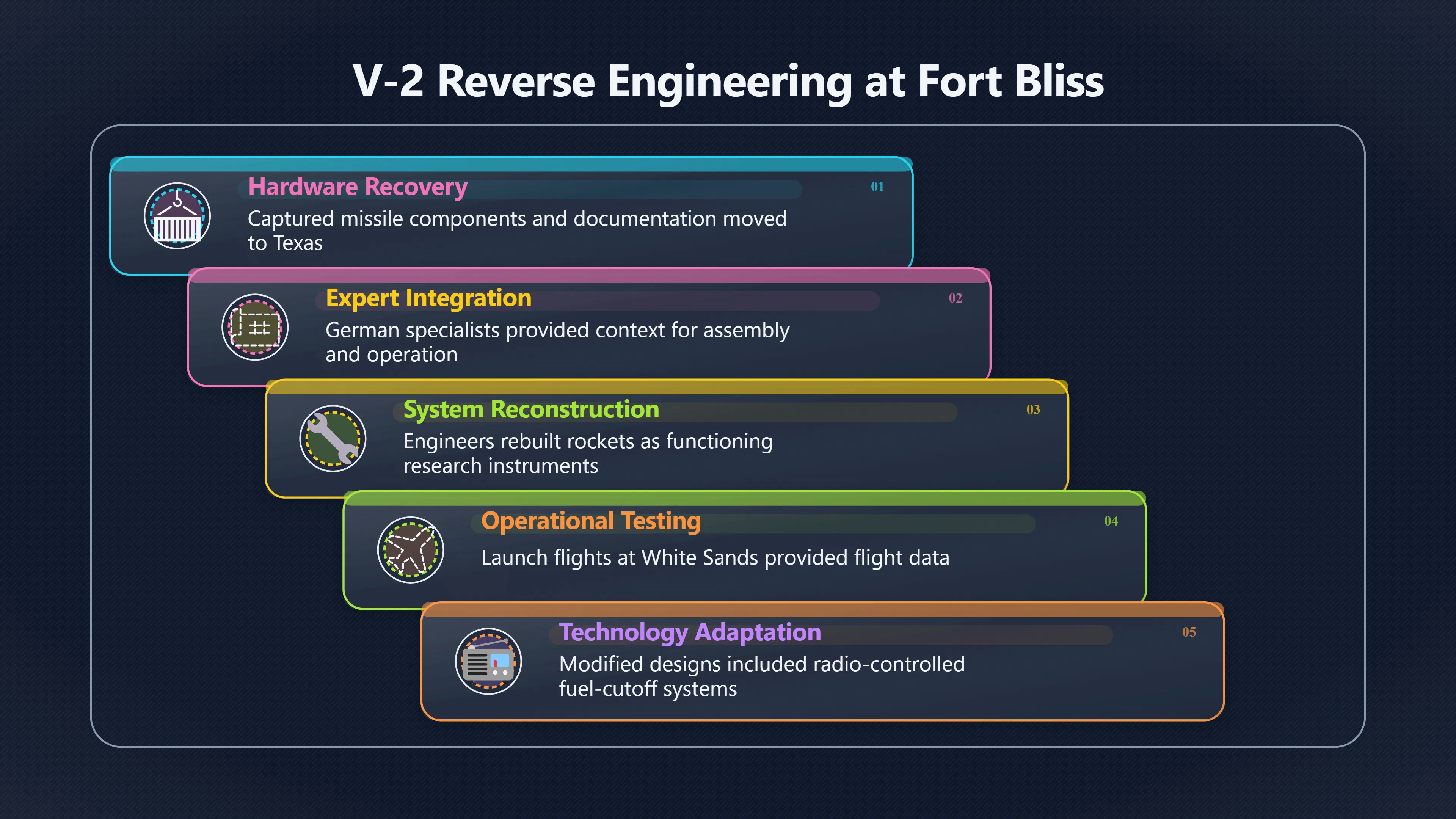
The Fort Bliss V-2 programme was one of the clearest examples of reverse engineering being carried out as a practical engineering process rather than a purely analytical exercise. After the Second World War, the United States did not rely only on captured drawings or intelligence reports about Germany’s V-2 ballistic missile. Instead, it transported missile components, support equipment and German rocket specialists to the United States, then rebuilt, tested and modified the rockets under American military control. The result was a working research programme that allowed American engineers to learn directly from an advanced foreign weapon system by operating it, breaking it, repairing it and gradually adapting its technologies to new purposes. U.S. Army Center of Military History[history.army.mil]history.army.milArmy Center of Military HistorySeize the High Ground: The Army in Space and Missile DefenseJune 7, 2013 — Fort Bliss, Texas … helped refu…

Within the broader framework of Project Paperclip, Fort Bliss became the organisational hub where German expertise and American institutions met. The programme demonstrated that reverse engineering often requires more than examining hardware. It can involve reconstructing an entire technological system, including manufacturing knowledge, operating procedures, maintenance practices and lessons learned from failure.[NASA]nasa.govwernher von braunWernher von BraunFeb 6, 2024 — There they worked on rockets for the U.S. Army and assisted in V-2 launches at White Sands Proving Gro…
Moving Missile Parts and Experts West
The United States emerged from the war with access to substantial portions of the German V-2 programme. American forces captured production facilities, technical documentation, missile components and key personnel associated with the rocket’s development. Enough major parts were recovered to assemble approximately one hundred V-2 missiles.[NASA]nasa.gov75 Years Ago: First Launch of a Two-Stage Rocket75 Years Ago: First Launch of a Two-Stage RocketMay 12, 2023 — The story begins near the end of World War II when on April 11, 1945…
The German specialists, including members of Wernher von Braun’s team, were brought to Fort Bliss, Texas, under Project Paperclip. Their role was not simply advisory. They trained American military personnel, civilian engineers and industrial contractors while helping refurbish and assemble the captured missiles destined for testing at White Sands Proving Ground in neighbouring New Mexico.[nasa.gov]nasa.govwernher von braunWernher von BraunFeb 6, 2024 — There they worked on rockets for the U.S. Army and assisted in V-2 launches at White Sands Proving Gro…
This arrangement revealed an important feature of reverse engineering in practice. Many critical details of a complex weapon system are difficult to recover from hardware alone. Engineers may be able to measure components, but understanding assembly methods, troubleshooting procedures, guidance calibration and operational limitations is much harder. The German specialists supplied this missing context, allowing American teams to move beyond inspection and into actual operation of the missiles.[National Air and Space Museum]airandspace.si.eduproject paperclip and american rocketry after world war iiNational Air and Space MuseumProject Paperclip and American Rocketry after World War IIMar 31, 2023 — Project Paperclip was a program tha…
Fort Bliss therefore functioned as more than a holding location for foreign scientists. It became a technical translation centre where knowledge embedded in people was transferred alongside knowledge embedded in machines. American engineers learned not merely what the V-2 looked like, but how it worked as a complete system.[The New Yorker]newyorker.comThe New Yorker White SandsThe New YorkerWhite SandsJuly 17, 1948 — American scientists and engineers, a number of whom had been in England during the uncomfortable…
Rebuilding, Launching and Improving V-2s
The practical heart of the programme was the effort to reconstruct operational V-2 rockets from captured components and launch them at White Sands. Launch facilities, gantries, test stands and control systems had to be created in the American desert before the rockets could be used. Construction began almost immediately after White Sands Proving Ground was established.[NASA]nasa.gov75 Years Ago: First Launch of a Two-Stage Rocket75 Years Ago: First Launch of a Two-Stage RocketMay 12, 2023 — The story begins near the end of World War II when on April 11, 1945…
The first phase involved learning how to assemble and test the missiles. Engineers worked through German hardware piece by piece, checking the condition of components that had survived transport and wartime storage. Captured missiles were not simply copied and placed in museums; they were treated as functioning research instruments. U.S. Army Center of Military History[history.army.mil]history.army.milArmy Center of Military HistorySeize the High Ground: The Army in Space and Missile DefenseJune 7, 2013 — Fort Bliss, Texas … helped refu…
The programme quickly evolved beyond straightforward reconstruction. Before the first launch, teams introduced modifications, including a radio-controlled fuel-cutoff system that could terminate a flight if the rocket became dangerous. This was an American operational improvement added to the original German design.[White Sands Missile Range Museum]wsmrmuseum.comoperation paperclip at fort blissWhite Sands Missile Range MuseumOperation Paperclip at Fort Bliss: 1945-1950Mar 28, 2022 — The V-2 launch site at White Sands Proving Gro…
The first launch on 16 April 1946 ended unsuccessfully when the missile lost control and had to be shut down. Yet the programme continued, and a successful launch followed less than a month later. Over the following years, dozens of V-2 flights were conducted from White Sands. These launches transformed the captured weapon into a research platform for studying high-altitude flight, atmospheric science, instrumentation and missile technology.[smithsonianmag.com]smithsonianmag.comOpen source on smithsonianmag.com.
This transition from weapon to experimental tool is significant. Reverse engineering was no longer limited to reproducing a foreign design. American engineers were learning how to adapt the design for new objectives, including scientific payloads, telemetry systems and experimental upper-atmosphere investigations. The V-2 became a laboratory as much as a missile.[White Sands Missile Range Museum]wsmrmuseum.comoperation paperclip at fort blissWhite Sands Missile Range MuseumOperation Paperclip at Fort Bliss: 1945-1950Mar 28, 2022 — The V-2 launch site at White Sands Proving Gro…
What Failures Taught American Engineers
One reason the Fort Bliss and White Sands programme mattered so much is that engineers learned from failures as well as successes. Captured technology rarely arrives in perfect condition. Components deteriorate, documentation is incomplete and operating environments change. The V-2 programme forced American personnel to confront these problems directly.[Facebook]facebook.comFirst v-2 rocket launch experience at White SandsFort Bliss in January 1946. GE personnel built new control components to replace…
The failed first launch illustrated this process. The rocket lost a steering vane, deviated from its intended path and had to be destroyed. Rather than ending the programme, the incident generated data about control systems, structural stresses and launch procedures. The newly installed emergency shutdown mechanism proved valuable, demonstrating the importance of safety systems absent from the original wartime operational context.[Smithsonian Magazine]smithsonianmag.comOpen source on smithsonianmag.com.
Repeated launches also exposed maintenance issues, reliability limits and operational weaknesses that were difficult to identify from blueprints alone. Engineers gained experience in fuel handling, guidance systems, launch preparation and recovery of scientific payloads. Each test produced practical knowledge about what could be retained, what needed modification and what should be replaced in future American missile designs.[White Sands Missile Range Museum]wsmrmuseum.comoperation paperclip at fort blissWhite Sands Missile Range MuseumOperation Paperclip at Fort Bliss: 1945-1950Mar 28, 2022 — The V-2 launch site at White Sands Proving Gro…
Equally important was the educational effect. American military officers, university researchers and industrial engineers observed launches and worked alongside the German specialists. The programme effectively became a training school for advanced rocketry, creating a domestic base of expertise that would outlast the captured missiles themselves.[The New Yorker]newyorker.comThe New Yorker White SandsThe New YorkerWhite SandsJuly 17, 1948 — American scientists and engineers, a number of whom had been in England during the uncomfortable…
Why the V-2 Tests Matter as a Reverse-Engineering Case
The Fort Bliss V-2 effort demonstrates that reverse engineering can be an active process of reconstruction and experimentation rather than a passive process of inspection. American engineers did not simply disassemble a foreign weapon to discover its secrets. They rebuilt the system, operated it repeatedly, incorporated selected improvements and used it to generate new knowledge. U.S. Army Center of Military History[history.army.mil]history.army.milArmy Center of Military HistorySeize the High Ground: The Army in Space and Missile DefenseJune 7, 2013 — Fort Bliss, Texas … helped refu…
The programme also showed the value of combining captured hardware with captured expertise. The V-2 was complex enough that practical understanding emerged through collaboration between American institutions and German specialists who possessed firsthand operational knowledge. This combination accelerated learning and reduced the time needed to transform a wartime enemy technology into the foundation of later American missile research.[National Air and Space Museum]airandspace.si.eduproject paperclip and american rocketry after world war iiNational Air and Space MuseumProject Paperclip and American Rocketry after World War IIMar 31, 2023 — Project Paperclip was a program tha…
Viewed through the lens of reverse engineering foreign military technology, the Fort Bliss and White Sands V-2 programme was not merely an exercise in copying. It was a sustained effort to understand, operate and ultimately surpass a captured weapons system by turning it into a working research programme. The lessons gained from rebuilding and launching those rockets became part of the technical foundation on which later American missile and space projects were constructed.[wikipedia.org]WikipediaWhite Sands V-2 Launching SiteWhite Sands V-2 Launching Site
Amazon book picks
Further Reading
Books and field guides related to How America Learned From the V-2. Use these as the next step if you want deeper reading beyond the article.
eBay marketplace picks
Marketplace Samples
Live-tested eBay searches with available results related to this page.

Endnotes
1.
Source: history.army.mil
Link:https://history.army.mil/portals/143/Images/Publications/catalog/70-88-1.pdf
Source snippet
Army Center of Military HistorySeize the High Ground: The Army in Space and Missile DefenseJune 7, 2013 — Fort Bliss, Texas … helped refu...
Published: June 7, 2013
2.
Source: nasa.gov
Title: wernher von braun
Link:https://www.nasa.gov/people/wernher-von-braun/
Source snippet
Wernher von BraunFeb 6, 2024 — There they worked on rockets for the U.S. Army and assisted in V-2 launches at White Sands Proving Gro...
3.
Source: nasa.gov
Title: 75 Years Ago: First Launch of a Two-Stage Rocket
Link:https://www.nasa.gov/history/75-years-ago-first-launch-of-a-two-stage-rocket/
Source snippet
75 Years Ago: First Launch of a Two-Stage RocketMay 12, 2023 — The story begins near the end of World War II when on April 11, 1945...
Published: May 12, 2023
4.
Source: Wikipedia
Title: White Sands V-2 Launching Site
Link:https://en.wikipedia.org/wiki/White_Sands_V-2_Launching_Site
5.
Source: facebook.com
Link:https://www.facebook.com/groups/spacehipsters/posts/27714306251520895/
Source snippet
First v-2 rocket launch experience at White SandsFort Bliss in January 1946. GE personnel built new control components to replace...
Published: January 1946
6.
Source: facebook.com
Link:https://www.facebook.com/groups/USHistoryGroup/posts/3671283266420369/
Source snippet
Army, and were soon moved to White Sands Proving Grounds (now White Sands Missile Range), New Mexico to...Read more...
7.
Source: facebook.com
Link:https://www.facebook.com/groups/spacehipsters/posts/26756608683957328/
Source snippet
ts.... The V-2 assembly...
8.
Source: Wikipedia
Title: Operation Paperclip
Link:https://en.wikipedia.org/wiki/Operation_Paperclip
Source snippet
Operation PaperclipOperation Paperclip was a secret United States intelligence program in which more than 1,600 German scientists, eng...
9.
Source: airandspace.si.edu
Title: project paperclip and american rocketry after world war ii
Link:https://airandspace.si.edu/stories/editorial/project-paperclip-and-american-rocketry-after-world-war-ii
Source snippet
National Air and Space MuseumProject Paperclip and American Rocketry after World War IIMar 31, 2023 — Project Paperclip was a program tha...
10.
Source: newyorker.com
Title: The New Yorker White Sands
Link:https://www.newyorker.com/magazine/1948/07/24/white-sands
Source snippet
The New YorkerWhite SandsJuly 17, 1948 — American scientists and engineers, a number of whom had been in England during the uncomfortable...
Published: July 17, 1948
11.
Source: wsmrmuseum.com
Title: operation paperclip at fort bliss 1945 1950
Link:https://wsmrmuseum.com/2022/03/28/operation-paperclip-at-fort-bliss-1945-1950/
Source snippet
White Sands Missile Range MuseumOperation Paperclip at Fort Bliss: 1945-1950Mar 28, 2022 — The V-2 launch site at White Sands Proving Gro...
12.
Source: smithsonianmag.com
Link:https://www.smithsonianmag.com/air-space-magazine/first-v2-rocket-launch-america-was-75-years-ago-today-180977520/
Published: April 16, 1946
13.
Source: wsmrmuseum.com
Title: white sands missile range hall of fame biographies
Link:https://wsmrmuseum.com/white-sands-missile-range-hall-of-fame-biographies/52/
Source snippet
Between 1932 and 1937, Von Braun was employed by the German Ordnance Department...
Additional References
14.
Source: thenmusa.org
Link:https://www.thenmusa.org/articles/early-army-space-innovation/
15.
Source: nmspacemuseum.org
Link:https://nmspacemuseum.org/inductee/wernher-von-braun/
Source snippet
New Mexico Museum of Space HistoryWernher von BraunVon Braun and his team taught rocketry to the U.S. Army and were soon moved to White S...
16.
Source: ed-thelen.org
Link:https://ed-thelen.org/WingedVictory-150r.pdf
Source snippet
Bliss and test-fired doz- ens of V-2 rockets at White Sands Proving Ground, meanwhile developing new rocket technologies...Read more...
17.
Source: nps.gov
Title: National Park Service White Sands V-2 Launching Site (U.S
Link:https://www.nps.gov/articles/white-sands-v2-launching-site.htm
Source snippet
National Park Service)Aug 29, 2017 — The American government in Operation Paperclip captured more than 100 V-2 rockets and numerous Germa...
18.
Source: pilotguides.com
Title: operation paperclip how ww 2 german scientists changed the world
Link:https://www.pilotguides.com/articles/operation-paperclip-how-ww-2-german-scientists-changed-the-world/
Source snippet
Operation Paperclip: How WW 2 German scientists...Beginning in late 1945, three rocket-scientist groups arrived in the United States for...
19.
Source: mjhnyc.org
Title: from wwii to the space race the story of project paperclip
Link:https://mjhnyc.org/events/from-wwii-to-the-space-race-the-story-of-project-paperclip/
Source snippet
From WWII to the Space Race: The Story of Project PaperclipBetween 1945 and the 1960s, the United States government brought more than 1,5...
20.
Source: reddit.com
Title: whatever happened to the german scientists that
Link:https://www.reddit.com/r/history/comments/eln4uv/whatever_happened_to_the_german_scientists_that/
Source snippet
the U.S...Operation Paperclip is approved by US Secretary of State in 1945, when Wernher Von Braun and around 1000 German scientists are...
21.
Source: reddit.com
Title: 104 german rocket scientists in 1946 at fort
Link:https://www.reddit.com/r/HistoryPorn/comments/tvzsgz/104_german_rocket_scientists_in_1946_at_fort/
Source snippet
The group had been subdivided into two sections: a smaller one at White Sands Proving Grounds for test launches and the larger at Fort Bl...
22.
Source: instagram.com
Link:https://www.instagram.com/p/DNlWPrqodBA/?hl=en
Source snippet
War II that brought more than 1,600 German scientists, engineers...
23.
Source: scopeviews.co.uk
Title: In the US, more than 100 engineers
Link:https://scopeviews.co.uk/V2LaunchSite.htm
Source snippet
A Visit to Spot the V2 Launch Site at White SandsAfter the war, some of the remaining V2s and the rocket engineers that built them went t...
Topic Tree