Within Sidewinder
Copying a Missile Is Not Mastering It
The Sidewinder story proves that reverse engineering can reveal architecture while leaving production quality and adaptation unresolved.
On this page
- What a captured weapon can reveal immediately
- What drawings and measurements cannot transfer
- Why adaptation decides whether a copy becomes useful
Page outline Jump by section
Introduction
The captured AIM-9B Sidewinder that reached Soviet engineers after the 1958 Taiwan Strait fighting is often presented as a triumph of reverse engineering. In one sense, it was. The missile provided a working example of a modern infrared-guided weapon and helped the Soviet Union develop the K-13 (AA-2 Atoll), while also influencing China’s later PL-2 programme. Yet the deeper lesson is not that advanced military technology can simply be copied. It is that copying reveals design solutions, while mastery depends on manufacturing, testing, adaptation and sustained engineering capability. The Sidewinder case remains one of the clearest demonstrations that obtaining a foreign weapon can dramatically accelerate learning without eliminating the harder challenge of building an effective technological ecosystem around it.[Wikipedia]WikipediaAIM-9 SidewinderAIM-9 Sidewinder

What a Captured Weapon Can Reveal Immediately
When Soviet engineers received access to a recovered Sidewinder, they gained something far more valuable than photographs or intelligence estimates. They could inspect a complete system whose components had already been proven in service. The missile exposed dimensions, internal layouts, guidance concepts, packaging methods and manufacturing choices that would otherwise have required years of experimentation to discover independently.[The Aviation Geek Club]theaviationgeekclub.comThe Aviation Geek ClubThe story of the AIM-9 Sidewinder that Failed to Detonate…The story of the AIM-9 Sidewinder that Failed to Deto…
This is why the Sidewinder episode became famous among engineers. Soviet missile designer Gennadiy Sokolovskiy later described the missile as a “university” in missile construction technology. The importance of that remark is often overlooked. He was not saying the Soviets merely copied a product. He was saying they learned how a successful weapons programme solved multiple engineering problems simultaneously.[Wikipedia]WikipediaK-13 (missileK-13 (missile
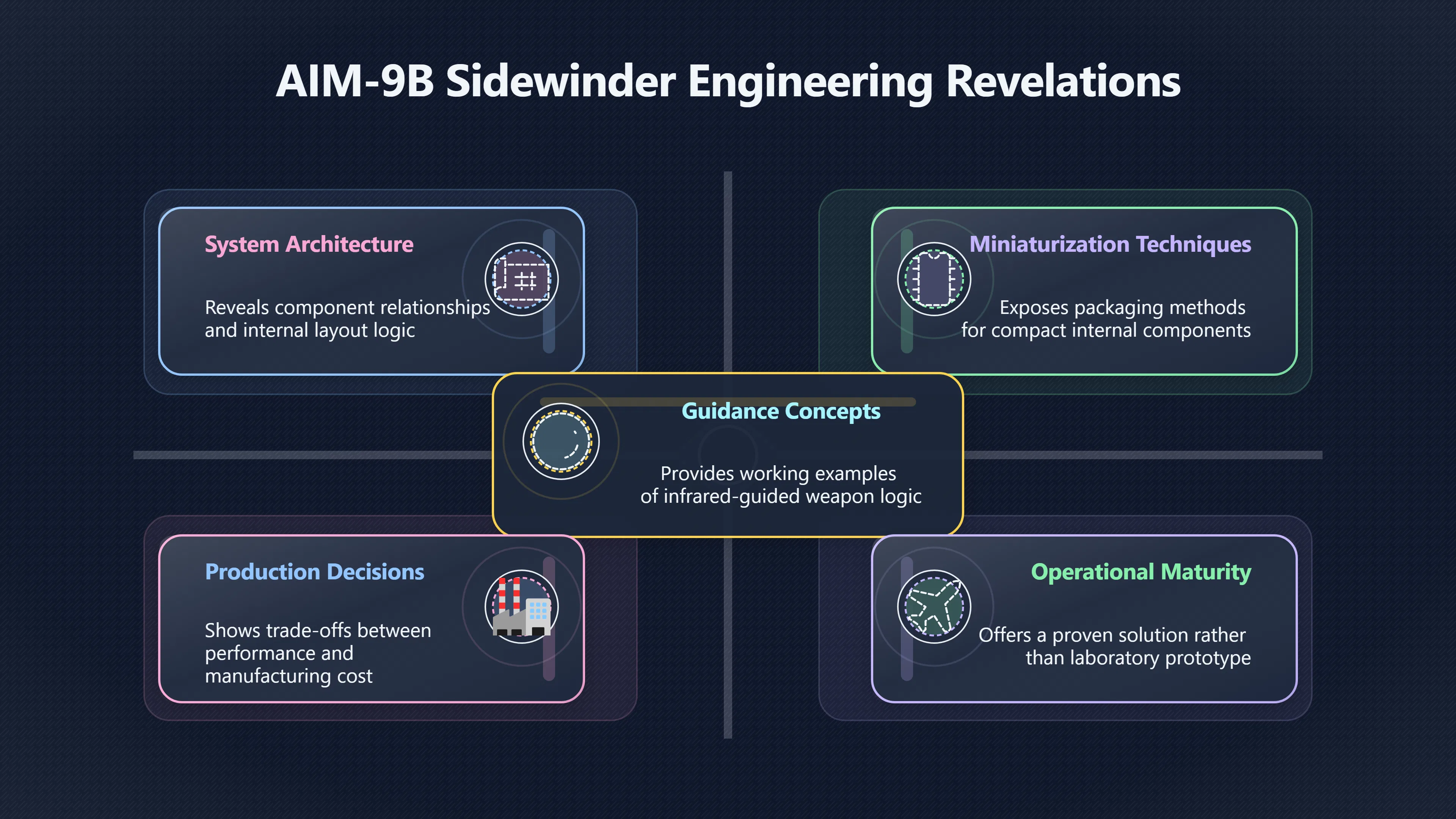
A captured weapon can immediately reveal:
- System architecture and component relationships.
- Packaging and miniaturisation techniques.
- Guidance and control concepts.
- Production-oriented design decisions.
- Trade-offs between performance, reliability and cost.
The Sidewinder was especially informative because its designers at China Lake had emphasised simplicity, reliability and producibility. Reverse engineers were not examining a laboratory prototype; they were studying a mature operational solution.[Air University]airuniversity.af.eduAir University Sidewinder: Creative Missile Development at China LakeAir UniversitySidewinder: Creative Missile Development at China LakeNovember 5, 2018 — 5 Nov 2018 — In Sidewinder: Creative Missile Devel…
What Drawings and Measurements Cannot Transfer
The common myth about reverse engineering is that possession of an object automatically transfers the knowledge required to reproduce it. The Sidewinder experience demonstrates the opposite.
A missile contains visible information and invisible information. Visible information includes dimensions, component arrangements and materials that can be measured. Invisible information includes production tolerances, quality-control procedures, supplier expertise, testing regimes and accumulated engineering judgement. Those factors rarely appear in the finished product itself.[arXiv]arxiv.orgarXiv Hardware Reverse Engineering: Overview and Open ChallengesHardware Reverse Engineering: Overview and Open ChallengesOctober 1, 2019…
Even when Soviet engineers reproduced the Sidewinder closely enough that some components reportedly became interchangeable with those of the American missile, they still had to recreate the industrial processes that made the original reliable. The K-13 entered service rapidly, but subsequent Soviet work focused heavily on improving seekers, fuzes, propulsion and manoeuvrability rather than simply reproducing the initial design indefinitely.[Wikipedia]WikipediaK-13 (missileK-13 (missile
The distinction is crucial. Reverse engineering can answer the question, “What did they build?” It does not automatically answer, “How did they consistently build it to operational standards?”
In military technology, the second question is often harder than the first.

Why Adaptation Matters More Than Duplication
The most important outcome of the Sidewinder story was not the creation of a Soviet copy. It was what happened afterwards.
The original K-13 closely followed the AIM-9B concept, but Soviet engineers soon modified and expanded the design. Later variants incorporated improved seekers, different guidance options, new propulsion arrangements and changes tailored to Soviet aircraft and operational doctrine. China followed a similar path, initially copying imported designs before developing indigenous improvements and later incorporating lessons from additional foreign missile technologies.[wikipedia.org]WikipediaK-13 (missileK-13 (missile
This progression highlights a broader principle of technological mastery: copied systems become strategically valuable only when they are adapted to local requirements.
A country must answer questions such as:
- Can the weapon integrate with domestic aircraft and electronics?
- Can local industry manufacture components at scale?
- Can operators maintain the system in field conditions?
- Can engineers improve the design when threats evolve?
If the answer to those questions is no, then a copied weapon remains an isolated achievement rather than a foundation for military capability.
The Sidewinder therefore demonstrates that successful reverse engineering is less about duplication than about absorption. The key achievement is not reproducing one missile but acquiring enough understanding to design the next generation independently.
The Governance Lesson: Capability Beats Acquisition
For governments, the Sidewinder case offers a useful warning against equating technology acquisition with technological competence.
Captured equipment, espionage and foreign procurement can shorten development timelines. They can reveal solutions that would otherwise require expensive research. However, they do not replace institutions capable of manufacturing, testing and improving complex systems over time.[Air University]airuniversity.af.eduAir University Sidewinder: Creative Missile Development at China LakeAir UniversitySidewinder: Creative Missile Development at China LakeNovember 5, 2018 — 5 Nov 2018 — In Sidewinder: Creative Missile Devel…
The Soviet Union benefited from obtaining the Sidewinder because it already possessed a substantial aerospace industry, trained engineers and missile-development organisations capable of exploiting the information. The captured missile accelerated an existing capability rather than creating one from nothing.[Wikipedia]WikipediaK-13 (missileK-13 (missile
This distinction helps explain why some states successfully leverage foreign technology while others struggle. Possession of the artefact matters far less than possession of the institutions needed to learn from it.
Copying a Missile Is Not Mastering It
The enduring significance of the Sidewinder episode lies in what it reveals about the limits of reverse engineering. A captured weapon can expose architecture, design philosophy and engineering choices with extraordinary clarity. It can dramatically accelerate learning and reduce uncertainty. Yet it cannot directly transfer production culture, testing experience, industrial quality or the capacity to innovate.
The Soviet K-13 proved that a sophisticated military technology could indeed be copied. What happened afterwards proved something more important: mastery emerged not from copying the Sidewinder itself, but from building the engineering and industrial capabilities required to adapt, improve and eventually move beyond it.[wikipedia.org]WikipediaK-13 (missileK-13 (missile
eBay marketplace picks
Marketplace Samples
Live-tested eBay searches with available results related to this page.


Endnotes
1.
Source: Wikipedia
Title: AIM-9 Sidewinder
Link:https://en.wikipedia.org/wiki/AIM-9_Sidewinder
2.
Source: Wikipedia
Title: K-13 (missile)
Link:https://en.wikipedia.org/wiki/K-13_%28missile%29
3.
Source: arxiv.org
Title: arXiv Hardware Reverse Engineering: Overview and Open Challenges
Link:https://arxiv.org/abs/1910.01518
Source snippet
Hardware Reverse Engineering: Overview and Open ChallengesOctober 1, 2019...
Published: October 1, 2019
4.
Source: popularmechanics.com
Link:https://www.popularmechanics.com/military/weapons/a60734289/aim-9-sidewinder-missile-history/
Source snippet
Popular MechanicsAIM-9 Sidewinder: How Russia Copied America's...5 Jun 2024 — By 1960, the Soviet Union had completed its reverse-engine...
5.
Source: theaviationgeekclub.com
Link:https://theaviationgeekclub.com/the-story-of-the-aim-9-sidewinder-that-failed-to-detonate-got-embedded-in-a-mig-17-and-was-reverse-engineered-into-the-soviet-aa-2-atoll/
Source snippet
The Aviation Geek ClubThe story of the AIM-9 Sidewinder that Failed to Detonate...The story of the AIM-9 Sidewinder that Failed to Deto...
6.
Source: airuniversity.af.edu
Title: Air University Sidewinder: Creative Missile Development at China Lake
Link:https://www.airuniversity.af.edu/AUPress/Book-Reviews/Display/Article/1681663/sidewinder-creative-missile-development-at-china-lake/
Source snippet
Air UniversitySidewinder: Creative Missile Development at China LakeNovember 5, 2018 — 5 Nov 2018 — In Sidewinder: Creative Missile Devel...
Published: November 5, 2018
7.
Source: popularmechanics.com
Link:https://www.popularmechanics.com/interactive/stories/a61935587/how-china-built-air-to-air-missle-story/
Source snippet
China Copied Its Way to Building a World-Class Air-...They reverse-engineered French Magic and Israeli Python-III missiles, leading to t...
8.
Source: theaviationgeekclub.com
Link:https://theaviationgeekclub.com/how-an-aim-9-sidewinder-that-failed-to-detonate-and-got-embedded-in-a-mig-17-was-reverse-engineered-into-the-soviet-aa-2-atoll/
Source snippet
How an AIM-9 Sidewinder that Failed to Detonate and Got...How an AIM-9 Sidewinder that failed to detonate and Got Embedded in a MiG-17 w...
Additional References
9.
Source: reddit.com
Link:https://www.reddit.com/r/hoggit/comments/ai7n8o/til_that_the_soviet_aa2_atoll_missile_was_reverse/
Source snippet
TIL that the Soviet AA-2 Atoll missile was reverse...The Soviet AA-2 Atoll missile was reverse engineered from a US AIM-9 Sidewinder aft...
10.
Source: facebook.com
Link:https://www.facebook.com/AboutGreggYan/videos/%F0%9D%90%93%F0%9D%90%88%F0%9D%90%86%F0%9D%90%84%F0%9D%90%91-%F0%9D%90%98%F0%9D%90%80%F0%9D%90%8D%F0%9D%90%92-%F0%9D%90%96%F0%9D%90%8E%F0%9D%90%91%F0%9D%90%8A%F0%9D%90%92%F0%9D%90%87%F0%9D%90%8E%F0%9D%90%8F-soviet-k-13-atoll-aa-missile-in-12-scale-its-been-a-while-si/704863088857164/
Source snippet
TIGER YAN'S WORKSHOP: Soviet K-13 Atoll AA Missile in 1:2...I finally found time these past weeks to build a replica of an Atoll Missile...
11.
Source: reddit.com
Link:https://www.reddit.com/r/todayilearned/comments/o4dv7o/til_the_soviet_k13_missile_is_almost_an_exact/
Source snippet
TIL the Soviet K-13 missile, is almost an exact copy of the...TIL that the Soviet AA-2 Atoll missile was reverse engineered from a US AI...
12.
Source: forum.warthunder.com
Title: history design performance of all russian air to air missiles ir sarh arh
Link:https://forum.warthunder.com/t/history-design-performance-of-all-russian-air-to-air-missiles-ir-sarh-arh/190245
Source snippet
warthunder.com☭History, Design & Performance of All Russian Air-to-Air...28 Nov 2024 — In 1961, while the AIM-9B was being reverse-engin...
13.
Source: youtube.com
Link:https://www.youtube.com/watch?v=LuhyUP9PmfU
Source snippet
The Genius Engineering of the AIM-9 SidewinderThis is a video about an infrared heat-seeking missile. The AIM-9 Sidewinder was first deve...
14.
Source: foreignaffairs.com
Title: sidewinder creative missile development china lake
Link:https://www.foreignaffairs.com/reviews/capsule-review/2000-07-01/sidewinder-creative-missile-development-china-lake
Source snippet
Sidewinder: Creative Missile Development at China Lake1 Jul 2000 — A short, well-written, and authoritative account of the development of...
15.
Source: strasam.org
Link:https://strasam.org/en/defense/aerospace-industry/how-the-soviets-were-able-to-copy-the-american-aim-9-sidewinder-airborne-missile-through-reverse-engineering-and-espionage-during-the-cold-war-3362
Source snippet
an-made AIM-9 Sidewinder Airborne Air Missiles through reverse engineering...
16.
Source: facebook.com
Link:https://www.facebook.com/TheAviationGeekClub/posts/the-aim-9-sidewinder-that-failed-to-detonate-got-embedded-in-a-mig-17-and-was-re/1531857578953065/
Source snippet
as the Vympel K- 13/R-3S missile, NATO reporting name AA-2...Read more...
17.
Source: facebook.com
Link:https://www.facebook.com/NextGenPHDef/posts/the-soviet-engineers-called-it-a-university-course-in-missile-design-and-they-we/1454199076502338/
Source snippet
and guidance system to the Zuni rocket in the late 1940s.Read more...
18.
Source: books.google.de
Link:https://books.google.de/books/about/Sidewinder.html?id=AZmJAAAAQBAJ&redir_esc=y
Source snippet
Google BooksSidewinder: Creative Missile Development at China LakeSidewinder: Creative Missile Development at China Lake … to develop the...
Topic Tree