Within Recovery Teams
The Photos That Save a Wreck's Original Story
A careful photo record lets specialists link close-up details back to the original battlefield scene.
On this page
- What a technical photolog records
- Baseline images before close up exploitation
- How missing photo context creates confusion
Page outline Jump by section
Introduction
A recovered missile fragment, drone circuit board, radar module or armoured vehicle component only retains its intelligence value if analysts can reconstruct where it came from, how it was found, and what relationship it had to the rest of the wreckage. In battlefield recovery operations, photographs are not merely illustrations. They are evidence records that preserve the original state of a site before transport, disassembly, weather, salvage activity or laboratory examination alters it. A well-constructed photolog allows later specialists to connect a serial number, damaged component or unusual modification back to its exact location in the field. Without that record, even genuine artefacts can become difficult to interpret confidently. Military exploitation doctrine consistently emphasises recording location data, markings and capture circumstances alongside recovered materiel, while evidence-photography standards show why photographs must progress from broad context to detailed examination.[nato.int]nllp.jallc.nato.intNATO JALLCAJP-2.5(A) CAPTURED PERSONS, MATERIEL AND…February 20, 2015 — Location of capture (geographic coordinates or UTM grid refere…
What a Technical Photolog Records
The purpose of a technical photolog is not simply to prove that wreckage existed. It is to preserve the chain of visual context that links recovered items to their battlefield origin.
A usable photolog normally records:
- Date and time of photography.
- Geographic location or grid reference.[nllp.jallc.nato.int]nllp.jallc.nato.intNATO JALLCAJP-2.5(A) CAPTURED PERSONS, MATERIEL AND…February 20, 2015 — Location of capture (geographic coordinates or UTM grid refere…
- Direction of view and camera position.
- Identity of the photographer or team.
- Description of the subject photographed.
- Relationship between individual components and the wider wreckage field.
- Visible markings, serial numbers, manufacturing labels and damage patterns.
- Any movement, removal or alteration that occurred after discovery.
NATO captured-materiel procedures stress documenting capture location, grid references, date-time information and identifying details associated with recovered material. These details become significantly more valuable when linked to photographs rather than written notes alone because analysts can later verify exactly what was observed at the scene.[NATO JALLC]nllp.jallc.nato.intNATO JALLCAJP-2.5(A) CAPTURED PERSONS, MATERIEL AND…February 20, 2015 — Location of capture (geographic coordinates or UTM grid refere…
In reverse-engineering work, seemingly minor details often matter. The orientation of a missile section, the position of wiring relative to a fuselage break, or the proximity of a detached sensor package may help determine whether damage occurred before impact, during interception, or during post-crash recovery. A photograph that records those relationships can preserve information that disappears once the wreckage is moved.
Baseline Images Before Close-Up Exploitation
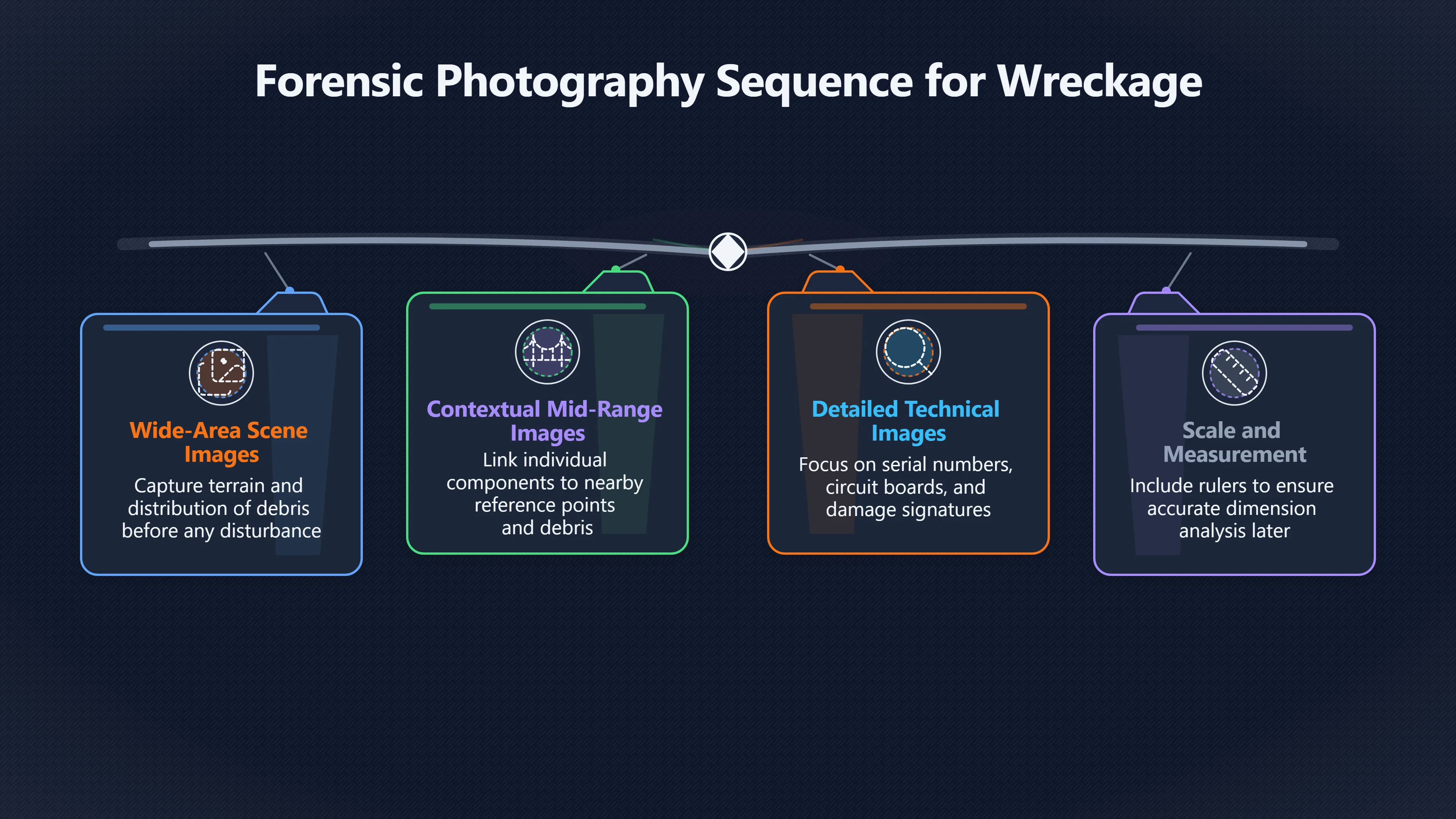
One of the most important principles borrowed from forensic evidence photography is the sequence of documentation. Investigators begin with overall views, then move to contextual images, and only afterwards take detailed close-ups. The same logic applies to battlefield wreckage exploitation.[nist.gov]nist.govStandard Guide for Crime Scene PhotographyMid-Range photographs provide a view of spatial relationships of items and evidence within…
Wide-Area Scene Images
The first photographs establish the scene as a whole. They show:
- The terrain surrounding the wreckage.
- Distribution of debris.
- Impact craters or blast effects.
- Nearby structures, roads or landmarks.
- The relative position of major components.
These photographs answer the future analyst’s most basic question: what did the site originally look like before recovery began? Evidence-photography guidance consistently recommends comprehensive overview images before any disturbance occurs.[forensicsciencesimplified.org]forensicsciencesimplified.orgA Simplified Guide To Crime Scene PhotographyShoot the scene: The photographer should take photographs before anything is disturbed, prog…
Context Images
The next layer documents individual components while still showing their surroundings. A guidance section, antenna, engine component or electronic module is photographed together with nearby reference points and adjacent debris.
This stage is critical because it preserves spatial relationships. Forensic-photography standards describe mid-range images as the bridge connecting close-up evidence to the larger scene. Without them, a detailed photograph of a component may reveal what it is but not where it was found.[nist.gov]nist.govStandard Guide for Crime Scene PhotographyMid-Range photographs provide a view of spatial relationships of items and evidence within…
Detailed Technical Images
Only after context has been preserved do photographers move to close-up documentation. These images typically focus on:
- Serial numbers.
- Manufacturer markings.
- Circuit boards.
- Connectors and interfaces.
- Damage signatures.
- Fasteners, welds and construction details.
Scales, rulers or measurement references are frequently included so that dimensions can later be examined accurately. Evidence-photography guidance emphasises that close-up images should remain linked to broader contextual photographs rather than existing in isolation.[Maine]maine.govCRIME SCENE PHOTOGRAPHY OVERALLTake overall, midrange, and close-up photos of the impression. -Do this with a scale, and then withou…
Why Analysts Need More Than Detail Shots
A common misconception is that the most valuable photographs are the sharpest close-ups. In practice, isolated detail images often create new uncertainty.
Consider a recovered electronics module. A close-up photograph may reveal part numbers, manufacturing methods and component suppliers. Yet analysts may also need to know:
- Which section of the weapon carried the module.
- Whether it remained attached or was detached.
- Whether blast damage affected it directly.
- Whether it was recovered near propulsion, guidance or communications components.
Those answers usually come from contextual photographs rather than laboratory photography.
This is particularly important when multiple teams participate in recovery. Field personnel may collect debris, transport crews may repackage it, and laboratory specialists may later disassemble it. The photolog becomes the visual bridge linking each stage. Military document and media exploitation guidance similarly stresses systematic photography and identification markings so recovered material remains traceable during later exploitation.[Public Intelligence |]info.publicintelligence.netIf. 446 detainees are captured a sanitized photograph…Read more…
How Missing Photo Context Creates Confusion
The absence of a disciplined photolog can reduce the intelligence value of otherwise important recoveries.
Lost Spatial Relationships
When debris is collected before photography, analysts may never know how components were originally distributed. This can complicate assessments of impact sequence, failure mode or weapon functioning.
For example, determining whether a subsystem separated before impact or only after impact may depend on where it was found relative to the main wreckage field. Once components are piled together for transport, that information can disappear permanently.
Ambiguous Component Attribution
Modern battlefields often contain overlapping debris from multiple systems. Without contextual photography, a photographed component may later be associated with the wrong platform.
Serial numbers can help, but many fragments lack complete identifiers. Analysts therefore rely on visual evidence showing where a fragment was recovered and what other items surrounded it. Photographic and documentary records have repeatedly been used to verify the provenance of weapons and components by linking serial-number analysis to observed field evidence.[Small Arms Survey]smallarmssurvey.orgSmall Arms SurveyGathering Arms and Ammunition Data in the FieldMarch 1, 2019 — The serial numbers were then compared to existing photogr…
Disputes Over Authenticity
Recovered foreign technology frequently becomes the subject of technical, political or intelligence scrutiny. A detailed photolog helps demonstrate that components genuinely originated from the reported site and were not substituted, rearranged or misidentified later.
Photographs taken before disturbance provide a permanent record that can be reviewed long after the recovery operation ends. Evidence-photography practice emphasises precisely this function: preserving conditions that can later be re-examined when questions arise.[Wikipedia]WikipediaForensic photographyForensic photography
The Photolog as a Technical Dataset
For battlefield recovery teams supporting reverse engineering, the most valuable photograph is often not the dramatic image of a damaged weapon but the carefully recorded image that captures context. A complete photolog functions as a dataset rather than a collection of pictures. Each image contributes information about location, orientation, condition, identity and relationship.
When specialists later analyse recovered hardware in a secure facility, they may be looking at components months after recovery and thousands of kilometres from the original site. The photolog preserves the wreck’s original story, allowing technical findings in the laboratory to remain anchored to evidence from the battlefield. Without that visual chain, recovered hardware may still be interesting; with it, the hardware becomes interpretable evidence.
Amazon book picks
Further Reading
Books and field guides related to The Photos That Save a Wreck's Original Story. Use these as the next step if you want deeper reading beyond the article.
The Pentagon's Brain
Provides intelligence-collection context behind technical exploitation.
Crime Scene Photography
Explains photographic workflows that parallel battlefield photolog practice.
Military Intelligence Blunders
Illustrates consequences of poor information capture and analysis.
eBay marketplace picks
Marketplace Samples
Live-tested eBay searches with available results related to this page.
Endnotes
1.
Source: nllp.jallc.nato.int
Link:https://nllp.jallc.nato.int/cmnt/ciedcoi/CIED%20PUBLICATIONS/Handbooks%20and%20Doctrines/AJP%202.5%28A%29%20Captured%20Persons%2C%20Material%20and%20Documents%20dated%20aug07.pdf
Source snippet
NATO JALLCAJP-2.5(A) CAPTURED PERSONS, MATERIEL AND...February 20, 2015 — Location of capture (geographic coordinates or UTM grid refere...
Published: February 20, 2015
2.
Source: nist.gov
Link:https://www.nist.gov/document/standard-guide-crime-scene-photography
Source snippet
Standard Guide for Crime Scene PhotographyMid-Range photographs provide a view of spatial relationships of items and evidence within...
3.
Source: forensicsciencesimplified.org
Link:https://www.forensicsciencesimplified.org/photo/Photography.pdf
Source snippet
A Simplified Guide To Crime Scene PhotographyShoot the scene: The photographer should take photographs before anything is disturbed, prog...
4.
Source: jbiocommunication.org
Link:https://jbiocommunication.org/issues/31-2/feature4.html
Source snippet
Forensic Imaging—An OverviewMid-range photographs will show relationships between objects in the scene, such as blood spatter, the victim...
5.
Source: maine.gov
Link:https://www.maine.gov/dps/msp/sites/maine.gov.dps.msp/files/inline-files/Crime%20Scene%20Photography.pdf
Source snippet
CRIME SCENE PHOTOGRAPHY OVERALLTake overall, midrange, and close-up photos of the impression. -Do this with a scale, and then withou...
6.
Source: Wikipedia
Title: Forensic photography
Link:https://en.wikipedia.org/wiki/Forensic_photography
7.
Source: medwinpublishers.com
Link:https://medwinpublishers.com/article/IJFSC/10.23880/ijfsc-16000286/full
Source snippet
Forensic Photography Concepts and Applications for Better...Feb 1, 2023 — Compared to close-ups, mid- range photos show where the eviden...
8.
Source: info.publicintelligence.net
Link:https://info.publicintelligence.net/USArmy-DOMEX.pdf
Source snippet
If. 446 detainees are captured a sanitized photograph...Read more...
9.
Source: smallarmssurvey.org
Link:https://www.smallarmssurvey.org/sites/default/files/resources/SAS-HB-06-Weapons-ID-ch7.pdf
Source snippet
Small Arms SurveyGathering Arms and Ammunition Data in the FieldMarch 1, 2019 — The serial numbers were then compared to existing photogr...
Published: March 1, 2019
10.
Source: assets.publishing.service.gov.uk
Title: doctrine uk captured persons jdp 1 10
Link:https://assets.publishing.service.gov.uk/media/5f71e2c9e90e0747bfbf9c3a/doctrine_uk_captured_persons_jdp_1_10.pdf
Source snippet
Doctrine Publication 1-10 Captured Persons10 Dec 2003 — Photography required for legal or forensic purposes will be conducted by Service...
11.
Source: dictionary.cambridge.org
Link:https://dictionary.cambridge.org/es/diccionario/ingles-espanol/crime
Source snippet
traducir al español - Cambridge Dictionary5 days ago — traducir CRIME: delincuencia, crimen, delito, crimen [masculine], crimen [mascul...
Additional References
12.
Source: cia.gov
Link:https://www.cia.gov/readingroom/document/cia-rdp75-00662r000100130077-6
Source snippet
MILITARY SECURITY CAPTURED ENEMY MATERIALMILITARY SECURITY CAPTURED ENEMY MATERIAL. Document Type: CREST. Collection: General CIA Records...
13.
Source: scenacriminis.com
Link:https://www.scenacriminis.com/wp-content/uploads/2017/10/CRIME-SCENE-PHOTOGRAPHY.pdf
Source snippet
Crime Scene Photography, Second EditionThese additional images are meant to aid students in their own practical e xperience by showing ex...
14.
Source: crime-scene-investigator.net
Link:https://www.crime-scene-investigator.net/csp-evidence-photography-at-the-crime-scene.html
Source snippet
Evidence Photography At the Crime SceneWhen photographing bloodstains you must first show the location of the bloodstain with mid–range p...
15.
Source: nsarchive2.gwu.edu
Link:https://nsarchive2.gwu.edu/NSAEBB/NSAEBB410/docs/Tactical%20Site%20Exploitation.pdf
Source snippet
National Security ArchiveTactical Site Exploitation.pdfPhotograph subject in room with evidence and mark with data and capture tag. Shoot...
16.
Source: raf.mod.uk
Link:https://www.raf.mod.uk/what-we-do/centre-for-air-and-space-power-studies/aspr/apr-vol2-iss1-2-pdf/
Source snippet
Combat Assessment consists of 3 component parts: Battle Damage Assessment (BDA), Weapons Effects Analysis 0/VEA) and Reattack Recommendat...
17.
Source: slideshare.net
Link:https://www.slideshare.net/slideshow/crime-scene-documentation-251710777/251710777
Source snippet
Scene DOCUMENTATION | PDFDocumentation of the crime scene is the most crucial step in processing the crime scene. It provides a permanent...
19.
Source: science.howstuffworks.com
Link:https://science.howstuffworks.com/crime-scene-photography.htm
Source snippet
Crime Scene Photography WorksThese mid-range photos might picture a piece of evidence, like a knife, but at enough of a distance to show...
20.
Source: police1.com
Link:https://www.police1.com/investigations/articles/a-better-understanding-of-midrange-photographs-in-a-crime-scene-sxveGuGs1YbLkC1n/
Source snippet
How to take a midrange photo for crime scene investigationsFeb 26, 2019 — A midrange photograph should consist of the item of evidence, t...
21.
Source: l-tron.com
Link:https://www.l-tron.com/what-three-types-of-photographs-are-taken-at-crime-scenes/
Source snippet
Their purpose is to show exactly where the scene was and to show all boundaries of the scene.Read more...
Topic Tree