Within Cold War Race
When a defected Mi G became a diplomatic problem
The 1953 Danish MiG-15 case shows how valuable hardware could force allies to balance secrecy, law and Soviet pressure.
On this page
- The five day inspection window
- Why host governments controlled access
- Secrecy, legality and retaliation fears
Page outline Jump by section
Introduction
In March 1953, a Polish Air Force pilot landed a MiG-15 fighter on the Danish island of Bornholm and unexpectedly created one of the Cold War’s most delicate intelligence dilemmas. For Western governments, the aircraft was a rare opportunity to inspect one of the Soviet bloc’s most important jet fighters. For Denmark, however, the aircraft was not simply a technical prize. It was a foreign military aircraft that had arrived on Danish territory during a period of intense East–West tension, creating legal obligations, alliance pressures and fears of Soviet retaliation. The resulting five-day inspection window illustrates how the exploitation of captured technology often depended as much on political authority as on engineering expertise.[National Security Archive]nsarchive.gwu.eduNational Security Archive Polish Mi G-15 in DenmarkExcerpt from Current Intelligence…31 Jan 2018 — The Danish government was not permitting flight tests of a Polish MiG-15 which landed…
The case is significant because it demonstrates that access to foreign military technology was frequently controlled by host governments rather than intelligence agencies or engineers. Denmark’s handling of the MiG-15 shows how even a NATO member had to balance alliance interests against diplomatic risks when confronted with a valuable piece of Soviet-designed hardware.[National Security Archive]nsarchive.gwu.eduNational Security Archive Polish Mi G-15 in DenmarkExcerpt from Current Intelligence…31 Jan 2018 — The Danish government was not permitting flight tests of a Polish MiG-15 which landed…
The five-day inspection window
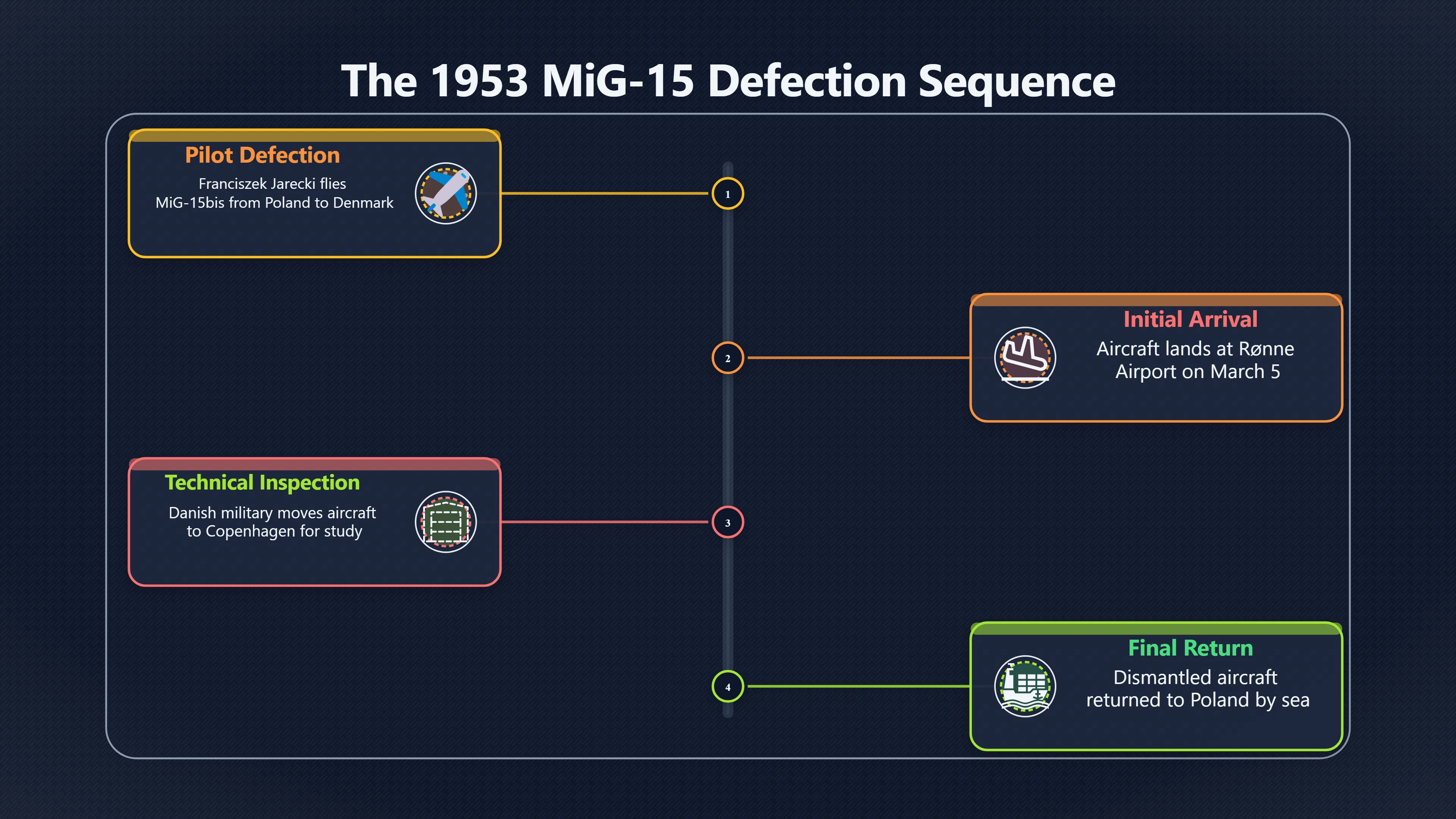
The aircraft arrived on 5 March 1953 when Polish pilot Franciszek Jarecki defected by flying his MiG-15bis from northern Poland to Rønne Airport on Bornholm. At the time, the MiG-15 was among the most closely studied aircraft in the world. Its performance during the Korean War had made it a major concern for Western air forces, yet intact examples remained extremely difficult to obtain.[Wikipedia]WikipediaFranciszek JareckiFranciszek Jarecki
The arrival of a flyable MiG-15 immediately attracted interest from the United States and Britain. According to a contemporary CIA intelligence bulletin later released through declassified archives, the Danish government allowed covert examination of the aircraft by British and American personnel but imposed a strict condition: the inspection had to be completed within five days, and Denmark would not permit flight testing.[National Security Archive]nsarchive.gwu.eduNational Security Archive Polish Mi G-15 in DenmarkExcerpt from Current Intelligence…31 Jan 2018 — The Danish government was not permitting flight tests of a Polish MiG-15 which landed…
This restriction is one of the most revealing features of the episode. Flight testing would have provided much deeper insight into the aircraft’s performance, handling characteristics and operational limits. Yet Denmark judged that prolonged retention of the fighter or overt testing would create unnecessary political complications. The result was a compressed intelligence operation focused on measurement, photography, dismantling and technical inspection rather than extensive experimental evaluation.[National Security Archive]nsarchive.gwu.eduNational Security Archive Polish Mi G-15 in DenmarkExcerpt from Current Intelligence…31 Jan 2018 — The Danish government was not permitting flight tests of a Polish MiG-15 which landed…
Danish military specialists first secured and examined the aircraft on Bornholm before moving it to facilities near Copenhagen for more detailed study. The aircraft was dismantled, inspected and documented before ultimately being returned to Poland by sea later that month. Information gathered during the inspection was reportedly shared with NATO partners, ensuring that even a brief access period produced intelligence value beyond Denmark itself.[World Aviation Photography]worldairphotography.wordpress.comWorld Aviation PhotographyThe MIG-15 Defection to Bornholm Denmark23 Oct 2015 — Polish Air Force MIG-15bis in the markings of the aircraf…
Why host governments controlled access
The MiG-15’s arrival demonstrates that possession and access were not the same thing. Although NATO intelligence services wanted maximum exploitation of the aircraft, Denmark retained legal and political control because the aircraft was physically on Danish territory.[National Security Archive]nsarchive.gwu.eduNational Security Archive Polish Mi G-15 in DenmarkExcerpt from Current Intelligence…31 Jan 2018 — The Danish government was not permitting flight tests of a Polish MiG-15 which landed…
Several factors strengthened Denmark’s position:
- Sovereign authority: The aircraft had landed in Denmark, giving Copenhagen the final say over who could inspect it and for how long.
- International obligations: Returning foreign military equipment was generally expected under existing diplomatic practice, especially in peacetime circumstances involving a defection rather than wartime capture.
- Regional security concerns: Denmark occupied a sensitive position at the entrance to the Baltic Sea and had little interest in provoking a direct confrontation with the Soviet bloc.
- Alliance management: Danish leaders wanted to assist allies without appearing to turn Danish territory into an unrestricted intelligence exploitation site.[National Security Archive]nsarchive.gwu.eduNational Security Archive Polish Mi G-15 in DenmarkExcerpt from Current Intelligence…31 Jan 2018 — The Danish government was not permitting flight tests of a Polish MiG-15 which landed…
The Danish decision therefore reflected governance rather than technology. Engineers could identify many additional tests they wished to perform, but political authorities determined the limits of what was acceptable.

Secrecy, legality and retaliation fears
The inspection occurred in an atmosphere shaped by both intelligence competition and diplomatic caution. Western governments clearly recognised the aircraft’s value, yet the operation was handled discreetly because publicity could have increased tensions with Poland and the Soviet Union. The CIA’s own reporting highlighted the diplomatic sensitivities surrounding the examination.[National Security Archive]nsarchive.gwu.eduNational Security Archive Polish Mi G-15 in DenmarkExcerpt from Current Intelligence…31 Jan 2018 — The Danish government was not permitting flight tests of a Polish MiG-15 which landed…
Denmark’s refusal to permit flight tests is especially revealing when viewed through the lens of retaliation risk. A highly visible programme of Western test flying could have been interpreted by Moscow as active exploitation of Soviet military technology rather than a limited examination conducted under Danish supervision. Restricting the scope and duration of access helped Copenhagen maintain the argument that it was acting responsibly and within accepted legal norms.[National Security Archive]nsarchive.gwu.eduNational Security Archive Polish Mi G-15 in DenmarkExcerpt from Current Intelligence…31 Jan 2018 — The Danish government was not permitting flight tests of a Polish MiG-15 which landed…
The timing also mattered. The defection occurred on the very day of Joseph Stalin’s death, a moment of uncertainty within the Soviet bloc. Danish policymakers had little reason to escalate an already sensitive situation. Returning the aircraft relatively quickly reduced the chance that the episode would become a prolonged diplomatic dispute.[Wikipedia]WikipediaFranciszek JareckiFranciszek Jarecki
What the case reveals about Cold War technology competition
The Danish MiG-15 episode shows that reverse engineering foreign military technology was rarely just a technical exercise. Access to hardware depended on geography, law, alliance politics and risk calculations. In this case, Western experts obtained valuable insight into a highly sought-after Soviet fighter, but only within limits imposed by a small allied government that had to consider consequences beyond intelligence gain.[National Security Archive]nsarchive.gwu.eduNational Security Archive Polish Mi G-15 in DenmarkExcerpt from Current Intelligence…31 Jan 2018 — The Danish government was not permitting flight tests of a Polish MiG-15 which landed…
The incident therefore occupies an important place in the broader history of Cold War foreign-materiel exploitation. It demonstrates that captured or defected equipment could become a diplomatic problem as quickly as it became an engineering opportunity. Denmark’s five-day inspection rule encapsulated the central tension: allies wanted knowledge, but host governments had to manage the political costs of acquiring it.[National Security Archive]nsarchive.gwu.eduNational Security Archive Polish Mi G-15 in DenmarkExcerpt from Current Intelligence…31 Jan 2018 — The Danish government was not permitting flight tests of a Polish MiG-15 which landed…
Amazon book picks
Further Reading
Books and field guides related to When a defected MiG became a diplomatic problem. Use these as the next step if you want deeper reading beyond the article.
The First Jet Pilot
Provides context for early jet technology and international interest in aircraft.
eBay marketplace picks
Marketplace Samples
Live-tested eBay searches with available results related to this page.

Endnotes
1.
Source: Wikipedia
Title: Franciszek Jarecki
Link:https://en.wikipedia.org/wiki/Franciszek_Jarecki
2.
Source: Wikipedia
Title: Mikoyan-Gurevich Mi G-15
Link:https://en.wikipedia.org/wiki/Mikoyan-Gurevich_MiG-15
Source snippet
Mikoyan-Gurevich MiG-15The Mikoyan-Gurevich MiG-15 is a single-seat transonic jet fighter aircraft developed by Mikoyan-Gurevich for t...
3.
Source: Wikipedia
Title: List of Cold War pilot [defections]({{ ‘defections/’ | relative_url }})
Link:https://en.wikipedia.org/wiki/List_of_Cold_War_pilot_defections
4.
Source: youtube.com
Title: How a Polish pilot stole the USSR’s most secret plane in 7 minutes
Link:https://www.youtube.com/watch?v=7NOAvi4xDv4
Source snippet
MiG-15 | Polacy, Bornholm and CIA...
5.
Source: youtube.com
Title: Mi G-15 | Polacy, Bornholm and CIA
Link:https://www.youtube.com/watch?v=_-n6VUMtzv8
Source snippet
1953 Franciszek Jarecki w Danii Theatrum Illuminatum ENGLISH...
6.
Source: nsarchive.gwu.edu
Title: National Security Archive Polish Mi G-15 in Denmark
Link:https://nsarchive.gwu.edu/document/16255-document-03-polish-mig-15-denmark-excerpt
Source snippet
Excerpt from Current Intelligence...31 Jan 2018 — The Danish government was not permitting flight tests of a Polish MiG-15 which landed...
7.
Source: worldairphotography.wordpress.com
Link:https://worldairphotography.wordpress.com/2015/10/23/the-mig-15-defection-to-bornholm-denmark/
Source snippet
World Aviation PhotographyThe MIG-15 Defection to Bornholm Denmark23 Oct 2015 — Polish Air Force MIG-15bis in the markings of the aircraf...
Additional References
8.
Source: facebook.com
Link:https://www.facebook.com/BoneyardSafari/posts/defectionin-april-1951-a-crashed-mig-15-was-spotted-near-the-chongchon-river-on-/825100750898809/
Source snippet
Defection In April 1951 a crashed MiG-15 was spotted near...On the morning of March 5, 1953, Fraciszek Jarecki, a pilot in the Polish Ai...
Published: april 1951
9.
Source: reddit.com
Link:https://www.reddit.com/r/todayilearned/comments/1eb890/til_a_north_korean_fighter_pilot_defected_with/
Source snippet
his MiG-15 in...TIL in 1953, a North Korean fighter pilot defected to South Korea with his MiG-15 and was rewarded $100,000 from the Uni...
10.
Source: ingeniumcanada.org
Link:https://ingeniumcanada.org/channel/articles/a-flight-for-freedom-which-pierced-the-iron-curtain-or-the-day-second-lieutenant
Source snippet
or, The day Second Lieutenant Franciszek Jarecki escaped...19 Mar 2023 — The two MiG-15 were flying at an altitude of about 5 500 metres...
11.
Source: nationalmuseum.af.mil
Title: the story of the mig 15bis on display
Link:https://www.nationalmuseum.af.mil/Visit/Museum-Exhibits/Fact-Sheets/Display/Article/196377/the-story-of-the-mig-15bis-on-display/
Source snippet
Story of the MiG-15bis on DisplayOn Sept. 21, 1953, a MiG-15bis. The airplane was disassembled and airlifted to Wright-Patterson Air Forc...
12.
Source: airuniversity.af.edu
Link:https://www.airuniversity.af.edu/Portals/10/ASPJ/journals/1953_Vol06_No1-4/1953_Vol6_No3.pdf
Source snippet
VI, No. 3The MIG-15's were committed to combat in. November 1950, and as the... which our NATO allies were being equipped. Naturally our...
Published: November 1950
13.
Source: designer.home.xs4all.nl
Title: mig15 intelligence
Link:https://designer.home.xs4all.nl/models/mig15-72/mig15-intelligence.html
Source snippet
xs4all.nlMiG-15 pilots defected to the West22 Jul 2019 — On March 5, 1953, the Polish pilot Jarecki flew his MiG15bis from the Polish bas...
Published: March 5, 1953
14.
Source: youtube.com
Link:https://www.youtube.com/watch?v=tNwZ13AE6cE
Source snippet
Jet to Freedom. The Pilot Who Infuriated Moscow...
15.
Source: kadena.af.mil
Title: AFD 120507 058
Link:https://www.kadena.af.mil/Portals/40/[documents
Source snippet
MiG-15 and the Kadena connection16 Mar 2010 — On September 21, 1953, Senior Lieutenant No Kum-Sok made his escape from communist North Ko...
Published: September 21, 1953
16.
Source: instagram.com
Title: DSOb OQk DFS8
Link:https://www.instagram.com/reel/DSObOQkDFS8/
Source snippet
MiG-15: U.S. Tests the Soviet Jet After the Famous 1953...(Rare Footage) Dive into the electrifying, restored, and colorized history of...
17.
Source: youtube.com
Title: Jet to Freedom. The Pilot Who Infuriated Moscow
Link:https://www.youtube.com/watch?v=WsIAUbaZ-yI
Source snippet
How a Polish pilot stole the USSR's most secret plane in 7 minutes...
Topic Tree