Within Tu 4 Copy
What the Soviets had to replace
The Tu-4 had to use Soviet powerplants, guns and equipment, proving that copying often means replacing what cannot be reproduced.
On this page
- Why the engines were not simple copies
- How Soviet armament changed the bomber
- What substitutions meant for reliability and performance
Page outline Jump by section
Introduction
The Tupolev Tu-4 is often described as a Soviet copy of the American B-29 Superfortress, but one of the most revealing parts of the programme was what the Soviets could not copy directly. The aircraft’s overall shape, structure and layout came from the captured B-29s, yet the bomber ultimately had to operate within Soviet industry, using Soviet engines, weapons and support equipment. Those substitutions were not minor details. They altered how the aircraft was built, maintained and fought, and they illustrate a central lesson of reverse engineering: reproducing an advanced weapon system usually requires replacing components that cannot be duplicated quickly or economically.[Wikipedia]WikipediaTupolev Tu-4Tupolev Tu-4
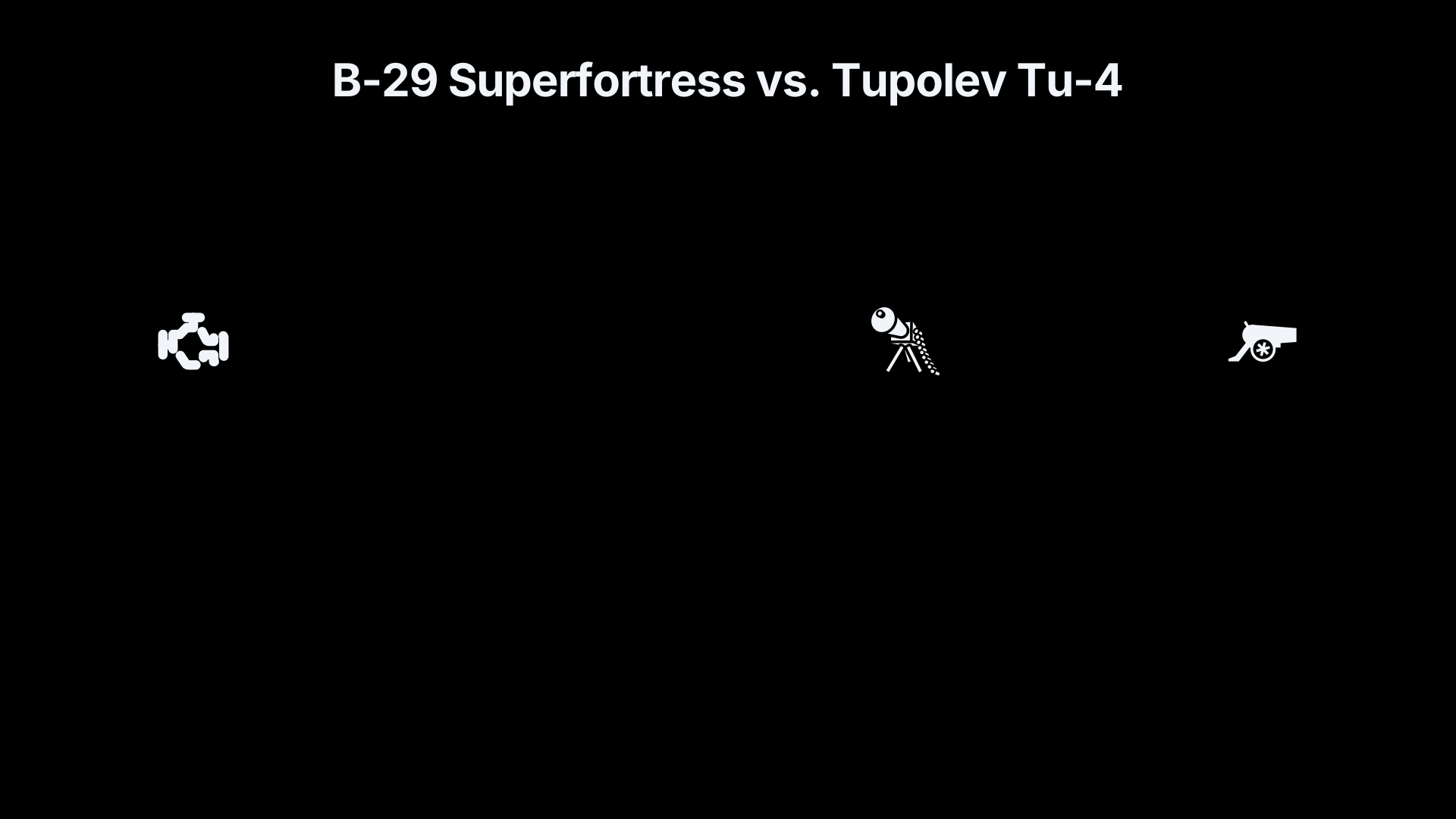
In the Tu-4’s case, the most important changes involved its powerplants and defensive armament. The Soviet Union retained the B-29’s general configuration but fitted domestic engines and redesigned the remote-controlled gun system around Soviet cannon armament. These decisions created an aircraft that looked almost identical to a Superfortress while reflecting the realities of Soviet manufacturing and military doctrine.[Wikipedia]WikipediaTupolev Tu-4Tupolev Tu-4
Why the engines were not simple copies
The B-29 used the American Wright R-3350 Duplex-Cyclone engine, one of the most powerful piston aero engines of the Second World War. Reproducing it exactly would have required more than copying dimensions. It would have meant recreating specialised manufacturing techniques, materials, tooling and production experience that the Soviet Union did not possess in identical form. Rather than attempt a direct clone, Soviet designers installed the Shvetsov ASh-73TK.[Smithsonian Magazine]smithsonianmag.comSmithsonian MagazineMade in the U.S.S.R.Arkadiy Shvetsov, a Soviet engine designer, learned from Tupolev that he would not have to replic…
A common misconception is that the ASh-73TK was simply a Soviet-made R-3350. In reality, the two engines were different designs that shared distant ancestry in earlier Wright radial-engine technology. The ASh-73TK evolved through the Soviet Shvetsov engine family rather than being a direct copy of the B-29 powerplant.[wikipedia.org]WikipediaTupolev Tu-4Tupolev Tu-4
This substitution demonstrates how reverse engineering often becomes adaptation. Soviet engineers needed an engine that could be produced immediately within existing factories and support networks. The ASh-73TK met that requirement. It also delivered power comparable to or greater than the original American installation, allowing the Tu-4 to preserve the B-29’s basic performance envelope despite using a different engine design.[The National Interest]nationalinterest.orgMost notably, the Tu-4 used Russian 2,400-horsepower ASh-73TK radial engines instead of the original 2,200-horsepower Duplex…Read more…
The choice was not entirely straightforward. Testing revealed engine- and propeller-related problems that required further modification after the prototype flew. The Tu-4 therefore became a continuing engineering project rather than a one-time copy. Even after entering service, equipment changes were introduced as operational experience accumulated.[Wikipedia]WikipediaTupolev Tu-4Tupolev Tu-4
Building a bomber around Soviet logistics
The engine decision mattered because it tied the aircraft to Soviet supply chains. Spare parts, maintenance procedures, training and production all had to function inside the Soviet industrial system. A theoretically perfect copy of the R-3350 would have offered little value if it could not be produced and supported at scale.
This was a recurring pattern in Cold War technology transfer. Captured equipment could reveal how a foreign system worked, but successful reproduction depended on domestic industry being able to manufacture and sustain the replacement parts. The Tu-4’s engine installation became a practical example of that reality.[Smithsonian Magazine]smithsonianmag.comSmithsonian MagazineMade in the U.S.S.R.Arkadiy Shvetsov, a Soviet engine designer, learned from Tupolev that he would not have to replic…
How Soviet armament changed the bomber
The Tu-4’s defensive weapons show an even clearer departure from the American original. The B-29 relied primarily on remote-controlled turrets armed with.50-calibre machine guns. Soviet planners preferred heavier cannon armament, reflecting both domestic weapon availability and Soviet views on bomber defence. As a result, the Tu-4’s remote turret system was redesigned around 23 mm cannon.[Wikipedia]WikipediaTupolev Tu-4Tupolev Tu-4
This was not a simple weapon swap. The larger guns required changes to turret installations and associated systems. Soviet engineers retained the concept of remotely controlled defensive positions but adapted them to carry far more destructive weapons than those found on the American aircraft.[Wikipedia]WikipediaTupolev Tu-4Tupolev Tu-4
By the time the design matured, the bomber carried ten 23 mm cannon distributed among multiple remotely controlled turrets. These weapons delivered substantially greater hitting power than heavy machine guns and offered improved effectiveness against fast, increasingly robust post-war aircraft.[Military Factory]militaryfactory.comMilitary Factory Strategic Heavy Bomber AircraftTwo cannons were fitted across four separate…Read more…
The armament change also reflected a different operational expectation. Soviet planners anticipated encounters with heavily built fighters and interceptor aircraft. In that environment, a few cannon hits could be more decisive than numerous machine-gun strikes. The Tu-4 therefore embodied Soviet preferences rather than merely reproducing American practice.[Military Factory]militaryfactory.comMilitary Factory Strategic Heavy Bomber AircraftTwo cannons were fitted across four separate…Read more…
What substitutions meant for reliability and performance
The engine and armament changes produced a bomber that was neither a pure clone nor a completely new design. Instead, the Tu-4 became a hybrid: American in overall architecture but Soviet in critical subsystems.[Wikipedia]WikipediaTupolev Tu-4Tupolev Tu-4
In performance terms, the substitutions allowed the aircraft to remain broadly comparable to the B-29. The Soviet bomber retained long-range capability and strategic usefulness while avoiding the enormous burden of reproducing every American component exactly. The aircraft entered service rapidly and gave the Soviet Union a strategic bomber force years earlier than would likely have been possible through an entirely indigenous design programme.[Air & Space Forces Magazine]airandspaceforces.comAir & Space Forces MagazineCarbon Copy BomberThe Soviet Union had done the impossible: It had reverse engineered and produced flyable B-2…
The changes also created trade-offs. Heavier cannon armament increased defensive firepower but added weight and required redesigned installations. The engine solution simplified production within Soviet industry but introduced its own development and reliability challenges. Engineers had to balance the desire for fidelity to the original aircraft against the realities of domestic manufacturing and maintenance.[wikipedia.org]WikipediaTupolev Tu-4Tupolev Tu-4
Perhaps the most important outcome was strategic rather than technical. The Tu-4 proved that copying an aircraft did not mean reproducing every component. Reverse engineering succeeded because Soviet designers knew when to imitate and when to substitute. The bomber’s engines and weapons became evidence that technological copying is often an exercise in integration and adaptation, not exact duplication.[Smithsonian Magazine]smithsonianmag.comSmithsonian MagazineMade in the U.S.S.R.Arkadiy Shvetsov, a Soviet engine designer, learned from Tupolev that he would not have to replic…
Amazon book picks
Further Reading
Books and field guides related to What the Soviets had to replace. Use these as the next step if you want deeper reading beyond the article.
The Pentagon's Brain
Explores how military organizations adapt technology to local needs.
The Cold War
Places Soviet substitution decisions within broader strategic competition.

Stalin's aviation gulag
Provides insight into Soviet engineering choices and constraints.
eBay marketplace picks
Marketplace Samples
Live-tested eBay searches with available results related to this page.
Endnotes
1.
Source: Wikipedia
Title: Tupolev Tu-4
Link:https://en.wikipedia.org/wiki/Tupolev_Tu-4
2.
Source: steamcommunity.com
Title: The two engines
Link:https://steamcommunity.com/app/236390/discussions/0/1474221865183487699/?l=spanish
Source snippet
Steam CommunityTU4 VS B29:: War Thunder Discusiones generalesContrary to popular misconception, the Tu-4's ASh-73 radial engines were no...
3.
Source: Wikipedia
Link:https://en.wikipedia.org/wiki/Tupolev
Source snippet
TupolevTupolev designed over 100 models of civilian and military aircraft and produced more than 18,000 aircraft for Russia, the Sovie...
4.
Source: smithsonianmag.com
Link:https://www.smithsonianmag.com/air-space-magazine/made-in-the-ussr-38442437/
Source snippet
Smithsonian MagazineMade in the U.S.S.R.Arkadiy Shvetsov, a Soviet engine designer, learned from Tupolev that he would not have to replic...
5.
Source: nationalinterest.org
Link:https://nationalinterest.org/blog/reboot/b-29-bomber-russia-loved-and-copied-iconic-plane-180065
Source snippet
Most notably, the Tu-4 used Russian 2,400-horsepower ASh-73TK radial engines instead of the original 2,200-horsepower Duplex...Read more...
6.
Source: bomberaircraft.fandom.com
Title: Tupolev Tu-4
Link:https://bomberaircraft.fandom.com/wiki/Tupolev_Tu-4
Source snippet
Tu-4 - Bomberaircraft Wiki - FandomThe B-29's remote-controlled gun turrets were redesigned to accommodate the Soviet Nudelman NS-23, a h...
7.
Source: militaryfactory.com
Title: Military Factory Strategic Heavy Bomber Aircraft
Link:https://www.militaryfactory.com/aircraft/detail.php?aircraft_id=701
Source snippet
Two cannons were fitted across four separate...Read more...
8.
Source: airandspaceforces.com
Link:https://www.airandspaceforces.com/article/0609bomber/
Source snippet
Air & Space Forces MagazineCarbon Copy BomberThe Soviet Union had done the impossible: It had reverse engineered and produced flyable B-2...
9.
Source: nuclearcompanion.com
Link:https://nuclearcompanion.com/data/tupolev-tu-4-standard-specification-performance/
Source snippet
Nuclear CompanionTupolev Tu-4 Standard Specification & Performance30 Jan 2023 — Weapons systems weight: offensive (bomb racks,release c...
10.
Source: nuclearcompanion.com
Title: wright r 3350 vs shvetsov ash 73tk comparison chart
Link:https://nuclearcompanion.com/data/wright-r-3350-vs-shvetsov-ash-73tk-comparison-chart/
Source snippet
Wright R-3350 vs Shvetsov ASh-73TK Comparison chartDecember 29, 2022 — While both engines had an identical bore size of 155.6 mm, the ASh...
Published: December 29, 2022
11.
Source: nationalinterest.org
Title: soviet tu 4 bomber looked like b 29 stratofortress bw
Link:https://nationalinterest.org/blog/buzz/soviet-tu-4-bomber-looked-like-b-29-stratofortress-bw
Source snippet
The plane was meant to close the gap with the Americans in terms...Read more...
12.
Source: planehistoria.com
Title: Tupolev Tu-4
Link:https://planehistoria.com/tupolev-tu-4/
Source snippet
It was a copy with some structural compromises due to limitations in replicating lightweight...Read more...
Additional References
13.
Source: tudublin.ie
Link:https://www.tudublin.ie/
Source snippet
TU Dublin: Technological University DublinTU Dublin is Ireland's first Technological University, offering diverse courses, research and v...
14.
Source: tuwien.at
Link:https://www.tuwien.at/en/
Source snippet
TU Wien | TU WienTechnology for people. A promise that we have kept with science, passion, and responsibility - since 1815. In Vienna, in...
15.
Source: coldwar.org
Link:https://coldwar.org/RB-29/HTML/03RelatedStories/03.03shortstories/03.03.10contss.htm
16.
Source: reddit.com
Link:https://www.reddit.com/r/Warthunder/comments/65k38q/i_see_a_lot_of_people_complaining_about_tu4_can/
Source snippet
It has 360° coverage with rapid-firing 23mm cannons, which when upgraded have 75% of explosive shells.Read more...
17.
Source: scribd.com
Link:https://www.scribd.com/document/466022169/Midland-Red-Star-007-Tupolev-Tu-4-pdf
Source snippet
(Midland) - (Red Star 007) - Tupolev Tu-4 PDF - Scribdcopy the Wright R-3350-23A; the engine that possible time frame, of the ASh-73TK en...
18.
Source: reddit.com
Title: Tupolev Tu-4. When The Soviets Reverse Engineered The Boeing B
Link:https://www.reddit.com/r/WeirdWings/comments/1cu7f2v/tupolev_tu4_when_the_soviets_reverse_engineered/
Source snippet
May 17, 2024 — Stalin saw copying the B-29 to be a shortcut to heavy bombers, and refused to listen to reason from Antonov and Tupolev...
Published: May 17, 2024
19.
Source: facebook.com
Title: A Soviet Tu-4 (B-29 clone) used as a test bed for a Tu
Link:https://www.facebook.com/planehistoria/posts/a-soviet-tu-4-b-29-clone-used-as-a-test-bed-for-a-tu-91-a-section-of-the-tu-91-i/973295268544649/
Source snippet
March 22, 2026 — Contrary to popular misconception, the Tu-4's ASh-73 radial engines were not copies of the B-29's Wright R-3350...
Published: March 22, 2026
20.
Source: facebook.com
Title: Did you know the Tu-4 was a copy of the B-29?
Link:https://www.facebook.com/BoneyardSafari/posts/did-you-know-the-tu-4-was-a-copy-of-the-b-29-b29-tu4-pimaairandspacemuseum-boney/1354024540089988/
Source snippet
#b29 #tu4...In terms of performance and capabilities, both the Tu- 4 and the B-29 were comparable, owing to the Tu-4's direct copying of...
21.
Source: facebook.com
Link:https://www.facebook.com/planehistoria/posts/tupolev-tu-4-when-the-soviets-reverse-engineered-the-boeing-b-29-superfortress-1/867976225743221/
Source snippet
0E cannons (20 mm), and later NS -23 cannons (23 mm) in...Read more...
22.
Source: mikesresearch.com
Title: Mike’s Research Soviet Tupolev Tu-4 Bomber
Link:https://mikesresearch.com/2023/05/28/soviet-tupolev-tu-4-bomber/
Source snippet
Soviet Tupolev Tu-4 Bomber - Mike's ResearchMay 28, 2023 — The B-29's 18-cylinder Wright R-3350 Turbo Cyclone engines were replaced with...
Published: May 28, 2023
Topic Tree