Within Replicas
The data behind realistic fake enemies
Reverse engineering often becomes data files, signatures and scenarios that update simulators long after hardware is recovered.
On this page
- Turning captured measurements into usable files
- Updating simulations as threats change
- Linking digital models to field replicas
Page outline Jump by section
Introduction
Realistic threat replicas do not remain realistic for long unless the data behind them is continuously updated. In the context of reverse engineering foreign military technology, the most valuable product is often not a recovered vehicle, radar or missile itself, but the library of measurements, signatures and behavioural data extracted from it. These threat libraries become the reference datasets that feed simulators, training ranges, mission-data systems and physical replicas for years after the original equipment was captured or examined. The result is a persistent digital representation of a foreign capability that can be revised as new intelligence arrives, allowing training and testing environments to evolve alongside the real-world threat.[U.S. Department of War]media.defense.govDepartment of WarUse of Foreign Materiel Exploitation ResultsSeptember 22, 2015 — 8 Oct 1997 — Foreign materiel exploitation supports DoD…

Threat libraries occupy a distinctive position between intelligence collection and operational training. They translate raw exploitation results into structured files that can be loaded into radar-warning receivers, electronic warfare systems, modelling tools and threat simulators. Without them, replicas quickly become historical artefacts rather than useful stand-ins for current adversaries.[E-Publishing]static.e-publishing.af.milJune 2, 2021 — 2 Jun 2021 — Electronic Warfare Integrated Reprogramming Data… Mission Data—Elements or files a processor employs to pe…
Turning Captured Measurements into Usable Files
The core purpose of a threat library is to convert technical observations into standardised data that can be reused across many systems. When engineers analyse a foreign radar, communications emitter or missile guidance system, they collect characteristics such as frequencies, pulse patterns, scan rates, modulation methods, power levels and operating modes. Those measurements are organised into machine-readable records that allow software and simulators to recognise or emulate the threat.[E-Publishing]static.e-publishing.af.milJune 2, 2021 — 2 Jun 2021 — Electronic Warfare Integrated Reprogramming Data… Mission Data—Elements or files a processor employs to pe…
In electronic warfare, these datasets often appear as mission data files or emitter identification libraries. Official Air Force guidance defines mission data as the files used by processors to discriminate signals, provide threat warning, identify targets and trigger countermeasures. The terminology varies by platform, but the principle remains the same: intelligence about foreign systems is encoded into updateable digital libraries that operational equipment can use.[E-Publishing]static.e-publishing.af.milJune 2, 2021 — 2 Jun 2021 — Electronic Warfare Integrated Reprogramming Data… Mission Data—Elements or files a processor employs to pe…
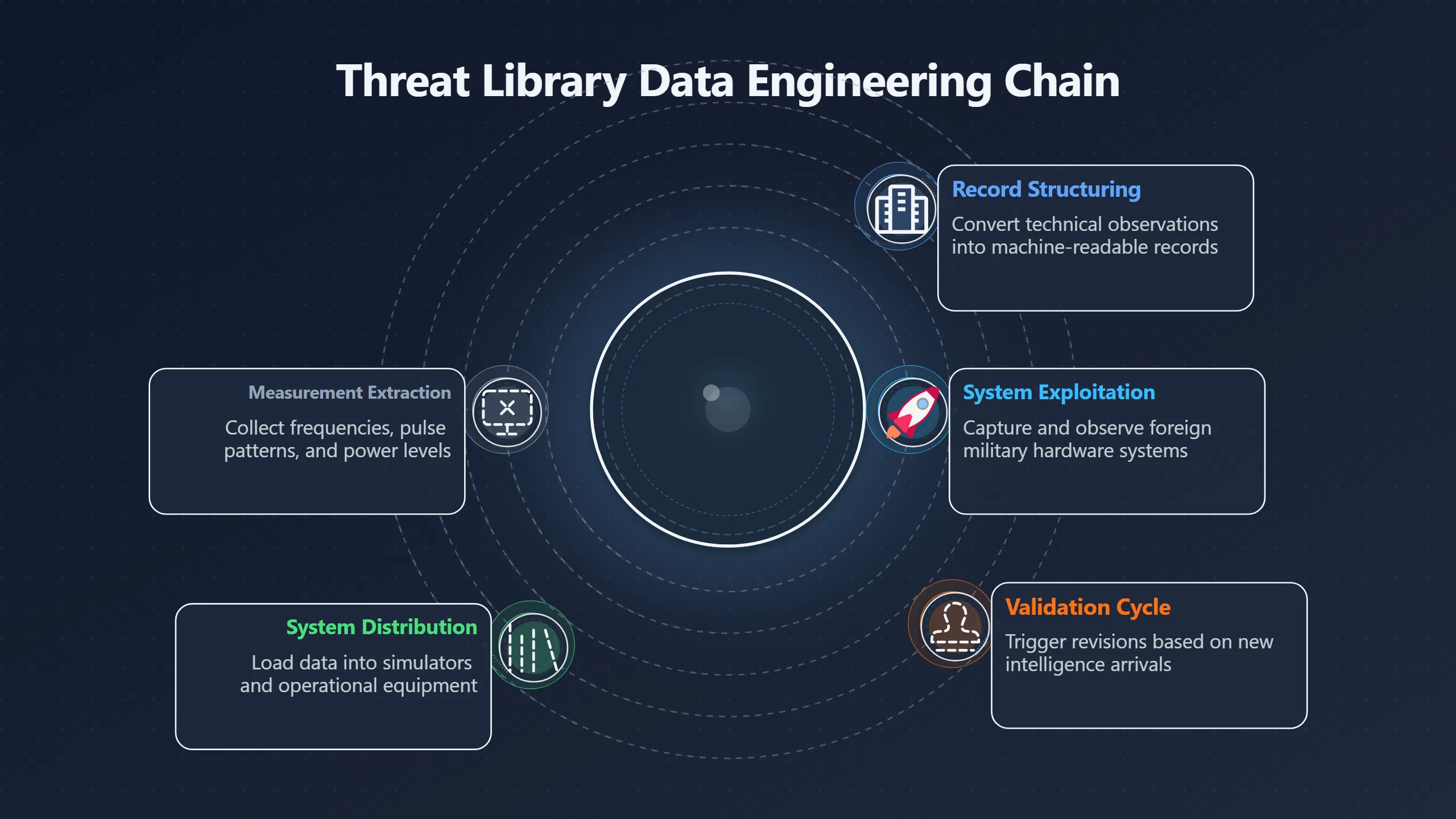
A useful way to think about the process is as a chain:
- A foreign system is captured, observed or otherwise exploited.
- Technical measurements are extracted and analysed.
- The results are converted into structured threat records.
- Those records are distributed into simulators, training ranges and operational systems.
- New observations trigger revisions and validation cycles.
The importance of this chain has been recognised for decades. A Department of Defense audit noted that foreign materiel exploitation results were routinely disseminated to modelling and simulation programmes, threat simulator developers and training communities, specifically so that representations of foreign systems could be updated and validated.[U.S. Department of War]media.defense.govDepartment of WarUse of Foreign Materiel Exploitation ResultsSeptember 22, 2015 — 8 Oct 1997 — Foreign materiel exploitation supports DoD…
Why Threat Libraries Matter More Than Individual Replicas
A physical replica can imitate only a specific configuration at a specific point in time. A threat library can support hundreds of different representations simultaneously.
The same radar-signature dataset, for example, may be used to:
- Update a training-range emitter simulator.
- Improve a pilot’s radar warning receiver database.
- Feed modelling and simulation environments.
- Support digital threat surrogates used during testing.
- Inform the behaviour of opposing-force training systems.[defense.gov]media.defense.govDepartment of WarUse of Foreign Materiel Exploitation ResultsSeptember 22, 2015 — 8 Oct 1997 — Foreign materiel exploitation supports DoD…
This creates an economy of scale. One exploitation effort can generate information that influences many separate training and evaluation activities. The recovered hardware may eventually become obsolete, damaged or unavailable, but the associated data library remains useful as long as it is maintained.
Modern electronic warfare systems demonstrate this dependence on libraries. Saab’s Sirius airborne electronic warfare suite, for example, emphasises the creation and maintenance of electronic intelligence databases and libraries for emitter identification. Likewise, radar warning receiver systems rely on threat libraries to classify emitters and provide meaningful warnings to operators.[Start]saab.comStart Sirius Airborne EW SuiteStartSirius Airborne EW Suite - HES-21Saab's HES-21 provides electronic support measures (ESM), electronic intelligence (ELINT) and self…
Updating Simulations as Threats Change
The greatest challenge is not creating a threat library but keeping it current.[docs.rapid7.com]docs.rapid7.comthreat libraryCopy link · From the Digital Risk Protection (Threat Command) main menu, choose Threat Intelligence (Intelligence Hub) > Threat Library.R…
Foreign military systems rarely remain static. Radar operators modify procedures. Manufacturers introduce software upgrades. New signal modes appear. Older equipment may be integrated into broader networks that alter its observable behaviour. If training systems continue to use outdated threat records, they risk teaching responses to adversaries that no longer exist.[RAND Corporation]rand.orgCorporation Outsmarting Agile Adversaries in the ElectromagneticRAND CorporationOutsmarting Agile Adversaries in the Electromagnetic…January 18, 2023 — by P VEDULA · 2023 · Cited by 9 — To assist in…
This is why many electronic warfare organisations treat reprogramming and library maintenance as continuous processes rather than occasional updates. RAND research on electromagnetic-spectrum operations highlights growing concern that adversary capabilities evolve faster than traditional update cycles were designed to handle, creating pressure for more rapid data engineering and software reconfiguration.[RAND Corporation]rand.orgCorporation Outsmarting Agile Adversaries in the ElectromagneticRAND CorporationOutsmarting Agile Adversaries in the Electromagnetic…January 18, 2023 — by P VEDULA · 2023 · Cited by 9 — To assist in…
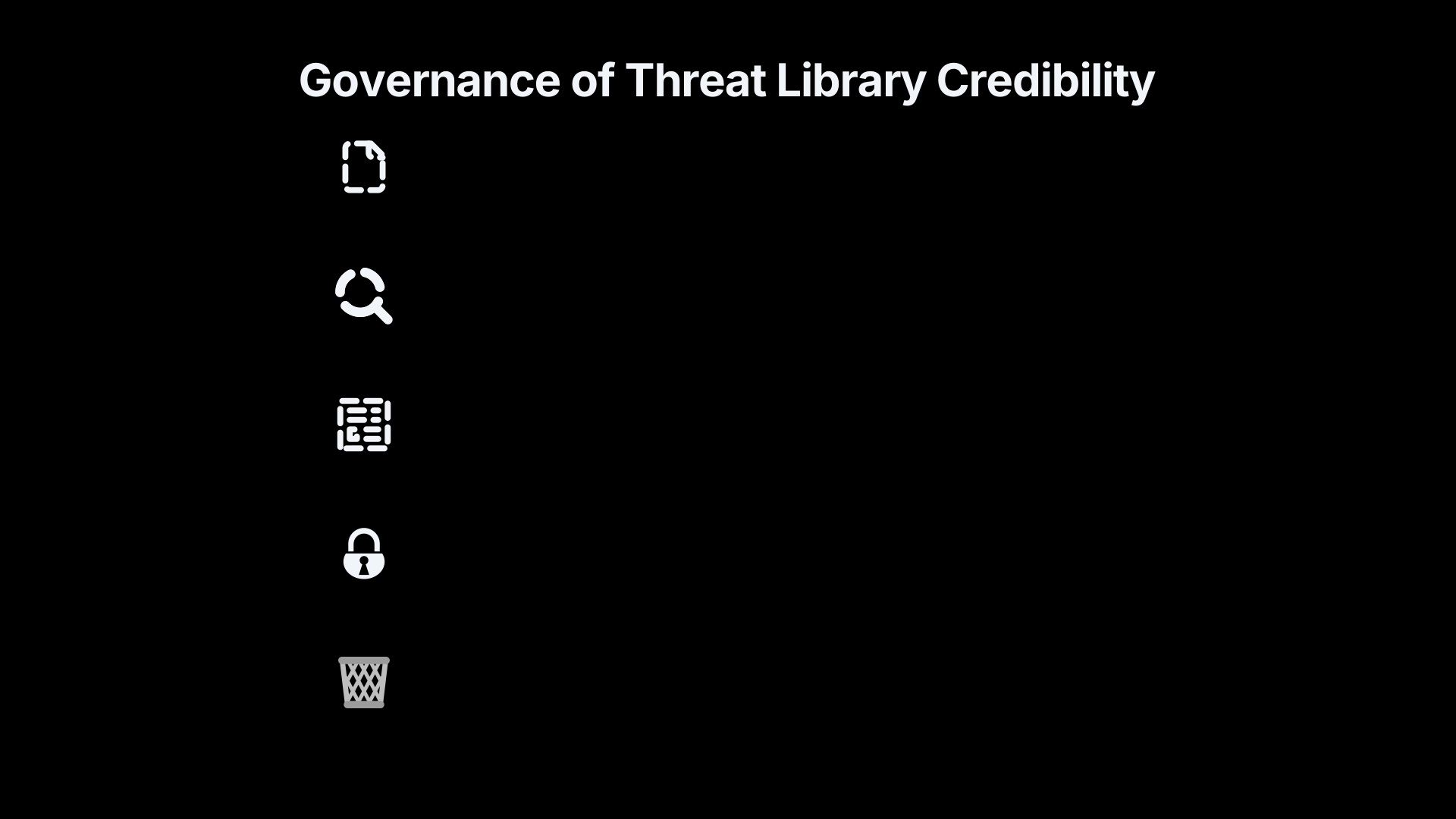
The governance problem is therefore as important as the technical problem. Maintaining a credible threat library requires:
- Procedures for incorporating new intelligence.
- Validation of revised threat records.
- Version control and configuration management.
- Distribution mechanisms for authorised users.
- Periodic review of obsolete entries.
Without those controls, different simulators and operational systems may drift apart, producing inconsistent representations of the same threat.
Linking Digital Models to Field Replicas
Threat libraries become especially valuable when they connect digital simulation with physical training systems.
A field-deployed radar threat simulator does not usually reproduce every engineering detail of the original foreign radar. Instead, it relies on a library describing how the threat should appear to sensors and operators. The library determines what signal is emitted, how the simulated radar changes state, and how it responds during a training scenario.[U.S. Department of War]media.defense.govDepartment of WarUse of Foreign Materiel Exploitation ResultsSeptember 22, 2015 — 8 Oct 1997 — Foreign materiel exploitation supports DoD…
The same principle applies to digital models. When a simulation environment portrays a foreign air-defence network, the behaviour is often driven by threat databases derived from exploitation and intelligence work rather than by direct copies of the original hardware. This allows developers to update behaviour through data revisions rather than rebuilding entire simulation architectures.[Dote]dote.osd.milTest and Evaluation Threat Resource Activity (TETRA)FOREIGN THREATS. OT&E and LFT&E programs rely on the availability of actual, fore…
As a result, the library acts as a bridge between three different worlds:
- Intelligence collection, where measurements are obtained.
- Modelling and simulation, where behaviour is represented digitally.
- Training and testing, where personnel encounter realistic threat replicas.
Changes introduced in the library can therefore propagate through multiple training systems at once, helping maintain consistency across ranges, simulators and operational preparation environments.
The Governance Challenge Behind Realistic Fake Enemies
The credibility of a threat library depends on how carefully information is curated and validated. Defence organisations have repeatedly stressed the need to verify that simulated threats accurately reflect available intelligence rather than relying on assumptions or outdated records. Historical reviews found cases where simulated systems were not always validated against the best exploitation data available, highlighting the risk of training against inaccurate surrogates.[U.S. Department of War]media.defense.govDepartment of WarUse of Foreign Materiel Exploitation ResultsSeptember 22, 2015 — 8 Oct 1997 — Foreign materiel exploitation supports DoD…
This makes threat libraries as much a governance problem as a technical one. Decisions must be made about classification, data quality, source confidence and update priorities. Every change affects not only intelligence databases but potentially the behaviour of training systems, test infrastructure and operational electronic warfare equipment.[E-Publishing]static.e-publishing.af.milJune 2, 2021 — 2 Jun 2021 — Electronic Warfare Integrated Reprogramming Data… Mission Data—Elements or files a processor employs to pe…
Within realistic threat replication, the library therefore becomes the enduring asset. Physical replicas, simulator hardware and training scenarios may change over time, but they remain tied together by a common dataset that captures what has been learned from foreign technology and continuously translates that knowledge into believable, current representations of potential adversaries.[defense.gov]media.defense.govDepartment of WarUse of Foreign Materiel Exploitation ResultsSeptember 22, 2015 — 8 Oct 1997 — Foreign materiel exploitation supports DoD…
Amazon book picks
Further Reading
Books and field guides related to The data behind realistic fake enemies. Use these as the next step if you want deeper reading beyond the article.
Artificial Intelligence
Rating: 4.5/5 from 10 Google Books ratings
Relevant to structured data, classification, and machine-readable models.

The Pentagon's Brain: An Uncensored History of DARPA, America...
Covers intelligence-derived technologies and military innovation.
eBay marketplace picks
Marketplace Samples
Live-tested eBay searches with available results related to this page.




Endnotes
1.
Source: media.defense.gov
Link:https://media.defense.gov/1997/Oct/08/2001715489/-1/-1/1/98-005.pdf
Source snippet
Department of WarUse of Foreign Materiel Exploitation ResultsSeptember 22, 2015 — 8 Oct 1997 — Foreign materiel exploitation supports DoD...
Published: September 22, 2015
2.
Source: saab.com
Title: Start Sirius Airborne EW Suite
Link:https://www.saab.com/products/sirius-airborne-ew-hes-21
Source snippet
StartSirius Airborne EW Suite - HES-21Saab's HES-21 provides electronic support measures (ESM), electronic intelligence (ELINT) and self...
3.
Source: rand.org
Title: Corporation Outsmarting Agile Adversaries in the Electromagnetic
Link:https://www.rand.org/content/dam/rand/pubs/research_reports/RRA900/RRA981-1/RAND_RRA981-1.pdf
Source snippet
RAND CorporationOutsmarting Agile Adversaries in the Electromagnetic...January 18, 2023 — by P VEDULA · 2023 · Cited by 9 — To assist in...
Published: January 18, 2023
4.
Source: dote.osd.mil
Link:https://www.dote.osd.mil/Portals/97/pub/reports/FY2023/dotemanaged/2023tetra.pdf?ver=a4FiXsVtjPy9ZvCB6tdiEA%3D%3D
Source snippet
Test and Evaluation Threat Resource Activity (TETRA)FOREIGN THREATS. OT&E and LFT&E programs rely on the availability of actual, fore...
5.
Source: static.e-publishing.af.mil
Link:https://static.e-publishing.af.mil/production/1/af_a5/publication/dafman10-703/dafman10-703.pdf
Source snippet
June 2, 2021 — 2 Jun 2021 — Electronic Warfare Integrated Reprogramming Data... Mission Data—Elements or files a processor employs to pe...
Published: June 2, 2021
6.
Source: docs.rapid7.com
Title: threat library
Link:https://docs.rapid7.com/threat-command/threat-library/
Source snippet
Copy link · From the Digital Risk Protection (Threat Command) main menu, choose Threat Intelligence (Intelligence Hub) > Threat Library.R...
Additional References
7.
Source: researchgate.net
Link:https://www.researchgate.net/publication/385128680_A_Novel_Machine_Learning_Approach_for_Optimizing_Radar_Warning_Receiver_Preprogramming
Source snippet
(PDF) A Novel Machine Learning Approach for Optimizing...22 Oct 2024 — Radar warning receivers (RWRs) are critical for swiftly and accur...
8.
Source: leidos.com
Link:https://www.leidos.com/capabilities/cyber/electronic-warfare
Source snippet
Electronic WarfareBuild systems to collect information about foreign threats. Support US vulnerability assessments and countermeasure dev...
9.
Source: cdn.everythingrf.com
Link:https://cdn.everythingrf.com/live/Electronic_Warfare_eBook_2024_638646752293473148_1_3_638760766145874076.pdf
Source snippet
WarfareCurrently, DRFMs know what to look for using a lookup table, known as a mission data file (MDF), which is loaded onto the. DRFM be...
10.
Source: northropgrumman.com
Link:https://www.northropgrumman.com/what-we-do/mission-solutions/radars/an-apr-39-digital-radar-warning-receiver-family
Source snippet
AN/APR-39 Digital Radar Warning Receiver FamilyIncludes a flight line reprogrammable Operational Flight Program and threat library; Suppo...
11.
Source: oe.t2com.army.mil
Link:https://oe.t2com.army.mil/opfor-opposing-forces-program/modeling-and-simulations/
Source snippet
OPFOR | Modeling And SimulationsThese products provide vital insights into contemporary operational environments and threats, forming the...
12.
Source: thalesgroup.com
Link:https://www.thalesgroup.com/sites/default/files/2026-04/AI%20for%20Electronic%20Warfare_0.pdf
Source snippet
AI for Electromagnetic WarfareAI offers here a capability for dynamic classification and discovery, complementing the libraries: novelty...
13.
Source: picussecurity.com
Link:https://www.picussecurity.com/product/picus-threat-library
14.
Source: researchgate.net
Title: 350057399 Simulation for cybersecurity state of the art and future directions
Link:https://www.researchgate.net/publication/350057399_Simulation_for_cybersecurity_state_of_the_art_and_future_directions
Source snippet
Simulation for cybersecurity: state of the art and future...25 Mar 2021 — to cybersecurity risk management with a cybersecurity game (CS...
15.
Source: foi.se
Link:https://www.foi.se/download/18.7fd35d7f166c56ebe0b10014/1542623726092/Efficient-implementation-simulation_FOI-S–5618–SE.pdf
Source snippet
ely simple computer simulations were developed to improve poorly supported training aspects, and support debriefing and...
16.
Source: threatdefence.com
Title: Cyber Security Simulation & Attack Simulation Platform
Link:https://threatdefence.com/cyber-range-and-attack-simulation-solutions
Source snippet
data, supported by integrated threat intelligence, automation, SOC workflows and alerting.... ThreatDefence offers comprehensive cyber r...
Topic Tree