Within Foreign Materiel
What Captured Weapons Tell Commanders
Real hardware turns vague performance estimates into practical knowledge for pilots, crews and commanders.
On this page
- From estimates to measurements
- Tactical lessons from hardware
- Limits of public specifications
Page outline Jump by section
Introduction
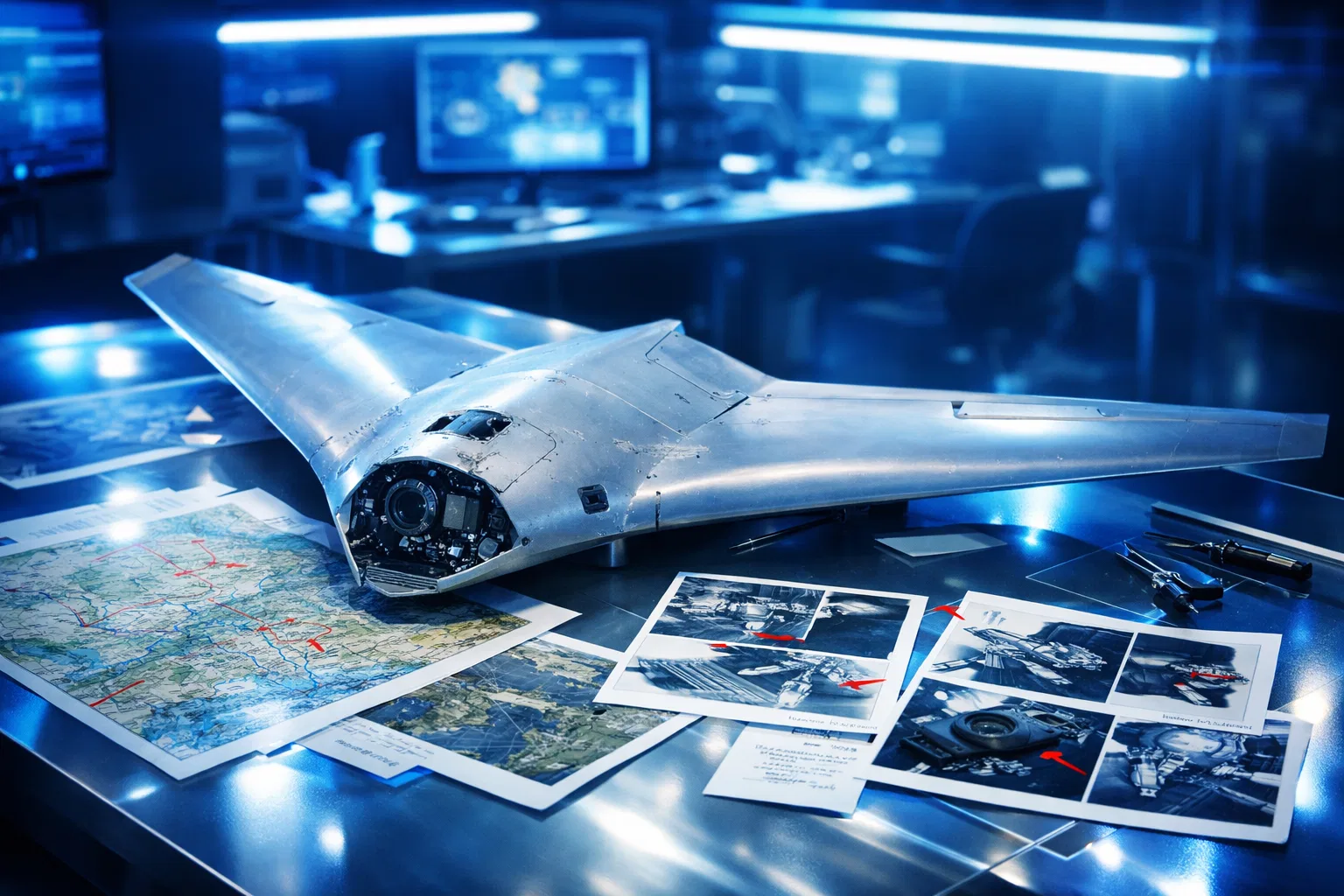
Captured weapons turn an opponent’s equipment from a rumour into a measured fact. In the wider work of reverse engineering foreign military technology, this is the operational intelligence layer: the point where analysts, pilots, crews and commanders learn what a weapon actually does under real conditions, not just what a brochure, parade statement or distant sensor track suggests. A recovered aircraft can reveal blind spots, control limits and maintenance burdens; a captured missile or drone can expose guidance methods, foreign components and exploitable weaknesses; a tank or radar can show how crews should fight against it tomorrow morning. Official US Army material describes technical intelligence as analysis of foreign equipment used to prevent technological surprise, assess capabilities and develop countermeasures, while US budget documents still justify foreign materiel exploitation partly because captured threat materiel may need “immediate exploitation” for countermeasures and force protection.[Army]army.milOpen source on army.mil.
From Estimates to Measurements
Before a weapon is captured, intelligence agencies often work from partial views. Satellites may show size and deployment patterns. Signals intelligence may reveal emissions. Combat reports may describe effects. Export brochures may claim range, penetration, accuracy or reliability. All of those matter, but each can mislead. Public specifications are usually selective, optimistic or deliberately vague; battlefield reports can confuse crew skill with equipment performance; and an adversary may use a system badly, making a good weapon look poor, or unusually well, making a limited weapon look formidable.
Physical access changes the question. Instead of asking, “How far might this radar see?” analysts can test antenna design, frequencies, processing behaviour and susceptibility to jamming. Instead of asking, “Can this aircraft out-turn ours?” test pilots can fly it against friendly aircraft and record where the advantage changes with altitude, speed and manoeuvre. Instead of asking, “How advanced is this drone?” engineers can open it, identify its sensors, flight controller, data links, power supply and component origins. The US National Air and Space Intelligence Center describes foreign materiel exploitation in exactly these practical terms: getting access to aircraft, surface-to-air missiles and radar so forces can work out how to evade, defeat or avoid detection by them.[Nasic]nasic.af.milAcquire, Assess, Exploit > National Air and Space Intelligence Center > Article Display…
The operational value lies in the narrowing of uncertainty. A commander does not need an encyclopaedia entry on an enemy system in the middle of a campaign. They need reliable answers to specific combat questions: what distance is dangerous, what manoeuvre is safe, what electronic signal gives warning, which munition works, which armour angle is weak, whether a weapon is being upgraded, and whether a countermeasure that worked last month still works now. That is why older US battlefield technical-intelligence doctrine distinguished between immediate field exploitation and deeper specialist analysis. At division and brigade level, intelligence and operations personnel were expected to examine captured materiel enough to determine its “immediate tactical significance”, while specialist centres performed more detailed evaluation to determine performance, limitations and countermeasure options.[Bits]bits.deFM34 54(1990FM34 54(1990
This distinction is important. Captured equipment is not valuable only when it is copied or displayed. Its first value may be a short warning message, a revised cockpit briefing, a change in route planning, a new electronic-warfare setting or a correction to a threat manual. The intelligence cycle is therefore not “capture, dissect, publish history”. It is “secure, identify, preserve, exploit quickly, disseminate what matters, then continue deeper analysis”.
Tactical Lessons from Hardware
The clearest examples come from aircraft, because pilots feel the difference between theoretical and measured performance immediately. A captured aircraft can reveal where a published maximum speed or turn rate hides the real combat answer: visibility, acceleration lag, control stiffness, weapon sighting, fuel behaviour, maintainability and how quickly the aircraft bleeds energy in a hard turn.
The Akutan Zero, recovered by US forces in Alaska in 1942 and restored to flying condition, is a classic case. Official US naval aviation history notes that test flights of captured Zero fighters showed that the aircraft’s famous manoeuvrability fell away at higher speeds and that it had difficulty rolling in some conditions.[Naval History and Heritage Command]history.navy.milcaptured zero fighters yielded intelligence for alliescaptured zero fighters yielded intelligence for allies That mattered because Allied pilots did not need to match the Zero at its strongest point; they needed to avoid fighting it there. The practical lesson was not “the Zero is bad”. It was more useful: exploit high-speed manoeuvre, avoid low-speed turning contests, and understand how its handling changed outside the range in which it felt almost unbeatable.
The case is also a warning against overclaiming. Some tactics against the Zero, including mutual-support manoeuvres associated with the Thach Weave, were being developed from earlier intelligence and combat experience before the Akutan aircraft was tested. Later debate has therefore pushed back against the simplified story that one captured fighter alone “solved” the Zero.[Wikipedia]WikipediaAkutan ZeroAkutan Zero The better conclusion is narrower and stronger: captured hardware did not create all Allied tactics from scratch, but it converted pilot reports and estimates into tested handling knowledge that could be taught with more confidence.
The same pattern appears in the Cold War exploitation of Soviet-designed aircraft. Project Have Doughnut, the US tactical evaluation of a MiG-21, was explicitly designed to evaluate existing US and Navy manoeuvres against the MiG-21, exploit its tactical capabilities in air-to-air combat, optimise tactics, and assess its design, performance and operational characteristics.[National Security Archive]nsarchive2.gwu.eduNational Security Archive The declassified briefing did not treat the MiG-21 as a set of abstract specifications. It identified combat-relevant limitations: poor forward and rearward visibility, a rear blind cone, low-altitude airspeed limits, severe buffet at high speed, limited cannon ammunition, tracking problems above 3G and a range-only radar vulnerable to chaff and jamming.[National Security Archive]nsarchive2.gwu.eduNational Security Archive
Those findings translate directly into operational advice. If a MiG-21 has poor rear visibility, attack geometry matters. If it bleeds energy rapidly at high G, a friendly aircraft may avoid prolonged turning at the wrong point but exploit vertical manoeuvre or acceleration advantages at another. The briefing concluded, for example, that the F-4 could control engagements below 15,000 feet by exploiting the MiG-21’s airspeed limitation and high-G energy loss, orienting attacks towards the blind cone and using vertical manoeuvre.[National Security Archive]nsarchive2.gwu.eduNational Security Archive That is operational intelligence in its purest form: not a copy of the enemy weapon, but a change in how friendly crews fight it.
Project Constant Peg carried the idea into training. The National Museum of the US Air Force describes it as a secret programme in which the 4477th Test and Evaluation Squadron flew MiG-17, MiG-21 and MiG-23 aircraft so US Air Force, Navy and Marine Corps crews could train against real Soviet-designed aircraft rather than simulations alone. The programme improved on ordinary aggressor training because its pilots used Soviet tactics while flying the same kinds of MiGs that US crews might meet in combat.[Air Force Museum]nationalmuseum.af.milCONSTANT PEG: Secret MiGs in the Desert > National Museum of the United States Air Force > Display… The intelligence product was therefore embodied in experience: pilots learned sight pictures, closure rates, turning behaviour and confidence under realistic conditions.
What Commanders Learn Beyond the Brochure
Captured weapons often matter most where public specifications are least useful. A brochure may list a missile’s range, but it will not reveal how long the seeker takes to acquire, how resistant the electronics are to jamming, whether the fuze is reliable, what components are hard to source, or which tactical assumptions its designers made. A tank’s advertised armour may not reveal sensor quality, crew ergonomics, thermal-signature problems, weak roof protection or maintenance fragility. A drone’s claimed endurance may not reveal whether it depends on vulnerable imported chips, civilian navigation aids or a data link that can be located and disrupted.
Modern exploitation of Russian systems in Ukraine shows this broader value. RUSI’s report on the Orlan-10 drone complex states that its researchers used datasets of components and microelectronics from disassembled Russian weapons that were captured or expended in Ukraine after February 2022, then standardised and categorised those technical assessments for further analysis. RUSI also reports that physical inspection during fieldwork helped confirm the authenticity and accuracy of the data, while comparing parts with product descriptions and serial numbers.[RUSI]static.rusi.orgThe Orlan Complex: Tracking the Supply Chains of Russia's Most Successful UAVThe Orlan Complex: Tracking the Supply Chains of Russia's Most Successful UAV That kind of work does not just say “this drone exists”. It helps explain how the system is built, how Russia sustains it, what foreign supply chains it relies on, and where sanctions, jamming or battlefield countermeasures might have an effect.
The same logic sits behind Ukraine’s more recent effort to share technical information from captured Russian weapons with allies. Reporting on the TrophyLab platform says it is intended to give allied governments, laboratories and defence manufacturers access to deep technical data, reports, vulnerabilities and, in some cases, physical equipment for testing, with the aim of shortening the development cycle for countermeasures.[The Kyiv Independent]kyivindependent.comOpen source on kyivindependent.com. The notable point is not the branding of the platform; it is the operational assumption behind it. Captured missiles, drones and vehicles are treated as reusable sources of evidence, not merely trophies. Each item can feed air-defence updates, electronic-warfare work, export-control investigations, armour lessons and industrial planning.
For commanders, the useful outputs usually fall into a few categories:
- Performance boundaries: the speed, range, altitude, turning, tracking or endurance limits where an enemy system stops matching its reputation.
- Countermeasure clues: frequencies, seeker behaviour, sensor blind spots, fuze design, software patterns or materials that suggest how to jam, decoy, spoof or defeat the system.
- Tactical warnings: safe distances, vulnerable approach angles, likely reload times, crew-visibility limits or maintenance constraints that affect immediate battlefield decisions.
- Training realism: the ability to build threat simulators, flying profiles, target sets and exercises around observed hardware rather than assumed behaviour.
- Supply-chain intelligence: component markings and manufacturing traces that reveal dependencies, procurement routes and possible future bottlenecks.
These are not separate from reverse engineering; they are one of its most urgent products. Copying a weapon may take years. Changing a tactic, warning a crew or adjusting a jammer can sometimes happen much faster.
The Chain from Battlefield Find to Usable Intelligence
The hard part is not only getting the enemy system. It is turning a battlefield find into a trustworthy answer quickly enough to matter. Doctrine and practice repeatedly stress handling, reporting and dissemination because a captured item can lose intelligence value if it is stripped, moved carelessly, contaminated, misidentified, publicly exposed or separated from associated documents.
NATO guidance on captured persons, materiel and documents says commanders must plan for the correct and expeditious handling of captured materiel and documents so information of intelligence and other value can be extracted.[nllp.jallc.nato.int]nllp.jallc.nato.intAJP 2.5(A) Captured Persons, Material and Documents dated aug07AJP 2.5(A) Captured Persons, Material and Documents dated aug07 US Army document and media exploitation guidance similarly notes that technical documents associated with captured enemy materiel should be identified and evacuated with the equipment to a captured materiel exploitation centre, where technical-intelligence analysts assess foreign documents, equipment, weapons systems and other war materiel.[Public Intelligence |]info.publicintelligence.netPublic IntelligencePublic Intelligence
That pairing of hardware and paperwork is often decisive. A missile launcher without manuals may still reveal construction and electronics; with logbooks, firing tables, maintenance cards or packing slips, it can reveal reliability, unit procedures, production batches and the way crews are trained to use it. A captured radio with its settings unchanged can be more valuable than the same radio after a curious soldier has turned every dial. Older US technical-intelligence guidance explicitly warned that captured communications-electronics equipment should not have dial settings and frequencies changed before screening.[Bits]bits.deFM34 54(1990FM34 54(1990
The workflow is therefore both tactical and forensic. The frontline unit must recognise that the item matters, report it, preserve it if safe, and avoid destroying useful context. Explosive ordnance disposal teams may need to make it safe. Intelligence personnel decide what can be learned locally and what needs specialist evacuation. Technical experts then test, image, dismantle, compare, catalogue and distribute findings to the people who can use them. At each stage, speed competes with care: commanders need quick warnings, but analysts need enough preservation to avoid false conclusions.
Why Public Specifications Are Not Enough
Public specifications tend to flatten a weapon into a few impressive numbers. Range, speed, calibre, penetration, payload and maximum altitude are easy to compare, so they dominate public debate. Operational intelligence asks less glamorous questions that often matter more.
A fighter may have excellent instantaneous turn performance but poor visibility, slow engine response or severe energy loss. A missile may have a long maximum range but be unreliable in clutter, vulnerable to chaff, or dependent on a launch profile that exposes the operator. A drone may have useful endurance but rely on commercial components, predictable navigation patterns or a control link that can be exploited. A tank may be heavily armoured in one arc but constrained by optics, crew workload or top-attack vulnerability.
The Have Doughnut MiG-21 findings show this clearly. Public knowledge that the MiG-21 was small, fast and highly manoeuvrable did not tell US pilots enough. The exploitable details were more precise: poor visibility in particular directions, specific low-altitude speed limits, radar vulnerability, cannon ammunition limits, tracking problems under G, and acceleration differences against US aircraft.[The Unwritten Record]unwritten-record.blogs.archives.govOpen source on archives.gov. Likewise, the Akutan Zero’s reputation for manoeuvrability was true but incomplete; test flying revealed where that manoeuvrability degraded and how Allied pilots could avoid fighting on the aircraft’s best terms.[Naval History and Heritage Command]history.navy.milcaptured zero fighters yielded intelligence for alliescaptured zero fighters yielded intelligence for allies
This is why captured weapons can overturn both underestimation and overestimation. Sometimes they reveal an adversary system is more capable than expected: better engineered, easier to maintain, more rugged or more adaptable. Sometimes they reveal design compromises hidden by propaganda or export marketing. Both outcomes help commanders. Inflated fear can lead to excessive caution; careless dismissal can get crews killed. Measured knowledge supports proportionate tactics.
The Limits of Captured-Weapon Intelligence
A captured weapon is evidence, not magic. One example may be damaged, export-standard, badly maintained, modified in the field or unrepresentative of the newest production batch. Battlefield wreckage may omit the very subsystem analysts need. An aircraft flown by test pilots in controlled conditions does not exactly reproduce a combat pilot’s stress, ground-control support or doctrine. A drone recovered after a crash may tell analysts about components but not always about the full command network that used it.
There is also the problem of context. Hardware can show what a weapon can do, but not always how an enemy will use it. Project Have Doughnut’s archival discussion recognised that the MiG-21’s value depended partly on the pilot and on whether the aircraft was used to its full potential.[The Unwritten Record]unwritten-record.blogs.archives.govOpen source on archives.gov. RUSI’s component work on Russian drones also shows a different kind of limit: identifying parts and supply chains is powerful, but counterfeit components, grey markets and incomplete records mean analysts must handle certainty carefully.[RUSI]static.rusi.orgThe Orlan Complex: Tracking the Supply Chains of Russia's Most Successful UAVThe Orlan Complex: Tracking the Supply Chains of Russia's Most Successful UAV
Commanders therefore need captured-hardware intelligence fused with other sources: combat reporting, signals intelligence, prisoner or document exploitation, imagery, maintenance observations, industry tracking and repeated recoveries over time. A single captured missile may suggest a vulnerability. A pattern across dozens of missiles from different dates can show whether the adversary has changed suppliers, upgraded guidance, altered fuzing or adapted to previous countermeasures.
The strongest operational use is iterative. Capture leads to measurement; measurement leads to a countermeasure or tactic; the adversary adapts; new wreckage or captured systems show the adaptation; commanders update again. In a fast war, this cycle may be more important than any single spectacular intelligence prize.
What Captured Weapons Tell Commanders
Captured weapons tell commanders how to replace reputation with evidence. They reveal the difference between maximum performance and usable performance, between design intent and field reliability, between advertised capability and exploitable limitation. They also turn reverse engineering into something immediately practical: a pilot’s manoeuvre, an air-defence setting, a route-planning rule, a maintenance warning, a procurement alert or a new training scenario.
The enduring lesson is that foreign military technology is not fully understood from outside. It must be observed, tested and compared against friendly systems under conditions that resemble combat. That is why foreign materiel exploitation remains a standing defence-intelligence mission rather than a historical curiosity. The captured object is only the starting point; the real product is decision advantage for the people who must fight, protect forces and adapt faster than the opposing system can change.
Amazon book picks
Further Reading
Books and field guides related to What Captured Weapons Tell Commanders. Use these as the next step if you want deeper reading beyond the article.
The Pentagon's Brain
Explains defense research, threat assessment and exploitation of foreign technology.
The Art of Intelligence
Provides operational context for turning information into actionable decisions.
Skunk Works
Shows how real-world technical intelligence and adversary capabilities shape military development.
Spycraft
Covers practical intelligence collection methods that complement technical exploitation.
eBay marketplace picks
Marketplace Samples
Live-tested eBay searches with available results related to this page.



Endnotes
1.
Source: army.mil
Link:https://www.army.mil/article/88115/techint_draws_interest_of_intelligence_community
2.
Source: asafm.army.mil
Title: Financial Management Justification Book
Link:https://www.asafm.army.mil/Portals/72/Documents/BudgetMaterial/2027/Discretionary%20Budget/rdte/RDTE%20-%20Vol%204%20-%20Budget%20Activity%206.pdf
3.
Source: [nasic]({{ ‘nasic/’ | relative_url }}). af.mil
Link:https://www.nasic.af.mil/News/Article-Display/Article/1010245/acquire-assess-exploit/
Source snippet
Acquire, Assess, Exploit > National Air and Space Intelligence Center > Article Display...
4.
Source: bits.de
Title: FM34 54(1990)
Link:https://www.bits.de/NRANEU/others/amd-us-archive/FM34-54%281990%29.pdf
5.
Source: history.navy.mil
Title: captured zero fighters yielded intelligence for allies
Link:https://www.history.navy.mil/content/history/museums/nnam/education/articles/history-up-close/captured-zero-fighters-yielded-intelligence-for-allies.html
6.
Source: Wikipedia
Title: Akutan Zero
Link:https://en.wikipedia.org/wiki/Akutan_Zero
7.
Source: nsarchive2.gwu.edu
Title: National Security Archive
Link:https://nsarchive2.gwu.edu/NSAEBB/NSAEBB443/docs/area51_48.PDF
8.
Source: nationalmuseum.af.mil
Title: Air Force Museum
Link:https://www.nationalmuseum.af.mil/Visit/Museum-Exhibits/Fact-Sheets/Display/Article/1682967/constant-peg-secret-migs-in-the-desert/
Source snippet
CONSTANT PEG: Secret MiGs in the Desert > National Museum of the United States Air Force > Display...
9.
Source: static.rusi.org
Title: The Orlan Complex: Tracking the Supply Chains of Russia’s Most Successful UAV
Link:https://static.rusi.org/SR-Orlan-complex-web-final.pdf
10.
Source: nllp.jallc.nato.int
Title: AJP 2.5(A) Captured Persons, Material and Documents dated aug07
Link:https://nllp.jallc.nato.int/cmnt/ciedcoi/CIED%20PUBLICATIONS/Handbooks%20and%20Doctrines/AJP%202.5%28A%29%20Captured%20Persons%2C%20Material%20and%20Documents%20dated%20aug07.pdf
11.
Source: info.publicintelligence.net
Title: Public Intelligence
Link:https://info.publicintelligence.net/USArmy-DocumentMediaExploitation.pdf
12.
Source: nato.int
Link:https://www.nato.int/content/dam/nato/webready/documents/deep/231208-RusWar-Ukraine-Lessons-Curriculum-Guide-en.pdf
13.
Source: static.rusi.org
Title: 359 SR Ukraine Preliminary Lessons Feb July 2022 web final
Link:https://static.rusi.org/359-SR-Ukraine-Preliminary-Lessons-Feb-July-2022-web-final.pdf
Published: July 2022
14.
Source: static.rusi.org
Title: lessons learned ukraine offensive 2022 23
Link:https://static.rusi.org/lessons-learned-ukraine-offensive-2022-23.pdf
15.
Source: rusi.org
Title: preliminary lessons ukraines offensive operations 2022 23
Link:https://www.rusi.org/explore-our-research/publications/special-resources/preliminary-lessons-ukraines-offensive-operations
16.
Source: army.mil
Link:https://www.army.mil/acic
17.
Source: army.mil
Title: battalion showcases techint
Link:https://www.army.mil/article/66856/battalion_showcases_techint
18.
Source: odin.t2com.army.mil
Title: Chapter 6: Terrorism
Link:https://odin.t2com.army.mil/TC/Chapter_6%3A_Terrorism
19.
Source: history.army.mil
Link:https://history.army.mil/portals/143/Images/Publications/catalog/90-19.pdf
20.
Source: home.army.mil
Title: mil F M 3-39 Military Police Operations
Link:https://home.army.mil/wood/application/files/9115/5751/8355/FM_3-39_Military_Police_Operations.pdf
21.
Source: mipb.ikn.army.mil
Title: mil The Army Intelligence Program of Analysis
Link:https://mipb.ikn.army.mil/media/hxgjry4o/mipb-2018-07-09-full-issue.pdf
22.
Source: history.army.mil
Link:https://history.army.mil/portals/143/Images/Publications/catalog/60-13.pdf
23.
Source: mipb.ikn.army.mil
Title: mil Download
Link:https://mipb.ikn.army.mil/media/10nl3s3g/mipb-2020-10-12-full-issue.pdf
24.
Source: oe.t2com.army.mil
Link:https://oe.t2com.army.mil/product/preliminary-lessons-in-conventional-warfighting-2/
25.
Source: Wikipedia
Title: Mitsubishi A6M Zero
Link:https://en.wikipedia.org/wiki/Mitsubishi_A6M_Zero
26.
Source: Wikipedia
Title: 4477th Test and Evaluation Squadron
Link:https://en.wikipedia.org/wiki/4477th_Test_and_Evaluation_Squadron
27.
Source: Wikipedia
Title: STC Orlan 10
Link:https://en.wikipedia.org/wiki/STC_Orlan-10
28.
Source: Wikipedia
Link:https://en.wikipedia.org/wiki/9M133_Kornet
29.
Source: bits.de
Link:https://www.bits.de/NRANEU/others/jp-doctrine/jp1_02%2804%29.pdf
30.
Source: kyivindependent.com
Link:https://kyivindependent.com/ukraine-launches-database-with-deep-technical-data-of-russian-weapons-to-share-with-allies/
31.
Source: unwritten-record.blogs.archives.gov
Link:https://unwritten-record.blogs.archives.gov/2022/10/18/throw-a-nickel-on-the-grass-and-have-a-doughnut%EF%BF%BC/
32.
Source: researchcentre.army.gov.au
Link:https://researchcentre.army.gov.au/library/australian-army-journal-aaj/volume-9-number-1-autumn/exploitation-intelligence-new-intelligence-discipline
33.
Source: nsarchive.gwu.edu
Link:https://nsarchive.gwu.edu/briefing-book/intelligence/2018-01-31/scavenging-intelligence-us-governments-secret-search-foreign-objects-during-cold-war
34.
Source: war-sanctions.gur.gov.ua
Link:https://war-sanctions.gur.gov.ua/en/components
Additional References
35.
Source: youtube.com
Title: Captured Russian Weapons: Ukraine Opens Access
Link:https://www.youtube.com/watch?v=iXObw10LmP4
Source snippet
This video shows how physical hardware analysis is performed on captured technical [fragments]({{ 'fragments/' | relative_url }}) to extract real-world weapon performance dat...
36.
Source: youtube.com
Title: TECHINT with 9K720 Iskander (SS-26 Stone) fragments from Ukraine
Link:https://www.youtube.com/watch?v=rRhjtgeRCBg
Source snippet
Zelensky's Bold Russian Weapons Proposal Stuns Moscow as Putin Renews Nuclear Warnings...
37.
Source: youtube.com
Link:https://www.youtube.com/watch?v=2LEgZjJocyA
Source snippet
Captured Russian Weapons: Ukraine Opens Access...
38.
Source: youtube.com
Title: Aviation Historian Peter Merlin talks about the Russian Mi Gs at AREA 51
Link:https://www.youtube.com/watch?v=t79ndKspdvQ
Source snippet
Ukraine Just Gave NATO the Keys to RUSSIA's Arsenal...
39.
Source: cia.gov
Link:https://www.cia.gov/readingroom/document/cia-rdp75-00662r000100130077-6
40.
Source: youtube.com
Title: Ukraine Just Gave NATO the Keys to RUSSIA’s Arsenal
Link:https://www.youtube.com/watch?v=am85ONjlHzQ
Source snippet
TECHINT with 9K720 Iskander (SS-26 Stone) fragments from Ukraine...
41.
Source: hsgac.senate.gov
Link:https://www.hsgac.senate.gov/wp-content/uploads/09.10.2024-Majority-Staff-Report-The-U.S.-Technology-Fueling-Russias-War-in-Ukraine.pdf
42.
Source: facebook.com
Link:https://www.facebook.com/EngineeringExplained/posts/the-t-90-russias-main-battletank-and-its-failure-in-ukraine-video-by-genius-inve/844150884204393/
43.
Source: researchgate.net
Link:https://www.researchgate.net/publication/393932296_Electronic_Warfare_in_Ukraine_Preliminary_Lessons_for_NATO_Air_Power_Capability_Development
44.
Source: instagram.com
Link:https://www.instagram.com/p/CmMITS4jRDm/
Topic Tree