Within Firmware
How Threat Libraries Reveal What Systems Recognize
Stored threat databases can show how electronic warfare systems classify signals and identify targets.
On this page
- Signal Classification Data
- Target Recognition Rules
- Operational Limitations
Page outline Jump by section
Introduction
When analysts gain access to the software and firmware of a captured electronic-warfare system, one of the most valuable discoveries is often not the hardware design but the system’s threat library. A threat library is a structured database that tells a sensor, radar warning receiver, electronic support system or jammer how to recognise, classify and prioritise signals in the electromagnetic environment. In practical terms, it embodies the system’s understanding of what constitutes a threat, how different emitters are distinguished from one another, and which responses should follow particular detections. Because these libraries encode years of intelligence collection and operational assumptions, they can reveal both capabilities and blind spots that are not visible from hardware inspection alone.[srcinc.com]srcinc.comEWIRDBRapid reprogramming of systems through the development of mission data sets; Production of the threat data source for mission plann…

Within the broader process of reverse engineering foreign military technology, threat libraries are especially important because they expose how a system interprets the world around it. A captured database may show which radar types are recognised, what signal parameters are considered significant, how confidence levels are assigned, and where identification becomes uncertain.[researchgate.net]researchgate.netResearch Gate An Expert System For Threat Analysis In Radar Warningemitter descriptors, are used to track the detected radar in time. The processor uses these parameters to identify the emitters, assess t…
How Threat Libraries Work
Modern electronic-warfare receivers rarely identify signals through a single frequency match. Instead, they compare observed emissions against large collections of reference data. These libraries may contain descriptions of radar systems, communication emitters, missile guidance signals and other electromagnetic sources gathered through intelligence collection and operational testing.[navysbir.us]navysbir.usAutomated Generation of Electronic Warfare LibrariesOBJECTIVE: The objective is to develop technologies that automate the creation of Ele…
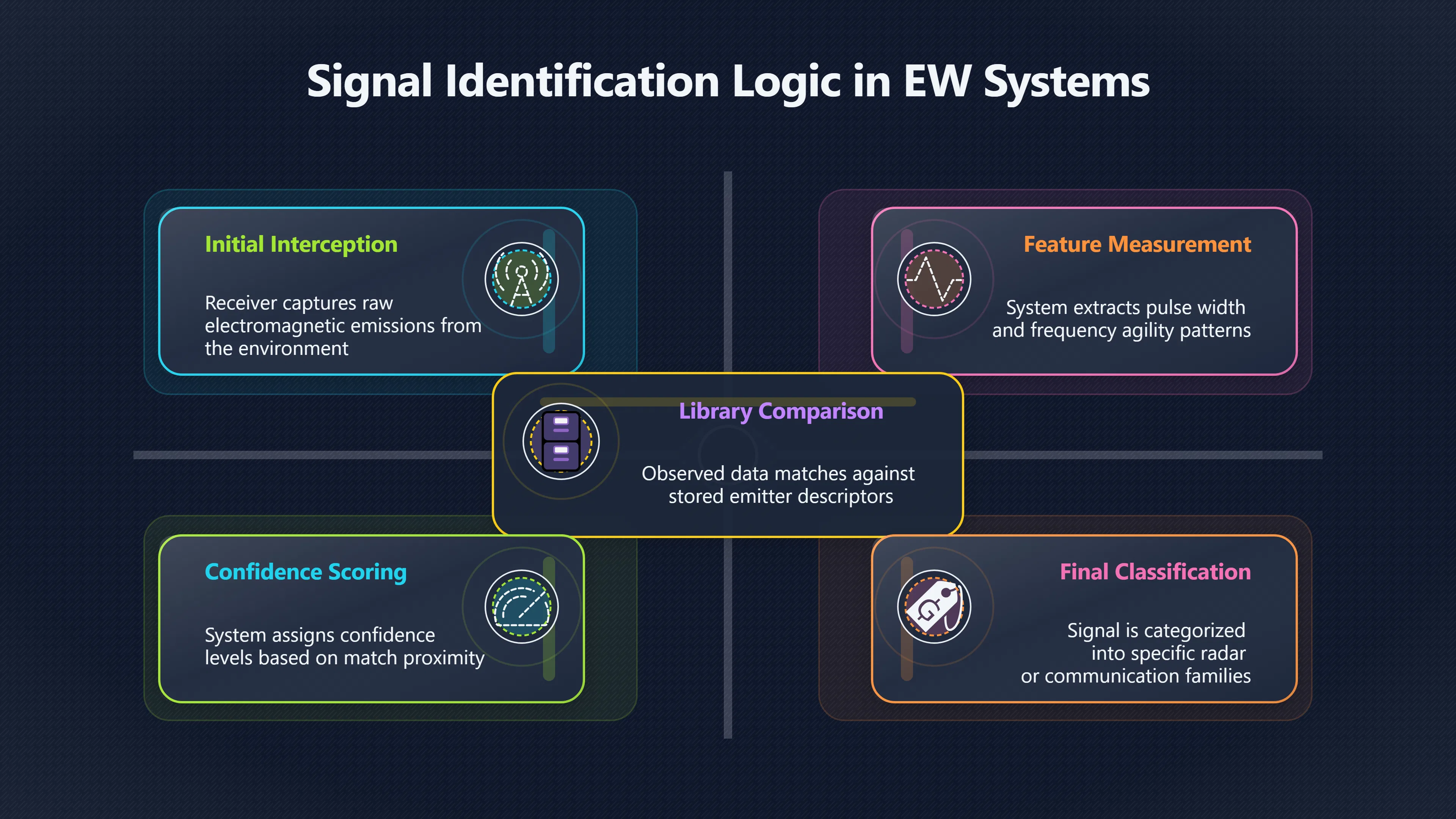
The process typically begins when a receiver intercepts a signal and measures its characteristics. Depending on the system, these measurements can include:
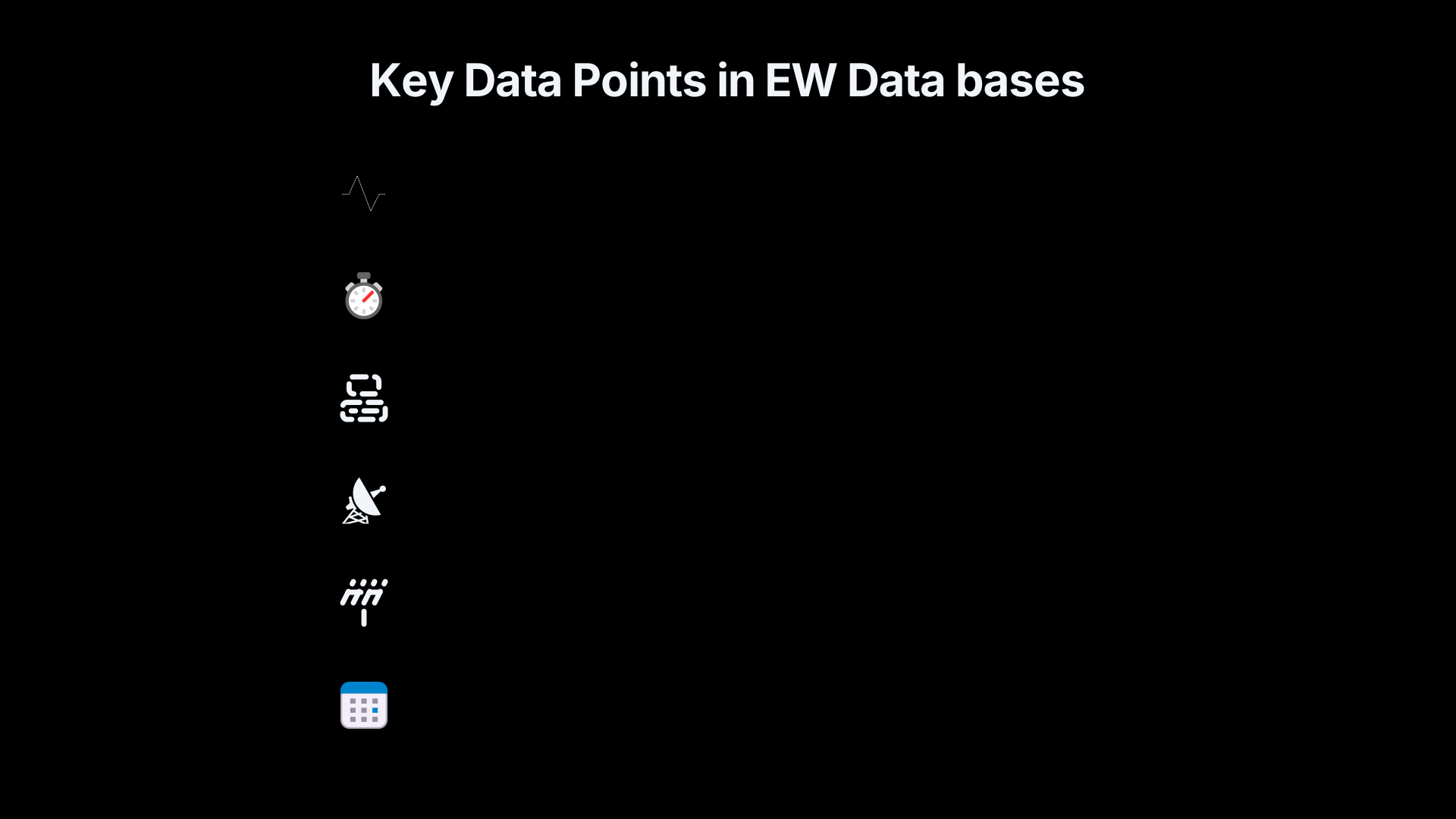
- Frequency and frequency-agility patterns.
- Pulse repetition intervals.
- Pulse width.
- Modulation type.
- Scan behaviour.
- Antenna characteristics.
- Signal timing relationships.
These features are compared against stored emitter descriptors. The closer the match, the higher the confidence that the signal originates from a known radar or emitter family.[researchgate.net]researchgate.netResearch Gate An Expert System For Threat Analysis In Radar Warningemitter descriptors, are used to track the detected radar in time. The processor uses these parameters to identify the emitters, assess t…
For reverse engineers, the significance is that a captured threat library effectively exposes the categories and distinctions the original designers considered operationally important. The database becomes a map of the system’s recognition logic.
Signal Classification Data
What the Database Actually Contains
Threat libraries are often described as lists of hostile emitters, but in practice they are closer to structured classification systems. They may include hundreds or thousands of entries, each associated with measured signal parameters and identification rules. Electronic-warfare databases such as the Electronic Warfare Integrated Reprogramming Database (EWIRDB) are specifically designed to support the creation of mission data sets and threat-identification capabilities.[srcinc.com]srcinc.comEWIRDBRapid reprogramming of systems through the development of mission data sets; Production of the threat data source for mission plann…
A captured library can reveal:
- Which foreign radar systems have been catalogued.
- How those radars are grouped into families.
- Which signal attributes receive the greatest weighting.
- What confidence thresholds trigger identification.
- How ambiguous detections are handled.
The contents often reveal not merely knowledge of an emitter but the quality of that knowledge. Detailed parameter ranges suggest extensive intelligence collection, while sparse entries may indicate uncertainty or limited access.[navysbir.us]navysbir.usAutomated Generation of Electronic Warfare LibrariesOBJECTIVE: The objective is to develop technologies that automate the creation of Ele…
Recognition Hierarchies
Many systems do not move directly from detection to precise identification. Instead, they classify signals through layers of confidence. A receiver may first determine that a signal resembles an air-defence radar, then narrow it to a specific family, and only finally attempt identification of a particular model or operating mode. Research on radar warning receivers consistently describes emitter identification as a staged process combining signal sorting, classification and threat assessment.[radars.ac.cn]radars.ac.cnsignal identification and threat…
If such decision hierarchies are preserved in firmware or mission-data files, they reveal the system’s internal assumptions about uncertainty and risk.
Target Recognition Rules
From Detection to Decision
The most sensitive information in many threat libraries is not the raw signal data but the rules that convert detections into operational decisions.
A radar warning receiver, for example, may not simply display every intercepted signal. Instead, it applies recognition rules that determine:
- Which emitters deserve alerts.
- Which are considered background activity.
- Which indicate targeting or missile guidance.
- Which require immediate defensive responses.
Modern systems are designed to identify emitters, assess threat levels and support countermeasure decisions through these programmed relationships.[researchgate.net]researchgate.netResearch Gate An Expert System For Threat Analysis In Radar Warningemitter descriptors, are used to track the detected radar in time. The processor uses these parameters to identify the emitters, assess t…
For reverse engineers, these rules can be more revealing than the emitter catalogue itself. Two systems may recognise the same radar, yet assign very different threat priorities or confidence levels.
Embedded Operational Assumptions
Threat libraries also expose doctrinal assumptions.
For example, entries may distinguish between:
- Search radars and fire-control radars.
- Peacetime and wartime operating modes.
- Mobile and fixed installations.
- Legacy and modern variants of the same emitter.
These distinctions indicate how the system’s designers expected operators to interpret the electromagnetic environment. A captured database may therefore reveal not only technical knowledge but also tactical expectations embedded in software.[ResearchGate]researchgate.netResearch Gate An Expert System For Threat Analysis In Radar Warningemitter descriptors, are used to track the detected radar in time. The processor uses these parameters to identify the emitters, assess t…
Mission Data Files as Intelligence Products
In many Western electronic-warfare architectures, mission-data files are treated as critical operational resources that require continual updates as adversary systems evolve. Studies of electronic-warfare mission-data programming describe these files as controlling identification and jamming behaviour across operational platforms.[AFIT Scholar]scholar.afit.eduEW operations include identifying and jamming radar operated…Read more…
Consequently, a captured mission-data package can provide a snapshot of what its owner believed about foreign emitters at a particular moment in time. Analysts may compare multiple versions to track changing threat assessments, newly recognised systems or shifts in classification priorities.
Operational Limitations Revealed by Captured Libraries
What the System Cannot Recognise
One of the most useful discoveries in a captured threat library is often what is absent.
A receiver can only reliably identify emitters represented in its database. Unknown signals may be flagged as generic threats, classified incorrectly or ignored entirely. The effectiveness of emitter recognition therefore depends heavily on the completeness and currency of the library.[Army]army.milimproves software against electronic warfare threatsArmy Improves Software against Electronic Warfare Threats22 Dec 2016 — The ARAT team serves as the Army's rapid reprogramming infrast…
Missing entries may reveal intelligence gaps, while outdated parameter sets can expose systems vulnerable to newer radar modes or modified emitter behaviours.
Ambiguity and False Identification
Threat libraries must operate in cluttered electromagnetic environments where multiple systems may share similar characteristics. As a result, recognition rules often include tolerances and confidence thresholds rather than exact matches.[ResearchGate]researchgate.netResearch Gate An Expert System For Threat Analysis In Radar Warningemitter descriptors, are used to track the detected radar in time. The processor uses these parameters to identify the emitters, assess t…
Captured software can reveal:
- Which emitters are frequently confused.
- Where confidence scores decline.
- How the system resolves conflicting evidence.
- Which parameters dominate identification decisions.
These details help analysts understand not only what the system knows, but also where it is likely to make mistakes.
The Reprogramming Burden
Threat libraries are not static. Electronic-warfare organisations invest heavily in rapid reprogramming because emitter behaviour changes continually. New radar modes, software updates, altered pulse patterns and modified operating procedures can all reduce recognition accuracy if databases are not updated. Official military guidance on electronic warfare repeatedly emphasises rapid reprogramming as a requirement for maintaining effectiveness against evolving threats.[Army]army.milimproves software against electronic warfare threatsArmy Improves Software against Electronic Warfare Threats22 Dec 2016 — The ARAT team serves as the Army's rapid reprogramming infrast…
A captured library therefore represents a moving target. Its value lies partly in showing the state of knowledge at the moment it was deployed and partly in revealing how frequently the owning force expected to refresh that knowledge.
Why Threat Libraries Matter More Than Hardware Alone
A radar receiver, jammer or electronic-support sensor may contain advanced processors and sophisticated radio-frequency hardware, but its practical performance depends heavily on the knowledge encoded in its threat library. The database determines which signals are recognised, how they are interpreted and what actions follow detection.[Northrop Grumman]northropgrumman.comNorthrop GrummanAN/APR-39 Digital Radar Warning Receiver FamilyIncludes a flight line reprogrammable Operational Flight Program and threa…
For analysts examining captured systems, these libraries provide a rare view into an adversary’s accumulated understanding of the electromagnetic battlespace. They reveal classification methods, recognition priorities, confidence models, intelligence assumptions and areas of uncertainty. In many cases, the most important secret inside a captured electronic-warfare system is not the sensor itself but the catalogue of signals it has been taught to recognise.[saab.com]saab.comStart Sirius Airborne EW SuiteStartSirius Airborne EW Suite - HES-21Saab's HES-21 provides electronic support measures (ESM), electronic intelligence (ELINT) and self…
Amazon book picks
Further Reading
Books and field guides related to How Threat Libraries Reveal What Systems Recognize. Use these as the next step if you want deeper reading beyond the article.
Introduction to Radar Systems
Provides background on signal classification and emitter characteristics.
Electronic Warfare in the Information Age
Relevant to threat recognition and signal libraries.
eBay marketplace picks
Marketplace Samples
Live-tested eBay searches with available results related to this page.

Endnotes
1.
Source: srcinc.com
Link:https://www.srcinc.com/services/intel-analysis-and-production/ewirdb.html
Source snippet
EWIRDBRapid reprogramming of systems through the development of mission data sets; Production of the threat data source for mission plann...
2.
Source: researchgate.net
Title: Research Gate An Expert System For Threat Analysis In Radar Warning
Link:https://www.researchgate.net/publication/265918287_An_Expert_System_For_Threat_Analysis_In_Radar_Warning_Receivers
Source snippet
emitter descriptors, are used to track the detected radar in time. The processor uses these parameters to identify the emitters, assess t...
3.
Source: rfessentials.com
Link:https://rfessentials.com/resources/block-diagrams/radar-warning-receiver/
Source snippet
Radar Warning Receiver (RWR) | Block DiagramA Radar Warning Receiver (RWR) is a passive electronic warfare system that detects, identifie...
4.
Source: radars.ac.cn
Link:https://radars.ac.cn/en/article/doi/10.12000/JR22200
Source snippet
signal identification and threat...
5.
Source: navysbir.us
Link:https://navysbir.us/n13_1/N131-036.htm
Source snippet
Automated Generation of Electronic Warfare LibrariesOBJECTIVE: The objective is to develop technologies that automate the creation of Ele...
6.
Source: scholar.afit.edu
Link:https://scholar.afit.edu/cgi/viewcontent.cgi?article=6111&context=etd
Source snippet
EW operations include identifying and jamming radar operated...Read more...
7.
Source: army.mil
Title: improves software against electronic warfare threats
Link:https://www.army.mil/article/180066/army_improves_software_against_electronic_warfare_threats
Source snippet
Army Improves Software against Electronic Warfare Threats22 Dec 2016 — The ARAT team serves as the Army's rapid reprogramming infrast...
8.
Source: researchgate.net
Link:https://www.researchgate.net/publication/385128680_A_Novel_Machine_Learning_Approach_for_Optimizing_Radar_Warning_Receiver_Preprogramming
Source snippet
(PDF) A Novel Machine Learning Approach for Optimizing...22 Oct 2024 — Radar warning receivers (RWRs) are critical for swiftly and accur...
9.
Source: researchgate.net
Link:https://www.researchgate.net/publication/398009719_Cognitive_Electronic_Warfare_Application_to_Emitter_Identification_Process_in_Airborne_Radar_Warning_Receiver_Systems
Source snippet
Effective RWR systems accurately identify [radar emitters]({{ 'radar-emitters/' | relative_url }}) in complex...Read more...
10.
Source: radar.com
Title: Geolocation platform | Geofencing SDK | Maps APIUnmatched extensibility
Link:https://radar.com/
Source snippet
Create custom geofences, reports, and rules. Push and pull data from anywhere. Radar adapts to your systems, not the other way around.Rea...
11.
Source: navysbir.com
Link:https://www.navysbir.com/13_1/60.htm
Source snippet
Automated Generation of Electronic Warfare LibrariesThis SBIR develops technologies to automate the creation of Electronic Warfare (EW) e...
12.
Source: saab.com
Title: Start Sirius Airborne EW Suite
Link:https://www.saab.com/products/sirius-airborne-ew-hes-21
Source snippet
StartSirius Airborne EW Suite - HES-21Saab's HES-21 provides electronic support measures (ESM), electronic intelligence (ELINT) and self...
13.
Source: baesystems.com
Link:https://www.baesystems.com/en/product/an-alr-56-radar-warning-receivers
Source snippet
AN/ALR-56 Radar Warning Receivers (RWR)The primary function of the RWR is to detect potentially hostile radars, providing pilots and crew...
14.
Source: northropgrumman.com
Link:https://www.northropgrumman.com/what-we-do/mission-solutions/radars/an-apr-39-digital-radar-warning-receiver-family
Source snippet
Northrop GrummanAN/APR-39 Digital Radar Warning Receiver FamilyIncludes a flight line reprogrammable Operational Flight Program and threa...
15.
Source: northropgrumman.com
Title: Northrop Grumman Electronic Warfare Capabilities for Large Aircraft
Link:https://www.northropgrumman.com/what-we-do/mission-solutions/electronic-warfare/electronic-warfare-capabilities-for-large-aircraft
Source snippet
mission data programming to characterize emitters and reduce ambiguities; Handles new and complex emitters, including millimeter wave fre...
16.
Source: theochem.ru.nl
Title: nl Radar warning receiver
Link:https://www.theochem.ru.nl/~pwormer/Knowino/knowino.org/wiki/Radar_warning_receiver.html
Source snippet
warning receiver - Knowino19 Dec 2010 — A radar warning receiver (RWR) detects radar signals that might be targeting the platform carryin...
17.
Source: Wikipedia
Title: Radar warning receiver
Link:https://en.wikipedia.org/wiki/Radar_warning_receiver
Source snippet
Radar warning receiverTheir primary purpose is to issue a warning when a radar signal that might be a threat is detected, like a fight...
18.
Source: Wikipedia
Link:https://en.wikipedia.org/wiki/Radar
Source snippet
RadarRadar is a system that uses radio waves to determine the distance (ranging), direction (azimuth and elevation angles), and radial...
19.
Source: voljournals.utk.edu
Link:https://voljournals.utk.edu/cgi/viewcontent.cgi?article=12735&context=utk_gradthes
Source snippet
Crumblish entitled "Flight testing a radar warning receiver in an operational effectiveness and value...Read more...
Additional References
20.
Source: meteoradar.ro
Link:https://www.meteoradar.ro/
Source snippet
Meteo & Radar RomâniaRadar meteo · Radar ploaie · Radar temperaturi · Radar vânt · Radar fulgere · Știri meteo · Articole recomandate · D...
21.
Source: emsopedia.org
Link:https://www.emsopedia.org/entries/radar-warning-system/
Source snippet
Radar Warning SystemThe Radar Warning Receiver (RWR) systems have the tasks to detect the E.M. Signals emitted by radar systems and to is...
22.
Source: meteoradar.ro
Link:https://www.meteoradar.ro/vremea/bucuresti/6220131
23.
Source: static.rusi.org
Title: airborne electronic warfare in nato
Link:https://static.rusi.org/airborne-electronic-warfare-in-nato.pdf
Source snippet
Electromagnetic Warfare in NATO4 Mar 2025 — The UK has maintained world-class signals analysis and mission data- programming expertise, e...
24.
Source: iqytechnicalcollege.com
Link:https://www.iqytechnicalcollege.com/Radar%20%26%20Electronic%20Warefare.pdf
Source snippet
RADAR AND ELECTRONIC WARFARE SYSTEMS...Designed to detect, classify and track small and high maneuvering targets, Leonardo's...
25.
Source: marines.mil
Title: MCWP 3 40.5 Electronic Warfare
Link:https://www.marines.mil/Portals/1/Publications/MCWP%203-40.5%20Electronic%20Warfare.pdf
Source snippet
MCWP 3-40.5 Electronic Warfare10 Sept 2002 — Electronic warfare (EW) includes “any military action involving the use of electromagnetic a...
26.
Source: youtube.com
Title: AI in Combat: A New Era of Radar Warning and Electronic Warfare
Link:https://www.youtube.com/watch?v=5MTJVCp0Jag
Source snippet
CEMA, The 'Data Problem', and An AI Overlay for Relational Databases...
27.
Source: rand.org
Title: RRA981 1
Link:https://www.rand.org/content/dam/rand/pubs/research_reports/RRA900/RRA981-1/RAND_RRA981-1.pdf
Source snippet
RAND CorporationOutsmarting Agile Adversaries in the Electromagnetic...by P VEDULA · 2023 · Cited by 9 — To assist in this effort, RAND...
28.
Source: acadlore.com
Link:https://www.acadlore.com/article/ATAIML/2024_3_4/ataiml030402
Source snippet
A Novel Machine Learning Approach for Optimizing Radar...Oct 22, 2024 — This study presents a machine learning-based approach for emitte...
29.
Source: papers.ssrn.com
Link:https://papers.ssrn.com/sol3/Delivery.cfm/5366513.pdf?abstractid=5366513&mirid=1
Source snippet
Warning Receivers and AIP Power Management for...Abstract—This paper presents a comprehensive embedded system integration for dual-domai...
Topic Tree
Follow this branch
Parent topic
Firmware The Software Hidden Inside WeaponsRelated pages 5
- Debug Access The Hidden Connectors That Give Up Firmware
- Drone Logic What Drone Firmware Reveals About Real Flight Behavior
- Service Data Why Maintenance Records Matter as Much as Code
- Threat Modeling Why Real Firmware Makes Better Threat Simulators
- Update Paths Can Operators Change the System in the Field