Within Replicas
When a fake radar feels real enough
Radar threat simulators matter because crews train against the warning signs and timing they would actually see in flight.
On this page
- What the aircraft must perceive
- Search, track and launch cues
- Training mistakes caused by bad signals
Page outline Jump by section
Introduction
In air warfare training, the most valuable replica is often not a missile launcher or radar vehicle but the radio-frequency signal that reaches the aircraft. Pilots react to what their sensors perceive. If a radar warning receiver identifies a hostile search radar, then suddenly detects a tracking mode and finally a launch indication, the pilot experiences the same sequence of decisions, stress and timing pressures that would occur in combat. For that reason, militaries invest heavily in radar threat emitters that reproduce the behaviour of foreign systems closely enough to trigger authentic cockpit warnings and defensive responses. The goal is not to copy every component of an adversary radar. It is to make the aircraft believe the threat is real.[Dote]dote.osd.milWarfighter TrainingThey are designed to provide free-space emulation of threat radar signals and can generate full-threat modulations…

Within the broader practice of reverse engineering foreign military technology, these emitters represent a practical application of intelligence gathering. Information about frequencies, scan patterns, pulse characteristics and engagement behaviour is translated into training systems that can repeatedly expose crews to realistic threats without needing access to operational enemy weapons.[U.S. Department of War]media.defense.govDepartment of WarDoD Management of Electronic Warfare Threat Simulators…March 9, 2015 — 15 Jul 1992 — This Air Force system can replic…
What the aircraft must perceive
A radar threat simulator succeeds when it causes an aircraft’s radar warning receiver (RWR) to react exactly as it would against the real system. Modern RWRs do far more than detect radio energy. They classify emitters, estimate threat type, prioritise dangers and generate visual and audible alerts that drive pilot decisions.[Wikipedia]WikipediaRadar warning receiverRadar warning receiver
This means a useful training emitter must reproduce several characteristics simultaneously:
- The operating frequency or frequency range.[textronsystems.com]textronsystems.comTextron SystemsPortable Range Threat SimulatorsThe Portable Range Threat Simulator (PRTS) is a modular, affordable, transportable medium…
- Pulse repetition behaviour.
- Scan and antenna patterns.
- Signal strength changes as the simulated threat searches or tracks.
- Transitions between operating modes.
- Timing associated with engagement sequences.
If any of these elements are wrong, the aircraft may classify the emitter incorrectly or fail to generate the warning cues pilots expect. Training then becomes misleading rather than realistic.[Rohde & Schwarz]rohde-schwarz.comRohde & SchwarzThreat Simulation and Verification for Radar Warning…This application note belongs to a series of application notes whi…
Modern threat simulators are therefore designed to emulate enemy search, acquisition and engagement radars rather than merely radiating generic radio-frequency energy. Open-air training systems used on military ranges specifically advertise the ability to replicate complete threat sequences because realistic pilot behaviour depends on recognising those transitions.[sigmadefense.com]sigmadefense.comSigma DefenseRadar Threat SimulatorsSigma Defense delivers high-fidelity radar threat simulators, replicating adversary systems & RF envi…
Search, track and launch cues
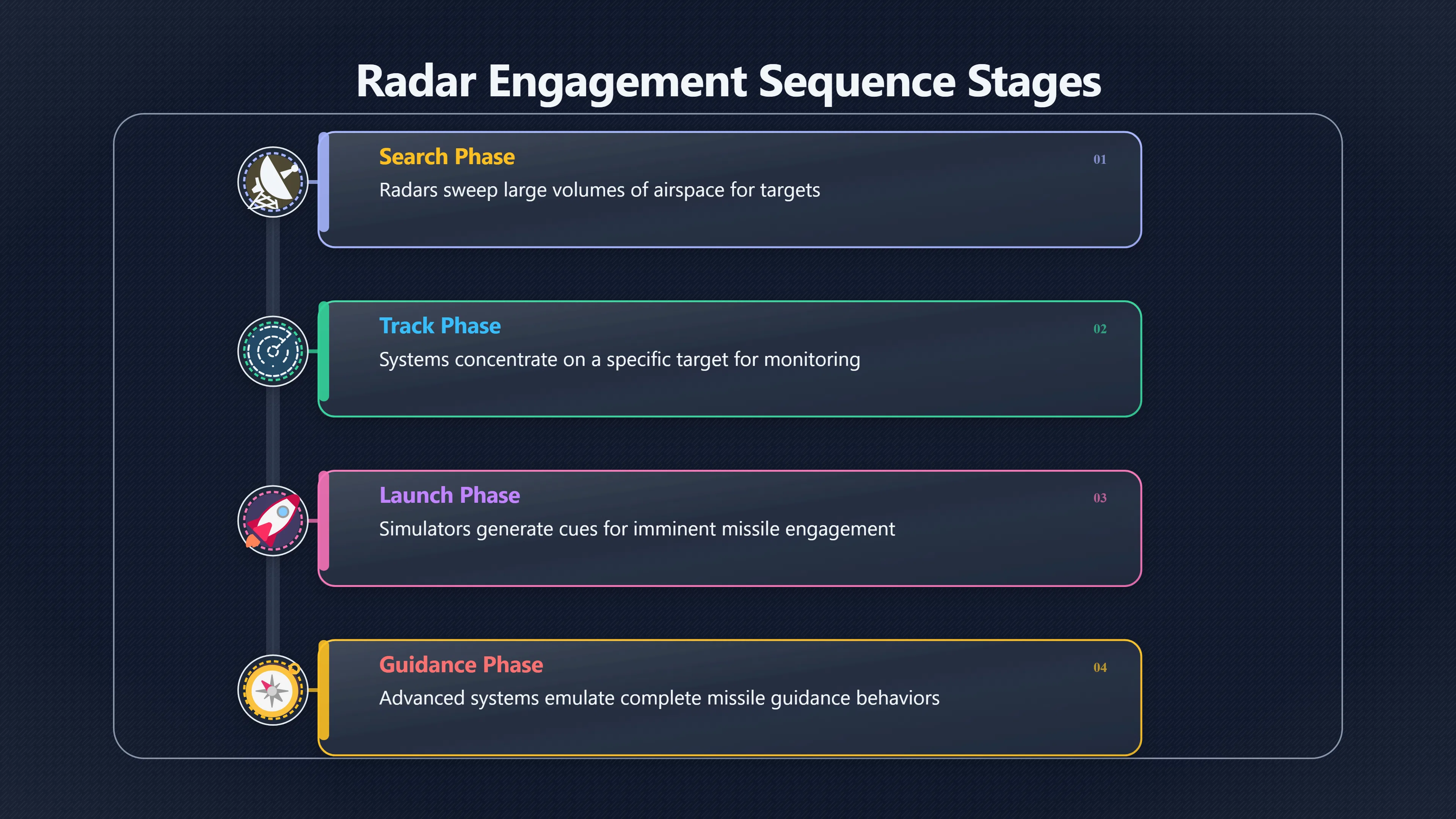
The most important feature of a realistic radar emitter is its ability to move through the same stages that a genuine air-defence radar would use.
The search phase
Search radars typically sweep large volumes of airspace. To the pilot, this often appears as a lower-priority warning indicating surveillance rather than immediate danger. The purpose of training at this stage is not simply detection but interpretation. Aircrew must learn when a search radar can be ignored and when it signals the presence of a larger integrated air-defence network.[Wikipedia]WikipediaRadar warning receiverRadar warning receiver
Threat simulators therefore reproduce scan patterns and surveillance behaviours rather than emitting a constant signal. This allows crews to practise threat recognition under realistic conditions.[Sigma Defense]sigmadefense.comSigma DefenseRadar Threat SimulatorsSigma Defense delivers high-fidelity radar threat simulators, replicating adversary systems & RF envi…

The track phase
Once a threat radar shifts into tracking mode, the aircraft’s warning systems usually display a more urgent indication. The radar is no longer searching broadly; it is concentrating on a specific target. Pilots must decide whether to manoeuvre, deploy countermeasures, attack the radar site or continue the mission.[Wikipedia]WikipediaRadar warning receiverRadar warning receiver
Because this transition is critical, threat simulators devote considerable effort to reproducing tracking behaviour accurately. Historical US Air Force systems such as the Multiple Threat Emitter System were specifically intended to replicate tracking and acquisition radars from foreign surface-to-air missile networks.[U.S. Department of War]media.defense.govDepartment of WarDoD Management of Electronic Warfare Threat Simulators…March 9, 2015 — 15 Jul 1992 — This Air Force system can replic…
The launch phase
The moment a crew believes a missile engagement may be occurring is where training realism matters most. Modern threat simulators are designed to generate engagement scenarios, including launch-related cues and guidance behaviours, so that aircraft sensors and pilots respond as they would in combat. Portable Range Threat Simulators used on military ranges are explicitly described as generating search, track and launch scenarios, while other advanced systems emulate the entire engagement cycle from acquisition through missile guidance.[Textron Systems]textronsystems.comTextron SystemsPortable Range Threat SimulatorsThe Portable Range Threat Simulator (PRTS) is a modular, affordable, transportable medium…
This sequence teaches what might be called the “right fear”: not panic, but an instinctive understanding of when a threat has moved from observation to imminent attack.
Why timing matters more than appearance
A common misunderstanding is that realism comes primarily from reproducing the exact hardware of a foreign radar. For training purposes, timing is often more important.
Pilots make decisions within seconds. If a simulated threat enters tracking mode too early, too late or for the wrong duration, crews learn incorrect habits. They may deploy countermeasures prematurely, delay evasive manoeuvres or misunderstand the behaviour of a genuine threat system. The simulator’s value lies in reproducing the temporal rhythm of an engagement rather than the physical appearance of the radar vehicle.[Sigma Defense]sigmadefense.comSigma DefenseRadar Threat SimulatorsSigma Defense delivers high-fidelity radar threat simulators, replicating adversary systems & RF envi…
This is why advanced systems increasingly focus on detailed waveform generation and behavioural modelling. Modern threat emulators are marketed on their ability to reproduce antenna scans, emitter characteristics, platform motion and complete engagement cycles rather than on any visual resemblance to foreign equipment.[D-TA]d-ta.comEW Threat EmulationD-TA's EW Threat Emulation products are active RF solutions used to provide testing and training of passive emitte…
A pilot never sees most hostile radars directly. The pilot sees warnings, symbols, tones and threat classifications. Training realism therefore depends on reproducing those perceptions accurately.
Training mistakes caused by bad signals
Poor threat simulation can create dangerous lessons.
One failure mode is under-training. If a simulator does not generate signals accurately enough to trigger aircraft warning systems, pilots may underestimate the threat posed by real adversary radars. The first realistic warning sequence they experience could then occur in combat rather than training.[Georgia Tech Research Institute]gtri.gatech.eduadvanced radar threat system helps aircrews train evade enemy missilesGeorgia Tech Research InstituteAdvanced Radar Threat System Helps Aircrews Train to…18 Sept 2023 — A 142-ton threat simulator system t…
Another problem is over-training. A badly modelled simulator may produce warnings that occur more frequently, more predictably or more dramatically than those generated by the actual threat. Pilots can develop habits tailored to the training range rather than to real-world conditions.[Rohde & Schwarz]rohde-schwarz.comRohde & SchwarzThreat Simulation and Verification for Radar Warning…This application note belongs to a series of application notes whi…
A third risk involves threat identification. Modern RWRs classify emitters based on signal characteristics. If the simulator’s waveform differs significantly from the foreign radar it represents, crews may learn incorrect associations between warning symbols and threat types. As airborne electronic-warfare systems become more sophisticated, accurate emitter identification becomes increasingly important for survivability.[ResearchGate]researchgate.netEffective RWR systems accurately identify radar emitters in complex…Read more…
These concerns explain why military organisations continue to invest in increasingly realistic radar emitters. Official descriptions of range threat simulators emphasise full-threat modulation, simultaneous engagements and free-space emulation of threat radar signals precisely because crews must learn to respond to authentic warning patterns rather than simplified approximations.[Dote]dote.osd.milWarfighter TrainingThey are designed to provide free-space emulation of threat radar signals and can generate full-threat modulations…
When a fake radar feels real enough
The most successful threat emitter is one that disappears into the training experience. The pilot does not think about the simulator itself. Instead, the aircraft’s sensors detect a familiar sequence: surveillance, tracking, engagement. Warning tones change, symbols shift priority, and decisions must be made under pressure.
That is the practical value of reverse-engineered radar knowledge. Intelligence about foreign emitters is transformed into a training environment where crews repeatedly experience the same cues they would encounter against real air-defence systems. When the warning receiver reacts correctly and the pilot’s instincts are tested at the right moment, the simulator has achieved its purpose. It has taught the right fear without requiring a real enemy radar on the range.[eviden.com]eviden.comlator was central to the NATO Tactical Leadership Program exercise…Read more…
Amazon book picks
Further Reading
Books and field guides related to When a fake radar feels real enough. Use these as the next step if you want deeper reading beyond the article.

The Pentagon's Brain: An Uncensored History of DARPA, America...
Discusses defense research supporting realistic training systems.
eBay marketplace picks
Marketplace Samples
Live-tested eBay searches with available results related to this page.
Endnotes
1.
Source: media.defense.gov
Link:https://media.defense.gov/1992/Jul/15/2001714601/-1/-1/1/92-125.pdf
Source snippet
Department of WarDoD Management of Electronic Warfare Threat Simulators...March 9, 2015 — 15 Jul 1992 — This Air Force system can replic...
Published: March 9, 2015
2.
Source: d-ta.com
Link:https://www.d-ta.com/ew-threat-emulation-mrse/
Source snippet
EW Threat EmulationD-TA's EW Threat Emulation products are active RF solutions used to provide testing and training of passive emitte...
3.
Source: Wikipedia
Title: Radar warning receiver
Link:https://en.wikipedia.org/wiki/Radar_warning_receiver
4.
Source: researchgate.net
Link:https://www.researchgate.net/publication/398009719_Cognitive_Electronic_Warfare_Application_to_Emitter_Identification_Process_in_Airborne_Radar_Warning_Receiver_Systems
Source snippet
Effective RWR systems accurately identify radar emitters in complex...Read more...
5.
Source: Wikipedia
Title: AN/ALR-67 radar warning receiver
Link:https://en.wikipedia.org/wiki/AN/ALR-67_radar_warning_receiver
6.
Source: eviden.com
Link:https://eviden.com/insights/press-releases/the-eviden-developed-arpege-surface-to-air-radar-threat-simulation-system-deployed-during-a-nato-air-force-training-exercise/
Source snippet
lator was central to the NATO Tactical Leadership Program exercise...Read more...
7.
Source: dote.osd.mil
Link:https://www.dote.osd.mil/About/Organization/CCM/Warfighter-Training/
Source snippet
Warfighter TrainingThey are designed to provide free-space emulation of threat radar signals and can generate full-threat modulations...
8.
Source: rohde-schwarz.com
Link:https://www.rohde-schwarz.com/us/applications/threat-simulation-and-verification-for-radar-warning-receiver-testing_56280-1050304.html
Source snippet
Rohde & SchwarzThreat Simulation and Verification for Radar Warning...This application note belongs to a series of application notes whi...
9.
Source: taborelec.com
Title: Radar Threat Simulator
Link:https://www.taborelec.com/Radar-Threat-Simulator
Source snippet
Tabor ElectronicsRadar & Threat SimulatorTSIM948xD 2/4 Channel Threat Simulator The TSIM9482/4 is a compact bench threat simulator capabl...
10.
Source: sigmadefense.com
Link:https://sigmadefense.com/capabilities/radar-threat-simulators/
Source snippet
Sigma DefenseRadar Threat SimulatorsSigma Defense delivers high-fidelity radar threat simulators, replicating adversary systems & RF envi...
11.
Source: textronsystems.com
Link:https://www.textronsystems.com/products/portable-range-threat-simulators
Source snippet
Textron SystemsPortable Range Threat SimulatorsThe Portable Range Threat Simulator (PRTS) is a modular, affordable, transportable medium...
12.
Source: gtri.gatech.edu
Title: advanced radar threat system helps aircrews train evade enemy missiles
Link:https://www.gtri.gatech.edu/newsroom/advanced-radar-threat-system-helps-aircrews-train-evade-enemy-missiles
Source snippet
Georgia Tech Research InstituteAdvanced Radar Threat System Helps Aircrews Train to...18 Sept 2023 — A 142-ton threat simulator system t...
13.
Source: textronsystems.com
Link:https://www.textronsystems.com/sites/default/files/_[documents
Source snippet
TEST, TRAINING & SIMULATIONThe Model 527 radar signal simulator is a handheld, portable device designed to determine the status of electr...
Additional References
14.
Source: leonardodrs.com
Link:https://www.leonardodrs.com/what-we-do/products-and-services/electronic-warfare-ew-threat-simulators/
Source snippet
Electronic Warfare (EW) Threat SimulatorsEW Threat Simulators prepare combat pilots for missile threats. Our EW threat simulators provide...
15.
Source: facebook.com
Link:https://www.facebook.com/MalaysiaMilitaryPower/posts/mrtes-mobile-radar-threat-emitter-simulator/3517468661609458/
Source snippet
MRTES (Mobile Radar Threat Emitter Simulator)Radar warning receiver systems detect and classify radar signals to issue warnings of potent...
16.
Source: mobileradar.org
Link:https://www.mobileradar.org/Documents/threatradar.pdf
Source snippet
Threat Radar SimulatorsDRS Training &. Control Systems offers an extensive line of practical, effective threat radar simulators for use o...
17.
Source: imlive.s3.amazonaws.com
Title: Required Capabilities Statement.docx E W Threat Systems
Link:https://imlive.s3.amazonaws.com/Federal%20Government/ID139729823678281330724349303823812233755/Required%20Capabilities%20Statement.docx
Source snippet
AN/MPS-14 Early Warning Height-Finder Radar Simulator. EW Threat Systems. AN/MPS-38 GCI Early Warning Search Radar Simulator. EW Threat...
18.
Source: instagram.com
Link:https://www.instagram.com/reel/DVv82SgjuRx/
Source snippet
equency, radar system, and GPS signal across a 100-kilometer radius...
19.
Source: patreon.com
Link:https://www.patreon.com/posts/cyrillic-101-for-141097668
Source snippet
Cyrillic-101 for DCS MiG-29 Pilots - SPO-15 LM Radar...13 Oct 2025 — As you've seen it in Wags' video, the SPO-15LM radar warning receiv...
20.
Source: youtube.com
Title: The specialist RAF ‘enemy’ unit using Soviet-era missile systems
Link:https://www.youtube.com/watch?v=283UtUzEEmk
Source snippet
Simulation of training with Astor IV - EW jammer system...
21.
Source: youtube.com
Link:https://www.youtube.com/watch?v=fl3Zv6D0Fw0
Source snippet
The specialist RAF 'enemy' unit using Soviet-era missile systems...
22.
Source: youtube.com
Title: Simulation of training with Astor IV
Link:https://www.youtube.com/watch?v=sBg7In6yXJ4
Source snippet
AI in Combat A New Era of Radar Warning and Electronic Warfare...
23.
Source: youtube.com
Title: Joint Threat Emitter
Link:https://www.youtube.com/watch?v=mPztkg0kKAk
Source snippet
Low Cost Threat Emitter Replication for Spark Tank 2020...
Topic Tree