Within Ethics
The Cost of Recruiting Enemy Scientists
Operation Paperclip shows how captured expertise can accelerate weapons programmes while burying responsibility for wartime abuses.
On this page
- Why captured expertise became strategically valuable
- How secrecy complicated accountability
- What Paperclip teaches about ethical red lines
Page outline Jump by section
Introduction
Operation Paperclip remains one of the clearest examples of the ethical tensions involved in exploiting captured military knowledge. After the Second World War, the United States secretly recruited more than 1,600 German scientists, engineers and technicians, many of whom had worked on advanced military programmes for Nazi Germany. American officials believed these specialists could accelerate missile, aerospace and weapons development while preventing their expertise from benefiting the Soviet Union. At the same time, many recruits had been members of Nazi organisations, and some were connected to programmes that relied on forced labour or other wartime abuses. The result was a lasting tradeoff between strategic advantage and accountability: the United States gained valuable technical expertise, but critics argue that the programme weakened efforts to confront responsibility for crimes committed during the war.[wikipedia.org]WikipediaOperation PaperclipOperation Paperclip
Why Captured Expertise Became Strategically Valuable
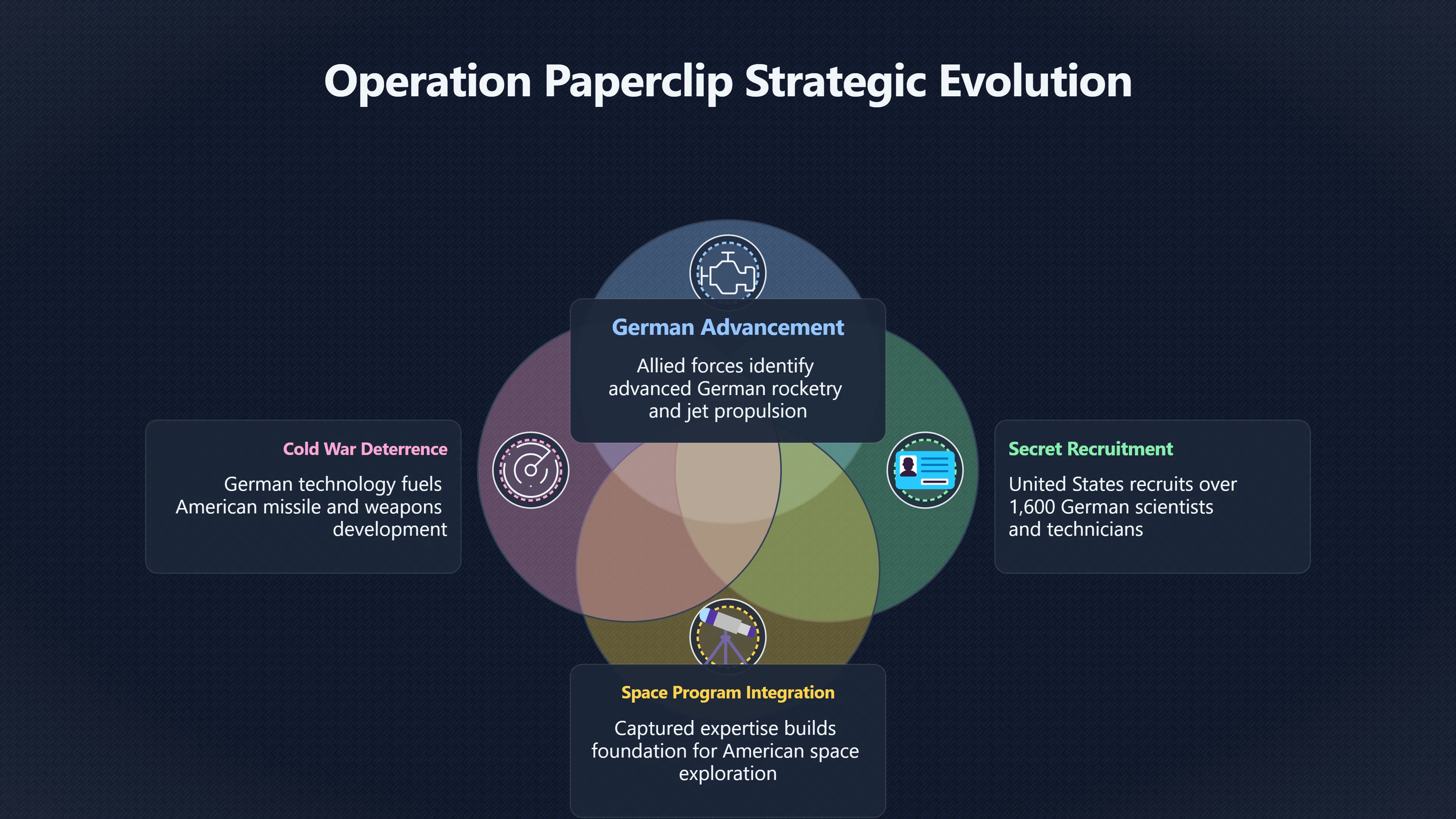
Operation Paperclip emerged from a postwar scramble for military and scientific advantage. Allied forces discovered that Germany possessed advanced capabilities in areas such as rocketry, jet propulsion, aeronautics and military medicine. American planners feared that if these specialists were not secured quickly, they might be recruited by rival powers, particularly the Soviet Union. The programme therefore shifted from simple interrogation of captured experts to long-term employment within the United States.[wikipedia.org]WikipediaOperation PaperclipOperation Paperclip
The most famous example was Wernher von Braun and his rocket team from Peenemünde. Their expertise contributed first to American missile programmes and later to the development of launch vehicles used in the US space programme. From a purely strategic perspective, Paperclip appeared highly successful: expertise originally developed for German military purposes became part of the technological foundation of Cold War deterrence and space exploration.[nasa.gov]nasa.govwernher von braunWernher von Braun6 Feb 2024 — Dr. Wernher von Braun (1912–1977) was one of the most important rocket developers and champions of spac…
For policymakers focused on national security, the calculation seemed straightforward. Captured knowledge was viewed not merely as information contained in documents or hardware but as knowledge embedded in people. Reverse engineering a weapon can reveal how it works; recruiting its designers can dramatically shorten development timelines. Operation Paperclip demonstrated the perceived value of acquiring human expertise alongside captured technology.[Wikipedia]WikipediaOperation PaperclipOperation Paperclip
How Secrecy Complicated Accountability
The ethical controversy surrounding Paperclip stems less from the recruitment itself than from how it was carried out. Official policy initially excluded individuals with significant Nazi affiliations, yet many recruited scientists had belonged to the Nazi Party, the SS or related organisations. Historical records released decades later indicate that American officials often faced pressure to reconcile these disqualifying backgrounds with strategic objectives.[archives.gov]archives.govNational ArchivesImplementation of the Nazi War Crimes Disclosure ActThe JIOA needed presidential authority because so many of the German…
The programme’s secrecy created conditions in which accountability concerns could be minimised. Historians have documented efforts to present certain recruits as politically acceptable candidates despite evidence of deeper involvement with Nazi institutions. Rather than publicly debating whether strategic benefits justified employing such individuals, many decisions occurred within classified bureaucratic processes.[archives.gov]archives.govNational ArchivesImplementation of the Nazi War Crimes Disclosure ActThe JIOA needed presidential authority because so many of the German…
This secrecy mattered because some German military-industrial projects had depended on forced labour. The V-2 rocket programme, for example, relied heavily on labour from the Mittelbau-Dora concentration camp system. While individual levels of responsibility remain debated among historians, the broader moral problem is clearer: technical expertise could not always be separated from the conditions under which it had been produced. When governments prioritised scientific value, questions about complicity and responsibility were often deferred or narrowed.[aljazeera.com]aljazeera.comAl Jazeera Wernher von Braun: History's most controversial figure?Al JazeeraWernher von Braun: History's most controversial figure?May 3, 2013 — That he was responsible for both the deadly Nazi V-2 and N…
The case of Arthur Rudolph illustrates the persistence of these issues. Rudolph became a respected American rocket engineer after the war, yet later investigations into wartime activities linked to the V-2 programme ultimately led him to leave the United States and renounce his citizenship in the 1980s. His case demonstrated that unresolved accountability questions could re-emerge decades after strategic decisions were made.[Los Angeles Times]latimes.comLos Angeles TimesWar Crimes: Arthur Rudolph seeks Canadian vindication…Sep 3, 1990 — Arthur Rudolph seeks Canadian vindication from hi…
The Central Tradeoff: Security Gains Versus Justice
Operation Paperclip forces a difficult question: should a state exploit valuable military expertise if doing so risks weakening accountability for past wrongdoing?
Supporters of the programme have argued that postwar leaders faced an urgent strategic environment. The emerging Cold War created incentives to secure advanced technical knowledge before adversaries could do so. From this perspective, refusing to use German expertise might have imposed real military costs without significantly improving justice outcomes.[wikipedia.org]WikipediaOperation PaperclipOperation Paperclip
Critics respond that this reasoning effectively transformed scientific value into a form of political protection. Individuals who possessed strategically useful knowledge could receive opportunities unavailable to others implicated in the wartime system. The concern is not only that some participants escaped scrutiny, but that governments signalled a willingness to discount ethical considerations when technological advantage appeared sufficiently important.[pbs.org]pbs.orgremembering operation paperclip when national security trumped ethical concernRemembering 'Operation Paperclip,' when national…Mar 31, 2014 — Nazi scientists, some of them tied to war crimes including horrific…
The controversy therefore extends beyond individual scientists. It raises a broader governance question: when a state acquires enemy expertise, can it fairly investigate wrongdoing while simultaneously relying on the same individuals for national security objectives? Operation Paperclip suggests that these goals often pull in opposite directions. The more valuable the expertise becomes, the stronger the incentive to limit scrutiny that might jeopardise access to it.[National Archives]archives.govNational ArchivesImplementation of the Nazi War Crimes Disclosure ActThe JIOA needed presidential authority because so many of the German…
What Paperclip Teaches About Ethical Red Lines
For debates about captured military technology and reverse engineering, Paperclip offers several enduring lessons.
First, technical value does not erase the origins of knowledge. Expertise gained through programmes associated with forced labour, coercion or abuse carries ethical baggage that cannot be removed simply by transferring personnel to a new employer.[PBS]pbs.orgremembering operation paperclip when national security trumped ethical concernRemembering 'Operation Paperclip,' when national…Mar 31, 2014 — Nazi scientists, some of them tied to war crimes including horrific…
Second, secrecy increases the risk that accountability will be subordinated to strategic objectives. When decisions about recruitment, vetting and disclosure occur behind closed doors, external scrutiny becomes difficult and ethical compromises become easier to justify.[National Archives]archives.govNational ArchivesImplementation of the Nazi War Crimes Disclosure ActThe JIOA needed presidential authority because so many of the German…
Third, human expertise requires different safeguards from captured hardware. A missile, aircraft or radar can be studied without granting legal or moral rehabilitation to its designers. Recruiting those designers introduces questions of responsibility, victim recognition and public trust that do not arise from reverse engineering equipment alone.[Wikipedia]WikipediaOperation PaperclipOperation Paperclip
Finally, Paperclip demonstrates that technological success and ethical success are not the same measure. The programme undeniably contributed to important American military and aerospace achievements. Yet its legacy remains controversial precisely because strategic gains were achieved alongside decisions that many observers view as compromises in postwar justice. The case remains a cautionary example of how the pursuit of military advantage can blur ethical boundaries when captured knowledge is embodied in people rather than machines.[nasa.gov]nasa.govwernher von braunWernher von Braun6 Feb 2024 — Dr. Wernher von Braun (1912–1977) was one of the most important rocket developers and champions of spac…

Amazon book picks
Further Reading
Books and field guides related to The Cost of Recruiting Enemy Scientists. Use these as the next step if you want deeper reading beyond the article.
Operation Paperclip
Direct examination of recruiting enemy scientists and accountability tradeoffs.
eBay marketplace picks
Marketplace Samples
Live-tested eBay searches with available results related to this page.

Endnotes
1.
Source: Wikipedia
Title: Operation Paperclip
Link:https://en.wikipedia.org/wiki/Operation_Paperclip
2.
Source: archives.gov
Link:https://www.archives.gov/iwg/reports/nazi-war-crimes-interim-report-october-1999
Source snippet
National ArchivesImplementation of the Nazi War Crimes Disclosure ActThe JIOA needed presidential authority because so many of the German...
3.
Source: history.com
Title: what was operation paperclip
Link:https://www.history.com/articles/what-was-operation-paperclip
Source snippet
What Was Operation Paperclip?2 Jun 2014 — This controversial top-secret US intelligence program brought Nazi German scientists to...
4.
Source: nasa.gov
Title: wernher von braun
Link:https://www.nasa.gov/people/wernher-von-braun/
Source snippet
Wernher von Braun6 Feb 2024 — Dr. Wernher von Braun (1912–1977) was one of the most important rocket developers and champions of spac...
5.
Source: digitalcommons.chapman.edu
Link:https://digitalcommons.chapman.edu/cgi/viewcontent.cgi?article=1050&context=war_and_society_theses
Source snippet
Chapman University Digital CommonsOperation Paperclip and the Use of National Securityby K Hawkins · 2025 — Secret Agenda: The United Sta...
6.
Source: pbs.org
Title: remembering operation paperclip when national security trumped ethical concern
Link:https://www.pbs.org/newshour/show/remembering-operation-paperclip-when-national-security-trumped-ethical-concern
Source snippet
Remembering 'Operation Paperclip,' when national...Mar 31, 2014 — Nazi scientists, some of them tied to war crimes including horrific...
7.
Source: archives.gov
Title: rg 330 defense secretary
Link:https://www.archives.gov/iwg/declassified-records/rg-330-defense-secretary
Source snippet
National ArchivesRecords of the Secretary of Defense (RG 330)11 Oct 2016 — Notice to Researchers in Records Released under the Nazi War C...
8.
Source: youtube.com
Link:https://www.youtube.com/watch?v=lfHjsY_Dtvs
Source snippet
Operation Paperclip - COLD WAR SPECIAL...
9.
Source: youtube.com
Title: Operation Paperclip
Link:https://www.youtube.com/watch?v=17cNgMpBiWw
10.
Source: youtube.com
Title: Operation Paperclip
Link:https://www.youtube.com/watch?v=cm0roxMfBas
11.
Source: airandspace.si.edu
Title: [project paperclip]({{ ‘paperclip/’ | relative_url }}) and american rocketry after world war ii
Link:https://airandspace.si.edu/stories/editorial/project-paperclip-and-american-rocketry-after-world-war-ii
Source snippet
National Air and Space MuseumProject Paperclip and American Rocketry after World War II31 Mar 2023 — Many of Project Paperclip's scientis...
12.
Source: coffeeordie.com
Title: operation paperclip
Link:https://www.coffeeordie.com/article/operation-paperclip
Source snippet
Coffee or DieOperation Paperclip: The Nazis Recruited To Win the Cold...Jun 28, 2023 — At the top of the Osenberg List was Wernher von B...
13.
Source: nationalgeographic.com
Link:https://www.nationalgeographic.com/history/article/operation-paperclip
Source snippet
National GeographicHow Operation Paperclip brought Nazi scientists to the U.S.12 May 2025 — Most scientists were Nazi party members or be...
Published: May 2025
14.
Source: aljazeera.com
Title: Al Jazeera Wernher von Braun: History’s most controversial figure?
Link:https://www.aljazeera.com/opinions/2013/5/3/wernher-von-braun-historys-most-controversial-figure
Source snippet
Al JazeeraWernher von Braun: History's most controversial figure?May 3, 2013 — That he was responsible for both the deadly Nazi V-2 and N...
Published: May 3, 2013
15.
Source: latimes.com
Link:https://www.latimes.com/archives/la-xpm-1990-09-03-vw-1589-story.html
Source snippet
Los Angeles TimesWar Crimes: Arthur Rudolph seeks Canadian vindication...Sep 3, 1990 — Arthur Rudolph seeks Canadian vindication from hi...
Additional References
16.
Source: mjhnyc.org
Title: from wwii to the space race the story of project paperclip
Link:https://mjhnyc.org/events/from-wwii-to-the-space-race-the-story-of-project-paperclip/
Source snippet
Jewish Heritage MuseumFrom WWII to the Space Race: The Story of Project PaperclipBetween 1945 and the 1960s, the United States government...
17.
Source: youtube.com
Title: Operation Paperclip: The Hidden Program That Brought Nazi Scientists to NASA
Link:https://www.youtube.com/watch?v=0SoaehnAqoI
Source snippet
Operation Paperclip's Darkest Secret: The Nazi Rocket Scientist and His Lost Brother...
18.
Source: youtube.com
Title: Operation Paperclip — How America Used Nazi Scientists to Win the Cold War
Link:https://www.youtube.com/watch?v=uAEMLgG4_FM
Source snippet
Operation Paperclip: The Hidden Program That Brought Nazi Scientists to NASA...
19.
Source: etd.ohiolink.edu
Link:https://etd.ohiolink.edu/acprod/odb_etd/ws/send_file/send?accession=bgsu1510914308951993&disposition=inline
Source snippet
OhioLINK ETD Centeroperation paperclip and the contrasting fates ofby A Eldridge-Nelson · 2017 · Cited by 3 — Once von Braun passed, this...
Topic Tree