Within Recovery Teams
When Souvenirs Destroy the Intelligence Story
Pilferage and cannibalisation can erase the markings, accessories and context that make captured materiel valuable.
On this page
- Why soldiers and civilians strip battlefield finds
- What disappears first from valuable materiel
- How guards and collection points preserve context
Page outline Jump by section
Introduction
In the recovery of foreign military technology, one of the simplest threats is often one of the most damaging: people taking pieces of the captured equipment. A battlefield trophy, a useful spare part, a unit badge, a data plate, a sighting device, or even a handful of documents can seem insignificant to the individual who removes it. For technical intelligence specialists, however, those missing items may destroy the ability to identify where the weapon came from, how it was configured, who used it, or what modifications it contained.

Military technical intelligence doctrine has long recognised this problem. Captured enemy materiel is treated as government property and is supposed to be protected from pilferage, cannibalisation, and souvenir hunters until specialists have examined it. The reason is straightforward: reverse engineering depends not only on the main object but also on its markings, accessories, documentation, and surrounding context. Once those disappear, the intelligence story becomes incomplete.[Bits]bits.defm2 22.401(06TECHINTJuly 27, 2006 — 9 Jun 2006 — (1) Exploitation of captured or defecting enemy materiel… States and must be protected from pi…
Why Soldiers and Civilians Strip Battlefield Finds
The impulse to remove items from captured equipment is older than modern intelligence organisations. Troops have collected battlefield souvenirs for centuries, and wartime studies of Allied forces in Europe documented widespread interest in keeping enemy weapons, insignia, flags, and other objects as personal trophies.[OhioLINK ETD Center]etd.ohiolink.eduOhioLINK ETD CenterGIs, Souvenir Hunting, and Looting in Germany, 1945July 20, 2010 — by SA Givens · 2010 · Cited by 6 — Not only was the…
From a technical intelligence perspective, the motives matter less than the consequences. Several pressures encourage stripping:
- Souvenir collecting. Personnel may want a visible reminder of combat success.
- Practical scavenging. Front-line units often need batteries, optics, cables, radios, tools, or vehicle components.
- Battlefield repair. Damaged friendly equipment may be repaired using parts from captured systems.
- Civilian looting. Once an area becomes accessible, civilians may remove valuable metals, electronics, or military memorabilia.
- Media and display pressures. Captured items are sometimes moved, cleaned, repainted, or rearranged for publicity before technical specialists arrive.
The problem is that technical exploitation values different things than battlefield users. A soldier may see a removable sight as a useful spare part. An engineer may see the same sight as evidence of a previously unknown production variant. A civilian may remove a metal identification plate for resale, while analysts need that plate to trace manufacturing origin and production batches.
This creates a recurring conflict between immediate tactical utility and longer-term intelligence value. Technical intelligence organisations therefore treat early security as a collection activity rather than merely a guard duty.[Bits]bits.defm2 22.401(06TECHINTJuly 27, 2006 — 9 Jun 2006 — (1) Exploitation of captured or defecting enemy materiel… States and must be protected from pi…
What Disappears First from Valuable Materiel
Souvenir stripping rarely begins with the largest components. The first losses are usually the very items that provide the richest intelligence.
Identification Plates and Serial Numbers
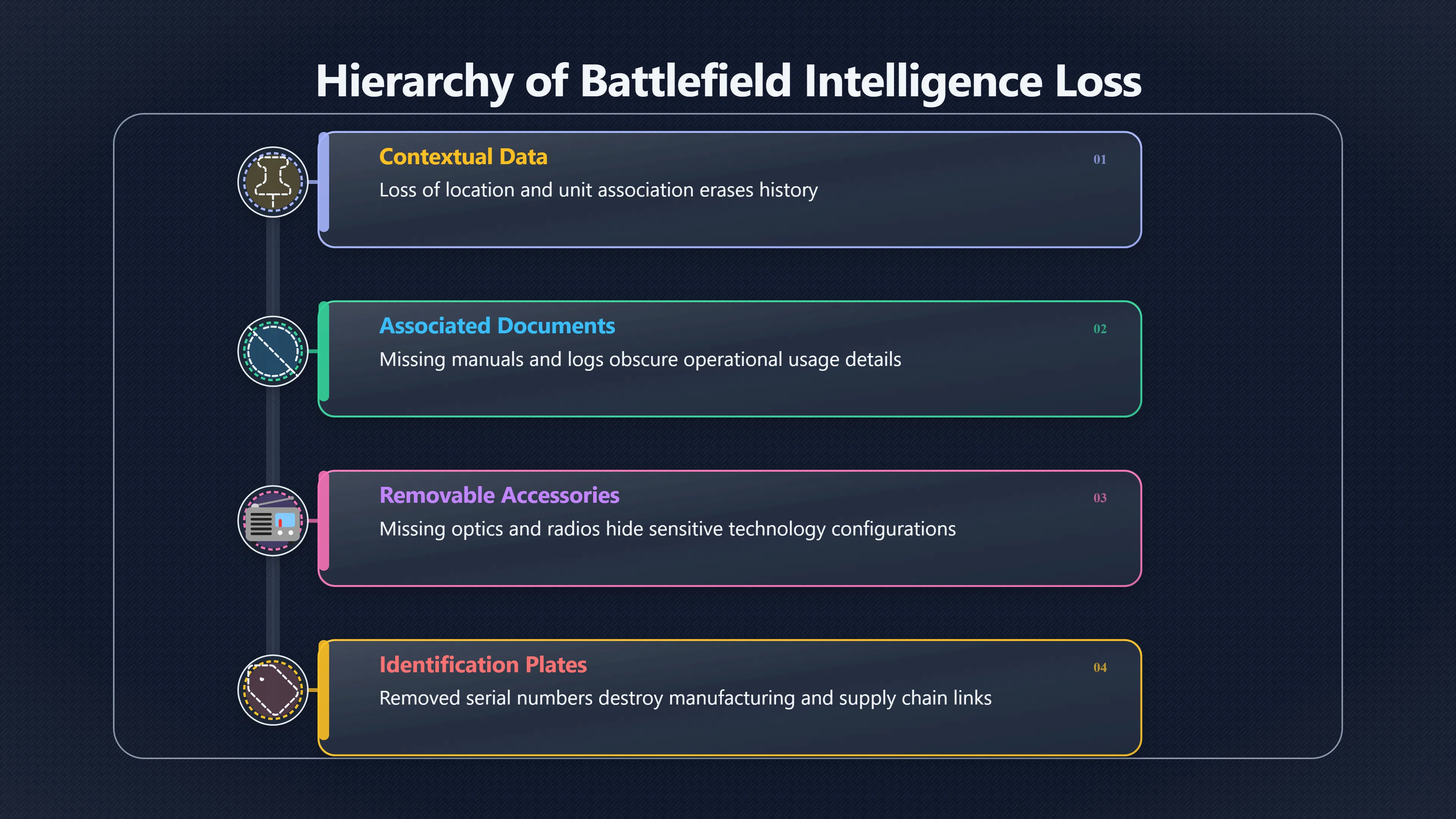
Data plates, serial tags, factory markings, inspection stamps, and production labels are often among the first removable items. Yet these markings can reveal manufacturing plants, production dates, supply chains, export customers, and modification histories.
Historical technical intelligence work frequently relied on such markings. During the Second World War, analysts extracted valuable production information from serial numbers and manufacturing markings found on German equipment and components.[LTC Howard]ltchoward.comLTC HowardTechnical Intelligence Chapter I Hitler Moves West, South, East!By studying the serial numbers and other markings on some 13,00…
When these identifiers disappear, analysts may still possess the weapon itself but lose the ability to place it within a broader industrial and military context.
Optics, Electronics, and Accessories
Removable accessories are especially vulnerable:
- Optical sights.
- Thermal imagers.
- Radios.
- Antennas.
- Batteries.
- Navigation units.
- Data storage devices.
- Cabling and connectors.
These components are attractive because they are portable and often useful. Unfortunately, they are also the parts most likely to contain sensitive technology, software, configuration data, or manufacturing clues.
A recovered missile launcher without its sighting system, or a drone without its payload electronics, may be dramatically less valuable for reverse-engineering purposes.
Documents and Associated Material
Captured equipment is often accompanied by operator manuals, maintenance logs, packing slips, firing tables, checklists, and handwritten notes. Technical intelligence doctrine repeatedly emphasises evacuating such documents together with the equipment whenever possible because they help explain how the system was actually used.[Bits]bits.deFM34 54(1990FM 34-54 BATTLEFIELD TECHNICAL INTELLIGENCE5 Apr 1990 — This field manual describes the Battlefield TECHINr process. Technical docume…
Once separated, the relationship between document and equipment may never be reconstructed with confidence.
The Context Around the Object
Perhaps the most overlooked loss is context.
Moving equipment before documentation can erase evidence about:
- Where it was found.
- Which unit possessed it.
- Nearby ammunition or support equipment.
- Damage patterns.
- Field modifications.
- Storage methods.
- Relationships to other captured items.
Modern exploitation doctrine treats a recovery location much like an evidence scene because context can be as important as the object itself.[National Security Archive]nsarchive2.gwu.eduNational Security Archive Tactical Site Exploitation.pdf• Team leader determines the scope of the exploitation. º Conducts a quick walk-through of the…Read more…
How Guards and Collection Points Preserve Context
The central defence against souvenir stripping is not a sophisticated laboratory procedure. It is disciplined control of the item immediately after capture.
Military technical intelligence guidance places responsibility on commanders to secure captured materiel and prevent unauthorised access until screening has occurred. Commanders are expected to provide adequate security and ensure that items of intelligence value are reported and protected.[Bits]bits.defm2 22.401(06TECHINTJuly 27, 2006 — 9 Jun 2006 — (1) Exploitation of captured or defecting enemy materiel… States and must be protected from pi…
In practice, this usually involves several linked measures.
Establishing a Controlled Perimeter
The first objective is limiting access.
Once a potentially valuable weapon system is identified, recovery personnel attempt to create a secure area around it. The goal is to stop the steady stream of curious visitors, photographers, scavengers, and would-be collectors who can unintentionally alter the find.
Even brief uncontrolled access can result in missing parts that are difficult to notice until much later.
Recording Before Moving
Technical intelligence guidance repeatedly stresses documenting equipment before destruction, abandonment, or evacuation. Recommended information includes photographs, grid coordinates, factory markings, and serial numbers.[Bits]bits.defm2 22.401(06TECHINTJuly 27, 2006 — 9 Jun 2006 — (1) Exploitation of captured or defecting enemy materiel… States and must be protected from pi…
This serves two purposes:
- It preserves evidence if the item later disappears or is damaged.
- It creates a baseline record showing what was originally present.
Once that record exists, analysts can identify whether components vanished during transport or storage.
Maintaining Item Integrity
Collection points and exploitation centres typically try to keep equipment, accessories, and documents together rather than processing them as separate objects.
This may seem obvious, but battlefield logistics naturally push in the opposite direction. A radio may go to communications specialists, documents may travel through intelligence channels, and vehicle components may be removed for transport convenience.
The more fragmentation occurs before screening, the harder reconstruction becomes. Technical intelligence systems therefore emphasise inventory, tagging, logging, and controlled transfer procedures to maintain accountability.[Public Intelligence |]info.publicintelligence.netUSArmy Document Media ExploitationDOMEX process requires understanding collected, exploited, and processed items. CAPTURED ENEMY…Read more…

Treating Captured Materiel as Evidence
A useful comparison is criminal evidence handling.
Document and media exploitation guidance stresses preserving original condition, maintaining accountability, and protecting evidentiary value throughout handling. Similar logic applies to captured weapons and equipment. Every unauthorised removal, modification, cleaning effort, or repair introduces uncertainty into later analysis.[Public Intelligence |]info.publicintelligence.netUSArmy Document Media ExploitationDOMEX process requires understanding collected, exploited, and processed items. CAPTURED ENEMY…Read more…
For reverse engineering, uncertainty is costly. Analysts need confidence that a missing component was absent in enemy service rather than removed after capture.
The Intelligence Cost of “Just One Missing Part”
The most dangerous misconception is that losing a small component has only a small effect.
Technical intelligence often works by connecting many small clues:
- A serial plate identifies a production batch.
- A maintenance log reveals operating history.
- A sighting unit shows a technology upgrade.
- A cable harness indicates integration with another system.
- A field modification reveals battlefield adaptation.
Individually, each item may appear trivial. Together, they allow analysts to understand capability, origin, production trends, and vulnerabilities.
Historical technical intelligence organisations repeatedly warned that souvenir hunting could destroy valuable captured materiel before specialists examined it, a problem recognised from the Second World War through modern technical intelligence doctrine. The recurring lesson is that the intelligence value of a captured weapon is rarely confined to the weapon itself.[DigitalCommons]digitalcommons.unl.eduiIlIt ms. Ord TeCh Intell partioipated in th~ following areas of oombat operations. audia…Read more…
In reverse engineering foreign military technology, protecting captured equipment from souvenir stripping is therefore not an administrative detail. It is a preservation mechanism. The guard standing beside a newly captured missile, drone, radar, or vehicle may be protecting not just a piece of hardware, but the evidence needed to understand an entire weapons system.
Amazon book picks
Further Reading
Books and field guides related to When Souvenirs Destroy the Intelligence Story. Use these as the next step if you want deeper reading beyond the article.
The Monuments Men
Centers on preserving valuable wartime artifacts before they disappear.
Saving Italy
Explores protection of historically important material from loss and looting.
Military Intelligence Blunders
Provides examples where missing information impaired intelligence.
eBay marketplace picks
Marketplace Samples
Live-tested eBay searches with available results related to this page.
Endnotes
1.
Source: bits.de
Title: fm2 22.401(06)
Link:https://www.bits.de/NRANEU/others/amd-us-archive/fm2-22.401%2806%29.pdf
Source snippet
TECHINTJuly 27, 2006 — 9 Jun 2006 — (1) Exploitation of captured or defecting enemy materiel... States and must be protected from pi...
Published: July 27, 2006
2.
Source: bits.de
Title: FM34 54(1990)
Link:https://www.bits.de/NRANEU/others/amd-us-archive/FM34-54%281990%29.pdf
Source snippet
FM 34-54 BATTLEFIELD TECHNICAL INTELLIGENCE5 Apr 1990 — This field manual describes the Battlefield TECHINr process. Technical docume...
3.
Source: etd.ohiolink.edu
Link:https://etd.ohiolink.edu/acprod/odb_etd/ws/send_file/send?accession=ohiou1275450120&disposition=inline
Source snippet
OhioLINK ETD CenterGIs, Souvenir Hunting, and Looting in Germany, 1945July 20, 2010 — by SA Givens · 2010 · Cited by 6 — Not only was the...
Published: July 20, 2010
4.
Source: bits.de
Title: ADRP1 02(16)
Link:https://www.bits.de/NRANEU/others/amd-us-archive/ADRP1-02%2816%29.pdf
Source snippet
ADRP 1-02: Terms and Military Symbols16 Nov 2016 — advantages over the enemy to seize and exploit the initiative. (ADP 3-0) combined arms...
5.
Source: ltchoward.com
Link:https://www.ltchoward.com/tech-intel/howard-tech-intell-01.pdf
Source snippet
LTC HowardTechnical Intelligence Chapter I Hitler Moves West, South, East!By studying the serial numbers and other markings on some 13,00...
6.
Source: digitalcommons.unl.edu
Link:https://digitalcommons.unl.edu/cgi/viewcontent.cgi?article=1057&context=dodmilintel&httpsredir=1&referer=
Source snippet
Field Manual FM 30-16, Technical Intelligence, 26 August 19551955 — Four m:tjor objectives are att:tined by proper in- tell...
7.
Source: nsarchive2.gwu.edu
Title: National Security Archive Tactical Site Exploitation.pdf
Link:https://nsarchive2.gwu.edu/NSAEBB/NSAEBB410/docs/Tactical%20Site%20Exploitation.pdf
Source snippet
• Team leader determines the scope of the exploitation. º Conducts a quick walk-through of the...Read more...
8.
Source: info.publicintelligence.net
Title: USArmy Document Media Exploitation
Link:https://info.publicintelligence.net/USArmy-DocumentMediaExploitation.pdf
Source snippet
DOMEX process requires understanding collected, exploited, and processed items. CAPTURED ENEMY...Read more...
9.
Source: digitalcommons.unl.edu
Link:https://digitalcommons.unl.edu/cgi/viewcontent.cgi?article=1059&context=dodmilintel&httpsredir=1&referer=
Source snippet
iIlIt ms. Ord TeCh Intell partioipated in th~ following areas of oombat operations. audia...Read more...
Additional References
10.
Source: cia.gov
Link:https://www.cia.gov/readingroom/docs/CIA-RDP75-00662R000100130077-6.pdf
Source snippet
MILITARY SECURITY CAPTURED ENEMY MATERIALThrough appropriate channels to theater commanders direct and control the movement of captured e...
11.
Source: researchcentre.army.gov.au
Link:https://researchcentre.army.gov.au/library/australian-army-journal-aaj/volume-9-number-1-autumn/exploitation-intelligence-new-intelligence-discipline
Source snippet
Australian Army Research CentreExploitation Intelligence: A New Intelligence Discipline?Exploitation Intelligence (EXINT): the process by...
12.
Source: reddit.com
Link:https://www.reddit.com/r/Xcom/comments/5poem0/lw2_if_reward_is_enemy_material_you_can_get/
Source snippet
LW2] if reward is "enemy material", you can get corpse in...LW2] if reward is "enemy materiel" in the mission info, you can get corpse i...
13.
Source: date.army.gov.au
Link:https://date.army.gov.au/sites/default/files/2022-08/OPORD%2007%20%28OPERATION%20IRON%20GUARDIAN%29%20CFLCC.pdf
Source snippet
07 (OPERATION IRON GUARDIAN) CFLCCRefer to Appendix 8 (Captured Enemy Equipment (CEE)) of this annex. (3)... CFLCC G-2 establishes GEOIN...
14.
Source: facebook.com
Title: in 1944 and 1945 the us and british armies prepared technical intelligence repor
Link:https://www.facebook.com/TankHistoria/posts/in-1944-and-1945-the-us-and-british-armies-prepared-technical-intelligence-repor/1471650171646326/
Source snippet
In 1944 and 1945, the US and British Armies prepared...Technical intelligence reports prepared by the US and British Armies detailing we...
15.
Source: reddit.com
Link:https://www.reddit.com/r/WarCollege/comments/xbi2xb/what_would_be_the_typical_process_for_the_us/
Source snippet
p the enemy from using it again. b. exploit it if there is...Read more...
16.
Source: home.army.mil
Title: mil F M 3-39 Military Police Operations
Link:https://home.army.mil/wood/application/files/9115/5751/8355/FM_3-39_Military_Police_Operations.pdf
Source snippet
3-39 Military Police Operations - Army Garrisons9 Apr 2019 — enhance the exploitation of captured enemy materiel and evidence gathered, s...
17.
Source: marines.mil
Title: • Collecting and distributing captured enemy supplies.Read more
Link:https://www.marines.mil/Portals/1/Publications/FM%202-22.3%20%20Human%20Intelligence%20Collector%20Operations_1.pdf
Source snippet
FM 2-22.3 Human Intelligence Collector Operations_16 Sept 2006 — Interrogation, the HUMINT subdiscipline responsible for MI exploitation...
18.
Source: scribd.com
Link:https://www.scribd.com/document/2513467/Army-FM2-22x401-Multi-Service-Tactics-Techniques-and-Procedures-for-Technical-Intelligence-Operations
Source snippet
es, and factory markings/serial numbers should be taken...
19.
Source: lieber.westpoint.edu
Title: captured enemy weapons
Link:https://lieber.westpoint.edu/captured-enemy-weapons/
Source snippet
Symposium – Captured Enemy Weapons30 May 2025 — The seizure of weapons from an enemy has long been recognized as lawful in war. Captured...
Published: May 2025
Topic Tree