Within Firmware
Can Operators Change the System in the Field
Update mechanisms can reveal whether equipment is designed for rapid adaptation, strict control, or long-term stability.
On this page
- Update Delivery Methods
- Authentication Controls
- Operational Tradeoffs
Page outline Jump by section
Introduction
When analysts examine software and firmware inside captured military systems, one of the most revealing questions is not simply what code is present, but how that code can be changed. Firmware update mechanisms expose a design philosophy. A system that can be rapidly reprogrammed in the field reflects a different operational doctrine from one that requires depot-level servicing, factory approval or tightly controlled cryptographic authorisation.
For reverse engineering efforts, update paths provide clues about battlefield adaptability, command authority, maintenance practices and cyber-security priorities. Captured firmware, bootloaders, update packages, cryptographic certificates and maintenance interfaces can reveal whether operators are expected to react quickly to new threats, whether commanders can modify behaviour during operations, and how much control manufacturers retain after deployment. In modern military electronics, the update architecture often says as much about operational flexibility as the hardware itself.[army.mil]army.milImproves Software against Electronic Warfare ThreatsArmy Improves Software against Electronic Warfare ThreatsDecember 22, 2016 — 22 Dec 2016 — Proper software updating allows ASE and co…
Can Operators Change the System in the Field?
The ability to alter software after deployment has become increasingly important because modern warfare evolves faster than traditional hardware procurement cycles. Electronic warfare systems, unmanned aircraft, communications equipment and sensor platforms often face new threats long before a new hardware generation can be fielded.
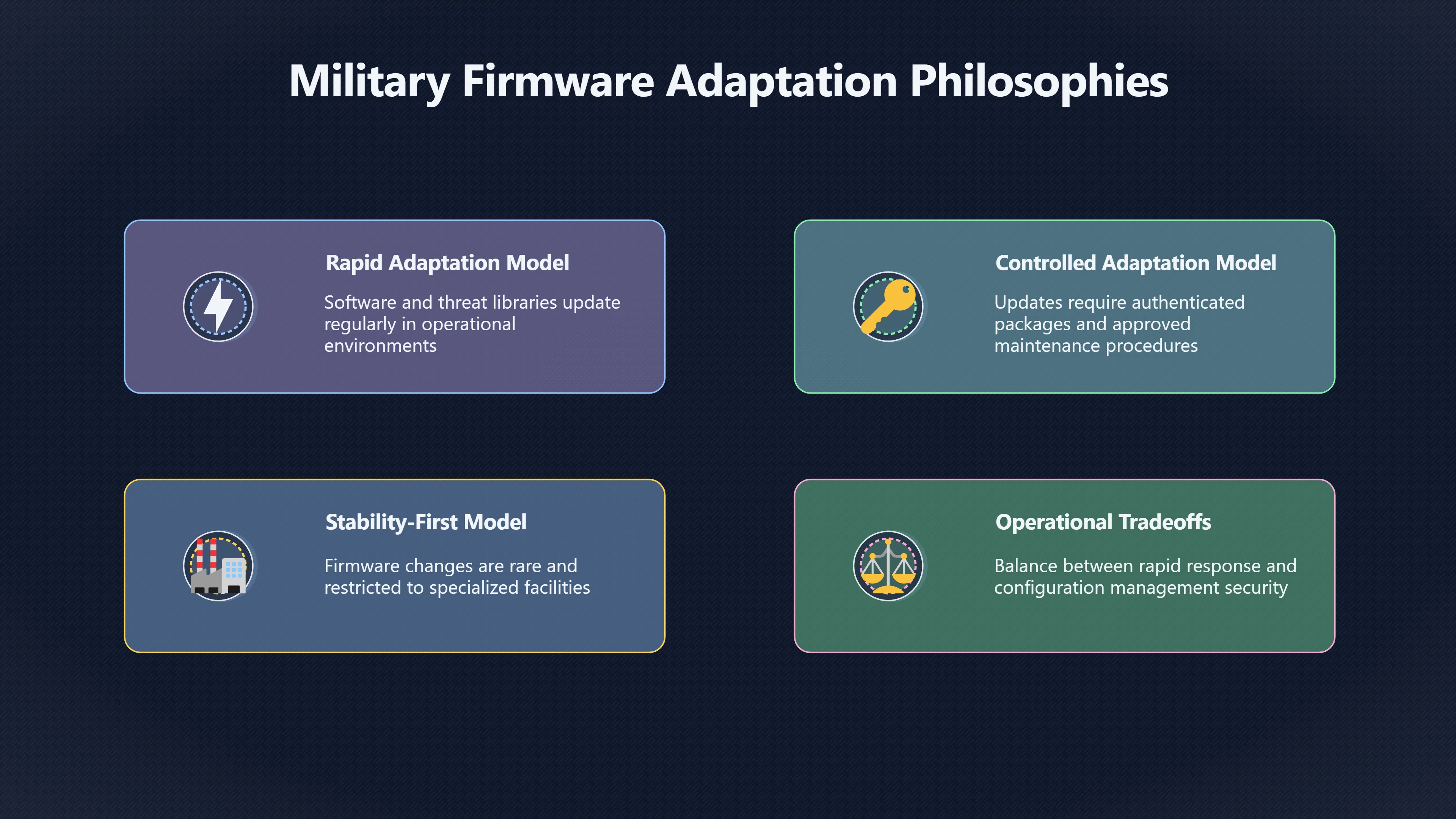
Captured systems frequently reveal one of three broad philosophies:
- Rapid adaptation models, where software and threat libraries can be updated regularly in operational environments.
- Controlled adaptation models, where updates are possible but require authenticated packages, approved maintenance procedures or higher-level authorisation.
- Stability-first models, where firmware changes are rare and intentionally difficult to perform outside specialised facilities.
Each approach reflects a different balance between flexibility and security. A highly adaptable system can respond faster to battlefield changes but creates additional opportunities for cyber intrusion, unauthorised modification or operational mistakes. Conversely, rigid update controls improve configuration management but may slow adaptation when adversaries introduce new tactics or electronic signatures.[nhtsa.gov]nhtsa.govHowever, software update functionality …Read moreNHTSACybersecurity of Firmware UpdatesOctober 9, 2020 — by R Bielawski · 2020 · Cited by 20 — Secure in-field software updates are nearly…
For reverse engineers, discovering which model a captured system follows can help explain how quickly its operator may be able to respond to changing battlefield conditions.
Update Delivery Methods
The delivery mechanism itself can reveal important operational assumptions.
Physical Maintenance Updates
Many military systems still rely on removable media, maintenance laptops or dedicated service interfaces. Such approaches prioritise control and accountability. Updates can be logged, inspected and installed only by authorised personnel.
Captured equipment may expose service connectors, diagnostic ports, maintenance software or update archives that indicate a dependence on formal logistics chains. These systems tend to favour reliability and configuration discipline over speed.
The disadvantage is that units operating far from support infrastructure may be unable to receive rapid capability improvements. A new electronic threat might be identified quickly, but updating deployed equipment could take considerably longer.
Networked and Over-the-Air Updates
More modern architectures increasingly support network-based or over-the-air updates. Secure over-the-air mechanisms allow firmware changes without physical access, making them attractive for distributed sensor networks, unmanned systems and communications equipment. Secure update frameworks typically rely on cryptographic validation, authenticated delivery and rollback protection to prevent malicious code installation.[securebydesignhandbook.com]securebydesignhandbook.comSecure OTA UpdatesA secure Over-the-Air (OTA) update mechanism is the process of delivering new firmware to a device in a way that protec…
For analysts, evidence of network update capabilities can indicate an expectation that systems will evolve continuously during service rather than remain static after deployment.
Mission Data and Threat Library Updates
Not every update changes core firmware. Many military systems rely on configurable mission data files, threat libraries and signal-identification databases.
Electronic warfare equipment provides a prominent example. Radar warning receivers and other spectrum-monitoring systems depend heavily on threat libraries that identify hostile emitters. These libraries often require regular reprogramming as new radar modes and electronic threats emerge. Studies of modern electronic warfare systems emphasise that static threat libraries become less effective as adversaries introduce increasingly agile and adaptive emitters.[cdn.everythingrf.com]cdn.everythingrf.comElectronic WarfareFebruary 25, 2025 — This paper has described the challenges that mode-agile RADAR and EW threat emitters pose to traditional static threa…
In practice, a captured system may reveal that battlefield flexibility comes less from rewriting firmware and more from updating data sets that guide system behaviour.
Authentication Controls
The most important question is often not whether updates are possible, but who is permitted to perform them.
Cryptographic Signing and Secure Boot
Modern secure-update architectures generally depend on cryptographic signatures and secure boot processes. Secure boot ensures that only authenticated firmware is executed, while signed update packages allow systems to verify that new software originated from an authorised source.[meegle.com]meegle.comFirmware Development For Military ApplicationsMilitary firmware must be resilient against cyberattacks, Strategies to enhance secur…
For reverse engineers, recovered certificates, public keys, validation routines and bootloader code are especially valuable. They reveal where authority resides within the update chain and how difficult it would be for an adversary to introduce unauthorised modifications.
Centralised Control Versus Local Authority
Some architectures place update authority almost entirely with the manufacturer or central military organisation. Others delegate portions of that authority to operational units.
A highly centralised model can ensure consistency across an entire force. Every platform receives approved software, reducing fragmentation and compatibility issues. However, this approach can slow adaptation when local commanders encounter unexpected conditions.
More decentralised models allow greater local responsiveness but require stronger safeguards to prevent accidental or malicious modification. Recent secure command-and-control research increasingly combines delegated operational authority with strong authentication and credential management rather than unrestricted local control.[arXiv]arxiv.orgSecure Command, Control and Communications Systems…26 Nov 2025 — This paper designed, implemented, and evaluated a new secure com…
Rollback Protection and Configuration Locking
Captured update mechanisms sometimes reveal protections against loading older software versions. Rollback prevention exists because an outdated version may contain vulnerabilities already corrected in later releases.
Such controls indicate that designers are concerned not only with hostile modification but also with maintaining a controlled operational baseline. Strong rollback protection generally reflects a preference for security and consistency over unrestricted operator flexibility.[researchgate.net]researchgate.netResearchGate(PDF) The Importance of Secure Firmware Updates in…7 Oct 2024 — This paper explores the critical importance of secure firm…
What Update Paths Reveal About Operational Doctrine
Firmware update systems often reflect broader military assumptions.
A force expecting long deployment cycles and stable missions may prioritise reliability, certification and strict change control. Systems built around this philosophy frequently exhibit restrictive update procedures and extensive authentication requirements.
By contrast, forces anticipating rapidly evolving electronic warfare environments often emphasise reprogrammability. The ability to update signal libraries, threat databases and defensive software can become a critical operational capability. The U.S. Army has explicitly highlighted the importance of software updates for electronic warfare and counter-threat systems, noting that updated software allows equipment to identify, classify and counter changing electromagnetic threats.[Army]army.milImproves Software against Electronic Warfare ThreatsArmy Improves Software against Electronic Warfare ThreatsDecember 22, 2016 — 22 Dec 2016 — Proper software updating allows ASE and co…
This distinction is particularly visible in radar warning receivers and electronic support systems. As radar technologies become more agile and adaptive, the value of rapid reprogramming increases because static identification databases can quickly become outdated.[cdn.everythingrf.com]cdn.everythingrf.comElectronic WarfareFebruary 25, 2025 — This paper has described the challenges that mode-agile RADAR and EW threat emitters pose to traditional static threa…
For analysts examining captured equipment, update infrastructure can therefore serve as a proxy indicator of expected operational tempo and adaptation strategy.
Operational Tradeoffs
No update architecture maximises every objective simultaneously.
Highly flexible systems offer:[europeradarwarningreceiver.docs.apiary.io]europeradarwarningreceiver.docs.apiary.ioRadar Warning Receiver Market PDF 2035 Report…A key trend is the increasing adoption of software-defined RWR systems, which offer grea…
- Faster adaptation to emerging threats.
- Quicker deployment of bug fixes and performance improvements.
- Greater responsiveness in electronic warfare environments.
However, they also:
- Expand the attack surface.
- Increase dependency on communications infrastructure.
- Require more sophisticated authentication and monitoring mechanisms.[nhtsa.gov]nhtsa.govHowever, software update functionality …Read moreNHTSACybersecurity of Firmware UpdatesOctober 9, 2020 — by R Bielawski · 2020 · Cited by 20 — Secure in-field software updates are nearly…
Highly controlled systems offer:[europeradarwarningreceiver.docs.apiary.io]europeradarwarningreceiver.docs.apiary.ioRadar Warning Receiver Market PDF 2035 Report…A key trend is the increasing adoption of software-defined RWR systems, which offer grea…
- Stronger configuration management.
- Reduced risk of unauthorised modification.
- Easier certification and accountability.
But they may:
- Adapt more slowly to new threats.
- Depend on formal maintenance chains.
- Limit local commanders’ ability to respond rapidly to changing conditions.[NHTSA]nhtsa.govHowever, software update functionality …Read moreNHTSACybersecurity of Firmware UpdatesOctober 9, 2020 — by R Bielawski · 2020 · Cited by 20 — Secure in-field software updates are nearly…
For reverse engineering teams, understanding these tradeoffs helps transform a captured update package or bootloader from a technical curiosity into evidence about how the system is expected to operate in real combat conditions. The update path is often a window into command authority, cyber-security priorities and battlefield adaptability, making it one of the most informative software features hidden inside modern military technology.
eBay marketplace picks
Marketplace Samples
Live-tested eBay searches with available results related to this page.



Endnotes
1.
Source: army.mil
Title: Improves Software against Electronic Warfare Threats
Link:https://www.army.mil/article/180066/army_improves_software_against_electronic_warfare_threats
Source snippet
Army Improves Software against Electronic Warfare ThreatsDecember 22, 2016 — 22 Dec 2016 — Proper software updating allows ASE and co...
Published: December 22, 2016
2.
Source: meegle.com
Link:https://www.meegle.com/en_us/topics/firmware-development/firmware-development-for-military-applications
Source snippet
Firmware Development For Military ApplicationsMilitary firmware must be resilient against cyberattacks, Strategies to enhance secur...
3.
Source: securebydesignhandbook.com
Link:https://www.securebydesignhandbook.com/docs/implementation/build-phase/ota-updates
Source snippet
Secure OTA UpdatesA secure Over-the-Air (OTA) update mechanism is the process of delivering new firmware to a device in a way that protec...
4.
Source: nhtsa.gov
Link:https://www.nhtsa.gov/sites/nhtsa.gov/files/[documents
Source snippet
Cybersecurity of Firmware UpdatesOctober 9, 2020 — by R Bielawski · 2020 · Cited by 20 — Secure in-field software updates are nearly...
Published: October 9, 2020
5.
Source: winbond.com
Link:https://www.winbond.com/hq/support/online-learning/articles-item/-Reducing-Firmware-Vulnerabilities-Through-Hardware-Enforced-Resilience?__locale=en
Source snippet
s can be patched against emerging threats without requiring physical access...
6.
Source: researchgate.net
Link:https://www.researchgate.net/publication/384687421_The_Importance_of_Secure_Firmware_Updates_in_Maintaining_System_Integrity
Source snippet
ResearchGate(PDF) The Importance of Secure Firmware Updates in...7 Oct 2024 — This paper explores the critical importance of secure firm...
7.
Source: cdn.everythingrf.com
Title: Electronic Warfare
Link:https://cdn.everythingrf.com/live/Electronic_Warfare_eBook_2024_638646752293473148_1_3_638760766145874076.pdf
Source snippet
February 25, 2025 — This paper has described the challenges that mode-agile RADAR and EW threat emitters pose to traditional static threa...
Published: February 25, 2025
8.
Source: arxiv.org
Link:https://arxiv.org/abs/2007.09071
9.
Source: arxiv.org
Link:https://arxiv.org/abs/1807.05002
10.
Source: arxiv.org
Link:https://arxiv.org/html/2511.21936v1
Source snippet
Secure Command, Control and Communications Systems...26 Nov 2025 — This paper designed, implemented, and evaluated a new secure com...
11.
Source: promwad.com
Title: firmware update strategies mission critical
Link:https://promwad.com/news/firmware-update-strategies-mission-critical
Source snippet
Firmware Update Strategies in Mission-Critical Devices6 May 2025 — This article explores modern strategies for secure over-the-air (OTA)...
Published: May 2025
12.
Source: trustedcomputinggroup.org
Title: TCG Secure Update of SW and FW on Devices v1r72 pub
Link:https://trustedcomputinggroup.org/wp-content/uploads/TCG-Secure-Update-of-SW-and-FW-on-Devices-v1r72_pub.pdf
Source snippet
TCG Guidance for Secure Update of Software and...10 Feb 2020 — This section describes and evaluates some other software and firmware upd...
13.
Source: samm.dsca.mil
Title: mil All Updates
Link:https://samm.dsca.mil/all-updates
Source snippet
Updates - Security Assistance Management Manual18 Jun 2026 — This policy memorandum adds guidance into the Security Assistance Management...
Additional References
14.
Source: keysight.com
Link:https://www.keysight.com/de/de/assets/7018-04055/application-notes/5991-2892.pdf
Source snippet
Radar and Electronic Warfare (EW) System TestingLearn the capabilities and benefits of using the SystemVue platform to ensure successful...
15.
Source: whitehouse.gov
Title: promoting advanced artificial intelligence innovation and security
Link:https://www.whitehouse.gov/presidential-actions/2026/06/promoting-advanced-artificial-intelligence-innovation-and-security/
Source snippet
Promoting Advanced Artificial Intelligence Innovation and...2 Jun 2026 — Advanced AI capabilities make our Nation stronger, but also int...
16.
Source: gao.gov
Link:https://www.gao.gov/products/nsiad
Source snippet
e Integrated Electronic Warfare System (INEWS) for the next generation tactical...
17.
Source: troopmessenger.com
Title: secure military communication challenges risks
Link:https://www.troopmessenger.com/blogs/secure-military-communication-challenges-risks
Source snippet
Secure Military Communication Challenges & Risks8 Jan 2026 — Explore how military protected communication systems address growing defence...
18.
Source: aerodefenseinsights.ra6.org
Title: cybersecurity for battlefield iot sensors
Link:https://aerodefenseinsights.ra6.org/cybersecurity-for-battlefield-iot-sensors.htm
Source snippet
For Battlefield IoT Sensors - Aerospace and DefenseBattlefield IoT sensors must be secured with zero trust principles, hardened edge devi...
19.
Source: europeradarwarningreceiver.docs.apiary.io
Link:https://europeradarwarningreceiver.docs.apiary.io/
Source snippet
Radar Warning Receiver Market PDF 2035 Report...A key trend is the increasing adoption of software-defined RWR systems, which offer grea...
20.
Source: l3harris.com
Link:https://www.l3harris.com/what-electronic-warfare
Source snippet
emy radar. The future of U.S. and allied spectrum...Read more...
21.
Source: dowcio.war.gov
Title: MFA U S Do DNetworks
Link:https://dowcio.war.gov/Portals/0/Documents/Library/MFA-U-S-DoDNetworks.pdf
Source snippet
CIO MFA Policy Memorandum1 Dec 2025 — This memorandum establishes DoD non. PKI MF A policy and identifies DoD-approved non-PKI MF As base...
22.
Source: forum.warthunder.com
Title: If new threats have been detected
Link:https://forum.warthunder.com/t/incorrect-threat-library-modeling-for-digital-rwr/183230
Source snippet
threat library modeling for digital RWR9 Nov 2024 — Setting up a threat library, Reprogramming of EID tables and consequently loading of...
23.
Source: coemed.org
Title: AJP 6 EDB V1 E 2525
Link:https://www.coemed.org/files/stanags/01_AJP/AJP-6_EDB_V1_E_2525.pdf
Source snippet
NATO STANDARD AJP-6 ALLIED JOINT DOCTRINE FOR...5 Apr 2024 — AJP-6 is prepared under the direction of the North Atlantic Treaty Organiza...
Topic Tree
Follow this branch
Parent topic
Firmware The Software Hidden Inside WeaponsRelated pages 5
- Debug Access The Hidden Connectors That Give Up Firmware
- Drone Logic What Drone Firmware Reveals About Real Flight Behavior
- Service Data Why Maintenance Records Matter as Much as Code
- Threat Libraries How Threat Libraries Reveal What Systems Recognize
- Threat Modeling Why Real Firmware Makes Better Threat Simulators