Within Radar Signatures
From Captured Pulses to Mission Data
Emitter libraries convert measured radar parameters into mission files that aircraft, jammers and simulators can use in the field.
On this page
- What parametric emitter data contains
- How libraries support identification and reprogramming
- Why updates matter after new captures
Page outline Jump by section
Introduction
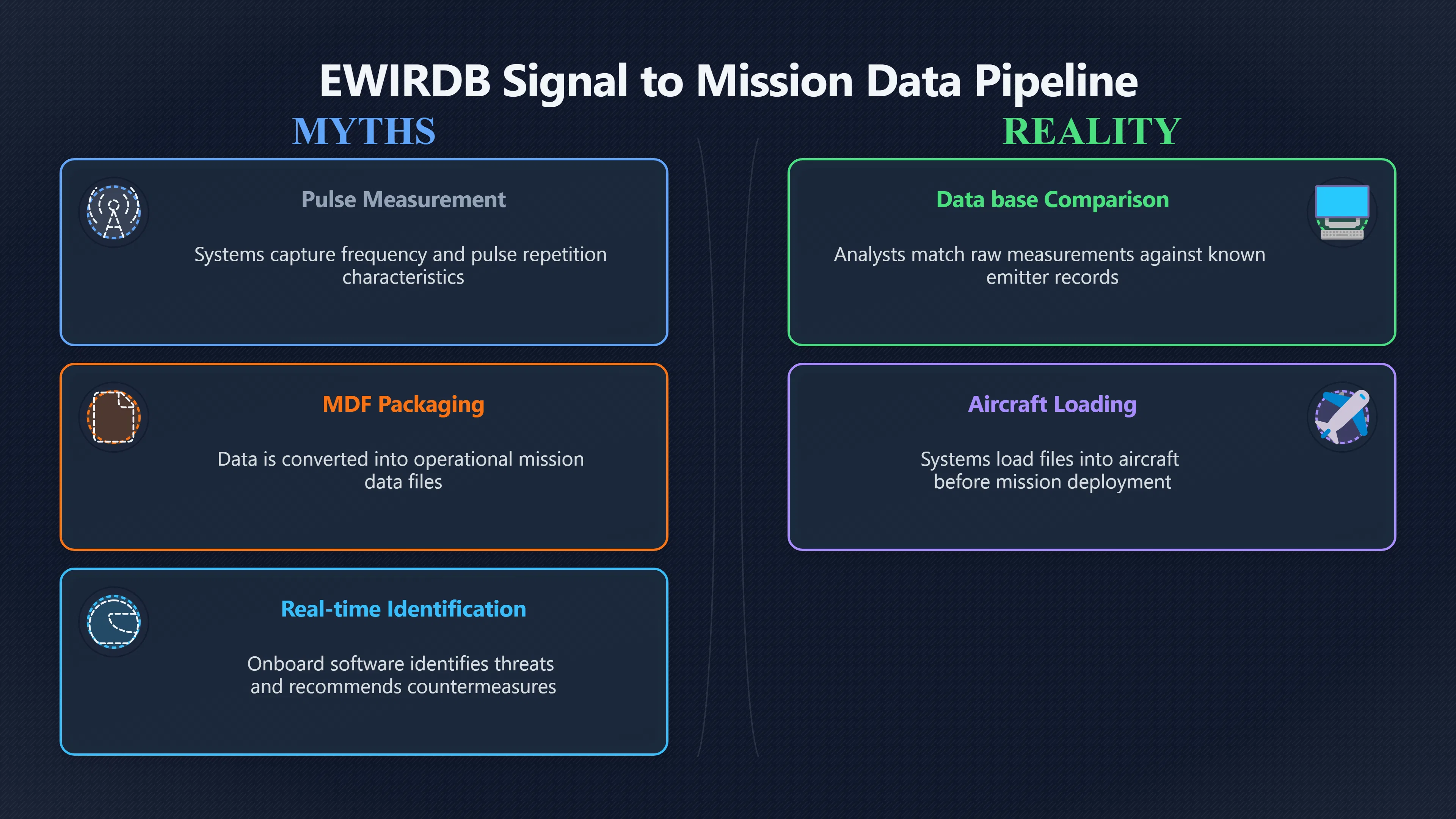
Modern electronic warfare does not rely on pilots, operators or analysts recognising radar signals from memory. Instead, it depends on emitter libraries: curated databases that translate measured radar characteristics into mission data files used by radar warning receivers, jammers, mission-planning systems and simulators. In the context of reverse engineering foreign military technology, the key objective is not merely to capture a radar signal but to convert that signal into a structured description that operational systems can recognise automatically. The result is a chain that begins with intercepted pulses and ends with aircraft identifying threats, selecting countermeasures and updating tactics. The quality of that chain often determines whether a newly discovered foreign radar becomes an actionable operational threat or remains an unidentified signal.[samm.dsca.mil]samm.dsca.mildscaDSCA 10-65 | Defense Security Cooperation Agency16 May 2011 — The EWIRDB is the primary DoD source for technical parametric performance d…
From Pulse Measurements to Emitter Records
A radar warning receiver or electronic-support system first measures observable signal parameters. These typically include carrier frequency, pulse width, pulse repetition characteristics, signal strength, angle of arrival and timing relationships between pulses. Modern systems must also separate overlapping emissions from multiple radars before identification can occur.[ResearchGate]researchgate.netAn Expert System For Threat Analysis In Radar Warning…PDF | Historically threat analysis were carried out through manual a…
Those measurements alone are not mission data. They become useful only after analysts compare them with known emitters and create a structured record describing the radar’s behaviour. Within the electronic warfare community, these records are maintained in specialised databases such as the Electronic Warfare Integrated Reprogramming Database (EWIRDB), which serves as a primary repository of technical emitter characteristics used to generate mission data files.[samm.dsca.mil]samm.dsca.mildscaDSCA 10-65 | Defense Security Cooperation Agency16 May 2011 — The EWIRDB is the primary DoD source for technical parametric performance d…
The process effectively converts raw observations into a digital identity. Rather than storing a simple radar name, libraries store measurable characteristics that allow future systems to recognise the emitter even when operating under different conditions. This approach is particularly important when exploiting foreign equipment because analysts often encounter previously unknown variants, modified export models or radars operating in unexpected modes.[GovTribe]govtribe.comewir pws draft dot pdfEWIR PWS Draft.pdf4 May 2022 — EIMs and EEMs comprise the parametric descriptions of associated emitter signals that are derived…
What Parametric Emitter Data Contains
An emitter library entry is best understood as a technical profile rather than a catalogue label. The database typically records multiple categories of information:
- Signal parameters: frequency ranges, pulse widths, pulse repetition behaviour, modulation methods and timing patterns.
- Emitter identity information: relationships between measured characteristics and specific radar systems, subsystems or variants.
- Mode descriptions: distinctions between search, acquisition, tracking, missile-guidance or other operating states.
- Threat attributes: assessments of the radar’s operational significance and likely role within a larger weapon system.
- Engineering models: representations of how the radar behaves under different operating conditions and environments.[govtribe.com]govtribe.comewir pws draft dot pdfEWIR PWS Draft.pdf4 May 2022 — EIMs and EEMs comprise the parametric descriptions of associated emitter signals that are derived…
The emphasis on parameters rather than names is deliberate. A radar warning receiver does not directly observe a manufacturer’s designation. It observes electromagnetic behaviour. Mission data therefore links behaviour to identity through a database of measurable signatures.[samm.dsca.mil]samm.dsca.milChapter 3Security Assistance Management ManualThe software typically includes a mission data file (MDF) or library that contains information/data…
For advanced systems, entries may contain multiple signatures for the same radar because modern emitters often change waveforms, frequencies or operating modes dynamically. A useful library must capture those variations without generating excessive false identifications.[Northrop Grumman]northropgrumman.comNorthrop GrummanAN/APR-39 Digital Radar Warning Receiver FamilyIncludes a flight line reprogrammable Operational Flight Program and threa…
How Libraries Become Mission Data Files
The crucial transformation occurs when database information is packaged into mission data files (MDFs), threat libraries or equivalent operational data sets. These files are loaded into aircraft and electronic warfare systems before deployment. The mission data file acts as the operational version of the larger intelligence database.[samm.dsca.mil]samm.dsca.mildscaDSCA 10-65 | Defense Security Cooperation Agency16 May 2011 — The EWIRDB is the primary DoD source for technical parametric performance d…
When a radar signal is detected during a mission, onboard software compares measured characteristics against entries stored in the mission data file. If a match is found, the system can:
- Display a threat identity to the crew.
- Prioritise the threat based on danger and proximity.
- Recommend or automatically select countermeasures.
- Support mission planning and route decisions.
- Feed data into wider situational-awareness systems.[afit.edu]scholar.afit.eduAFIT ScholarMachine Learning Application for Mission Data…by PA Bingham · 2021 — a Radar Warning Receiver uses MD to identify a threat…
This conversion from intelligence database to operational file explains why reprogramming organisations occupy a central role in electronic warfare. Intelligence collection alone does not improve battlefield performance. The information must be translated into formats that aircraft and combat systems can use immediately. Recent US Air Force descriptions of spectrum warfare units emphasise rapid mission-data-file reprogramming precisely because mission systems depend on current threat data to identify and counter emitters effectively.[DefenseScoop]defensescoop.comAir Force spectrum wing activates new unit focused on…30 Aug 2023 — The Air Force's 350 th Spectrum Warfare Wing activated…

How Libraries Support Identification and Reprogramming
Emitter libraries enable identification by providing a common reference against which new observations can be compared. Instead of asking whether a detected pulse exactly matches a known radar, modern systems evaluate whether the observed characteristics fit an established emitter model. This allows recognition despite noise, environmental effects or incomplete observations.[ResearchGate]researchgate.netAn Expert System For Threat Analysis In Radar Warning…PDF | Historically threat analysis were carried out through manual a…
Reprogramming occurs when intelligence organisations discover new information that changes those models. New data may come from:
- Signals intelligence collection.
- Captured foreign equipment.
- Laboratory testing.
- Operational encounters.
- Allied intelligence sharing.
- Post-mission analysis.[leidos.com]leidos.comElectronic WarfareWe support the development of NGES, the Next-Generation EW Integrated Reprogramming Database (EWIRDB) System…
Once validated, the updated information is incorporated into the central database and then distributed through revised mission data files. The process allows existing hardware to gain new recognition capabilities without physical modification. Several modern radar warning receiver families explicitly advertise reprogrammable threat libraries because software updates are often more important than hardware changes in maintaining relevance against evolving threats.[Northrop Grumman]northropgrumman.comNorthrop GrummanAN/APR-39 Digital Radar Warning Receiver FamilyIncludes a flight line reprogrammable Operational Flight Program and threa…
Why Updates Matter After New Captures
The value of a newly captured radar extends far beyond technical curiosity. Exploitation can reveal operating modes, waveform variations and emitter behaviours that were not visible through routine interception. Those discoveries frequently expose gaps in existing emitter libraries.[Leidos]leidos.comElectronic WarfareWe support the development of NGES, the Next-Generation EW Integrated Reprogramming Database (EWIRDB) System…
A library built from incomplete observations may recognise a radar only in one mode while misclassifying it in another. Captured equipment allows analysts to observe behaviour systematically, improving the fidelity of emitter models and reducing ambiguity. The resulting updates can then be pushed into mission data files across multiple platforms.[GovTribe]govtribe.comewir pws draft dot pdfEWIR PWS Draft.pdf4 May 2022 — EIMs and EEMs comprise the parametric descriptions of associated emitter signals that are derived…
Updates are also essential because adversaries modify systems. Software revisions, new operating modes and altered waveforms can make previously accurate library entries obsolete. Electronic warfare organisations therefore treat emitter databases as living repositories rather than static reference works. The operational requirement for rapid reprogramming reflects the reality that radar signatures evolve over time and that recognition systems must evolve with them.[defensescoop.com]defensescoop.comAir Force spectrum wing activates new unit focused on…30 Aug 2023 — The Air Force's 350 th Spectrum Warfare Wing activated…
Why Governance Matters as Much as Technology
Emitter libraries are not merely technical products; they are controlled intelligence assets. Mission data files derived from databases such as EWIRDB are subject to strict release, certification and protection requirements because they encode sensitive knowledge about foreign emitters and friendly recognition capabilities. Official guidance treats the database and its derivative mission files as controlled resources whose distribution requires approval and oversight.[samm.dsca.mil]samm.dsca.mildscaDSCA 10-65 | Defense Security Cooperation Agency16 May 2011 — The EWIRDB is the primary DoD source for technical parametric performance d…
This governance layer is significant because the effectiveness of electronic warfare increasingly depends on shared, trusted and rapidly updated threat knowledge. A captured radar becomes operationally useful only when its characteristics are analysed, entered into authoritative databases, validated through reprogramming processes and distributed to fielded systems. The strategic advantage lies not simply in collecting signals, but in maintaining the institutional machinery that turns those signals into mission-ready data.[dsca.mil]samm.dsca.mildscaDSCA 10-65 | Defense Security Cooperation Agency16 May 2011 — The EWIRDB is the primary DoD source for technical parametric performance d…
Amazon book picks
Further Reading
Books and field guides related to From Captured Pulses to Mission Data. Use these as the next step if you want deeper reading beyond the article.
Introduction to Airborne Radar
Explains radar signal characteristics that become parametric emitter data.
EW 102
Goes deeper into practical EW concepts useful for mission-data and signal-library thinking.
Electronic Warfare and Radar Systems Engineering Handbook
Contains applied EW and radar engineering material aligned with emitter libraries and reprogramming.
Radar Handbook
Provides technical grounding for radar waveforms, parameters and system classification.
eBay marketplace picks
Marketplace Samples
Live-tested eBay searches with available results related to this page.


Endnotes
1.
Source: samm.dsca.mil
Title: dsca 10 65
Link:https://samm.dsca.mil/policy-memoranda/dsca
Source snippet
DSCA 10-65 | Defense Security Cooperation Agency16 May 2011 — The EWIRDB is the primary DoD source for technical parametric performance d...
Published: May 2011
2.
Source: samm.dsca.mil
Title: Chapter 3
Link:https://samm.dsca.mil/chapter/chapter-3
Source snippet
Security Assistance Management ManualThe software typically includes a mission data file (MDF) or library that contains information/data...
3.
Source: researchgate.net
Link:https://www.researchgate.net/publication/265918287_An_Expert_System_For_Threat_Analysis_In_Radar_Warning_Receivers
Source snippet
An Expert System For Threat Analysis In Radar Warning...PDF | Historically threat analysis were carried out through manual a...
4.
Source: leidos.com
Link:https://www.leidos.com/capabilities/cyber/electronic-warfare
Source snippet
Electronic WarfareWe support the development of NGES, the Next-Generation EW Integrated Reprogramming Database (EWIRDB) System...
5.
Source: govtribe.com
Title: ewir pws draft dot pdf
Link:https://govtribe.com/file/government-file/ewir-pws-draft-dot-pdf
Source snippet
EWIR PWS Draft.pdf4 May 2022 — EIMs and EEMs comprise the parametric descriptions of associated emitter signals that are derived...
Published: May 2022
6.
Source: scholar.afit.edu
Link:https://scholar.afit.edu/cgi/viewcontent.cgi?article=6111&context=etd
Source snippet
AFIT ScholarMachine Learning Application for Mission Data...by PA Bingham · 2021 — a Radar Warning Receiver uses MD to identify a threat...
7.
Source: defensescoop.com
Link:https://defensescoop.com/2023/08/30/air-force-spectrum-wing-activates-new-unit-focused-on-reprogramming-mission-data-files/
Source snippet
Air Force spectrum wing activates new unit focused on...30 Aug 2023 — The Air Force's 350 th Spectrum Warfare Wing activated...
8.
Source: rfpdb.com
Link:https://www.rfpdb.com/view/document/name/SOURCES-SOUGHT-NOTICE-_-Electronic-Warfare-Integrated-Reprogramming-%28EWIR%29-Analysis%2C-Production-and-Process-Support_W911W5_16_R_0001
Source snippet
process support to the Technical Electronic Intelligence (TechELINT) Branch...Read more...
9.
Source: srcinc.com
Link:https://www.srcinc.com/services/intel-analysis-and-production/ewirdb.html
Source snippet
EWIRDBRapid reprogramming of systems through the development of mission data sets; Production of the threat data source for mission plann...
10.
Source: srcinc.com
Title: Electronic Warfare
Link:https://www.srcinc.com/innovation/electronic-warfare-mission-intelligence-engineering.html
Source snippet
Mission Intelligence and EngineeringThe EW data and systems produced by SRC provide electromagnetic spectrum superiority to help keep our...
11.
Source: Wikipedia
Title: Radar warning receiver
Link:https://en.wikipedia.org/wiki/Radar_warning_receiver
12.
Source: northropgrumman.com
Link:https://www.northropgrumman.com/what-we-do/mission-solutions/radars/an-apr-39-digital-radar-warning-receiver-family
Source snippet
Northrop GrummanAN/APR-39 Digital Radar Warning Receiver FamilyIncludes a flight line reprogrammable Operational Flight Program and threa...
Additional References
13.
Source: lockheedmartin.com
Link:https://www.lockheedmartin.com/content/dam/lockheed-martin/rms/[documents
Source snippet
AN/APR-52(V)1The AN/APR-52(V)1 ESM/RWR system performs concurrent situational awareness and threat warning functions to provide early aud...
14.
Source: forum.warthunder.com
Title: incorrect threat library modeling for digital rwr
Link:https://forum.warthunder.com/t/incorrect-threat-library-modeling-for-digital-rwr/183230
Source snippet
threat library modeling for digital RWR9 Nov 2024 — Digital RWR systems use antenna receivers to detect threats, Reprogramming of EID tab...
15.
Source: strategicmarketresearch.com
Link:https://www.strategicmarketresearch.com/market-report/radar-warning-receiver-market
Source snippet
efense agencies to update radar detection capabilities as new threats emerge...
16.
Source: intelligencecommunitynews.com
Title: ngic posts draft ewir solicitation
Link:https://intelligencecommunitynews.com/ngic-posts-draft-ewir-solicitation/
Source snippet
15 June 2016 — During the contract period, NGIC personnel will identify Electronic Warfare Integrated Reprogramming Database (EWIRDB) pro...
Published: June 2016
17.
Source: static.e-publishing.af.mil
Title: i10 703 minotafbsup
Link:https://static.e-publishing.af.mil/production/1/minotafb/publication/afi10-703_minotafbsup/afi10-703_minotafbsup.pdf
Source snippet
E-Publishingafi10-703_minotafbsup4 Jun 2014 — MD is also called Emitter Identification Data (EID), Mission Data File (MDF). Pre-Flight M...
18.
Source: youtube.com
Title: Radar and Electronic Warfare
Link:https://www.youtube.com/watch?v=ScwCCTozNuY
Source snippet
Lessons from Ukraine: Data, AI, and Electromagnetic Warfare...
19.
Source: globalsecurity.org
Link:https://www.globalsecurity.org/intell/systems/ewirdb.htm
Source snippet
Electronic Warfare Integrated Reprogramming Database...28 July 2011 — The EWIRDB is a very sophisticated and complex product, while the...
Published: July 2011
20.
Source: youtube.com
Title: Lessons from Ukraine: Data, AI, and Electromagnetic Warfare
Link:https://www.youtube.com/watch?v=yuMzFYEJQ70
Source snippet
CEMA, The 'Data Problem', and 'An AI Overlay for Relational Databases'...
21.
Source: upload.wikimedia.org
Link:https://upload.wikimedia.org/wikipedia/commons/4/49/Design_and_analysis_of_an_object-oriented_database_of_electronic_warfare_data_%28IA_designndnalysiso1094532145%29.pdf
Source snippet
It is cryptic in...Read more...
22.
Source: youtube.com
Title: Accelerate Validation of EW Threat Sim Libraries
Link:https://www.youtube.com/watch?v=Y2_-VmsgzNc
Source snippet
Radar and Electronic Warfare - EEs Talk Tech Electrical Engineering Podcast #22...
Topic Tree