Within Recovery Teams
Making Captured Weapons Safe Without Ruining the Clues
Explosive hazards can destroy intelligence before analysts ever see the captured weapon.
On this page
- Why attractive intelligence targets can be lethal
- Render safe work before technical exploitation
- Hazard packaging and transport decisions
Page outline Jump by section
Introduction
In the recovery of foreign military technology, the first challenge is often not understanding a weapon but surviving contact with it. Missiles, drones, guided munitions, radar components and ammunition caches can contain live explosives, damaged batteries, toxic propellants, pressurised systems or improvised anti-handling devices. If those hazards are triggered during recovery, the result may be injuries, loss of the intelligence target and destruction of the very evidence analysts hope to exploit.

Explosive Ordnance Disposal (EOD) teams sit at this critical junction between battlefield recovery and technical intelligence. Their role is not simply to remove danger. Modern doctrine explicitly links EOD render-safe operations with technical exploitation, recognising that hazardous enemy materiel often contains intelligence value that must be preserved rather than destroyed. The challenge is making captured weapons safe enough to move, inspect and transport without destroying clues about design, manufacture, capabilities or employment.[marines.mil]marines.milMCTP 10 10D (SECUREDMarine CorpsExplosive Ordnance DisposalJune 11, 2026 — 1 Jun 2026 — The ability to render safe and exploit explosive hazards and ordnance…
Why Attractive Intelligence Targets Can Be Lethal
The most valuable pieces of captured military technology are frequently the most dangerous. A recovered cruise missile may still contain explosive components. A drone may carry damaged lithium batteries capable of thermal runaway. Air-defence missiles can retain sensitive propellants and energetic materials long after impact. Ammunition stockpiles may include booby traps or unstable fuzes designed to kill anyone attempting recovery.
For EOD personnel, the first task is therefore diagnosis rather than exploitation. Standard EOD procedures begin with locating, accessing, identifying and assessing a hazard before deciding whether recovery is possible. NATO and US doctrine describe this as determining the item’s condition, functioning and associated hazards before any render-safe action occurs.[marines.mil]marines.milMCTP 10 10D (SECUREDMarine CorpsExplosive Ordnance DisposalJune 11, 2026 — 1 Jun 2026 — The ability to render safe and exploit explosive hazards and ordnance…
This assessment phase matters because intelligence collectors and engineers naturally want access to internal components. Opening a munition too quickly can trigger anti-disturbance mechanisms, initiate explosive trains or release hazardous substances. A destroyed seeker head or electronics package may permanently erase evidence about guidance systems, manufacturing methods or supply chains.
The Intelligence Value Hidden Inside Hazards
Many clues sought by reverse-engineering teams are embedded in components that EOD operators encounter first:
- Fuzes and initiation systems.
- Guidance electronics and circuit boards.
- Battery technologies and power-management systems.
- Propellants and energetic materials.
- Serial numbers, lot markings and manufacturing codes.
- Sensor packages and antennas.
A successful recovery operation preserves these features while eliminating immediate threats. An unsuccessful one may leave only fragmented debris with little technical value.
Render-Safe Work Before Technical Exploitation
The core EOD contribution is the render-safe procedure (RSP). NATO terminology defines an RSP as the use of specialised methods and tools to interrupt critical functions or separate essential components so that unacceptable detonation cannot occur.[NATO JALLC]nllp.jallc.nato.intAll Agency Compendium of C IED Terminology v3 C IED COENATO JALLCIMPROVISED EXPLOSIVE DEVICE TERMINOLOGY7 Dec 2014 — Render Safe Procedures [NATO AJP 3.15]. A Render Safe Procedure (RSP) is an…
In practice, render-safe work is often a balancing act between safety and preservation.
A purely disposal-oriented approach might destroy a munition in place. That eliminates risk but also eliminates intelligence. When commanders judge the item sufficiently valuable, EOD teams attempt to neutralise hazards while preserving technical evidence for later exploitation. NATO doctrine specifically notes the importance of rendering explosive ordnance safe for subsequent intelligence exploitation when operational conditions permit.[GOV.UK Assets]assets.publishing.service.gov.ukAJP 3 18 EOD Ed B V1Allied Joint Doctrine for Explosive Ordnance Disposal…27 Sept 2023 — An example of where this is pertinent to EOD is the renderi…
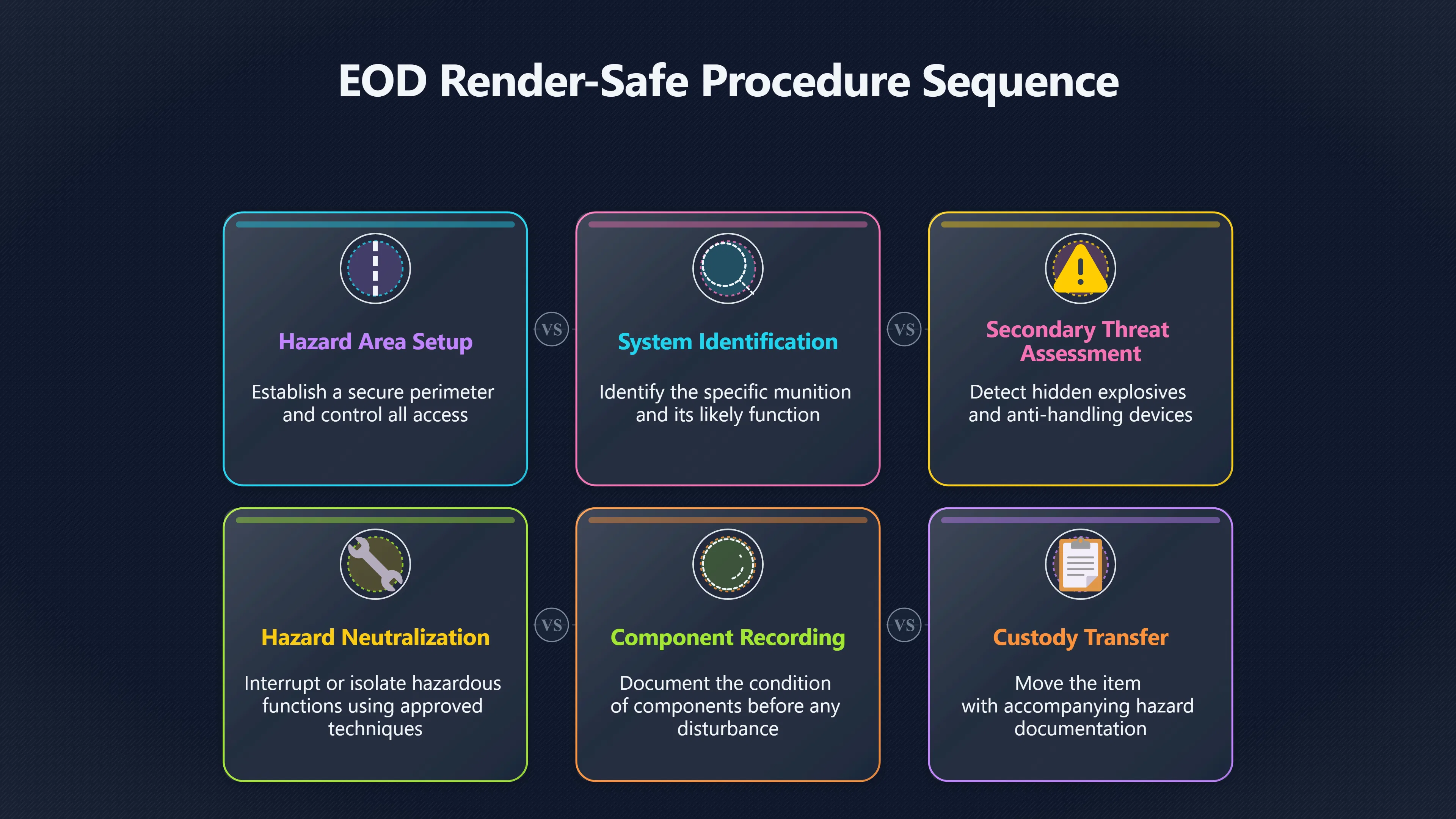
The sequence typically follows a structured logic:
- Establish the hazard area and control access.
- Identify the munition or system and determine likely functioning.
- Assess secondary threats, including anti-handling devices and hidden explosives.
- Interrupt or isolate hazardous functions through approved render-safe techniques.
- Record the condition of components before disturbance.
- Recover the item or selected components for technical exploitation.
- Transfer custody with accompanying hazard documentation.
United Nations EOD guidance similarly treats recording and component recovery as integral parts of EOD activity rather than separate intelligence functions.[Resource Hub]resourcehub01.blob.core.windows.netResource Hub United Nations Peacekeeping Missions Military ExplosiveResource HubUnited Nations Peacekeeping Missions Military Explosive…September 29, 2025 — IEDD refers to the EOD procedures intended to…
Preserving Evidence During Neutralisation
An important misconception is that EOD teams merely make things safe and then hand them over. In reality, exploitation often begins during the render-safe process itself.
Military EOD training and doctrine increasingly emphasise exploitation at the incident site because disassembly can reveal information that may later be lost. Documentation, photography, component recording and controlled recovery are incorporated into the EOD workflow. Marine Corps guidance explicitly notes that exploitation begins at the incident scene during render-safe operations and supports preservation of material for continued technical exploitation.[U.S. Marine Corps]marines.milNAVMC 3500.66D (SECUREDU.S. Marine CorpsNAVMC 3500.66D (SECURED)April 27, 2026 — 10 Aug 2021 — the incident site with the EOD team/element performing render saf…
This is particularly important when dealing with:
- Fragile electronics damaged by impact.
- Burned or partially detonated munitions.
- Improvised modifications.
- Prototype or previously unseen systems.
- Foreign components integrated into domestic weapons.
Once transported, vibration, contamination, corrosion or additional handling can degrade evidence. Capturing technical details early reduces that risk.

When Safety and Intelligence Goals Conflict
Not every intelligence target can be preserved intact.
A munition may be too unstable to move safely. Chemical contamination may make recovery impractical. Operational pressures may require rapid clearance of an airfield, road or combat position rather than painstaking exploitation. EOD doctrine consistently recognises that force protection and mission requirements remain the primary considerations.[U.S. Marine Corps]marines.milMCTP 10 10D (SECUREDMarine CorpsExplosive Ordnance DisposalJune 11, 2026 — 1 Jun 2026 — The ability to render safe and exploit explosive hazards and ordnance…
These situations force trade-offs.
An EOD commander may decide that preserving the entire weapon creates unacceptable risk. Instead, technicians might recover only selected components, record markings and technical characteristics, and destroy the remainder. Even when complete recovery is impossible, photographs, measurements, serial numbers and component inventories can retain significant intelligence value.
The result is often a graded approach rather than a simple choice between recovery and destruction.
Hazard Packaging and Transport Decisions
Making a weapon safe does not automatically make it transportable.
Many captured systems continue to contain hazardous materials after render-safe procedures. Batteries may remain damaged. Residual explosives can still be present. Toxic fuels and propellants may leak during movement. Structural damage may leave components vulnerable to vibration or shock.
For this reason, EOD teams frequently participate in packaging, certification and transportation decisions. Technical intelligence doctrine assigns EOD responsibilities that include hazardous-material assessment, movement and packaging support.[U.S. Marine Corps]marines.milMCTP 10 10D (SECUREDMarine CorpsExplosive Ordnance DisposalJune 11, 2026 — 1 Jun 2026 — The ability to render safe and exploit explosive hazards and ordnance…
Choosing What Travels
Transport decisions generally depend on three questions:
Can the entire item move safely?
If yes, the complete system offers maximum intelligence value because analysts can study interactions between components.
Can only selected assemblies move safely?
In some cases, warheads, propulsion sections or hazardous modules are removed while electronics or sensors are preserved.
Must evidence be collected in place?
When transport risks are unacceptable, teams may document and recover only critical evidence before disposal.
The choice affects what later analysts can learn. Recovering a complete air-defence missile may reveal manufacturing integration and system architecture. Recovering only electronics may answer different intelligence questions while sacrificing others.
Packaging as Evidence Protection
Packaging is not merely a safety exercise. It also protects technical evidence.
Proper containers can prevent:
- Corrosion from environmental exposure.
- Mechanical damage during transport.
- Cross-contamination between components.
- Loss of fragments and markings.
- Further deterioration of batteries and electronics.
Military hazardous-material transport regulations and logistics guidance require explosive and hazardous items to be classified, packaged and handled according to strict safety standards. These controls reduce both transport risk and accidental destruction of intelligence-bearing material.[Defense Logistics Agency]dla.milDefense Logistics Agency[PDF] PACKAGING OF HAZARDOUS MATERIALDefense Logistics AgencyApril 21, 2015 — Explosive items procured must be properly classified under the UN system in order to ensure safe…
The Transition from EOD to Reverse Engineering
The handover from EOD teams to technical exploitation specialists is one of the most important moments in the intelligence process.
By the time analysts receive a captured weapon, many crucial decisions have already been made: which components were preserved, what hazards were removed, what documentation was collected and whether the system survived transport intact. EOD reporting often becomes part of the intelligence record because technicians are the first specialists to inspect the item closely. Modern doctrine increasingly treats EOD observations as intelligence contributions rather than purely safety documentation.[mipb.ikn.army.mil]mipb.ikn.army.milExplosive Ordnance Disposal IntelligenceEOD render-safe procedures.2 When deployed, EOD units are often approached… Explosive Ordnance…
For reverse engineering programmes, this means the quality of later laboratory analysis depends heavily on earlier render-safe work. A carefully neutralised and documented missile, drone or munition can reveal design choices, manufacturing networks, supply chains and technological capabilities. A poorly handled recovery may leave only fragments and unanswered questions.
In that sense, EOD teams do more than make captured weapons safe. They preserve the conditions that make technical intelligence possible in the first place.
Amazon book picks
Further Reading
Books and field guides related to Making Captured Weapons Safe Without Ruining the Clues. Use these as the next step if you want deeper reading beyond the article.
The Pentagon's Brain
Provides context for exploitation of recovered military technology.
eBay marketplace picks
Marketplace Samples
Live-tested eBay searches with available results related to this page.

Endnotes
1.
Source: marines.mil
Title: MCTP 10 10D (SECURED)
Link:https://www.marines.mil/Portals/1/Publications/MCTP%2010-10D%20%28SECURED%29.pdf?ver=o6W5E-x_5sReW5APowgxAA%3D%3D
Source snippet
Marine CorpsExplosive Ordnance DisposalJune 11, 2026 — 1 Jun 2026 — The ability to render safe and exploit explosive hazards and ordnance...
Published: June 11, 2026
2.
Source: assets.publishing.service.gov.uk
Title: AJP 3 18 EOD Ed B V1
Link:https://assets.publishing.service.gov.uk/media/65d48f3f38fef90011b5b03b/AJP_3_18_EOD_EdB_V1.pdf
Source snippet
Allied Joint Doctrine for Explosive Ordnance Disposal...27 Sept 2023 — An example of where this is pertinent to EOD is the renderi...
3.
Source: mipb.ikn.army.mil
Link:https://mipb.ikn.army.mil/media/g34ndm13/cordaro-julsep2021.pdf
Source snippet
Explosive Ordnance Disposal IntelligenceEOD render-safe procedures.2 When deployed, EOD units are often approached... Explosive Ordnance...
4.
Source: eodcoe.org
Link:https://www.eodcoe.org/files/en/standardization/concept-doctrine-standardization/terminology/new-eod-terminology.pdf
Source snippet
Informal Interorganizational Glossary of EOD TerminologyRender-safe procedures - The portion of the explosive ordnance disposal procedure...
5.
Source: nllp.jallc.nato.int
Title: All Agency Compendium of C IED Terminology v3 C IED COE
Link:https://nllp.jallc.nato.int/cmnt/ciedcoi/CIED%20PUBLICATIONS/Lexicon%20and%20Terminology/All%20Agency%20Compendium%20of%20C-IED%20Terminology%20v3%20C-IED%20COE.pdf
Source snippet
NATO JALLCIMPROVISED EXPLOSIVE DEVICE TERMINOLOGY7 Dec 2014 — Render Safe Procedures [NATO AJP 3.15]. A Render Safe Procedure (RSP) is an...
6.
Source: safety.army.mil
Link:https://safety.army.mil/
Source snippet
army.mil[PDF] U.S. ARMY EXPLOSIVES SAFETY HANDBOOKTheir responsibilities include protecting personnel and property from the potentially h...
7.
Source: resourcehub01.blob.core.windows.net
Title: Resource Hub United Nations Peacekeeping Missions Military Explosive
Link:https://resourcehub01.blob.core.windows.net/%24web/Policy%20and%20Guidance/corepeacekeepingguidance/Thematic%20Operational%20Activities/Military/2025.20%20United%20Nations%20Peacekeeping%20Missions%20Military%20Explosive%20Ordnance%20Disposal%20Unit%20Manual.pdf
Source snippet
Resource HubUnited Nations Peacekeeping Missions Military Explosive...September 29, 2025 — IEDD refers to the EOD procedures intended to...
Published: September 29, 2025
8.
Source: marines.mil
Title: NAVMC 3500.66D (SECURED)
Link:https://www.marines.mil/Portals/1/Publications/NAVMC%203500.66D%20%28SECURED%29.pdf?ver=xG2O213nbvUnOC5WnpWwGQ%3D%3D
Source snippet
U.S. Marine CorpsNAVMC 3500.66D (SECURED)April 27, 2026 — 10 Aug 2021 — the incident site with the EOD team/element performing render saf...
Published: April 27, 2026
9.
Source: dla.mil
Title: Defense Logistics Agency[PDF] PACKAGING OF HAZARDOUS MATERIAL
Link:https://www.dla.mil/portals/104/documents/j5strategicplanspolicy/publicissuances/r4145.41.pdf
Source snippet
Defense Logistics AgencyApril 21, 2015 — Explosive items procured must be properly classified under the UN system in order to ensure safe...
Published: April 21, 2015
10.
Source: mikelimadba.substack.com
Title: munitions technical intelligence
Link:https://mikelimadba.substack.com/p/munitions-technical-intelligence
Source snippet
Technical Intelligence - by Mike Lima, DBAThe current doctrine requires units that capture or discover enemy ammunition and explosives to...
11.
Source: eodcoe.org
Title: click 3 click4 click 5 eod stanags overview jun 17
Link:https://www.eodcoe.org/files/en/standardization/concept-doctrine-standardization/doctrines/click3-eod-publications-overview-pcs/click-3-click4-click-5-eod-stanags-overview-jun-17.pdf
Source snippet
stanag 2143/aeodp-10This publication is to provide a manual for NATO forces concerned with explosives ordnance disposal on fixed installa...
Additional References
12.
Source: unmas.org
Link:https://www.unmas.org/sites/default/files/handbook_english.pdf
Source snippet
LANDMINES, EXPLOSIVE REMNANTS OF WAR AND IED...This handbook is the 3rd edition of the former Landmine and. Unexploded Ordnance Safety H...
13.
Source: zeticauxo.com
Link:https://zeticauxo.com/wp-content/uploads/2023/02/guidance-notes-for-commercial-eod-in-gb.pdf
Source snippet
Level Three operators are competent to conduct render-safe procedures and final disposal of any type of explosive ordnance with the excep...
14.
Source: cool.osd.mil
Title: I willfully accept the danger of my chosen profession and will
Link:https://www.cool.osd.mil/usn/LaDR/eod_e8.pdf
Source snippet
osd.mil[PDF] Explosive Ordnance Disposal Technician (EOD) - Osd.milI am a United States Navy EOD Technician, a warrior, professional Sail...
15.
Source: static.e-publishing.af.mil
Title: mil[PDF] Air Force Specialty Code (AFSC) 3E8X1
Link:https://static.e-publishing.af.mil/production/1/af_a4/publication/cfetp3e8x1/cfetp3e8x1.pdf
Source snippet
af.mil[PDF] Air Force Specialty Code (AFSC) 3E8X1 - EXPLOSIVE ORDNANCE...May 6, 2025 — Provides emergency response (on or off installati...
Published: May 6, 2025
16.
Source: law.cornell.edu
Title: Legal Information Institute49 CFR § 173.7
Link:https://www.law.cornell.edu/cfr/text/49/173.7
Source snippet
Government operations and materials.(1) Hazardous materials sold by the DOD in packagings that are not marked in accordance with the requ...
17.
Source: info.publicintelligence.net
Title: USArmy Document Media Exploitation
Link:https://info.publicintelligence.net/USArmy-DocumentMediaExploitation.pdf
Source snippet
publicintelligence.net[PDF] TC 2-91.8 Document and Media Exploitation - Public IntelligenceJune 8, 2010 — [Captured materials]({{ 'material-ledger/' | relative_url }}) are document...
Published: June 8, 2010
18.
Source: coespu.org
Title: The contribution of SP to EODIn
Link:https://www.coespu.org/articles/contribution-sp-eod
Source snippet
summary, in many cases NATO SP will be the first responder, the SP element may have the capability to accomplish the handling of the EOD/...
19.
Source: 19january2021snapshot.epa.gov
Link:https://19january2021snapshot.epa.gov/sites/static/files/documents/ifuxoctthandbook.pdf
Source snippet
epa.gov[PDF] Handbook on the Management of Ordnance and Explosives at...This handbook provides guidance to EPA staff. The document does...
20.
Source: youtube.com
Title: Joint Deployable Exploitation and Analysis Laboratory (JDEAL)
Link:https://www.youtube.com/watch?v=jAA9qO1jpDk
Source snippet
Counter-IED-Course Part 2: The Laboratory - Bundeswehr...
21.
Source: youtube.com
Title: Training Weapons Intelligence Teams to combat IEDs
Link:https://www.youtube.com/watch?v=sR9RYmGYhWk
Source snippet
Joint Deployable Exploitation and Analysis Laboratory (JDEAL) - powered by EDA...
Topic Tree