Within Materials
When good steel is processed badly
Similar-looking steels can behave very differently when quenching, tempering, welding, or surface treatment has gone wrong.
On this page
- Why chemistry alone is not enough
- Hardness gradients, grain structure and phases
- What poor processing says about production quality
Page outline Jump by section
Introduction
A missile casing fragment can reveal far more than its chemical composition. In foreign materiel exploitation, analysts often find that the decisive clues lie in how the steel was processed rather than what alloy it contains. Two missile casings made from nominally identical steel can behave very differently if one was quenched too aggressively, tempered incorrectly, welded after heat treatment, or subjected to uneven cooling during manufacture. These processing mistakes leave microscopic signatures inside recovered fragments: abnormal hardness patterns, unexpected phases, residual stresses, coarse grains and characteristic fracture features. By examining these traces, analysts can assess not only how a weapon was designed to perform, but also how well its manufacturer controlled production quality.[ASM Digital Library]dl.asminternational.orgASM Digital LibraryProblems Associated with Heat Treated Parts | Technical BooksApril 30, 2024 — One of the most common causes of difficu…

For investigators studying foreign military technology, heat-treatment evidence is valuable because it links battlefield debris to industrial capability. A fragment that shows poor process control may indicate production shortcuts, inadequate quality assurance, manufacturing under wartime pressure, or difficulties reproducing a design at scale.
Why Chemistry Alone Is Not Enough
Chemical analysis is often the starting point for metallurgical examination, but it rarely provides the complete story. Alloy composition establishes what properties engineers intended to achieve. Heat treatment determines whether those properties were actually obtained.
A medium-carbon alloy steel, for example, may be selected because it can develop a strong martensitic structure after quenching and then regain toughness through tempering. If the quench is uneven, however, some regions may transform fully while others remain softer. If tempering is incorrect, the casing may become either excessively brittle or insufficiently strong. The elemental analysis would still identify the correct alloy, yet the actual performance could differ substantially from the design intent.[imetllc.com]imetllc.comIndustrial MetallurgistsMetal Heat Treating - metallurgy explainationNovember 25, 2024 — Quenching and tempering is a two-step heat treat…
This distinction is particularly important when evaluating missile debris. Reverse-engineering efforts are often concerned with practical military capability rather than theoretical specifications. A recovered fragment may therefore answer a more useful question: not “What steel was chosen?” but “Was the steel processed well enough to deliver the intended performance?”
Hardness Gradients, Grain Structure and Phases
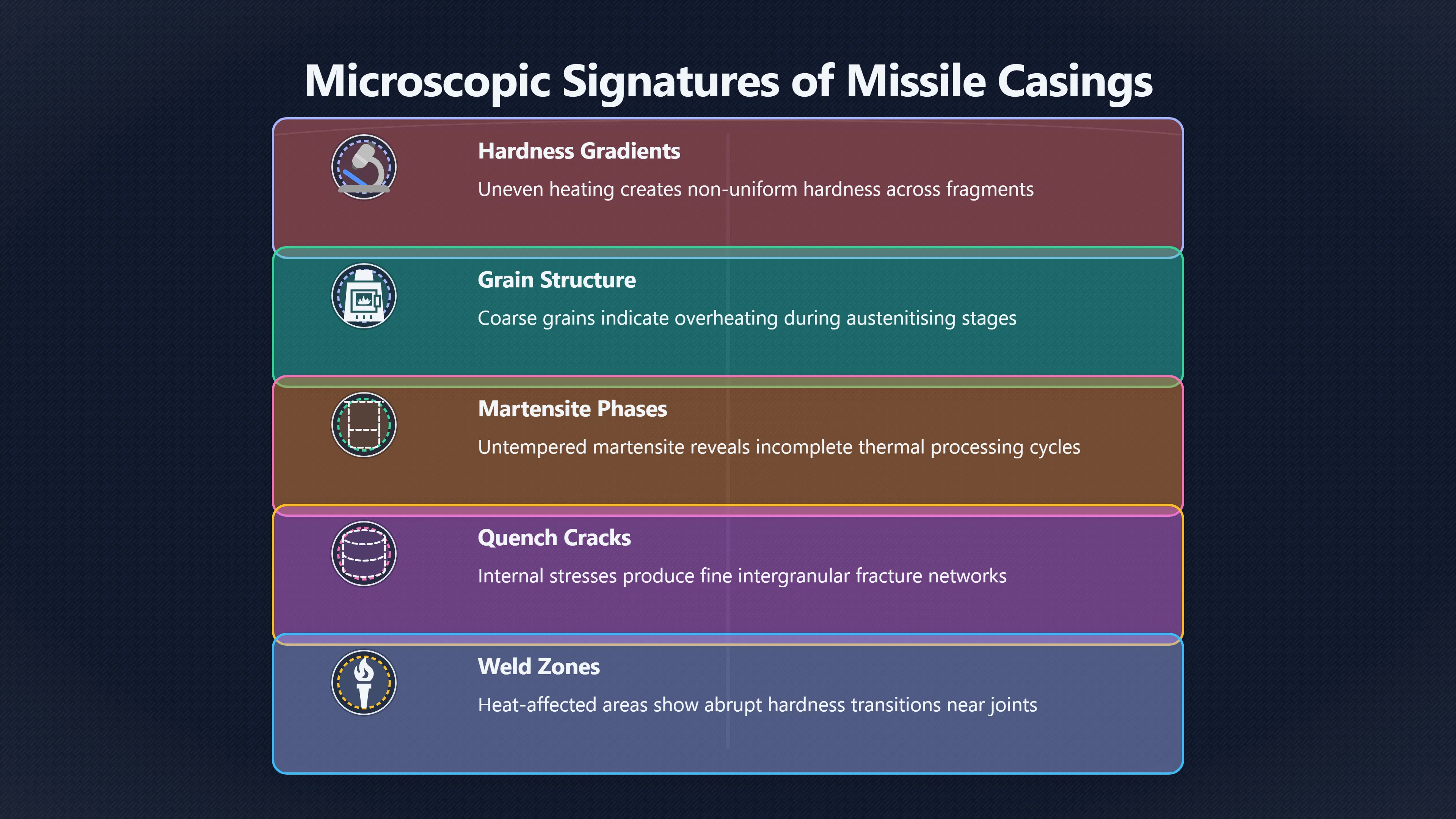
Heat-treatment mistakes are frequently hidden within the microstructure. These features survive explosive events surprisingly well and can often be reconstructed from fragments.
Uneven Hardness as a Manufacturing Fingerprint
One of the most revealing signs is a hardness gradient. Analysts routinely perform microhardness measurements across a fragment’s cross-section. A properly treated casing generally exhibits hardness values within a controlled range. Large variations may indicate non-uniform heating, inconsistent quenching, or inadequate process control.[ASM Digital Library]dl.asminternational.orgASM Digital LibraryProblems Associated with Heat Treated Parts | Technical BooksApril 30, 2024 — One of the most common causes of difficu…
A fragment may show:
- A very hard outer layer and softer interior.
- Alternating hard and soft regions.
- Abrupt hardness changes near welds.
- Localised over-hardened zones adjacent to repaired areas.
These patterns often point to process variability rather than deliberate design choices.
What the Grain Structure Reveals
Metallographic examination can expose whether the steel experienced appropriate thermal treatment. Grain size is particularly informative.
Excessively large grains often indicate overheating during austenitising or prolonged exposure to elevated temperatures. Coarse-grained steel generally exhibits reduced toughness and increased susceptibility to brittle fracture. Conversely, refined grains are usually associated with better toughness and more controlled processing. Research on heat-treated steels consistently shows that grain refinement improves resistance to cleavage fracture and enhances toughness.[TU Delft Repository]repository.tudelft.nlTU Delft Repository Microstructure-based cleavage modelling to study grainTU Delft RepositoryMicrostructure-based cleavage modelling to study grain…May 21, 2023 — by Q Jiang · 2023 · Cited by 6 — Study of the…
When fragments display unusual grain growth in only certain regions, analysts may infer local overheating during manufacturing, welding, or repair operations.
Martensite, Retained Austenite and Other Clues
The phases present inside steel provide a direct record of thermal history. Proper quenching produces martensite, a hard phase that is subsequently tempered to balance strength and toughness. Metallographic examination can reveal whether this sequence was completed successfully.[cam.ac.uk]phase-trans.msm.cam.ac.ukPhase TransitionsTempered MartensiteTempering is a term historically associated with the heat treatment of martensite in steels. It descr…
Common warning signs include:
- Untempered martensite, suggesting incomplete processing.
- Excess retained austenite, indicating inadequate transformation during cooling.
- Mixed microstructures that suggest inconsistent quench rates.
- Localised phase variations around welds or heat-affected zones.
Such findings are valuable because they reveal process execution rather than merely material selection.
The Hidden Signature of Quench Damage
Quenching is one of the most demanding stages of steel processing. Rapid cooling generates both thermal stresses and transformation stresses as martensite forms and expands.
If cooling is too severe or poorly controlled, internal stresses can exceed the steel’s strength and produce quench cracks. These cracks may be microscopic at first and remain hidden until the component experiences service loads. Failure-analysis literature identifies quench cracking as a consequence of combined thermal contraction and martensitic transformation stresses.[Scribd]scribd.comFailure Analysis of Heat Treated Steel Components 2008 pdfFailure Analysis of Heat Treated Steel Components (2008)…Steel Heat Treatment Failures due to Quenching… 21. Quench cracking…
In missile casing fragments, investigators may discover:
- Fine intergranular cracks.
- Branching crack networks.
- Crack origins associated with hardened regions.
- Fracture surfaces indicative of residual stress failures.
These features can indicate that a casing carried latent manufacturing defects before it ever entered service.
The significance extends beyond a single component. If multiple recovered fragments exhibit similar quench-related damage, analysts may conclude that the issue reflects a production-wide process problem rather than an isolated manufacturing error.
Tempering Errors and False Confidence
A missile casing must resist launch loads, aerodynamic stresses, handling damage and, in some designs, controlled fragmentation effects. Achieving this balance usually depends on proper tempering after hardening.
Tempering reduces excessive hardness and relieves internal stresses while preserving much of the steel’s strength. Improper tempering can create a deceptive situation in which a component appears strong during routine inspection but possesses inadequate toughness under operational loading.[MHCC Library Press]mhcc.pressbooks.pubMHCC Library PressTempering – MetallurgyTempering is a process of heat treating, which is used to increase the toughness of iron-based al…
Several metallurgical signatures may indicate tempering problems:
- Hardness levels significantly above specification.
- Brittle fracture features despite acceptable chemistry.
- Incomplete stress relief.
- Microstructures characteristic of insufficient tempering.
- Localised variations suggesting inconsistent furnace conditions.
The resulting failures may only appear under shock loading, vibration, impact or other demanding service conditions. From an intelligence perspective, such evidence suggests that a manufacturer may have achieved the outward appearance of a capable system without fully mastering the production process needed to ensure reliability.

Weld Repairs and Heat-Affected Zones
Missile casings frequently contain welds, and these areas often preserve some of the clearest evidence of processing quality.
Welding introduces localised thermal cycles that can alter previously heat-treated material. If post-weld heat treatment is inadequate, the heat-affected zone may contain undesirable microstructures, elevated residual stresses or abrupt hardness transitions. Failure-analysis references consistently identify welding-related thermal effects as a major source of metallurgical defects in heat-treated steel components.[ResearchGate]researchgate.netSteel Failures due to Tempering and Isothermal Heat…September 1, 2008 — Failure Analysis of Heat Treated Steel Components…
Recovered fragments sometimes reveal:
- Over-hardened regions adjacent to welds.
- Coarse grains produced by excessive heat input.
- Softened zones where original properties were degraded.
- Cracking concentrated near weld boundaries.
Because welds are often associated with assembly and repair operations, these features can provide clues about factory practices, maintenance standards and production throughput pressures.
What Poor Processing Says About Production Quality
The most important intelligence value of heat-treatment evidence is that it connects microscopic observations to broader industrial questions.
A poorly heat-treated fragment does not automatically mean the weapon was ineffective. Many systems remain functional despite significant metallurgical imperfections. However, repeated findings across multiple recovered components can indicate systemic manufacturing weaknesses.
Patterns that attract attention include:
- Wide hardness variation between supposedly identical parts.
- Recurring quench-crack signatures.
- Inconsistent grain size distributions.[metallographic.com]metallographic.comPurpose and Applications of MetallographyManufacturers use metallography to verify that incoming raw materials meet specifications: Check…
- Variable weld quality.
- Evidence of uncontrolled thermal processing.
Such findings may suggest difficulties maintaining furnace temperatures, inconsistent quality assurance procedures, shortages of skilled metallurgical personnel, rushed wartime production, or challenges scaling laboratory designs into mass manufacture.[asminternational.org]dl.asminternational.orgASM Digital LibraryProblems Associated with Heat Treated Parts | Technical BooksApril 30, 2024 — One of the most common causes of difficu…
For reverse engineers, this information can be as important as alloy identification. A fragment showing sophisticated alloy selection but poor process control tells a different story from one showing both advanced materials and consistent manufacturing execution. The first points to design ambition constrained by production realities; the second points to a mature industrial capability capable of translating metallurgical theory into reliable military hardware.
Amazon book picks
Further Reading
Books and field guides related to When good steel is processed badly. Use these as the next step if you want deeper reading beyond the article.
Metallurgy for the Non-metallurgist
Explains how processing changes microstructure and properties.
Practical Heat Treating
Shows how real-world heat-treatment decisions affect steel behaviour.
Callister's Materials Science and Engineering: An Introductio...
Provides core concepts behind phase transformations and hardness.
eBay marketplace picks
Marketplace Samples
Live-tested eBay searches with available results related to this page.

Endnotes
1.
Source: metallographic.com
Link:https://www.metallographic.com/guides/purpose-and-applications.html
Source snippet
Purpose and Applications of MetallographyManufacturers use metallography to verify that incoming raw materials meet specifications: Check...
2.
Source: scribd.com
Title: Failure Analysis of Heat Treated Steel Components 2008 pdf
Link:https://www.scribd.com/document/335122848/Failure-Analysis-of-Heat-Treated-Steel-Components-2008-pdf
Source snippet
Failure Analysis of Heat Treated Steel Components (2008)...Steel Heat Treatment Failures due to Quenching... 21. Quench cracking...
3.
Source: researchgate.net
Link:https://www.researchgate.net/publication/364049894_Steel_Failures_due_to_Tempering_and_Isothermal_Heat_Treatment
Source snippet
Steel Failures due to Tempering and Isothermal Heat...September 1, 2008 — Failure Analysis of Heat Treated Steel Components...
Published: September 1, 2008
4.
Source: researchgate.net
Title: 399108715 Steels for defense applicaton
Link:https://www.researchgate.net/publication/399108715_Steels_for_defense_applicaton
Source snippet
(PDF) Steels for defense applicaton28 Dec 2025 — The development of steels for defense application focus on improving strength, toughness...
5.
Source: researchgate.net
Link:https://www.researchgate.net/publication/327337003_Influence_of_the_Heat_Treatments_on_Martensite_Microstructure_and_Abrasive_Wear_Behavior_of_X52_Dual-phase_Steel
Source snippet
(PDF) Influence of the Heat Treatments on Martensite...9 Feb 2026 — In this study abrasive wear behaviour of X52 dual phase steel with t...
6.
Source: sciencedirect.com
Link:https://www.sciencedirect.com/science/article/pii/S2238785426007015
Source snippet
A review on near net shape hot isostatic pressing of...by J Anwar · 2026 — Moreover, uneven grain size and precipitation are the drawbac...
7.
Source: dl.asminternational.org
Link:https://dl.asminternational.org/technical-books/monograph/204/chapter/3915223/Problems-Associated-with-Heat-Treated-Parts-1
Source snippet
ASM Digital LibraryProblems Associated with Heat Treated Parts | Technical BooksApril 30, 2024 — One of the most common causes of difficu...
Published: April 30, 2024
8.
Source: imetllc.com
Link:https://www.imetllc.com/metal-heat-treating/
Source snippet
Industrial MetallurgistsMetal Heat Treating - metallurgy explainationNovember 25, 2024 — Quenching and tempering is a two-step heat treat...
Published: November 25, 2024
9.
Source: phase-trans.msm.cam.ac.uk
Link:https://www.phase-trans.msm.cam.ac.uk/2004/Tempered.Martensite/tempered.martensite.html
Source snippet
Phase TransitionsTempered MartensiteTempering is a term historically associated with the heat treatment of martensite in steels. It descr...
10.
Source: mhcc.pressbooks.pub
Link:https://mhcc.pressbooks.pub/metallurgy/chapter/tempering/
Source snippet
MHCC Library PressTempering – MetallurgyTempering is a process of heat treating, which is used to increase the toughness of iron-based al...
11.
Source: repository.tudelft.nl
Title: TU Delft Repository Microstructure-based cleavage modelling to study grain
Link:https://repository.tudelft.nl/file/File_bf9c0661-be74-4952-b5a8-f765b2df4cc2
Source snippet
TU Delft RepositoryMicrostructure-based cleavage modelling to study grain...May 21, 2023 — by Q Jiang · 2023 · Cited by 6 — Study of the...
Published: May 21, 2023
Additional References
12.
Source: arxiv.org
Link:https://arxiv.org/abs/2203.15868
Source snippet
Microstructural Characterization and Mechanical Property Evaluation of High Nitrogen Martensitic Stainless Steel Subjected to Heat T...
13.
Source: online-pdh.com
Link:https://www.online-pdh.com/pluginfile.php/80448/mod_resource/content/1/Fundamentals%20of%20Material%20Defects%20and%20Deficiencies%20-MS.pdf
Source snippet
Fundamentals of Material Defects & DeficienciesHeat treatment processes such as annealing can reduce dislocation density (recovery), rear...
14.
Source: heat-treat-doctor.com
Link:https://www.heat-treat-doctor.com/[documents
Source snippet
the heat treat doctorTemper embrittlement is a phenomenon inherent in many steels, characterized by reduced impact toughness. It occurs i...
15.
Source: youtube.com
Link:https://www.youtube.com/watch?v=LvZkfPdjnN8
Source snippet
Tempering of martensite in steelsA detailed and technical exploration of the process of tempering steel, which is a heat treatment histor...
16.
Source: facebook.com
Link:https://www.facebook.com/CircuitSquadron/posts/the-steel-that-explodes-before-the-gun-fires-forensic-metallurgy-audit-evaluatin/122130957027175913/
Source snippet
g elastic stress release and residual hoop stress dynamics...
17.
Source: books.google.com
Link:https://books.google.com/books/about/Failure_Analysis_of_Heat_Treated_Steel_C.html?id=jrYOK1b6_BsC
Source snippet
Google BooksFailure Analysis of Heat Treated Steel ComponentsThis thorough reference work discusses various causes of failure with integr...
18.
Source: facebook.com
Link:https://www.facebook.com/groups/485362748969702/posts/1212129152959721/
Source snippet
larly alloys and steels, become susceptible to brittle...
19.
Source: sutlib2.sut.ac.th
Link:https://sutlib2.sut.ac.th/sut_contents/H126798.pdf
Source snippet
Scott MacKenzie, Houghton International, Inc. General Sources of Failure.Read more...
20.
Source: youtube.com
Title: What is Heat Treatment: Types, Process, Key Factors and Applications
Link:https://www.youtube.com/watch?v=jknpCIKAwKY
Source snippet
Damascus Steel: This 900 Year Old Metal Contains Structures We Can't Manufacture...
21.
Source: nvlpubs.nist.gov
Title: SP.960 16e3
Link:https://nvlpubs.nist.gov/nistpubs/specialpublications/NIST.SP.960-16e3.pdf
Source snippet
of Ceramics and Glasses, Third EditionCertain commercial entities, equipment, or materials may be identified in this document in order to...
Topic Tree