Within Firmware
The Hidden Connectors That Give Up Firmware
Manufacturing and repair interfaces often become the fastest route into a captured system's software.
On this page
- Factory Test Interfaces
- Board Level Access Points
- Extracting Reliable Data
Page outline Jump by section
Introduction
In the reverse engineering of foreign military technology, one of the fastest routes into a captured system is often not a sophisticated cryptographic attack or a painstaking chip-level teardown. It is a connector, test pad, maintenance header or debugging interface that engineers originally installed to build, test, repair or update the device. Even highly protected military electronics require practical access during manufacturing and servicing. Those access pathways can reveal boot messages, firmware images, processor state, configuration data and diagnostic functions that would otherwise remain hidden.

For analysts examining captured drones, missiles, radios, electronic-warfare equipment or guidance systems, debug interfaces frequently provide the bridge between physical hardware and the software controlling it. The challenge is not simply finding these pathways, but identifying which ones remain active, what level of access they provide and whether the data obtained can be trusted and verified. Research on firmware extraction consistently shows that exposed debugging and service interfaces remain among the most effective routes to acquiring embedded software and understanding device behaviour.[ResearchGate]researchgate.netResearch Gate Breaking All the Things—A Systematic Survey of FirmwareBreaking All the Things—A Systematic Survey of Firmware…March 1, 2019 — In this paper, we systematically review and catego…
Factory Test Interfaces
Modern military electronics are manufactured using many of the same design-for-test principles found in commercial embedded systems. During production, engineers need a way to verify circuit-board assembly, load firmware, calibrate sensors and diagnose faults. Those requirements create interfaces that may survive long after a system leaves the factory.
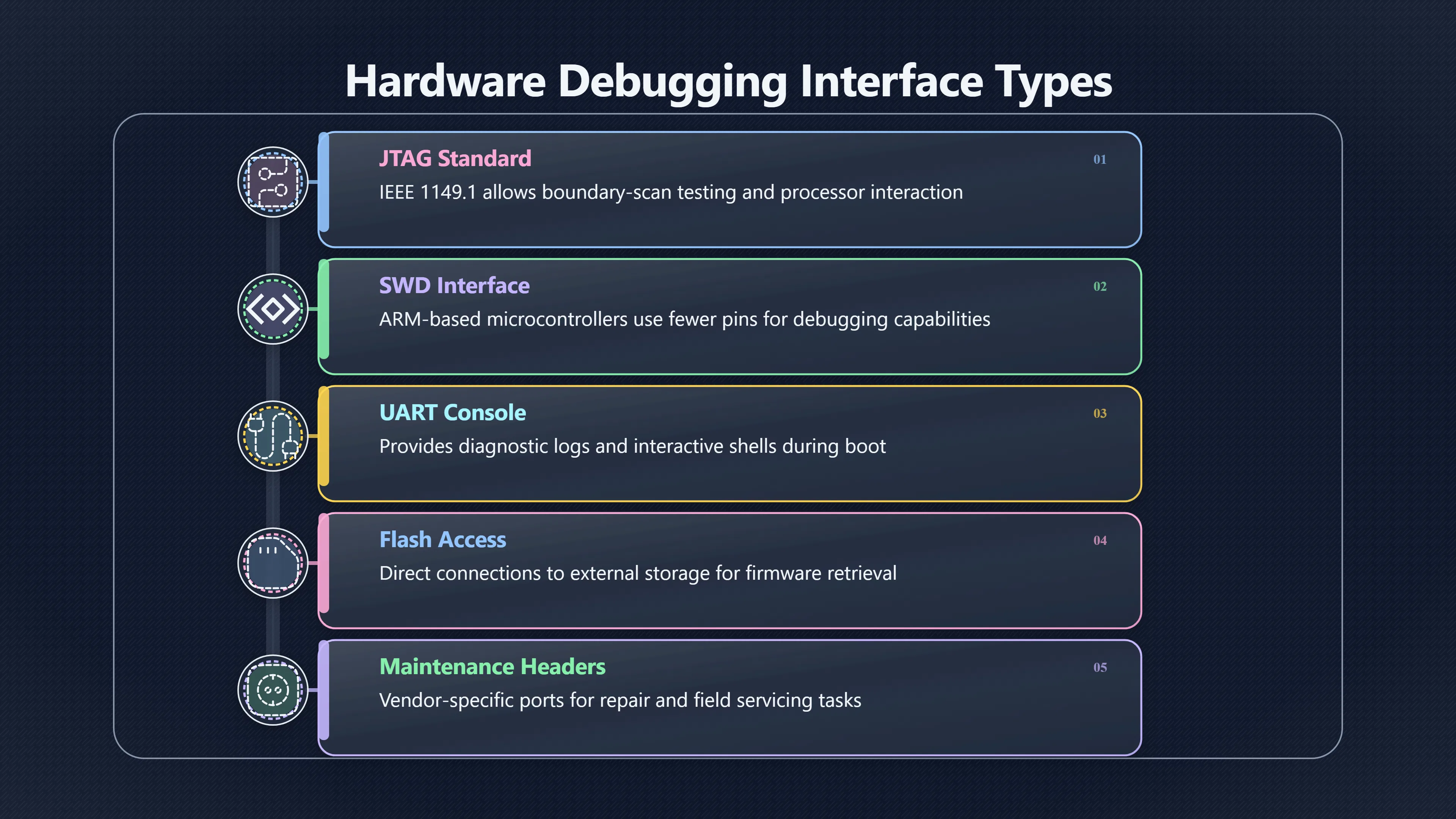
The most widely encountered standard is JTAG (Joint Test Action Group), formalised as IEEE 1149.1. Originally intended for boundary-scan testing of printed circuit boards, JTAG evolved into a powerful debugging mechanism that allows direct interaction with processors, memory and on-chip diagnostic logic. Through a small set of pins, engineers can inspect registers, examine memory and load software during development and testing.[embedded.com]embedded.comJTAG: An Introduction - EmbeddedOctober 29, 2002 — 29 Oct 2002 — The specification JTAG devised uses boundary-scan technology, wh…
A closely related interface is Serial Wire Debug (SWD), commonly used on ARM-based microcontrollers. SWD offers many of the capabilities of JTAG while using fewer pins, making it attractive for compact systems where board space is limited. Because many modern military subsystems rely on ARM processors, SWD is frequently encountered during hardware exploitation work.[element14.com]community.element14.comelement14 CommunityUsing SWD with ARM Microcontrollers: An Introduction to…3 Jun 2026 — Technically you don't have to use SWD, which…
Manufacturers often assume these interfaces will be disabled or physically inaccessible after production. In practice, however, test functionality may remain enabled, connectors may be hidden rather than removed, or undocumented service procedures may still permit access. Studies of firmware extraction techniques have repeatedly identified accessible debugging interfaces as one of the most common routes to acquiring embedded code. One large survey found that exposed serial interfaces alone were sufficient for firmware extraction in a substantial proportion of examined devices.[ResearchGate]researchgate.netResearch Gate Breaking All the Things—A Systematic Survey of FirmwareBreaking All the Things—A Systematic Survey of Firmware…March 1, 2019 — In this paper, we systematically review and catego…
For foreign materiel exploitation, the significance is straightforward: a captured device may contain an intentionally engineered pathway designed to communicate directly with the system’s software.
Board-Level Access Points
The most valuable access pathways are not always obvious connectors. Military systems frequently use internal test points, solder pads, programming headers and manufacturing fixtures that were never intended for end users.
Analysts commonly search for several categories of board-level access:
- UART serial interfaces used for diagnostic consoles and boot messages.
- JTAG or SWD pads used for programming and debugging processors.
- Flash memory access points connected to external storage devices.
- Vendor-specific maintenance headers supporting repair and servicing.[Boundary-Scan]jtag.comJTAG TechnologiesIs an electronic serial four port jtag interface that allows access to the special embedded logic on a great many of tod… scan chains** linking multiple integrated circuits for testing.
UART (Universal Asynchronous Receiver-Transmitter) interfaces are especially important because they often reveal information immediately when power is applied. Bootloaders, kernel messages and diagnostic logs may be transmitted automatically during startup. In some cases, the interface also provides an interactive console through which operators or technicians can issue commands. Reverse-engineering practitioners routinely identify hidden UART ports by tracing board connections, locating unpopulated headers or observing serial traffic during boot.[jcjc-dev.com]jcjc-dev.comHack The World Practical Reverse Engineering Part 1Hack The WorldPractical Reverse Engineering Part 1 - Hunting for Debug Ports8 Apr 2016 — We're simple looking for a serial port that the…
A common misconception is that secure systems always expose obvious connectors. In reality, many modern devices use unlabeled test pads, tiny vias or manufacturing fixtures that disappear beneath shielding or conformal coatings. As a result, physical investigation often involves mapping printed-circuit-board traces, identifying processor pin assignments and searching for characteristic electrical patterns associated with known debugging standards. Tools designed specifically to identify hidden JTAG and SWD interfaces have emerged because manually locating these pathways can be time-consuming even when they remain present on the board.[CyberTruck Challenge]cybertruckchallenge.orgCyberTruck ChallengeHardware Reverse EngineeringJune 13, 2023 — 13 Jun 2023 — JTAGulator - Nifty tool that automates checking test-points…
Military systems can add further complexity through environmental sealing, anti-tamper coatings or custom connector arrangements. Yet the underlying engineering reality remains unchanged: software must usually be loaded, tested and maintained somehow, and those lifecycle requirements often leave traces that investigators can exploit.
Why Hidden Access Survives in Deployed Systems
A useful question is why such pathways continue to exist at all.
The answer lies in competing engineering priorities. Manufacturing teams require rapid testing. Repair organisations need efficient diagnostics. Software developers need debugging capability. Programme managers need systems that can be updated and serviced throughout their operational life.
Removing every access mechanism entirely would complicate production, increase costs and make field maintenance difficult. Instead, many systems rely on procedural controls, physical concealment or software lockouts. Some processors include mechanisms that disable memory readout after manufacturing, restrict debugging functions or require authentication before access is granted. Secure JTAG implementations and similar protective features are specifically intended to reduce the risks posed by exposed debug interfaces.[Wikipedia]WikipediaOpen source on wikipedia.org.
However, implementation quality varies. Research on embedded-device security continues to demonstrate that debug interfaces are sometimes left enabled, incompletely secured or protected by mechanisms that can be bypassed under laboratory conditions. Academic studies have shown that open debugging interfaces can provide significant access with relatively modest equipment and expertise when protections are absent or poorly configured.[arXiv]arxiv.orgLeaving Your Things Unattended is No Joke! Memory Bus Snooping and Open Debug Interface ExploitsJanuary 19, 2022…
For analysts examining captured foreign equipment, the practical lesson is that a hidden access pathway should never be assumed inactive simply because it was not intended for operational users.
Extracting Reliable Data
Finding a debug interface is only the beginning. The harder problem is determining whether the information obtained is complete, accurate and representative of the system under examination.
Several factors affect reliability:
Readout restrictions. Some devices permit diagnostic access but block firmware extraction. Others expose only limited memory regions while protecting critical code areas.[tomchothia.gitlab.io]tomchothia.gitlab.ioVisually identify possible JTAG/SWD (and other) debug interfaces. SWD requires only two pins, while…Read more…
Multiple firmware locations. Modern systems often distribute software across several processors, field-programmable gate arrays, secure elements and external flash devices. Accessing one component may provide only a partial picture.[arXiv]arxiv.orgA Multi-Interface Firmware Acquisition and Validation Methodology for Low-Cost Consumer Drones: A Case Study on Three Holy Stone Pla…
Configuration dependence. Data recovered through a debug port may reflect a specific operational state, maintenance mode or test configuration rather than normal deployment behaviour.
Data validation. Firmware images acquired through debugging interfaces require verification. Investigators frequently compare multiple acquisition methods, examine file-system structures, analyse entropy patterns and confirm that extracted images contain meaningful executable content rather than incomplete or corrupted data. Recent research on drone firmware acquisition emphasises the importance of validating extracted images rather than assuming that a successful read operation produced a complete firmware dump.[arXiv]arxiv.orgA Multi-Interface Firmware Acquisition and Validation Methodology for Low-Cost Consumer Drones: A Case Study on Three Holy Stone Pla…
The most reliable exploitation efforts therefore combine debug-port access with other evidence sources: flash-memory analysis, component documentation, circuit tracing, boot logs and behavioural testing. A UART console may reveal how a system starts. A JTAG interface may expose processor memory. External flash may contain the firmware image itself. Together, these pathways allow analysts to reconstruct software architecture with far greater confidence than any single source alone.[gitlab.io]tomchothia.gitlab.ioVisually identify possible JTAG/SWD (and other) debug interfaces. SWD requires only two pins, while…Read more…
What Debug Access Reveals About a Captured System
When successful, debug access provides insights that are difficult to obtain through hardware examination alone.
Analysts may discover:
- Firmware versions and update history.
- Processor architectures and memory maps.
- Bootloader behaviour and recovery mechanisms.
- Diagnostic commands used by maintainers.
- Calibration data and operational parameters.
- Logging functions and fault records.
- Communications settings and protocol information.
- Relationships between multiple subsystems.
These findings help transform a captured device from a collection of components into a functioning software-defined system. In the broader context of reverse engineering foreign military technology, hidden debug pathways matter because they expose how equipment actually behaves rather than merely how it appears to be built. They are often the shortest route from a circuit board to the firmware that governs navigation, sensing, communication and mission execution.[wikipedia.org]WikipediaOpen source on wikipedia.org.
Amazon book picks
Further Reading
Books and field guides related to The Hidden Connectors That Give Up Firmware. Use these as the next step if you want deeper reading beyond the article.
Practical Reverse Engineering
Directly relevant to extracting and understanding firmware.
eBay marketplace picks
Marketplace Samples
Live-tested eBay searches with available results related to this page.

Endnotes
1.
Source: researchgate.net
Title: Research Gate Breaking All the Things—A Systematic Survey of Firmware
Link:https://www.researchgate.net/publication/331612826_Breaking_All_the_Things-A_Systematic_Survey_of_Firmware_Extraction_Techniques_for_IoT_Devices_Studies_on_Socio-Ecological_Systems%27_Vulnerability_Resilience_and_Governance
Source snippet
Breaking All the Things—A Systematic Survey of Firmware...March 1, 2019 — In this paper, we systematically review and catego...
Published: March 1, 2019
2.
Source: tomchothia.gitlab.io
Link:https://tomchothia.gitlab.io/Papers/CARDIS18.pdf
Source snippet
Visually identify possible JTAG/SWD (and other) debug interfaces. SWD requires only two pins, while...Read more...
3.
Source: embedded.com
Link:https://www.embedded.com/introduction-to-jtag/
Source snippet
JTAG: An Introduction - EmbeddedOctober 29, 2002 — 29 Oct 2002 — The specification JTAG devised uses boundary-scan technology, wh...
Published: October 29, 2002
4.
Source: Wikipedia
Link:https://en.wikipedia.org/wiki/JTAG
5.
Source: jtag.com
Link:https://www.jtag.com/boundary-scan/
Source snippet
JTAG TechnologiesIs an electronic serial four port jtag interface that allows access to the special embedded logic on a great many of tod...
6.
Source: community.element14.com
Link:https://community.element14.com/technologies/embedded/b/blog/posts/using-swd-with-arm-microcontrollers-an-introduction-to-firmware-programming-and-debugging
Source snippet
element14 CommunityUsing SWD with ARM Microcontrollers: An Introduction to...3 Jun 2026 — Technically you don't have to use SWD, which...
7.
Source: hardbreak.wiki
Title: extract firmware using jtag swd
Link:https://www.hardbreak.wiki/hardware-hacking/interface-interaction/jtag-swd/extract-firmware-using-jtag-swd
Source snippet
Extract Firmware using JTAG/SWD19 Jan 2025 — Steps to Extract Firmware Over JTAG/SWD 1. Identify JTAG/SWD Pins Locate the JTAG or SWD pin...
8.
Source: riverloopsecurity.com
Title: led and/or are hidden among dozens of other headers
Link:https://riverloopsecurity.com/blog/2020/01/hw-101-uart/
Source snippet
Hardware Hacking 101: Getting a root shell via UART7 Jan 2020 — To make accessing these debugging pins easier, solder a set of header pin...
9.
Source: arxiv.org
Link:https://arxiv.org/abs/2201.07462
Source snippet
Leaving Your Things Unattended is No Joke! Memory Bus Snooping and Open Debug Interface ExploitsJanuary 19, 2022...
Published: January 19, 2022
10.
Source: arxiv.org
Link:https://arxiv.org/abs/2605.11040
Source snippet
A Multi-Interface Firmware Acquisition and Validation Methodology for Low-Cost Consumer Drones: A Case Study on Three Holy Stone Pla...
11.
Source: wrongbaud.github.io
Title: jtag hdd
Link:https://wrongbaud.github.io/posts/jtag-hdd/
Source snippet
Hardware Debugging for Reverse Engineers Part 2: JTAG...1 Apr 2026 — JTAG is a hardware level debugging mechanism that many embedded CPU...
12.
Source: jcjc-dev.com
Title: Hack The World Practical Reverse Engineering Part 1
Link:https://jcjc-dev.com/2016/04/08/reversing-huawei-router-1-find-uart/
Source snippet
Hack The WorldPractical Reverse Engineering Part 1 - Hunting for Debug Ports8 Apr 2016 — We're simple looking for a serial port that the...
13.
Source: cybertruckchallenge.org
Link:https://www.cybertruckchallenge.org/wp-content/uploads/2023/06/hardware-reverse-engineering-students-2023.pdf
Source snippet
CyberTruck ChallengeHardware Reverse EngineeringJune 13, 2023 — 13 Jun 2023 — JTAGulator - Nifty tool that automates checking test-points...
Published: June 13, 2023
14.
Source: medium.com
Link:https://medium.com/%40wadixtech/embedded-systems-jtag-protocol-for-debugging-8af6be0f7cc6
15.
Source: dev.to
Title: how i went from im not a hardware person to reverse engineering devices 894
Link:https://dev.to/numbpill3d/how-i-went-from-im-not-a-hardware-person-to-reverse-engineering-devices-894
Source snippet
It happens more often than you think. That feeling...Read more...
Additional References
16.
Source: vaadata.com
Link:https://www.vaadata.com/en/blog/debug-ports-how-they-work-types-and-security-risks-in-iot-systems/
Source snippet
Debug Ports: How They Work, Types and IoT Security RisksWhat is a debug port? In this article, we explain the main types of ports, how th...
17.
Source: medium.com
Link:https://medium.com/%40aliaksandr.kavalchuk/diving-into-jtag-part-6-security-d40f1e84e6ba
Source snippet
Diving into JTAG. Part 6 — SecurityIn the sixth part of the “Diving into JTAG” article series, we will focus on security issues related t...
18.
Source: arshon.com
Link:https://arshon.com/blog/jtag-and-swd-debugging-techniques-a-field-guide-for-reliable-bring-up-flashing-and-trace/
Source snippet
JTAG and SWD debugging techniques: a field guide...17 Oct 2025 — This article gives a practical, high-signal overview of JTAG and SWD de...
19.
Source: wonderfulpcb.com
Link:https://www.wonderfulpcb.com/blog/how-jtag-works-for-pcb-testing-debugging-and-fault-detection/
Source snippet
How JTAG works for PCB testing and debuggingBoundary-scan testing helps you spot soldering issues, shorts, or broken connections...
20.
Source: medium.com
Title: reverse engineering uart to gain shell de9019ae427a
Link:https://medium.com/%40shubhamgolam10/reverse-engineering-uart-to-gain-shell-de9019ae427a
Source snippet
Reverse engineering UART to gain shellIn this article, I am going to practically perform reverse engineering of TP-LINK (TD-W8968 v1.1) r...
21.
Source: thisisnotrocketscience.nl
Title: programming microcontroller devices the hard way
Link:https://www.thisisnotrocketscience.nl/programming-microcontroller-devices-the-hard-way/
Source snippet
Reverse engineering SWD JTAG debugging/flashing...2 Feb 2015 — The debugging interface allows anyone to inspect the inner state of the c...
22.
Source: reddit.com
Link:https://www.reddit.com/r/ReverseEngineering/comments/4e1n8i/practical_reverse_engineering_for_embedded/
Source snippet
essary. Obviously, equipment … may attempt to disable/hide uart...
23.
Source: allpcb.com
Title: jtags role in embedded system debugging
Link:https://www.allpcb.com/allelectrohub/jtags-role-in-embedded-system-debugging
Source snippet
JTAG's Role in Embedded System Debugging27 Aug 2025 — Explore JTAG's critical role in debugging embedded systems, from boundary-scan test...
24.
Source: bugcrowd.com
Link:https://www.bugcrowd.com/blog/introduction-to-uart-hardware-hacking/
Source snippet
17 Jun 2025 — UARTs are used as a console port for debugging and development. Have you ever wanted a root shell on a coffeemaker? The UAR...
25.
Source: youtube.com
Link:https://www.youtube.com/watch?v=ZmZuKA-Rst0
Source snippet
ial port) and using it to access a shell on a very soft target...
Topic Tree
Follow this branch
Parent topic
Firmware The Software Hidden Inside WeaponsRelated pages 5
- Drone Logic What Drone Firmware Reveals About Real Flight Behavior
- Service Data Why Maintenance Records Matter as Much as Code
- Threat Libraries How Threat Libraries Reveal What Systems Recognize
- Threat Modeling Why Real Firmware Makes Better Threat Simulators
- Update Paths Can Operators Change the System in the Field