Within Paperclip
When Captured Files Needed Human Interpreters
Wright Field's huge document haul made specialists valuable because translation alone could not explain whole research systems.
On this page
- The scale of captured technical records
- Why terminology and context mattered
- How specialists connected papers to machines
Page outline Jump by section
Introduction
One of the least appreciated aspects of postwar military technology exploitation was the sheer volume of captured technical documentation. By 1945–46, Allied forces had seized vast archives from German military laboratories, aircraft firms, research institutes and weapons programmes. The challenge was not simply translating documents from German into English. The deeper problem was that technical records arrived in quantities so large, and with so much specialised context, that translation alone could not reveal how an entire weapons system functioned, how a research programme had evolved, or which unfinished ideas were worth pursuing. This translation bottleneck helps explain why programmes such as Project Paperclip valued engineers and scientists as much as captured hardware and paperwork. Experts could interpret relationships, assumptions and practical experience that were often invisible in the written record.[escholarship.org]escholarship.orgScience, Technology, and Know-How: Exploitation of…by DM O'Reagan · 2014 · Cited by 8 — This dissertation is a comparative…
The Scale of Captured Technical Records
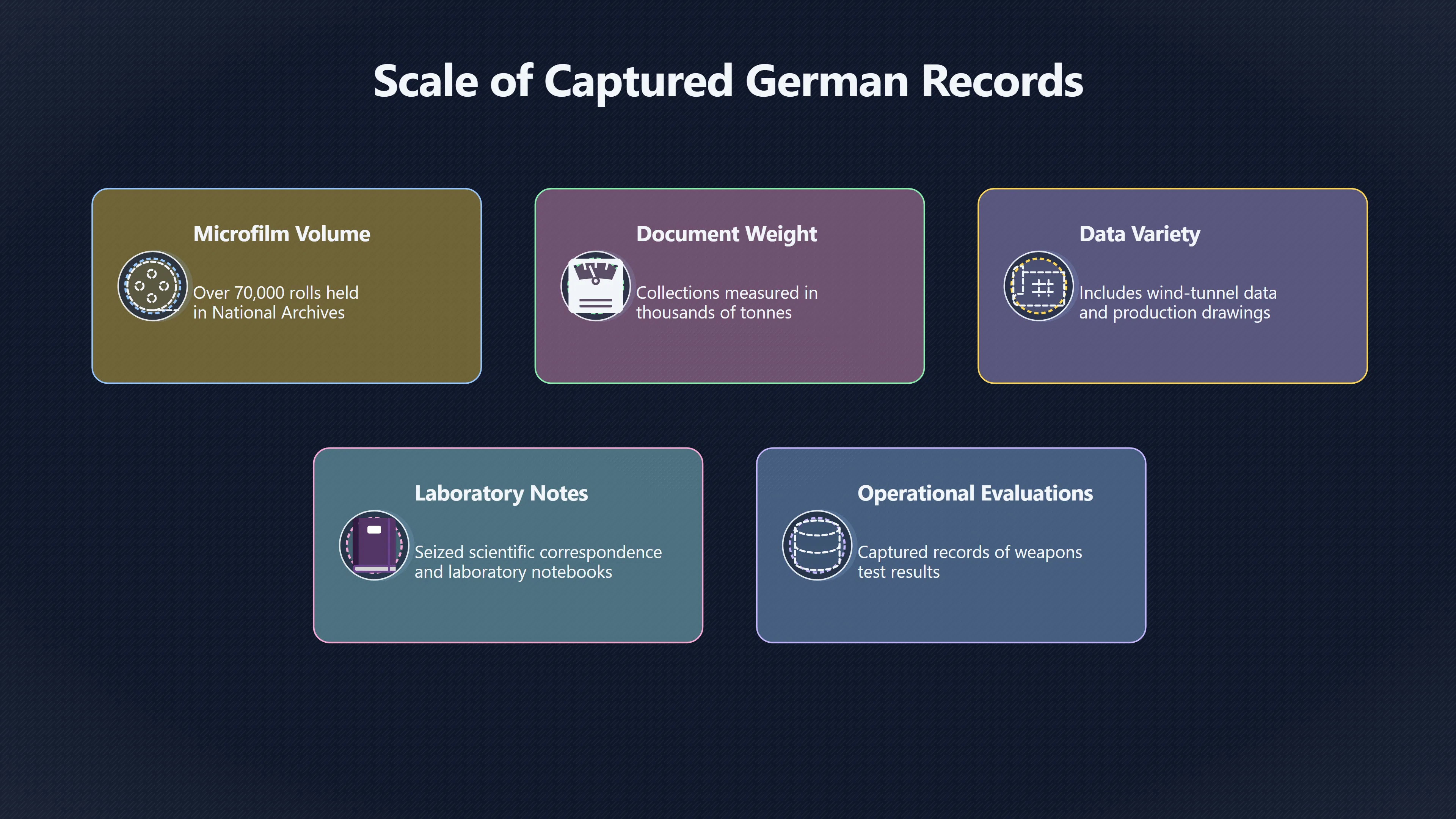
The documentary haul collected by Allied technical intelligence teams after the Second World War was enormous. Specialised units seized files from government ministries, military commands, industrial firms, laboratories and testing facilities before they could be destroyed or dispersed. The resulting archive ran into thousands of tonnes of records and, over time, tens of thousands of microfilm rolls. The United States National Archives alone now holds more than 70,000 rolls of microfilm reproducing captured German records, illustrating the extraordinary scale of the material that had to be examined, catalogued and translated.[National Archives]archives.govNational ArchivesCaptured German and Related Records on MicrofilmSeptember 12, 2016 — The National Archives holds over 70,000 rolls of mi…
The challenge was not confined to administrative archives. Technical exploitation teams collected engineering reports, wind-tunnel data, weapons test results, production drawings, scientific correspondence, laboratory notebooks and operational evaluations. The Smithsonian’s holdings of captured German and Japanese air technical documents reflect only a small surviving portion of a much wider effort to preserve and translate wartime research materials.[National Air and Space Museum]airandspace.si.eduNational Air and Space MuseumCaptured German & Japanese Air Technical DocumentsIn the final days of World War II, the advancing Allies ca…
Contemporary intelligence records show that Allied agencies were already struggling with storage, indexing and exploitation problems. An interagency conference on captured enemy documentation discussed collections measured in tons and highlighted the practical difficulties of processing and distributing such material among government departments. The problem was not finding documents; it was extracting useful knowledge from them quickly enough to matter.[CIA]cia.govINTERAGENCY CONFERENCE ON CAPTURED ENEMY…The Department of the Aray holds a collection of four tons of captured Italian Army record…
Why Translation Alone Was Not Enough
At first glance, the solution appears straightforward: translate the documents. In practice, technical translation became a bottleneck because advanced military research depended heavily on context.
A translated engineering report could describe a rocket combustion experiment, but it might not explain:
- Why a particular design path had been chosen.
- Which alternatives had already failed.
- Whether the reported results were considered reliable by the original researchers.
- How the experiment connected to parallel programmes in other facilities.
- Which production constraints shaped the final design.
Without that background, even accurate translations could be misleading. Technical terminology often carried meanings specific to a laboratory, company or research community. A translator could render words correctly while still missing the practical significance of a concept inside a larger weapons-development effort.[eScholarship]escholarship.orgScience, Technology, and Know-How: Exploitation of…by DM O'Reagan · 2014 · Cited by 8 — This dissertation is a comparative…
The scale of the archive compounded the problem. Translation resources were limited, forcing intelligence agencies to prioritise certain subjects while leaving many documents unread or only partially examined. Valuable information could remain buried in large collections because no one knew which files deserved immediate attention. This created a situation in which knowledgeable specialists became guides through the documentary landscape rather than mere sources of additional information.[eScholarship]escholarship.orgScience, Technology, and Know-How: Exploitation of…by DM O'Reagan · 2014 · Cited by 8 — This dissertation is a comparative…

The Difference Between Information and Knowledge
Captured records contained information. What intelligence organisations wanted was usable knowledge.
For example, a collection of reports might describe years of rocket development, but understanding the trajectory of that research required knowing which tests represented dead ends and which represented breakthroughs. The written record often preserved outcomes without fully capturing informal discussions, laboratory culture, engineering judgement or institutional priorities. Those elements remained in the minds of researchers and project leaders.[eScholarship]escholarship.orgScience, Technology, and Know-How: Exploitation of…by DM O'Reagan · 2014 · Cited by 8 — This dissertation is a comparative…
This distinction became especially important in rapidly developing fields such as guided missiles, aerodynamics, jet propulsion and advanced aircraft design. Allied investigators repeatedly discovered that technical expertise could accelerate interpretation of captured records far more effectively than translation alone.[National Air and Space Museum]airandspace.si.eduproject paperclip and american rocketry after world war iiNational Air and Space MuseumProject Paperclip and American Rocketry after World War IIMarch 31, 2023 — 31 Mar 2023 — Project Paperclip w…
How Specialists Connected Papers to Machines
The value of imported specialists under Project Paperclip becomes clearer when viewed against the documentary overload facing American intelligence and military organisations.
The official rationale for exploiting German and Austrian specialists emphasised their scientific and technological value to national security. These individuals were not merely translators of their own work. They could explain how captured reports related to physical hardware, test facilities, manufacturing methods and future development possibilities.[Office of the Historian]history.state.govOffice of the Historian Historical Documents1. It is the policy of this Government (SWNCC 257/5)91 to exploit selected…Read more…
A scientist who had participated in a programme could answer questions that thousands of pages of records might leave unresolved:
- Which design assumptions were considered sound?
- Which reported results were viewed sceptically by the original team?
- What undocumented modifications occurred during testing?
- Which research lines were abandoned and why?
- What practical obstacles prevented deployment?
In this sense, specialists acted as living indexes to massive document collections. They helped investigators determine where important information was located and how separate records fit together. Rather than replacing documentary exploitation, they made it more efficient.[eScholarship]escholarship.orgScience, Technology, and Know-How: Exploitation of…by DM O'Reagan · 2014 · Cited by 8 — This dissertation is a comparative…
The relationship between documents and expertise was therefore complementary. Captured files provided evidence, data and technical detail. Human experts supplied interpretation, prioritisation and organisational memory. Together they created a more complete understanding of foreign military technology than either source could provide independently.[eScholarship]escholarship.orgScience, Technology, and Know-How: Exploitation of…by DM O'Reagan · 2014 · Cited by 8 — This dissertation is a comparative…

What the Translation Bottleneck Revealed About Reverse Engineering
The enormous postwar document haul demonstrated a broader lesson about reverse engineering foreign military technology. Possessing artefacts, blueprints and reports does not automatically reveal how a technological system works.
Military technologies emerge from networks of laboratories, factories, testing organisations and scientific communities. Captured documents can preserve fragments of those networks, but understanding the relationships between the fragments often requires interpretation by people familiar with the original environment. The translation bottleneck exposed the limits of purely documentary exploitation and helped justify the recruitment of foreign specialists alongside the seizure of hardware and archives.[escholarship.org]escholarship.orgScience, Technology, and Know-How: Exploitation of…by DM O'Reagan · 2014 · Cited by 8 — This dissertation is a comparative…
For American technical intelligence after 1945, the problem was therefore not a shortage of information. It was an overabundance of it. The challenge lay in converting mountains of captured records into actionable understanding, and that task frequently depended on experts who could connect papers, machines and research programmes into a coherent whole.[archives.gov]archives.govNational ArchivesCaptured German and Related Records on MicrofilmSeptember 12, 2016 — The National Archives holds over 70,000 rolls of mi…
Amazon book picks
Further Reading
Books and field guides related to When Captured Files Needed Human Interpreters. Use these as the next step if you want deeper reading beyond the article.
The Pentagon's Brain
Provides broader context for postwar technology exploitation and analysis.
eBay marketplace picks
Marketplace Samples
Live-tested eBay searches with available results related to this page.
Endnotes
1.
Source: escholarship.org
Link:https://escholarship.org/uc/item/3w65f1hm
Source snippet
Science, Technology, and Know-How: Exploitation of...by DM O'Reagan · 2014 · Cited by 8 — This dissertation is a comparative...
2.
Source: dokumen.pub
Link:https://dokumen.pub/science-technology-and-reparations-exploitation-and-plunder-in-postwar-germany-0804717613-9780804717618.html
Source snippet
Science, Technology, and Reparations: Exploitation and...Lester Walker described the German scientific and technical holdings at Wright...
3.
Source: archives.gov
Link:https://www.archives.gov/research/captured-german-records
Source snippet
National ArchivesCaptured German and Related Records on MicrofilmSeptember 12, 2016 — The National Archives holds over 70,000 rolls of mi...
Published: September 12, 2016
4.
Source: cia.gov
Link:https://www.cia.gov/readingroom/docs/CIA-RDP81-00706R000200020009-6.pdf
Source snippet
INTERAGENCY CONFERENCE ON CAPTURED ENEMY...The Department of the Aray holds a collection of four tons of captured Italian Army record...
5.
Source: cia.gov
Link:https://www.cia.gov/readingroom/document/00010786
Source snippet
S FOR PROJECT PAPERCLIP INCLUDES...A member of the party since 1933 Ms captured files contained a stenographic transcription of a speech...
6.
Source: ia600409.us.archive.org
Link:https://ia600409.us.archive.org/35/items/annie-jacobsen-operation-paperclip.-the-secret-intelligence-program-that-brought/Annie%20Jacobsen%20-%20Operation%20Paperclip.%20The%20Secret%20Intelligence%20Program%20that%20Brought%20Nazi%20Scientists%20to%20America%20-%202014.pdf
Source snippet
PaperclipThis is a book about Nazi scientists and American government secrets. It is about how dark truths can be hidden from the public...
7.
Source: archives.gov
Title: m1934 subject list
Link:https://www.archives.gov/files/research/holocaust/microfilm-publications/m1934-subject-list.pdf
Source snippet
Subject Listing of Numbered Documents in M1934, OSS WASHINGTON SECRET INTELLIGENCE/SPECIAL FUNDS RECORDS, 1942-46. Roll #. Doc #. Subject...
8.
Source: history.state.gov
Title: Office of the Historian Historical Documents
Link:https://history.state.gov/historicaldocuments/frus1946v05/d448
Source snippet
1. It is the policy of this Government (SWNCC 257/5)91 to exploit selected...Read more...
9.
Source: airandspace.si.edu
Link:https://airandspace.si.edu/archives/archival-collections/captured-german-japanese-air-technical-documents
Source snippet
National Air and Space MuseumCaptured German & Japanese Air Technical DocumentsIn the final days of World War II, the advancing Allies ca...
10.
Source: airandspace.si.edu
Title: project paperclip and american rocketry after world war ii
Link:https://airandspace.si.edu/stories/editorial/project-paperclip-and-american-rocketry-after-world-war-ii
Source snippet
National Air and Space MuseumProject Paperclip and American Rocketry after World War IIMarch 31, 2023 — 31 Mar 2023 — Project Paperclip w...
Published: March 31, 2023
Additional References
11.
Source: history.army.mil
Link:https://history.army.mil/portals/143/Images/Publications/catalog/70-49.pdf
Source snippet
Cold War Military Records and HistoryPossibilities included micro- filming records and inventories, preparing joint documentary publicati...
12.
Source: bear.buckingham.ac.uk
Title: Creighton Angus ‘Pinching German Military and Economic Knowledge
Link:https://bear.buckingham.ac.uk/722/1/Creighton%20Angus%20-%20%27Pinching%20German%20Military%20and%20Economic%20Knowledge.pdf
Source snippet
Targeted Intelligence Capture 1942by A Creighton · 2026 — This dissertation will analyse how and why British intelligence target collatio...
13.
Source: sirismm.si.edu
Title: Captured German Technical Documents (Technical
Link:https://sirismm.si.edu/EADpdfs/NASM.XXXX.0409.pdf
Source snippet
risThis collection is consists of two rolls of microfilm containing translations of documents which were captured in Germany and compil...
14.
Source: scribd.com
Title: Operation Paperclip: Nazi Scientists in U.S
Link:https://www.scribd.com/document/896168605/Operation-Paperclip-The-History-of-the-Secret-Program
Source snippet
PDFOperation Paperclip was a secret program initiated by the United States after World War II to recruit German scientists, particularl...
15.
Source: raf.mod.uk
Link:https://www.raf.mod.uk/what-we-do/our-history/air-historical-branch/ahb-german-translations/
Source snippet
They vividly record the German perspective on wartime...Read more...
16.
Source: facebook.com
Link:https://www.facebook.com/shopgovx/posts/werner-heisenbergs-knowledge-made-him-a-top-target-his-capture-allowed-the-allie/1080200000806518/
Source snippet
es to assess the progress of the German nuclear program...
17.
Source: cambridge.org
Title: University Press & Assessment1
Link:https://www.cambridge.org/core/books/struggle-for-the-files/confiscation-of-german-documents-19441949/D4D459A8F32BC270B82A5B1E6B34602D
Source snippet
Cambridge University Press & Assessment1 - The Confiscation of German Documents, 1944–1949Preparations for the confiscation and protectio...
18.
Source: Wikipedia
Title: Operation Paperclip
Link:https://en.wikipedia.org/wiki/Operation_Paperclip
Source snippet
Operation PaperclipOperation Paperclip was a secret United States intelligence program in which more than 1,600 German scientists, eng...
19.
Source: govinfo.gov
Title: Piercing the Fog
Link:https://www.govinfo.gov/content/pkg/GOVPUB-D301-PURL-LPS47632/pdf/GOVPUB-D301-PURL-LPS47632.pdf
Source snippet
Intelligence and Army Air Forces...It examines how World War I1 was a watershed period for Air Force Intelligence and for the acquisitio...
20.
Source: youtube.com
Title: Operation Paperclip: The Hidden Program That Brought Nazi Scientists to NASA
Link:https://www.youtube.com/watch?v=0SoaehnAqoI
Source snippet
When the U.S. recruited Nazis for 'Operation Paperclip'...
Topic Tree