Within Missile Seekers
The Cost of Crying Missile Too Often
Warning systems must detect real missile threats fast while avoiding false alarms that waste countermeasures and overload crews.
On this page
- How missile approach warning systems cue countermeasures
- Why confirmation sensors matter for crew trust
- How seeker knowledge improves warning thresholds
Page outline Jump by section
Introduction
Missile approach warning systems exist to answer a question that is deceptively difficult: is the object approaching an aircraft actually a missile, and if so, how much time remains to react? In defensive aviation, a warning that arrives too late can be fatal, but a warning system that cries missile too often can be nearly as damaging. False alarms waste flares and other countermeasures, distract crews, reduce confidence in automated systems, and may eventually lead operators to ignore genuine threats. The central challenge is therefore not simply detection, but balancing detection speed against confidence. In the context of reverse engineering foreign missile technology, knowledge of seeker behaviour and missile signatures becomes a critical tool for improving that balance. By understanding what real threats look like, warning systems can be tuned to react faster to genuine attacks while rejecting harmless events more reliably.[Wikipedia]WikipediaMissile approach warning systemMissile approach warning system

The Fundamental Tradeoff: Fast Warnings Versus False Alarms
Missile approach warning systems (MAWS) are designed to detect incoming missiles and automatically cue defensive actions such as manoeuvres, flare release, chaff deployment, or directed infrared countermeasures. The difficulty is that missiles often provide only a few seconds of warning, especially in the case of short-range shoulder-fired weapons. A system that waits too long to confirm a threat may leave insufficient time for survival actions.[Wikipedia]WikipediaMissile approach warning systemMissile approach warning system
Yet every warning decision is made under uncertainty. Sensors collect data, estimate whether a missile is present, and trigger an alert once a confidence threshold is reached. Raising that threshold reduces false alarms but requires more evidence and therefore more time. Lowering it produces earlier alerts but increases the risk of reacting to non-threats. Technical literature on missile warning systems explicitly identifies this as an inherent conflict: reducing false alarms generally requires gathering more information, which reduces available time-to-impact.[Wikipedia]WikipediaMissile approach warning systemMissile approach warning system
For aircraft operators, the consequences are practical rather than theoretical:
- Crews become distracted during critical flight phases.
- Automated countermeasure systems may activate unnecessarily.
- Confidence in the warning system declines over time.[Wikipedia]WikipediaMissile approach warning systemMissile approach warning system
- Genuine threats risk being discounted as yet another false indication.
Conversely, a warning system that is overly conservative may achieve impressive false-alarm statistics while failing to provide enough reaction time during an actual missile engagement.[Wikipedia]WikipediaMissile approach warning systemMissile approach warning system
How Missile Approach Warning Systems Cue Countermeasures
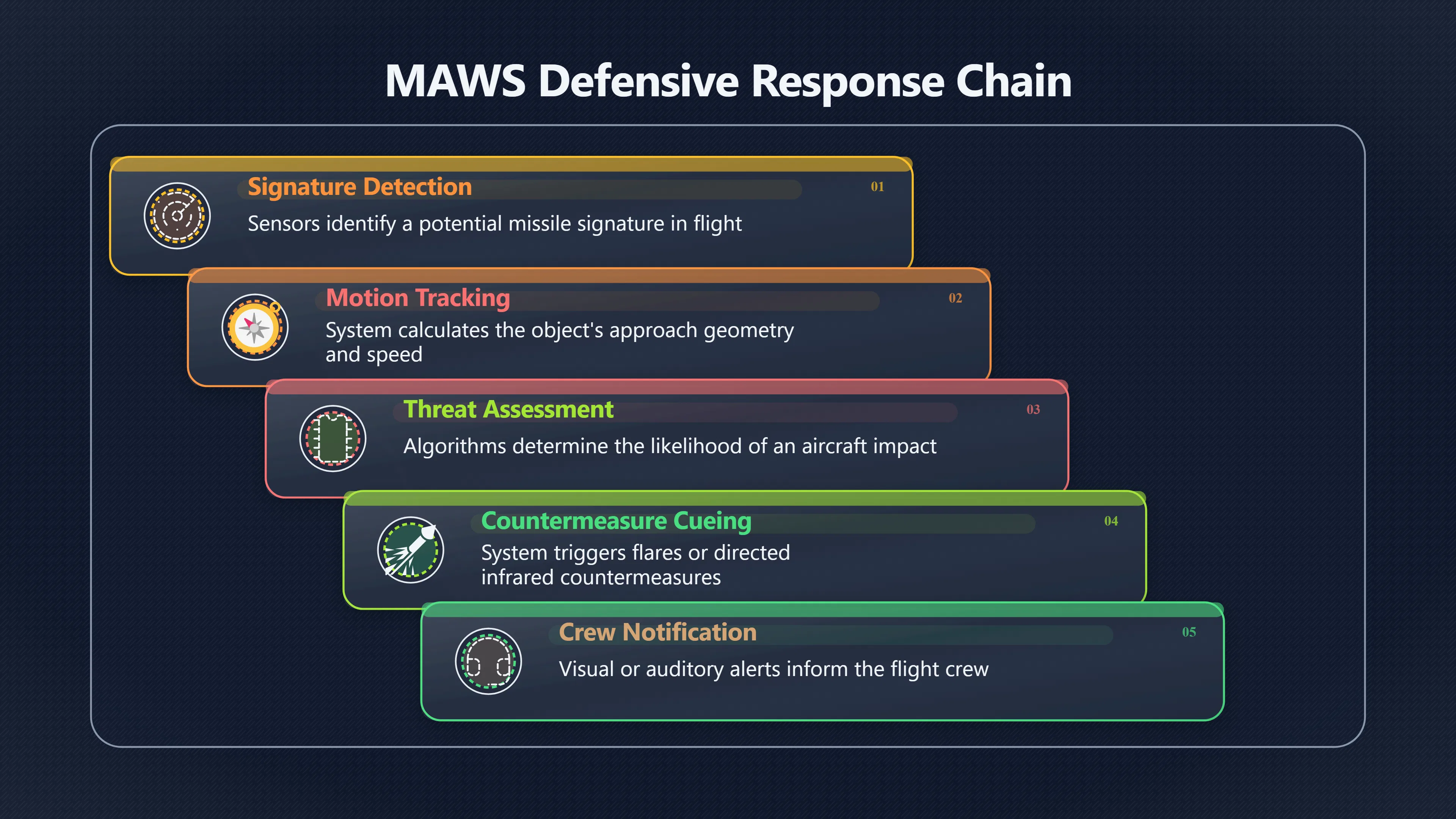
Modern warning systems are not merely detectors; they are decision engines that drive defensive responses. Once a potential missile launch is identified, the warning chain typically proceeds through several stages:
- Detection of a possible missile signature.
- Tracking of the object’s motion and approach geometry.
- Threat assessment to determine whether the object is likely to impact the aircraft.
- Countermeasure cueing based on estimated threat type and urgency.
- Crew notification with visual or auditory alerts.
The quality of the initial warning directly affects every subsequent action. If a warning is false, flares may be released unnecessarily or a directional jammer may be pointed at empty sky. If the warning is genuine but delayed, countermeasures may arrive too late to alter the missile’s tracking solution.[wikipedia.org]WikipediaMissile approach warning systemMissile approach warning system
Different sensing technologies approach this problem differently. Ultraviolet systems often exploit the relative absence of natural background radiation in specific wavelength bands, helping reduce false detections. Infrared systems may achieve longer detection ranges but must contend with intense environmental clutter from the sun, terrain, clouds, fires, and reflections. Radar-based warning systems can estimate range and velocity directly but face their own challenges from radio-frequency clutter and interference. Each architecture reflects a different compromise between detection speed, range, and false-alarm resistance.[wikipedia.org]WikipediaMissile approach warning systemMissile approach warning system
Why Confirmation Sensors Matter for Crew Trust
One of the most significant developments in aircraft self-protection has been the introduction of confirmation layers that validate an initial warning before expensive or disruptive defensive actions occur.
The logic is straightforward. A primary warning sensor may be optimised for maximum sensitivity and early detection. A secondary sensor then attempts to verify whether the suspected missile possesses characteristics expected of a real threat. This approach seeks to preserve reaction time while reducing false alarms.[HENSOLDT]hensoldt.netMACSThe Missile Approach Confirmation Sensor (MACS) eliminates false alarms and reduces unnecessary stress situations for the pil…
An example is the use of dedicated missile confirmation sensors that activate after an initial missile warning. These systems collect additional information such as closing velocity, distance, and estimated time-to-impact before validating the threat. Manufacturers explicitly market such confirmation systems as tools for eliminating false alarms and reducing unnecessary crew stress while maintaining the warning timeline established by the primary detector.[HENSOLDT]hensoldt.netMACSThe Missile Approach Confirmation Sensor (MACS) eliminates false alarms and reduces unnecessary stress situations for the pil…
Crew trust is a major operational factor. Historical experience across aviation safety systems shows that operators quickly develop mental models of system reliability. If alerts occur repeatedly without visible threats, pilots may become sceptical. Missile warning systems therefore face a psychological challenge in addition to a technical one. A system with excellent laboratory performance can lose practical value if crews stop believing it. Technical requirements for MAWS frequently emphasise not only high probability of warning but also sufficiently low false-alarm rates because aircrew confidence depends on both.[Wikipedia]WikipediaMissile approach warning systemMissile approach warning system
How Seeker Knowledge Improves Warning Thresholds
Reverse engineering foreign missile seekers provides one of the most powerful ways to improve warning-system discrimination.
A missile seeker leaves observable clues during flight. Depending on design, these may include characteristic acceleration profiles, closing speeds, seeker scan patterns, roll rates, plume signatures, or spectral features. When intelligence organisations recover missile components, analyse captured hardware, or study combat debris, they gain information that can be fed back into warning-system algorithms.[Google Patents]patents.google.comGoogle PatentsAirborne distributed pulse doppler radar missile warning…The system comprises a library of known missile parameters incl…
The benefit is not simply identifying a missile after launch. Rather, seeker knowledge helps define what a real threat should look like. Warning software can compare detected objects against known missile behaviour and reject events that do not match expected profiles.
Examples of useful threat parameters include:
- Velocity envelopes.
- Acceleration limits.
- Seeker spin frequencies.[patents.google.com]patents.google.comGoogle PatentsAirborne distributed pulse doppler radar missile warning…The system comprises a library of known missile parameters incl…
- Roll rates.
- Characteristic propulsion signatures.
- Expected approach geometries.
Patent literature describing advanced missile warning concepts explicitly references libraries of known missile parameters used to validate alarms, optimise countermeasure responses, and minimise false alarms. The same documents describe updating these libraries as new threat intelligence becomes available.[Google Patents]patents.google.comGoogle PatentsAirborne distributed pulse doppler radar missile warning…The system comprises a library of known missile parameters incl…
This creates a direct connection between foreign materiel exploitation and operational survivability. Every recovered seeker, captured component, or analysed missile fragment can refine the thresholds that determine whether a future warning is accepted, rejected, or escalated.
Adapting to New Missile Generations
The false-alarm problem is not static because missile technology evolves.
Many early warning systems were optimised against missiles with bright, easily detectable rocket plumes. Modern missile developments increasingly seek to reduce observable signatures through changes in propellants, exhaust design, and flight profiles. Lower-signature weapons may resemble background clutter more closely, forcing warning systems to detect weaker signals while still avoiding false positives.[TNO Repository]repository.tno.nlAimed primarily at detecting short-range, shoulder-fired…Read more…
This pressure often drives sensor fusion and multi-band approaches. Dual-colour infrared warning systems, for example, attempt to distinguish genuine missile signatures from environmental clutter by comparing behaviour across multiple spectral bands. Research on such systems highlights improved detection performance alongside reduced false-alarm rates.[ResearchGate]researchgate.netResearch Gate(PDF) OPTICS FOR DUAL COLOR INFRARED MISSILEResearchGate(PDF) OPTICS FOR DUAL COLOR INFRARED MISSILE-…December 1, 2011 — Dual color missile approach warning system (DCMAWS) opera…
The challenge becomes increasingly important as aircraft face a mixture of legacy missiles, modern low-signature threats, and dense civilian or battlefield environments filled with competing sources of heat, light, and electromagnetic emissions.
The Real Cost of Crying Missile Too Often
The false-alarm tradeoff is ultimately a problem of resource management and trust under extreme time pressure. Aircraft crews have only seconds to react to many missile threats, making early warning essential. However, every false warning carries costs in workload, countermeasure expenditure, and confidence.
The most effective solutions therefore do not simply seek the lowest false-alarm rate or the earliest possible warning. Instead, they combine rapid detection, confirmation sensors, threat libraries, and continuously updated intelligence derived from missile exploitation programmes. Reverse engineering foreign seekers contributes directly to this process by revealing the observable behaviours that distinguish real missiles from background clutter. The result is not perfect certainty, but a more informed balance between reacting too often and reacting too late.[hensoldt.net]hensoldt.netMACSThe Missile Approach Confirmation Sensor (MACS) eliminates false alarms and reduces unnecessary stress situations for the pil…

Amazon book picks
Further Reading
Books and field guides related to The Cost of Crying Missile Too Often. Use these as the next step if you want deeper reading beyond the article.
Introduction to Airborne Radar
Provides sensor and detection fundamentals behind aircraft warning systems.
Tactical Missile Design
Explains missile performance and seeker constraints that warning systems must recognise.
Missile Guidance and Control Systems
Shows how missile motion and guidance behaviour inform warning thresholds.
Electronic Warfare and Radar Systems Engineering Handbook
Contains practical EW and radar system material relevant to warning and countermeasure logic.
eBay marketplace picks
Marketplace Samples
Live-tested eBay searches with available results related to this page.



Endnotes
1.
Source: Wikipedia
Title: Missile approach warning system
Link:https://en.wikipedia.org/wiki/Missile_approach_warning_system
2.
Source: patents.google.com
Link:https://patents.google.com/patent/US7425916B2/en
Source snippet
Google PatentsAirborne distributed pulse doppler radar missile warning...The system comprises a library of known missile parameters incl...
3.
Source: iai.co.il
Link:https://www.iai.co.il/wp-content/uploads/2025/10/ELTA-ELM-2160-Missile-Approach-Warning-System-MAWS-1.pdf
Source snippet
Missile Approach Warning System (MAWS)The MAWS detects all types of incoming missiles such as. IR guided MANPADS from multiple sources si...
4.
Source: researchgate.net
Link:https://www.researchgate.net/publication/241361323_Two-color_infrared_missile_warning_sensors
Source snippet
Two-color infrared missile warning sensors | Request PDFMissile warning systems operating in the ultraviolet part of the spectrum have be...
5.
Source: hensoldt.net
Link:https://www.hensoldt.net/products/macs-missile-approach-confirmation-sensor
Source snippet
MACSThe Missile Approach Confirmation Sensor (MACS) eliminates false alarms and reduces unnecessary stress situations for the pil...
6.
Source: repository.tno.nl
Link:https://repository.tno.nl/SingleDoc?docId=21723
Source snippet
Aimed primarily at detecting short-range, shoulder-fired...Read more...
7.
Source: researchgate.net
Title: Research Gate(PDF) OPTICS FOR DUAL COLOR INFRARED MISSILE
Link:https://www.researchgate.net/publication/309208826_OPTICS_FOR_DUAL_COLOR_INFRARED_MISSILE-APPROACH-WARNING-SYSTEM
Source snippet
ResearchGate(PDF) OPTICS FOR DUAL COLOR INFRARED MISSILE-...December 1, 2011 — Dual color missile approach warning system (DCMAWS) opera...
Published: December 1, 2011
8.
Source: hensoldt.net
Link:https://www.hensoldt.net/domains/air/protection/self-protection-systems
Source snippet
Self-protection systemsInfrared-based missile approach warning systems are designed to detect incoming missiles from long distances, prov...
9.
Source: researchgate.net
Link:https://www.researchgate.net/publication/229043790Missile_warning_and_countermeasure_systems_in-flight_testing_by_threat_simulation_and_countermeasure_analysis_in_the_field-_art_no_62061Y
Source snippet
Missile warning and countermeasure systems in-flight...4 May 2015 — Our method outperforms all the compared algorithms on the ground-tru...
Published: May 2015
10.
Source: youtube.com
Title: Elbit Systems / Unified EW Airborne Self-Protection Suite
Link:https://www.youtube.com/watch?v=JBj5EVVdWao
Source snippet
HENSOLDT MILDS – Missile Launch Detection Sensors...
11.
Source: youtube.com
Title: HENSOLDT MILDS – Missile Launch Detection Sensors
Link:https://www.youtube.com/watch?v=02I1CyCoi70
Source snippet
The U.S. Is Racing to Multiply Its Missile Warning Satellites...
12.
Source: baesystems.com
Link:https://www.baesystems.com/en/product/anaar57-common-missile-warning-system-cmws
Source snippet
AN/AAR-57 Common Missile Warning System (CMWS)BAE Systems' AN/AAR-57 Common Missile Warning System helps protect against infrared missile...
Additional References
13.
Source: emsopedia.org
Link:https://www.emsopedia.org/entries/missile-warning-system/
Source snippet
Missile Warning SystemThe MWS (Missile Warning System) is a passive defence warning system aiming at detecting, tracking and giving warni...
14.
Source: ftp.idu.ac.id
Link:https://ftp.idu.ac.id/wp-content/uploads/ebook/tdg/MILITARY%20PLATFORM%20DESIGN/Missile%20Guidance%20And%20Control%20Systems.pdf
Source snippet
Guidance and Control SystemsThe design of a guided weapon. (i.e., a missile) is a large undertaking, requiring the team effort of many en...
15.
Source: ci-systems.com
Link:https://www.ci-systems.com/lab-simulations-for-advanced-maw-testing
Source snippet
and [maintenance]({{ 'maintenance/' | relative_url }}) of missile approach warning systems in aviation >>...
16.
Source: facebook.com
Link:https://www.facebook.com/groups/1750146961953560/posts/2639544369680477/
Source snippet
uver and deploy the available countermeasures...Read more...
17.
Source: trendxinsights.com
Title: missile warning system market
Link:https://trendxinsights.com/syndicated-market-research-reports/missile-warning-system-market/
Source snippet
Size, Share & ForecastThe Missile Warning System Market was valued at USD 2.80 billion in 2025 and is projected to reach USD 6.11 billion...
18.
Source: electronics.leonardo.com
Link:https://electronics.leonardo.com/documents/16277707/18358405/MAIR%2BMultiple%2BAperture%2BIR%2BMissile%2BWarning%2BSystem%2B%28mm09000%29%2BLQ.pdf
Source snippet
Multiple Aperture Infrared Missile Warning SystemMAIR provides immediate warnings, high detection probability and very low false alarm ra...
19.
Source: applied-infrared.com.au
Title: Missile Warning Testers
Link:https://applied-infrared.com.au/product/missile-warning-testers/
Source snippet
Hand-Held Or Long Range. UV...CI Systems provides a wide range of Missile Warning Testers. Accurately simulating approaching missile rad...
20.
Source: youtube.com
Title: War Thunder WHAT is MAWS? Do we NEED it in fixed wing aircraft?
Link:https://www.youtube.com/watch?v=PGiUDQdmLL4
Source snippet
US Army Receives Delivery of 400 Advanced Missile Warning Systems...
21.
Source: youtube.com
Title: US Army Receives Delivery of 400 Advanced Missile Warning Systems
Link:https://www.youtube.com/watch?v=_EV6UgxY4zI
Source snippet
Elbit Systems / Unified EW Airborne Self-Protection Suite...
22.
Source: radartutorial.eu
Link:https://www.radartutorial.eu/06.antennas/pubs/a566236.pdf
Source snippet
Electronic Warfare and Radar Systems Engineering...1 Apr 1997 — This handbook is designed to aid electronic warfare and radar systems en...
Topic Tree