Within Threat Myths
When Caution Turns Into Threat Inflation
Threat inflation often begins when analysts fill unknowns with the most dangerous plausible interpretation.
On this page
- Why underestimation feels more dangerous than overestimation
- How mirror imaging distorts foreign weapon judgments
- When alarming assumptions still lead to useful preparation
Page outline Jump by section
Introduction
Before engineers, intelligence services or test pilots can inspect a foreign weapon directly, they must judge it through fragments of evidence: photographs, radar tracks, official claims, combat rumours and partial technical data. In that environment, military organisations often default to the most dangerous plausible interpretation. The logic is understandable. Underestimating an adversary can produce strategic surprise, whereas overestimating one may seem merely expensive. Yet this asymmetry can turn uncertainty itself into a force that inflates perceived threats.

In the context of reverse engineering foreign military technology, worst-case planning is not simply caution. It is a specific mechanism that converts unknowns into assumed capabilities. Until physical inspection provides evidence about design trade-offs, reliability, production limits or actual performance, analysts may fill gaps with assumptions that systematically favour the enemy system. The result is often a weapon that appears more capable on paper than it proves to be when examined in detail.[Quincy Institute]quincyinst.orgthreat inflation and the chinese military 2Quincy InstituteThreat Inflation and the Chinese Military2 Jun 2022 — Threat inflation is a major problem in evaluating China's military…
Why Underestimation Feels More Dangerous Than Overestimation
Military institutions operate under powerful incentives that make pessimistic assumptions attractive. If a threat is underestimated and later proves real, the consequences can be severe: battlefield losses, political blame and accusations of intelligence failure. By contrast, overestimating a threat often appears safer because the costs are distributed across budgets, procurement programmes and training decisions rather than concentrated in a single dramatic event.
This creates a structural bias. When analysts encounter uncertainty about a foreign aircraft, missile or air-defence system, they may ask not what is most likely but what is most dangerous if true. Over time, the distinction between possibility and probability can blur. A capability that is merely plausible begins to be treated as expected. Intelligence scholars and practitioners have long noted that threat assessments can drift upward when unknowns are consistently resolved in the direction of maximum danger.[icct.nl]icct.nlChapter 20 The Role of Intelligence in the Prevention of…October 13, 2021 — by KA Duncan · Cited by 5 — It does this by converting…
In foreign technology assessment, this tendency is especially strong because many critical characteristics remain hidden before inspection. A missile’s advertised range may be known, but not the payload compromises required to achieve it. A fighter’s appearance may suggest high performance, while its engine reliability, maintenance burden or sensor limitations remain unknown. In a worst-case framework, the hidden variables are often assumed to be favourable rather than constraining.
The effect can become self-reinforcing. If planners assume the adversary possesses the maximum plausible capability, they may demand countermeasures sized for that assumption. Those countermeasures then become evidence that the threat must be serious, further legitimising the original estimate.
How the Mechanism Works Before Hardware Inspection
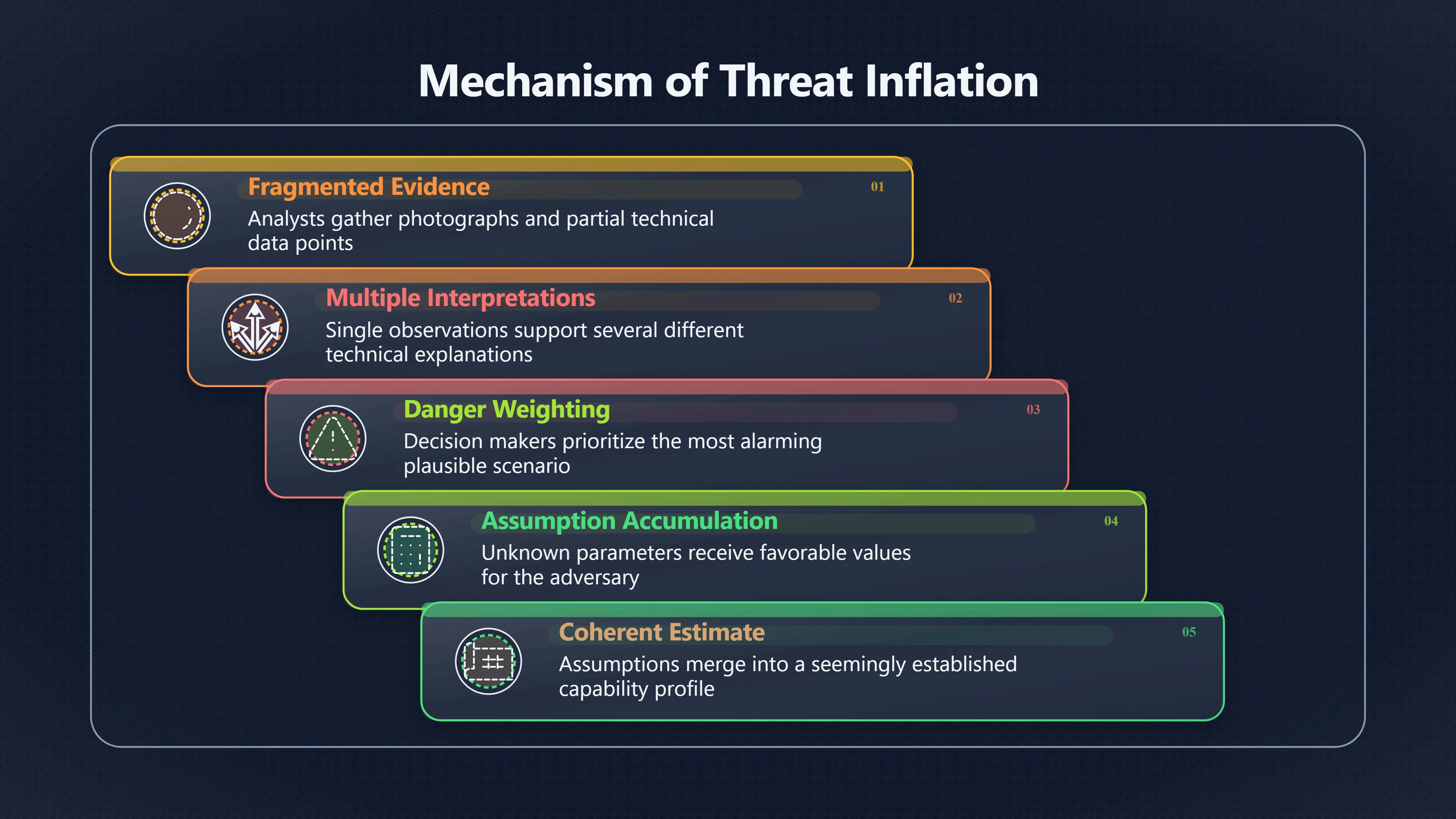
Threat inflation through worst-case planning usually follows a recognisable sequence.
- Information is incomplete. Analysts possess only fragments of technical evidence.
- Multiple interpretations are possible. The same observation may support several explanations.
- The most dangerous explanation receives extra weight. Decision-makers focus on avoiding surprise.
- Assumptions accumulate. Each unknown parameter is assigned a favourable value for the adversary.
- The resulting estimate appears coherent. The collection of assumptions begins to resemble an established capability rather than a hypothesis.
The crucial point is that each individual assumption may appear reasonable. The distortion emerges when many uncertain variables are simultaneously assigned their most threatening values. A radar might be assumed to achieve maximum range, a missile maximum accuracy, an aircraft maximum readiness and a production programme maximum efficiency. The combined result can greatly exceed the system’s real-world effectiveness.
Historical analyses of threat inflation repeatedly identify this pattern: uncertainty does not merely create ignorance; it creates opportunities for assumptions that systematically bias estimates upward.[quincyinst.org]quincyinst.orgthreat inflation and the chinese military 2Quincy InstituteThreat Inflation and the Chinese Military2 Jun 2022 — Threat inflation is a major problem in evaluating China's military…
How Mirror-Imaging Distorts Foreign Weapon Judgments
Worst-case planning often interacts with another analytical problem: mirror-imaging. This occurs when analysts assume a foreign military would make the same engineering, doctrinal or operational choices they would make themselves. Intelligence literature has repeatedly identified mirror-imaging as a major source of assessment error.[ialeia.org]ialeia.orgPDF] The Psychology of Intelligence AnalysisIALEIA[PDF] The Psychology of Intelligence AnalysisDecember 13, 2005 — Mirror-imaging is a common source of analytical error, and one tha…
In technology assessment, mirror-imaging can inflate perceived capability in several ways:
- Analysts may assume foreign engineers solved technical problems using methods familiar to advanced domestic industries.
- They may assume manufacturing quality matches the standards of their own defence sector.
- They may infer that a rival values the same performance characteristics and therefore made similar design trade-offs.
- They may project their own operational concepts onto foreign forces.
For example, an observer might see a large radar antenna and assume sophisticated signal-processing capabilities because that is how their own military would exploit such hardware. In reality, the foreign system may compensate for software limitations with larger physical components. Without direct examination, both interpretations can appear plausible.
Studies of intelligence bias consistently warn that analysts often substitute their own decision-making framework for that of the adversary. When combined with worst-case thinking, mirror-imaging can transform an unknown feature into evidence of exceptional capability rather than a question requiring further investigation.[springer.com]link.springer.comCognitive biases in military intelligence analysis: amplification…by Y Huo · 2026 — Mirror imaging refers to the tendency of i…

The Team B Lesson: When Alternative Analysis Becomes Escalation
One of the most discussed examples of worst-case reasoning in strategic intelligence emerged during the 1976 Team B exercise in the United States. Team B was created to challenge existing intelligence estimates of Soviet capabilities and intentions. Its members argued that prevailing assessments underestimated the Soviet threat and that more alarming interpretations should be considered.[state.gov]history.state.govd judgments that underpin NIE evaluations of Soviet strategic objectives.Read more…
The significance of Team B is not that alternative analysis is inherently flawed. Competitive analysis can reveal blind spots and challenge complacency. The lesson is that a process designed to guard against underestimation can itself become vulnerable to systematic overestimation if uncertainty is repeatedly resolved in favour of the most threatening explanation.
Later debates over Team B focused heavily on whether some of its assumptions exceeded what available evidence could support. The episode remains important because it illustrates how institutional fear of surprise can encourage analysts to treat worst-case possibilities as likely realities.[pitt.edu]sites.pitt.eduUniversity of Pittsburgh Team B Intelligence CoupsTeam B intelligence coups'' in the original 1976 Team B exercise and the 1998 Rumsfeld.Read more…
For foreign technology assessment, the implication is straightforward: alternative hypotheses are valuable, but they become problematic when the burden of proof shifts from demonstrating a capability to merely imagining it.
When Alarming Assumptions Still Lead to Useful Preparation
Worst-case planning persists because it serves legitimate purposes. Military organisations cannot ignore low-probability but catastrophic possibilities. Preparing for dangerous surprises is part of their mission.
The challenge is distinguishing between preparation and prediction.
Useful worst-case planning asks:
- What if this capability exists?
- How would we respond?
- What evidence would confirm or disprove it?
Threat inflation occurs when planners instead assume:
- The capability probably exists.
- The most effective version of it exists.
- Counter-evidence is less important than precaution.
Modern intelligence practice increasingly emphasises structured analytical methods precisely because they force analysts to separate assumptions, evidence and confidence levels. Such approaches do not eliminate uncertainty, but they make it easier to identify where judgments depend on worst-case reasoning rather than demonstrated facts.[centrumbalticum.org]centrumbalticum.orgCentrum BalticumKristian Gustafson: Structured intelligence analysis for the…January 22, 2026 — 22 Jan 2026 — Even if accuracy improve…
In reverse engineering foreign military technology, physical access to hardware often becomes the decisive corrective. Once a missile, aircraft, radar or electronic system can be inspected, tested or dismantled, hidden compromises emerge. Engineers discover limitations alongside strengths. Reliability, maintainability, manufacturing quality and software architecture become measurable rather than hypothetical. The role of exploitation is therefore not only to reveal what an adversary can do, but also to determine which frightening assumptions were never true.
Why the Mechanism Matters
The most important consequence of worst-case planning is not simply that it can exaggerate threats. It changes the way uncertainty is interpreted. Unknowns cease to be gaps in knowledge and become evidence for maximum capability.
Before hardware inspection, that transformation can make foreign systems appear more advanced, more reliable and more operationally effective than the available evidence warrants. The mechanism is powerful because it grows from a rational desire to avoid surprise. Yet the same caution that protects against underestimation can also create inflated assessments that survive until direct technical evidence forces a reassessment. In the history of foreign military technology analysis, many of the most revealing discoveries have not been hidden strengths uncovered by inspection, but hidden limitations that uncertainty had previously concealed.
Amazon book picks
Further Reading
Books and field guides related to When Caution Turns Into Threat Inflation. Use these as the next step if you want deeper reading beyond the article.
Psychology of Intelligence Analysis
Directly addresses biases and worst-case thinking in threat assessment.
Thinking, Fast and Slow
Helps explain cognitive biases that contribute to threat inflation.
Intelligence: From Secrets to Policy
Explains how uncertainty affects national security judgments.
eBay marketplace picks
Marketplace Samples
Live-tested eBay searches with available results related to this page.
Endnotes
1.
Source: usni.org
Title: exaggerating threats shortchanges future
Link:https://www.usni.org/magazines/proceedings/2002/september/exaggerating-threats-shortchanges-future
Source snippet
Naval InstituteExaggerating Threats Shortchanges the Future | ProceedingsWhere we cannot follow such progress with precision, it is safes...
2.
Source: icct.nl
Link:https://icct.nl/sites/default/files/2023-01/Chapter-20-Handbook-.pdf
Source snippet
Chapter 20 The Role of Intelligence in the Prevention of...October 13, 2021 — by KA Duncan · Cited by 5 — It does this by converting...
Published: October 13, 2021
3.
Source: jstor.org
Link:https://www.jstor.org/stable/4137546
Source snippet
Threat Inflation and the Failure of the Marketplace of Ideasby C Kaufmann · 2004 · Cited by 593 — Assessing the risk of future failu...
4.
Source: ialeia.org
Title: [PDF] The Psychology of Intelligence Analysis
Link:https://www.ialeia.org/docs/Psychology_of_Intelligence_Analysis.pdf
Source snippet
IALEIA[PDF] The Psychology of Intelligence AnalysisDecember 13, 2005 — Mirror-imaging is a common source of analytical error, and one tha...
Published: December 13, 2005
5.
Source: link.springer.com
Link:https://link.springer.com/article/10.1186/s40359-026-04443-3
Source snippet
Cognitive biases in military intelligence analysis: amplification...by Y Huo · 2026 — Mirror imaging refers to the tendency of i...
6.
Source: quincyinst.org
Title: threat inflation and the chinese military 2
Link:https://quincyinst.org/research/threat-inflation-and-the-chinese-military-2/
Source snippet
Quincy InstituteThreat Inflation and the Chinese Military2 Jun 2022 — Threat inflation is a major problem in evaluating China's military...
7.
Source: globalsecurity.org
Link:https://www.globalsecurity.org/intell/ops/bias.htm
Source snippet
Intelligence Analytical BiasesMirror imaging occurs when analysts assume that foreign actors will think, perceive, and decide in ways sim...
8.
Source: rsdi.ae
Title: seeing what we want to see how cognitive biases distort security assessments
Link:https://rsdi.ae/en/publications/seeing-what-we-want-to-see-how-cognitive-biases-distort-security-assessments
Source snippet
Rabdan Security and Defence InstituteHow Cognitive Biases Distort Security Assessments20 Sept 2025 — Intelligence assessments are particu...
9.
Source: history.state.gov
Link:https://history.state.gov/historicaldocuments/frus1969-76v35/d171
Source snippet
d judgments that underpin NIE evaluations of Soviet strategic objectives.Read more...
10.
Source: armscontrolwonk.com
Title: team b
Link:https://www.armscontrolwonk.com/archive/403488/team-b/
Source snippet
16 Jul 2012 — Team B was led by Soviet historian Richard Pipes. It included Gen. Danny Graham, William Van Cleave, Paul Nitze and Paul Wo...
11.
Source: americanprogress.org
Title: its time to bench team b
Link:https://www.americanprogress.org/article/its-time-to-bench-team-b/
Source snippet
It's Time to Bench “Team B”18 Aug 2004 — Bush created a Team B to assess a 1975 National Intelligence Estimate by his agency on Soviet St...
12.
Source: sites.pitt.edu
Title: University of Pittsburgh Team B Intelligence Coups
Link:https://sites.pitt.edu/~gordonm/JPubs/TeamBqjs.pdf
Source snippet
''Team B intelligence coups'' in the original 1976 Team B exercise and the 1998 Rumsfeld.Read more...
13.
Source: Wikipedia
Title: Team B
Link:https://en.wikipedia.org/wiki/Team_B
Source snippet
Team BTeam B was a competitive analysis exercise commissioned by the Central Intelligence Agency (CIA) to analyze threats the Soviet U...
14.
Source: centrumbalticum.org
Link:https://centrumbalticum.org/kristian-gustafson-structured-intelligence-analysis-for-the-modern-military
Source snippet
Centrum BalticumKristian Gustafson: Structured intelligence analysis for the...January 22, 2026 — 22 Jan 2026 — Even if accuracy improve...
Published: January 22, 2026
Additional References
15.
Source: veda.polac.cz
Link:https://veda.polac.cz/wp-content/uploads/2019/10/How-Psychological-Biases-Affect-Intelligence-Analysis.pdf
Source snippet
Psychological Biases Affect Intelligence Analysisby AC Arslan · Cited by 1 — While mirror imaging results in strategic and tactical surpr...
16.
Source: tnsr.org
Link:https://tnsr.org/2025/09/the-world-is-more-uncertain-than-you-think-assessing-and-combating-overconfidence-among-2000-national-security-officials/
Source snippet
The World Is More Uncertain Than You Think3 Sept 2025 —... worse than 0.250. In other words, most national security... threat inflation...
17.
Source: cia.gov
Link:https://www.cia.gov/readingroom/docs/CIA-RDP80-00630A000300030001-4.pdf
Source snippet
roach to analysis and that to allow it to do so would be the mark...Read more...
18.
Source: international-review.icrc.org
Title: the overlooked importance of intelligence analysis in ihl 928
Link:https://international-review.icrc.org/sites/default/files/reviews-pdf/2025-06/the-overlooked-importance-of-intelligence-analysis-in-ihl-928.pdf
Source snippet
overlooked importance of intelligence analysis in IHLby L Voss · 2025 · Cited by 4 — 20 It can provide insight into an enemy's intentions...
19.
Source: armyupress.army.mil
Title: mil Thriving in Uncertainty From Predictive- to Probability
Link:https://www.armyupress.army.mil/Journals/Military-Review/English-Edition-Archives/Mar-Apr-2019/54-Thriving/
Source snippet
threat/adversary courses of action and... No mission event is better or worse than another if it is a possible event within the operatio...
20.
Source: researchgate.net
Title: 236805126 Of Note Mirror Imaging and Its Dangers
Link:https://www.researchgate.net/publication/236805126_Of_Note_Mirror-Imaging_and_Its_Dangers
Source snippet
Of Note: Mirror-Imaging and Its Dangers9 Feb 2026 — Mirror-imaging frequently results in gross distortions of intelligence and raw data...
21.
Source: researchgate.net
Title: (PDF) The Complexity of Intelligence Estimates‖
Link:https://www.researchgate.net/publication/228488886_The_Complexity_of_Intelligence_Estimates
Source snippet
Risk Assessment: A Call for. Change‖ from the National Academies Press). 1.1... Any other approach is wishful thinking at best and dange...
22.
Source: cgsc.contentdm.oclc.org
Link:https://cgsc.contentdm.oclc.org/digital/api/collection/p4013coll3/id/4346/download
Source snippet
Intelligence: Risk Reduction Redundancy in...30 Jun 2022 — Commanders develop hazard controls through a two-stage risk management proces...
23.
Source: cia.gov
Title: CIA RDP85B00134R000200080004 7
Link:https://www.cia.gov/readingroom/docs/CIA-RDP85B00134R000200080004-7.pdf
Source snippet
Adelman in the attached article, the conclusions of Team B on the Soviet threat have fared...Read more...
24.
Source: youtube.com
Title: The [Mi G-25]({{ ‘mi-g-25/’ | relative_url }})’s BIGGEST SECRET — Why America FEARED a Plane That Was a LIE
Link:https://www.youtube.com/watch?v=E9C8VZCLKvk
Source snippet
Victor Belenko | The Pilot Who Stole the Soviet Union’s Greatest Secret...
Topic Tree