Within Missile Seekers
What Broken Missile Seekers Can Still Tell
Damaged seeker parts can still expose sensor type, design age, component choices and likely vulnerabilities for defensive threat models.
On this page
- Which seeker fragments are most revealing
- How components point to design generation and supply chains
- Why incomplete debris can still improve defensive models
Page outline Jump by section
Introduction
Recovered missile fragments rarely provide a complete picture of a weapon, yet even heavily damaged seeker components can reveal far more than their appearance suggests. For defensive analysts, the question is not whether a missile can be rebuilt from debris, but what the surviving pieces reveal about the seeker’s technological generation, sensing method, manufacturing base and likely battlefield behaviour. A cracked infrared detector, a fragment of radar antenna, a damaged gimbal assembly or a surviving processor board can transform a vague threat estimate into a more evidence-based assessment. Modern foreign-materiel exploitation programmes place high value on such debris because seeker remnants often preserve clues about sensor sophistication, component sourcing and countermeasure resistance even when the rest of the missile is destroyed.[iiss.org]iiss.orgTracking the Components of Missiles and UAVs Used byTracking the Components of Missiles and UAVs Used by…September 24, 2025 — It examines the technological make-up of Russian, Irania…
Within missile seeker reverse engineering, fragments are therefore not merely battlefield leftovers. They function as physical evidence that helps defenders estimate what a missile could see, how it tracked targets, and whether it belongs to an older analogue-era design, a digital seeker generation, or a more recent imaging and multi-sensor class of weapon.
Which Seeker Fragments Are Most Revealing?
Not all debris carries equal intelligence value. Certain components provide disproportionately useful information because they sit at the centre of the missile’s sensing and tracking process.
The most revealing fragments often include:
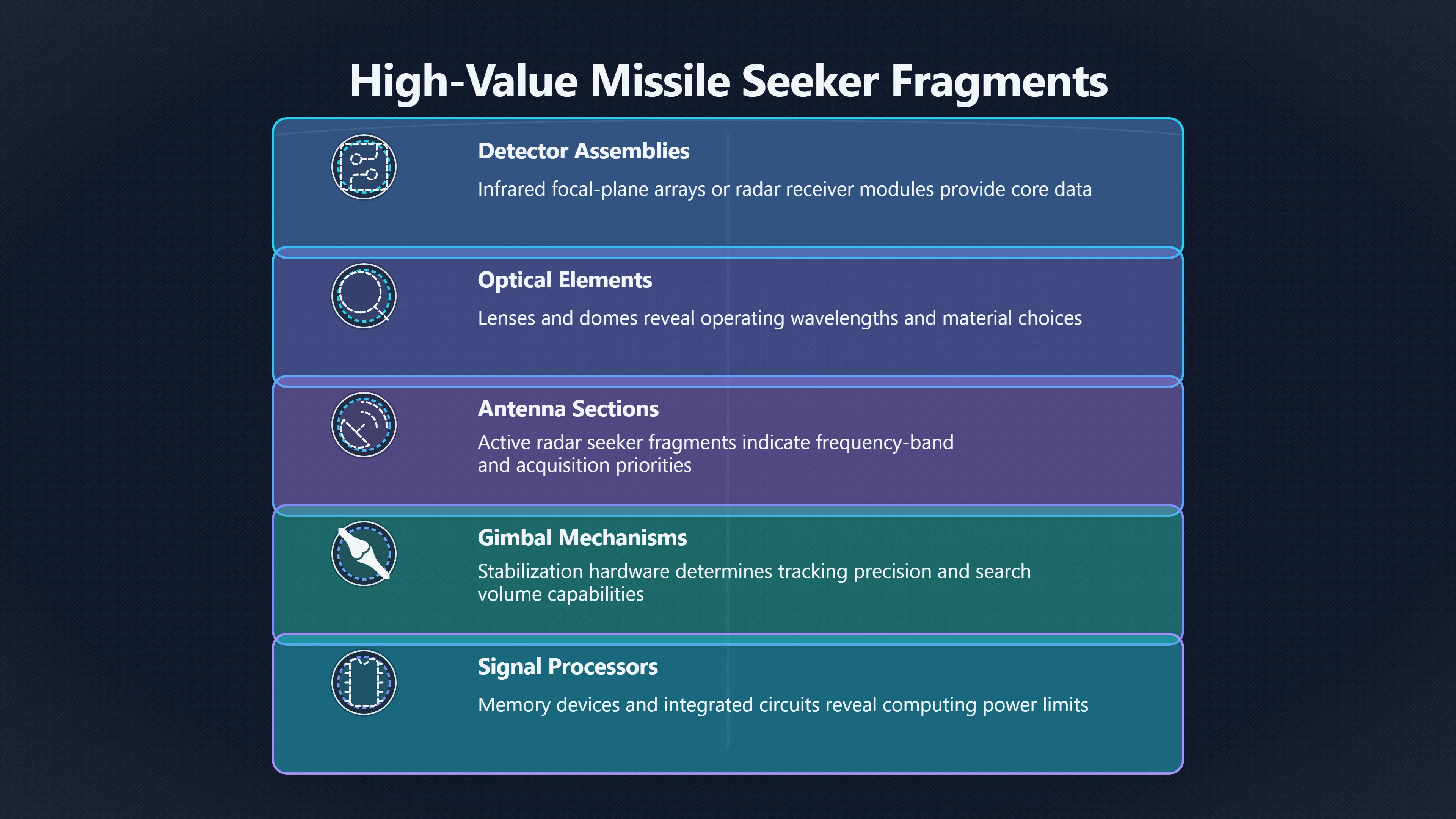
- Detector assemblies, such as infrared focal-plane arrays or radar receiver modules.
- Optical elements, including lenses, domes and filters.
- Antenna sections from active radar seekers.
- Gimbal and stabilisation mechanisms that allow the seeker to maintain line-of-sight tracking.
- Signal-processing boards, memory devices and specialised integrated circuits.
- Power-conditioning electronics located close to the seeker package.
An infrared detector can be especially informative. Older seekers often relied on relatively simple point detectors or scanning arrangements, whereas later generations increasingly adopted focal-plane arrays containing hundreds or thousands of sensing elements. The presence of a focal-plane-array architecture, advanced stabilisation hardware and digital image-processing components generally indicates a more modern seeker generation than a simple scanning detector arrangement.[ResearchGate]researchgate.netIR focal plane array seekers for ground-to-ground and air-…October 1, 2001 — It is based on a 640 X 486 element FPA and a…
Similarly, fragments of radar seekers can reveal antenna geometry, frequency-band choices and receiver technology. Even partial antenna structures may indicate whether designers prioritised broad target acquisition, resistance to electronic attack, or higher-resolution target discrimination.[publications.sto.nato.int]publications.sto.nato.intenemy's active mansmission of… mmtching techniques, in cdination with the exploitation of radar seeker data (SARI.Read more…
How Components Point to Design Generation and Supply Chains
A key goal of seeker exploitation is determining not merely what a missile does, but roughly when its technology base was established.
Reading the Technology Timeline
Defensive analysts frequently look for indicators that distinguish different technological eras.
A seeker containing predominantly discrete electronic components, older fabrication methods and limited processing hardware may indicate a design lineage rooted decades earlier, even if the missile itself remains in production. By contrast, compact digital processors, advanced semiconductor packaging and image-processing hardware can suggest more recent upgrades or a newer development programme.
Infrared seekers provide a particularly clear example. The transition from simple heat-seeking detectors to focal-plane-array imaging seekers represented a major technological leap. Imaging seekers can compare shapes, patterns and target features rather than merely pursuing the brightest heat source. Consequently, discovering focal-plane-array hardware in debris immediately changes assumptions about potential countermeasure effectiveness and target-recognition capability.[ResearchGate]researchgate.netIR focal plane array seekers for ground-to-ground and air-…October 1, 2001 — It is based on a 640 X 486 element FPA and a…

Supply-Chain Clues
Fragments often reveal where technology came from as much as how it works.
Part numbers, semiconductor markings, manufacturing codes, packaging styles and specialised electronic components can expose procurement patterns and industrial dependencies. Investigations of missile and UAV debris recovered in Ukraine have repeatedly used component analysis to trace foreign-made electronics, identify procurement channels and evaluate the technological maturity of weapon systems. Such studies demonstrate that even damaged electronics can provide insight into production methods and access to advanced technologies.[iiss.org]iiss.orgTracking the Components of Missiles and UAVs Used byTracking the Components of Missiles and UAVs Used by…September 24, 2025 — It examines the technological make-up of Russian, Irania…
For defenders, this matters because supply chains influence future threat development. A seeker dependent on difficult-to-obtain components may evolve differently from one supported by a robust domestic manufacturing base.
Why Gimbals, Optics and Mechanics Matter as Much as Electronics
Observers often focus on processors and microchips, but mechanical fragments can be equally revealing.
A seeker’s stabilisation system reflects its intended performance. Gimbal assemblies, rate gyros and pointing mechanisms determine how effectively the sensor can maintain lock while the missile manoeuvres. More sophisticated stabilisation systems generally support wider search volumes, improved tracking precision and better performance against evasive targets.[Google Patents]patents.google.comFirst, the sensor line of sight (LOS) scanning or stepping…Read more…
Optical fragments can also reveal significant design choices. The materials used in seeker windows and domes provide clues about operating wavelengths. Different infrared bands require different optical materials, and those choices influence environmental performance, target discrimination and vulnerability to specific countermeasures.
Because mechanical architecture tends to evolve more slowly than software, even incomplete fragments can help analysts place a seeker within a broader technological family.
Why Incomplete Debris Can Still Improve Defensive Models
A common misconception is that intelligence value requires recovering an intact seeker. In practice, partial recovery is often sufficient to improve defensive understanding.
Analysts rarely depend on a single fragment. Instead, they combine debris evidence with known missile characteristics, previous recoveries, test data and operational observations. A damaged detector, for example, may not reveal full seeker performance, but it can confirm sensor type. A processor board may not expose software, yet it can indicate available computing power. A fragment of antenna structure may not disclose tracking algorithms, but it can narrow estimates of radar capabilities.
This cumulative approach reduces uncertainty. Rather than treating a missile as an unknown threat, defenders can construct a progressively refined model based on physical evidence. Foreign-materiel exploitation organisations routinely emphasise this process of acquiring, assessing and exploiting recovered equipment to reduce technological surprise and improve countermeasure development.[IISS]iiss.orgTracking the Components of Missiles and UAVs Used byTracking the Components of Missiles and UAVs Used by…September 24, 2025 — It examines the technological make-up of Russian, Irania…
The value lies less in perfect reconstruction than in replacing assumptions with measured observations.
What Fragments Cannot Reliably Reveal
Debris analysis also has limits.
Physical fragments rarely provide direct access to software logic, target-recognition algorithms or classified performance parameters. Modern seekers increasingly rely on digital processing, and hardware alone cannot fully reveal how the system behaves in complex operational environments.
A recovered focal-plane array may demonstrate that a seeker is imaging-capable, but it does not automatically reveal the quality of its recognition algorithms. Likewise, radar hardware may indicate a sophisticated sensor, yet not disclose exactly how it reacts to jamming, clutter or decoys.
As a result, debris exploitation is most powerful when combined with modelling, simulation, electronic testing and operational observations. Physical evidence narrows possibilities; it does not eliminate uncertainty.
Why Seeker Fragments Remain a Defensive Intelligence Asset
The enduring value of missile seeker debris is that it converts speculation into evidence. A handful of surviving components can reveal sensor type, approximate technological generation, manufacturing choices and industrial dependencies. Even when the seeker is shattered, detector remnants, optics, antenna fragments, stabilisation hardware and electronics can collectively indicate whether defenders are facing an older design, a modern imaging seeker or an upgraded hybrid system.[iiss.org]iiss.orgTracking the Components of Missiles and UAVs Used byTracking the Components of Missiles and UAVs Used by…September 24, 2025 — It examines the technological make-up of Russian, Irania…
For defensive threat modelling, that distinction matters. Knowing what a missile seeker was built to see is often the first step toward understanding how it might be deceived, countered or defeated.
Amazon book picks
Further Reading
Books and field guides related to What Broken Missile Seekers Can Still Tell. Use these as the next step if you want deeper reading beyond the article.
Introduction to Electronic Warfare Modeling
Relevant to radar, seekers and countermeasure analysis.
eBay marketplace picks
Marketplace Samples
Live-tested eBay searches with available results related to this page.



Endnotes
1.
Source: iiss.org
Title: Tracking the Components of Missiles and UAVs Used by
Link:https://www.iiss.org/globalassets/media-library—content–migration/files/research-papers/2025/09/pub25-094-tracking-the-components-of-missiles-and-uavs-used-by-russia-in-ukraine.pdf
Source snippet
Tracking the Components of Missiles and UAVs Used by...September 24, 2025 — It examines the technological make-up of Russian, Irania...
Published: September 24, 2025
2.
Source: facebook.com
Link:https://www.facebook.com/Euractiv/posts/ukraine-studies-debris-from-new-russian-ballistic-missile-ukrainian-[experts
Source snippet
Ukraine studies debris from new Russian ballistic missileUkrainian experts study such debris to gain insight into Russian military supply...
3.
Source: researchgate.net
Link:https://www.researchgate.net/publication/253697915_IR_focal_plane_array_seekers_for_ground-to-ground_and_air-to-ground_missiles
Source snippet
IR focal plane array seekers for ground-to-ground and air-...October 1, 2001 — It is based on a 640 X 486 element FPA and a...
Published: October 1, 2001
4.
Source: patents.google.com
Link:https://patents.google.com/patent/US5129595A/en
Source snippet
First, the sensor line of sight (LOS) scanning or stepping...Read more...
5.
Source: publications.sto.nato.int
Link:https://publications.sto.nato.int/publications/AGARD/AGARD-CP-524/AGARDCP524.pdf
Source snippet
enemy's active mansmission of... mmtching techniques, in cdination with the exploitation of radar seeker data (SARI.Read more...
6.
Source: kyivindependent.com
Link:https://kyivindependent.com/russias-oreshnik-isnt-cutting-edge-weapons-ukraine-says-after-components-analysis/
Source snippet
The Kyiv IndependentOreshnik missile 'isn't cutting-edge' as Russia claims...29 May 2026 — Ukrainian experts display foreign-made compon...
Published: May 2026
Additional References
7.
Source: conflictarm.com
Link:https://www.conflictarm.com/field-dispatches/
Source snippet
Conflict Armament ResearchFIELD DISPATCHESConflict Armament Research identifies and tracks conventional weapons and ammunition in contemp...
8.
Source: dia.mil
Link:https://www.dia.mil/News-Features/Articles/Article-View/Article/3848524/dia-report-confirms-north-korean-[missile-debris
Source snippet
Defense Intelligence AgencyDIA report confirms North Korean missile debris found in...North Korean missile debris was found throughout U...
9.
Source: ftp.idu.ac.id
Link:https://ftp.idu.ac.id/wp-content/uploads/ebook/tdg/MILITARY%20PLATFORM%20DESIGN/Missile%20Guidance%20And%20Control%20Systems.pdf
Source snippet
Guidance and Control SystemsChapter 7 focuses on cruise missile theory and design. Much of the material in... exploit these advantages a...
10.
Source: fragmentation.esoc.esa.int
Link:https://fragmentation.esoc.esa.int/
Source snippet
esa.intESA's fragmentation databaseSpace Debris and Meteoroid. All reported fragment counts are based on information from known catalogue...
11.
Source: assets.publishing.service.gov.uk
Link:https://assets.publishing.service.gov.uk/media/5a7ebee940f0b6230268b464/20140808_MOD_Acronyms_and_Abbreviations.pdf
Source snippet
of Defence acronyms and abbreviationsMinistry of Defence acronyms and abbreviations. Missile AAAP Advanced Avionics Architecture and Policy...
12.
Source: tsn.ua
Title: fragments of oreshnik missile sent for analysis what experts have found 3092384
Link:https://tsn.ua/en/ukrayina/fragments-of-oreshnik-missile-sent-for-analysis-what-experts-have-found-3092384.html
Source snippet
Fragments of “Oreshnik” missile sent for analysis26 May 2026 — Ukraine has sent debris from a third «Oreshnik» missile for expert analysi...
Published: May 2026
13.
Source: aiaa.org
Link:https://aiaa.org/wp-content/uploads/2026/02/2nd-Place_University-of-Kansas_Missile-Design-2025.pdf
Source snippet
It is... This approach allows three-dimensional directional control using only two canards by exploiting roll-induced symmetry.Read more...
14.
Source: dtic.minsky.ai
Title: DTICFY97 CONVENTIONAL ARMAMENT TECHNOLOGY
Link:https://dtic.minsky.ai/index/ADA323278/pdf
Source snippet
Minsky DTICtargeting for a SAR seeker using either on-board or off- missile launchers, or radar sites have special seeker board sensor in...
15.
Source: oa.upm.es
Title: FRANCISCO DE BORJA IBARRONDO HERNANDEZ
Link:https://oa.upm.es/38301/1/FRANCISCO_DE_BORJA_IBARRONDO_HERNANDEZ.pdf
Source snippet
exploitation of the synergies: • Adjust the autopilot response to accommodate guidance demands considering time-to-go information. • Avoi...
16.
Source: iqytechnicalcollege.com
Title: RADA R AND ELECTRONIC WARFARE SYSTEMS
Link:https://www.iqytechnicalcollege.com/Radar%20%26%20Electronic%20Warefare.pdf
Source snippet
radar image modes, fast-scan. GMTI, maritime and dismount capabilities that drive exploitation and tracking applications for demanding op...
Topic Tree