Within Operation LUSTY
How Watson's Whizzers flew enemy aircraft home
Watson's Whizzers turned captured German aircraft into usable intelligence by finding pilots, fuel, routes and working machines before rivals did.
On this page
- Why the Whizzers were formed
- Training on unfamiliar German aircraft
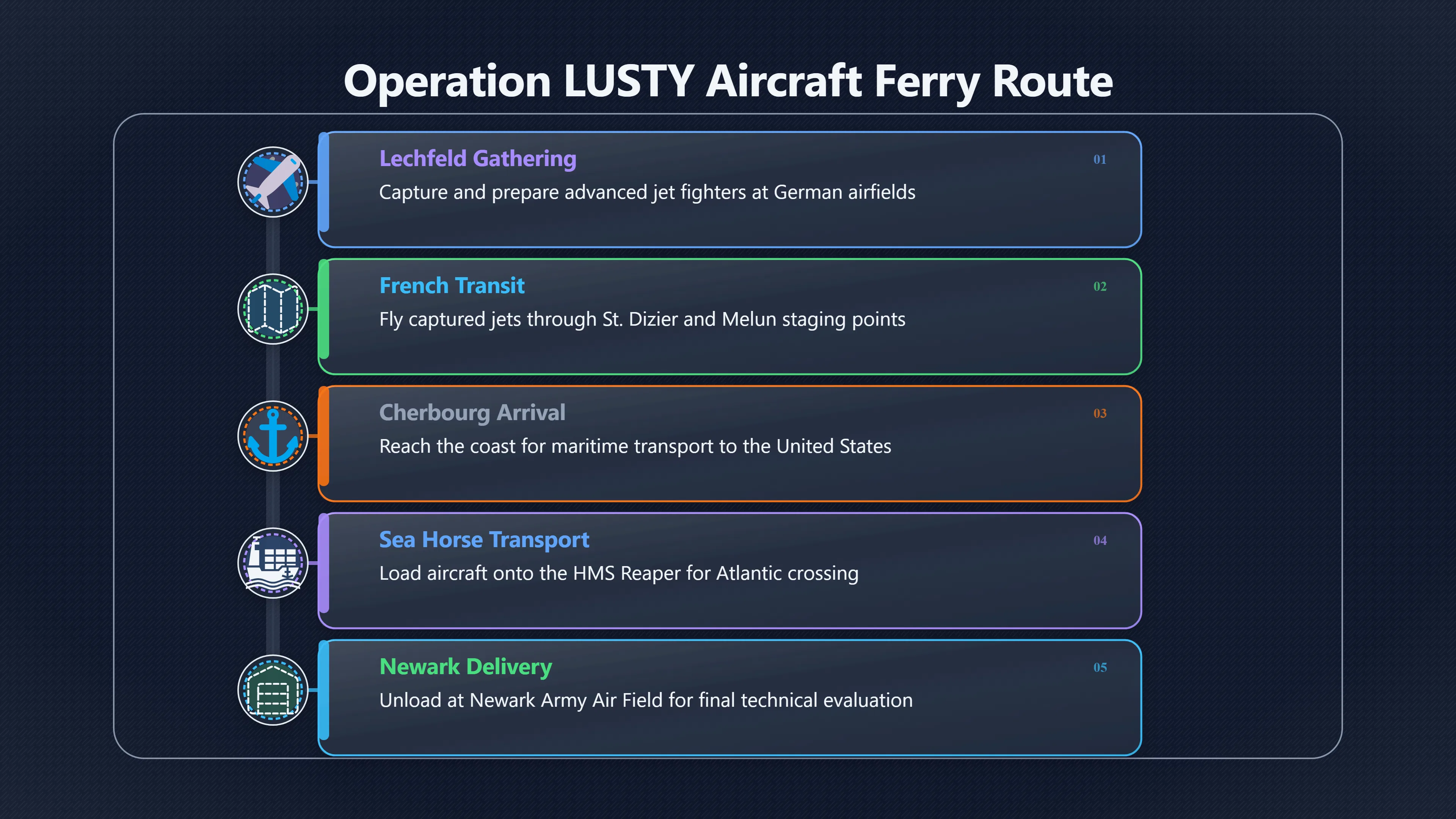
- The ferry route from Lechfeld to Cherbourg
Page outline Jump by section
Introduction
In the closing weeks of the Second World War, the United States faced an unusual intelligence problem. Capturing advanced German aircraft was not enough; the aircraft had to be found before rival Allied teams reached them, restored to flying condition, and ferried out of a collapsing Germany before they were destroyed, dismantled, or stranded. The group that carried out this task became known as Watson’s Whizzers, a specialised team led by Colonel Harold E. Watson under Operation LUSTY (“Luftwaffe Secret Technology”). Their achievement was not merely collecting aircraft but turning captured machines into usable intelligence by flying them across Europe and eventually to the United States for evaluation.[Air Force Museum]nationalmuseum.af.milAir Force Museum Operation LUSTYAir Force MuseumOperation LUSTY - National Museum of the USAF - Air ForceOperation LUSTY began with the aim of exploiting captured German…

For the history of reverse engineering foreign military technology, the Whizzers represent a crucial implementation stage. They transformed German aircraft from battlefield trophies into working technical evidence. Every successful ferry flight preserved knowledge about engines, controls, maintenance procedures and operational performance that could not be learned from wreckage alone.[Air Force Museum]nationalmuseum.af.milAir Force Museum Operation LUSTYAir Force MuseumOperation LUSTY - National Museum of the USAF - Air ForceOperation LUSTY began with the aim of exploiting captured German…
Why the Whizzers Were Formed
By 1944, intelligence specialists at Wright Field had assembled “Black Lists” of German aviation technologies that American engineers wanted to examine. These lists included jet aircraft, experimental designs, engines, weapons and related equipment. Watson’s team of pilots, engineers and maintenance personnel was tasked with locating and securing these priority items before they disappeared into the post-war chaos.[Air Force Museum]nationalmuseum.af.milAir Force Museum Operation LUSTYAir Force MuseumOperation LUSTY - National Museum of the USAF - Air ForceOperation LUSTY began with the aim of exploiting captured German…
Speed mattered. Numerous Allied technical intelligence organisations were operating across occupied Europe, all seeking access to the same high-value targets. Aircraft could be claimed by another service, damaged by retreating forces, stripped for parts, or fall into areas controlled by other occupying powers. The Whizzers therefore operated as a mobile recovery force, travelling from airfield to airfield in search of flyable examples of Germany’s most advanced aircraft.[Air Force Museum]nationalmuseum.af.milAir Force Museum Operation LUSTYAir Force MuseumOperation LUSTY - National Museum of the USAF - Air ForceOperation LUSTY began with the aim of exploiting captured German…
Their mission differed from simple collection. A captured Me 262 or Arado Ar 234 was valuable precisely because it could still fly. If American pilots could operate the aircraft, engineers could study its behaviour under real conditions rather than relying solely on documents or wreckage. This made operational recovery a race against time as much as an intelligence exercise.[Air & Space Forces Magazine]airandspaceforces.comAir & Space Forces MagazineOperation LustyThe project went by the code name Lusty (for Luftwaffe secret technology). The effort required…
Training on Unfamiliar German Aircraft
Finding the people who knew the machines
One of the Whizzers’ greatest challenges was that the aircraft they wanted were unlike anything most American pilots had flown. Germany’s Me 262 was the world’s first operational jet fighter, and its engines, handling characteristics and operating procedures differed significantly from conventional piston-engined aircraft.[HistoryNet]historynet.comHistory Net Watson's WhizzersWatson's Whizzers - Saving the Me-26221 Aug 2012 — After WWII, "Watson's Whizzers" returned a handful of German Me-262s to the…
To solve this problem, Watson recruited German expertise. Among those who joined the effort were Messerschmitt chief test pilot Karl Baur, test pilot Ludwig Hofmann, engineering superintendent Gerhard Coulis and other Luftwaffe or industry pilots. Their knowledge allowed American crews to understand starting procedures, engine limitations, cockpit systems and emergency handling techniques that were often undocumented or difficult to interpret quickly.[wikipedia.org]WikipediaOperation LUSTYOperation LUSTY
The arrangement reflected a broader truth about reverse engineering: knowledge resides not only in machines but also in the people who operate them. Captured aircraft without experienced instructors would have been far more difficult—and far more dangerous—to exploit.[Air & Space Forces Magazine]airandspaceforces.comBaur with him on other flight test missions for captured aircraft. The handful…Read more…
Learning to fly the Me 262
The Whizzers’ training programme centred on a captured two-seat Me 262 trainer. Ludwig Hofmann and Karl Baur used this aircraft to familiarise American pilots with jet operations. The dual-control aircraft provided a rare opportunity to teach handling techniques directly in flight rather than through trial and error.[Wikipedia]WikipediaLudwig Hofmann (FliegerLudwig Hofmann (Flieger
According to accounts from the operation, Hofmann flew demonstration and training missions while American personnel occupied the second seat. Colonel Watson himself received familiarisation flights from Baur before participating in the ferry effort. The aircraft nicknamed “Vera”, later renamed “Willie”, became an important training platform for pilots who would subsequently fly captured jets across Europe.[silverhawkauthor.com]silverhawkauthor.comMe 262. On the 30th of May, Hofmann's counterpart, Karl Baur, took Colonel Watson on a familiarization flight in this aircraft. “Vera” wa…
This training reduced the risks inherent in operating unfamiliar aircraft. German jets had unique throttle-response characteristics and engines that could be damaged by improper handling. The Whizzers therefore relied heavily on direct instruction from German specialists before attempting long ferry flights.[indianamilitary.org]indianamilitary.orgWatsonLudwig Hofmann (dubbed Willie) and Karl Baur (called Pete), both from Messerschmitt, taught the young Americans to fly the exotic…

The Ferry Route from Lechfeld to Cherbourg
Gathering the aircraft at Lechfeld
One of the most significant discoveries made by the Whizzers was a group of Me 262 jet fighters at Lechfeld airfield near Augsburg. These aircraft represented some of the most advanced aviation technology available in Europe in 1945. German test pilots associated with the recovery effort had the experience necessary to evaluate and prepare them for movement.[wikipedia.org]WikipediaOperation LUSTYOperation LUSTY
Lechfeld became the starting point for a carefully planned ferry operation. The objective was not simply to move aircraft from one airfield to another but to transfer them from occupied Germany to a port where they could be shipped safely to the United States.[Wikipedia]WikipediaOperation LUSTYOperation LUSTY
Flying across post-war Europe
The route generally moved westward through a chain of Allied-controlled airfields. Captured aircraft, including Me 262 fighters and Arado Ar 234 jet bombers, were flown from Lechfeld to St. Dizier in France, then onward to Melun near Paris, before reaching the Cherbourg area on the French coast.[Wikipedia]WikipediaOperation LUSTYOperation LUSTY
Each stage involved logistical challenges. Spare parts were scarce, fuel supplies varied, maintenance records were incomplete and crews were operating aircraft whose reliability under sustained ferry conditions was still being assessed. Every successful leg demonstrated that the aircraft could function beyond short wartime sorties and provided valuable operational data.[Air & Space Forces Magazine]airandspaceforces.comBaur with him on other flight test missions for captured aircraft. The handful…Read more…
Melun became an important staging point where aircraft were inspected, repaired when necessary and prepared for the final movement to the coast. Some aircraft received informal American nicknames during this period, reflecting the unusual mixture of German technology and American recovery personnel that characterised the operation.[silverhawkauthor.com]silverhawkauthor.comMe 262. On the 30th of May, Hofmann's counterpart, Karl Baur, took Colonel Watson on a familiarization flight in this aircraft. “Vera” wa…
From Cherbourg to America
The final destination was the port of Cherbourg, where the escort carrier HMS Reaper was prepared to transport the aircraft across the Atlantic. Aircraft arriving from Germany were protected against sea exposure, loaded aboard the carrier and shipped to Newark Army Air Field in the United States. This maritime phase became known as Operation Sea Horse, the naval component of the wider recovery effort.[Wikipedia]WikipediaOperation Sea HorseOperation Sea Horse
The ferry route mattered because it preserved complete, operational aircraft. Once in the United States, the captured machines could be tested by military and naval evaluators, compared against American designs and studied in detail. Several aircraft recovered through the Whizzers’ efforts survive today in museum collections, demonstrating how successful the operation was in rescuing rare examples of German aviation technology.[Wikipedia]WikipediaOperation LUSTYOperation LUSTY
What the Race Revealed About Technical Intelligence
Watson’s Whizzers illustrate a practical reality of military technology exploitation: possession alone is not enough. Advanced equipment generates intelligence value only when it can be operated, examined and understood. The Whizzers had to combine pilots, engineers, mechanics, logistics specialists and even former enemy test pilots into a single recovery system.[Air Force Museum]nationalmuseum.af.milAir Force Museum Operation LUSTYAir Force MuseumOperation LUSTY - National Museum of the USAF - Air ForceOperation LUSTY began with the aim of exploiting captured German…
Their race to fly captured aircraft home was therefore more than a dramatic post-war episode. It was an early example of a complete exploitation cycle for foreign military technology. Aircraft were identified through intelligence requirements, recovered before competitors reached them, made operational through expert knowledge, and transferred into structured testing programmes. In that sense, the Whizzers turned captured German aircraft from war trophies into actionable technical intelligence, providing a model that would influence later Cold War approaches to evaluating foreign aerospace systems.[af.mil]nationalmuseum.af.milAir Force Museum Operation LUSTYAir Force MuseumOperation LUSTY - National Museum of the USAF - Air ForceOperation LUSTY began with the aim of exploiting captured German…
Amazon book picks
Further Reading
Books and field guides related to How Watson's Whizzers flew enemy aircraft home. Use these as the next step if you want deeper reading beyond the article.
The Right Stuff
Rating: 4.5/5 from 8 Google Books ratings
Reflects the culture of risky experimental flying and aircraft evaluation.
Skunk Works
Shows how captured knowledge and testing feed future aircraft development.
The Jet Race and the Second World War
Provides context for the technologies being ferried and tested.
Germany's Secret Weapons in World War II
Covers many aircraft and systems sought by Watson's team.
eBay marketplace picks
Marketplace Samples
Live-tested eBay searches with available results related to this page.

Endnotes
1.
Source: Wikipedia
Title: Operation LUSTY
Link:https://en.wikipedia.org/wiki/Operation_LUSTY
2.
Source: historynet.com
Title: History Net Watson’s Whizzers
Link:https://historynet.com/watsons-whizzers-saving-the-me262/
Source snippet
Watson's Whizzers - Saving the Me-26221 Aug 2012 — After WWII, "Watson's Whizzers" returned a handful of German Me-262s to the...
3.
Source: indianamilitary.org
Link:https://www.indianamilitary.org/FreemanAAF/WatsonWizzers/WatsonWhizzers.htm
Source snippet
WatsonLudwig Hofmann (dubbed Willie) and Karl Baur (called Pete), both from Messerschmitt, taught the young Americans to fly the exotic...
4.
Source: Wikipedia
Title: Ludwig Hofmann (Flieger)
Link:https://de.wikipedia.org/wiki/Ludwig_Hofmann_%28Flieger%29
5.
Source: silverhawkauthor.com
Link:https://silverhawkauthor.com/aviation/aviation-germany/warplanes-of-germany-luftwaffe-messerschmitt-me-262/
Source snippet
Me 262. On the 30th of May, Hofmann's counterpart, Karl Baur, took Colonel Watson on a familiarization flight in this aircraft. “Vera” wa...
6.
Source: Wikipedia
Title: Operation LUSTY
Link:https://de.wikipedia.org/wiki/Operation_LUSTY
7.
Source: Wikipedia
Title: Operation Sea Horse
Link:https://en.wikipedia.org/wiki/Operation_Sea_Horse
8.
Source: nationalmuseum.af.mil
Title: Air Force Museum Operation LUSTY
Link:https://www.nationalmuseum.af.mil/Visit/Museum-Exhibits/Fact-Sheets/Display/Article/196144/operation-lusty/
Source snippet
Air Force MuseumOperation LUSTY - National Museum of the USAF - Air ForceOperation LUSTY began with the aim of exploiting captured German...
9.
Source: airandspaceforces.com
Link:https://www.airandspaceforces.com/article/0105lusty/
Source snippet
Air & Space Forces MagazineOperation LustyThe project went by the code name Lusty (for Luftwaffe secret technology). The effort required...
10.
Source: airandspaceforces.com
Link:https://www.airandspaceforces.com/PDF/MagazineArchive/Documents/2005/January%202005/0105lusty.pdf
Source snippet
Baur with him on other flight test missions for captured aircraft. The handful...Read more...
11.
Source: captured-wings.fandom.com
Title: Captured Wings Category:Watson’s Whizzers
Link:https://captured-wings.fandom.com/wiki/Category%3AWatson%27s_Whizzers
Source snippet
Captured WingsCategory:Watson's Whizzers - Captured Wings Wiki - FandomWhen the Whizzers located nine Messerschmitt Me 262 jet aircraft a...
12.
Source: afhistory.org
Title: 25 april 1945
Link:https://afhistory.org/25-april-1945/
Source snippet
Air Force Historical Foundation25 April 194525 Apr 2025 — 1945: General Carl 'Tooey' Spaatz personally kicked off Operation Lusty (Luftwa...
Published: april 1945
Additional References
13.
Source: facebook.com
Link:https://www.facebook.com/groups/399005652699740/posts/791112123489089/
Source snippet
Operation Lusty: US captures Luftwaffe aircraftOn June 10, 1945, its pilots (maybe a mix of US and ex- Luftwaffe pilots) flew ten aircraf...
Published: June 10, 1945
14.
Source: linkedin.com
Title: “Operation Lusty”-The last of four German Ar234 jet
Link:https://www.linkedin.com/posts/matt-phillips-77b27713b_24-june-1945-operation-lusty-the-last-activity-7475529100426776576-rwDd
Source snippet
aircraft was at Cherbourg, France. The Whizzers flew the Me 262s and other aircraft from Lechfeld to St. Dizier to Melun and then to Cher...
15.
Source: militaryaviationmuseum.org
Title: me 262 vera operation lusty
Link:https://www.militaryaviationmuseum.org/me-262-vera-operation-lusty/
Source snippet
Me 262: Vera & Operation LUSTY4 Jul 2025 — The Whizzers themselves were responsible for actually collecting enemy aircraft and weapons fo...
16.
Source: airfactsjournal.com
Title: wwii watsons whizzers
Link:https://airfactsjournal.com/2012/06/wwii-watsons-whizzers/
Source snippet
WWII Watson's Whizzers: Air Facts...20 Jun 2012 — It was surrendered at Lechfeld just prior to VE Day. Karl Baur test flew this aircra...
17.
Source: facebook.com
Link:https://www.facebook.com/groups/4aviation.flightline/posts/2999176190174436/
Source snippet
39 BuNo. 121448 | Wk.Nr.110639 | Me 262B-1aOn the 30th of May, Hofmann's counterpart, Karl Baur, took Colonel Watson on a familiarization...
18.
Source: airandspace.si.edu
Title: watsons whizzers 0
Link:https://airandspace.si.edu/events/watsons-whizzers-0
Source snippet
si.eduWatson's Whizzers23 Nov 2016 — Watson's Whizzers: Operation Lusty and the Race for Nazi Aviation Technology Several times a month...
19.
Source: youtube.com
Title: Watson’s Whizzers: The Secret Team That Hunted Nazi Aviation Tech
Link:https://www.youtube.com/watch?v=Y1YPnMq4ekI
Source snippet
What Happened To The German Me 262 Jet Fighter After WW2?...
20.
Source: youtube.com
Title: What Happened To The German Me 262 Jet Fighter After WW2?
Link:https://www.youtube.com/watch?v=ZSFQh4QR6YA
Source snippet
WWII GSAP Combat Footage and Rare Me 262 Jet Fighter Captured Films...
21.
Source: youtube.com
Title: Aviation Stuff: Operation Lusty and Watson’s Whizzers
Link:https://www.youtube.com/watch?v=A0y08v8Y5TY
Source snippet
Watson's Whizzers: The Secret Team That Hunted Nazi Aviation Tech...
22.
Source: youtube.com
Title: Watson’s Whizzers
Link:https://www.youtube.com/watch?v=vOkijVSwNwc
Source snippet
Operation "LUSTY"Operation Lusty and Colonel Watson's Wizards brought back an impressive inventory of German aviation technology for rese...
Topic Tree