Within Radar Signatures
The Clues Hidden in a Radar Beam
Beam width, sidelobes, dwell time and scan rhythm can reveal how a radar searches, locks on and exposes tactical weak points.
On this page
- Scan rhythm as a signature
- Sidelobes, blind sectors and dwell time
- Tactical use of predictable antenna behavior
Page outline Jump by section
Introduction
A radar’s antenna movement is often as revealing as the signal it transmits. For organisations engaged in the exploitation of foreign military technology, scan patterns provide a behavioural fingerprint that can expose how a radar searches for targets, how quickly it can react, when it becomes vulnerable, and whether it is optimised for surveillance, tracking or missile guidance. Electronic-support receivers frequently identify radars not only by frequency and pulse characteristics, but also by the timing and geometry of their antenna motion. Scan rate, beam width, dwell time, sidelobe structure and scan shape all leave measurable signatures that can be observed without physically inspecting the radar.[archiwum.pe.org.pl]archiwum.pe.org.plType of scan pattern (circular, sector,The Specific Radar Signature in Electronic Recognition…June 29, 2013 — scan pattern and rate, • beam width and side lobe levels, The s…

Within radar exploitation, these patterns matter because they reveal operational design choices. A radar that revisits a sector every few seconds behaves differently from one that concentrates energy on a narrow threat corridor. A tracking radar that stares continuously at a target exposes different vulnerabilities from a rotating search radar. By analysing scan behaviour, intelligence organisations can infer capabilities that may not be obvious from hardware inspection alone.[pe.org.pl]archiwum.pe.org.plType of scan pattern (circular, sector,The Specific Radar Signature in Electronic Recognition…June 29, 2013 — scan pattern and rate, • beam width and side lobe levels, The s…
Scan Rhythm as a Signature
Every radar has a characteristic rhythm. A mechanically rotating air-surveillance radar may complete a full revolution every few seconds, while a fire-control radar may remain fixed on a target. To an electronic-support receiver, these patterns appear as recurring bursts of illumination separated by predictable gaps. The timing of those bursts can be as distinctive as a fingerprint.[whitehorseradar.co.uk]whitehorseradar.co.ukars and active missile seekers, do not scan their beams in a periodic pattern but instead dwell continuously…Read more…
The scan period often reveals the radar’s intended mission. Long-range early-warning radars generally rotate more slowly because they need sufficient dwell time to collect echoes from distant targets. Faster scan rates favour rapid updates at shorter ranges. Researchers in radar electronic recognition note that scan rates commonly vary from a few revolutions per minute to several dozen, and that scan pattern type is closely linked to operational function.[archiwum.pe.org.pl]archiwum.pe.org.plType of scan pattern (circular, sector,The Specific Radar Signature in Electronic Recognition…June 29, 2013 — scan pattern and rate, • beam width and side lobe levels, The s…
The geometry of the scan is equally informative:
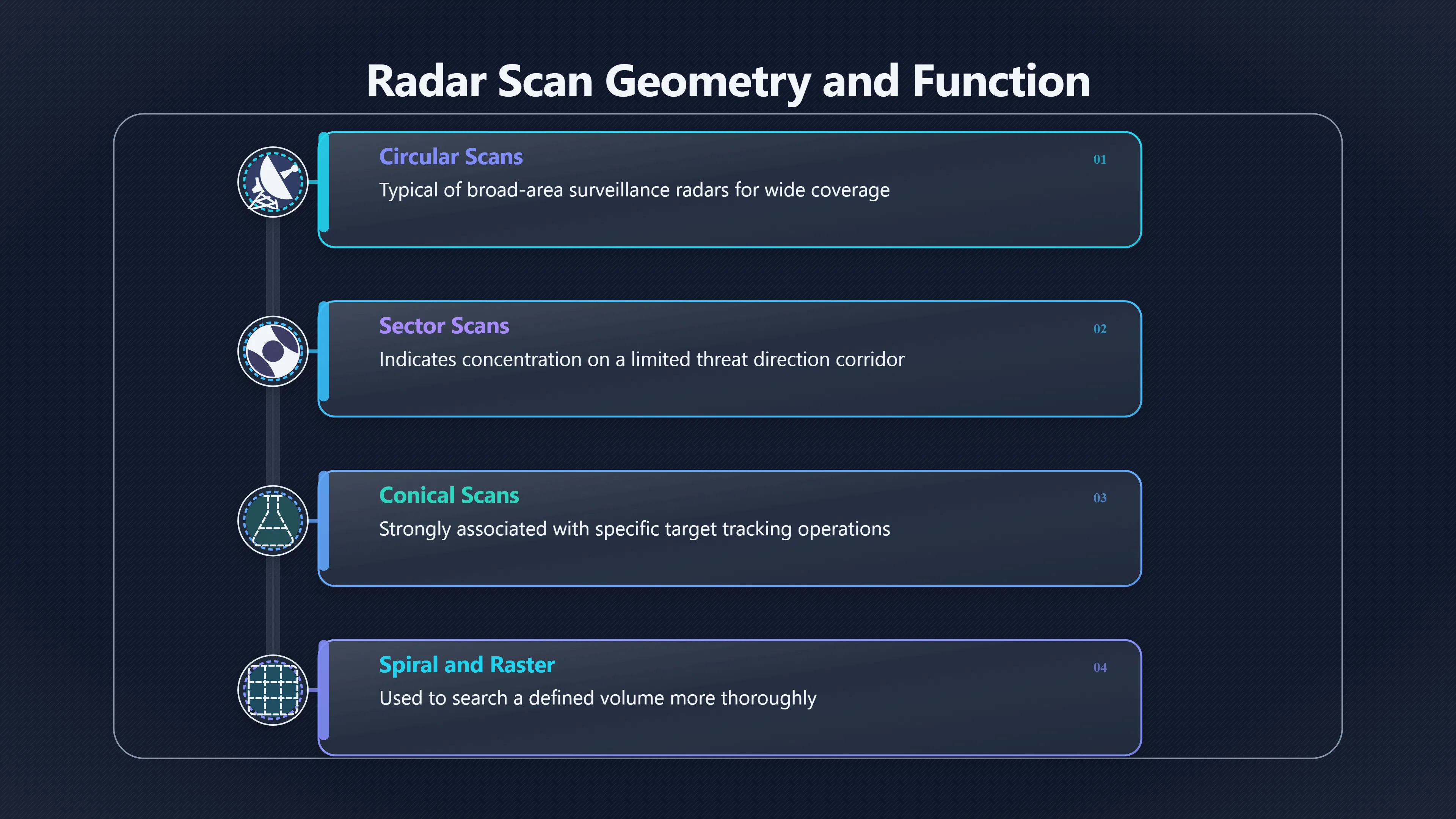
- Circular scans are typical of broad-area surveillance radars.
- Sector scans indicate concentration on a limited threat direction.
- Conical scans are strongly associated with target tracking.[radartutorial.eu]radartutorial.euTracking radarSpecial target tracking radars are categorized according to their technology into: Radar sets with conical scan and; Radar…
- Spiral and raster scans are commonly used when a radar must search a defined volume more thoroughly than a simple rotation permits.[pe.org.pl]archiwum.pe.org.plType of scan pattern (circular, sector,The Specific Radar Signature in Electronic Recognition…June 29, 2013 — scan pattern and rate, • beam width and side lobe levels, The s…
Because these patterns are observable externally, they allow analysts to classify radar functions even when other technical details remain unknown.
What Mode Changes Reveal
Scan rhythm can also reveal transitions between operating modes. A radar that normally rotates at a steady rate may suddenly spend more time on a particular sector. Such behaviour can indicate target acquisition, threat prioritisation or the initiation of tracking functions.
Track-while-scan systems are particularly revealing. These radars continue searching while simultaneously revisiting selected targets at higher rates. Observers can often detect changes in revisit timing or beam allocation that indicate the radar has shifted from general surveillance to engagement-related activity.[radartutorial.eu]radartutorial.euFire-control Radar or Tracking RadarTrack-while-scan is a method of combining search and track functions. This radar can tra…
For intelligence analysts, these transitions provide evidence not just of what a radar is, but of what it is doing at a specific moment.
Sidelobes, Blind Sectors and Dwell Time
The main beam attracts most attention, but valuable clues often come from the radar’s imperfections. Real antennas produce sidelobes—smaller emissions outside the primary beam—which can reveal antenna design quality and signal-processing sophistication. Side-lobe levels are recognised radar-identification parameters and can contribute to distinguishing one emitter from another.[archiwum.pe.org.pl]archiwum.pe.org.plType of scan pattern (circular, sector,The Specific Radar Signature in Electronic Recognition…June 29, 2013 — scan pattern and rate, • beam width and side lobe levels, The s…
Sidelobes matter because they may expose a radar’s presence even when the main beam is pointed elsewhere. They can also reveal how effectively the radar suppresses unwanted emissions. A system with unusually prominent sidelobes may be easier to detect or characterise than designers intended.
Dwell time provides another important clue. Dwell time is the period during which a radar beam remains on a particular area or target. It is largely determined by beam width and scan speed. Longer dwell times generally allow more returned energy to be collected, improving detection performance, especially against weak or distant targets.[Radartutorial]radartutorial.euDwell Time and Hits per ScanDwell Time and Hits per Scan - RadartutorialThe value of hits per scan m says how many echo signals per single target during…
From an exploitation perspective, dwell time can indicate priorities:
- Long dwell times suggest emphasis on sensitivity and long-range detection.
- Short dwell times suggest a preference for rapid updates and broader coverage.
- Variable dwell times may indicate electronically scanned arrays allocating resources dynamically according to perceived threats.[sciencedirect.com]sciencedirect.comScienceDirect Electronic Warfare SystemElectronic Warfare System - an overviewMechanically rotating radars have invariable data rate and dwell time, and transmit t…
Modern electronically scanned arrays are especially informative because they can change dwell schedules in response to tactical demands. Unlike mechanically rotating radars, they do not necessarily illuminate every part of the surveillance volume equally. Their behaviour can therefore reveal the radar’s internal resource-management logic.[ScienceDirect]sciencedirect.comScienceDirect Electronic Warfare SystemElectronic Warfare System - an overviewMechanically rotating radars have invariable data rate and dwell time, and transmit t…
Detecting Blind Sectors
Scan analysis can also uncover areas receiving less attention. Sector-focused radars inevitably devote more energy to some directions than others. Even full-rotation systems may exhibit temporary coverage gaps caused by antenna supports, mechanical constraints or scheduling priorities.
These blind sectors may not represent design flaws, but they reveal how the radar balances competing requirements. For military planners, understanding such patterns can be as valuable as knowing maximum detection range because it identifies moments or directions in which surveillance effectiveness is reduced.
Tactical Use of Predictable Antenna Behaviour
One reason scan patterns are studied so closely is that predictability creates opportunity. A mechanically rotating search radar illuminates a receiver only when its beam points in the appropriate direction. This creates a repeating pattern of exposure and silence. Electronic-support systems can exploit that regularity to improve detection and classification.[whitehorseradar.co.uk]whitehorseradar.co.ukars and active missile seekers, do not scan their beams in a periodic pattern but instead dwell continuously…Read more…
The distinction between search and tracking behaviour is especially important. Search radars generally produce periodic illumination tied to antenna movement. Tracking radars, by contrast, often dwell continuously on a target, appearing almost as constant emitters. This difference allows analysts to determine whether a radar is merely observing or actively maintaining a firing-quality track.[whitehorseradar.co.uk]whitehorseradar.co.ukars and active missile seekers, do not scan their beams in a periodic pattern but instead dwell continuously…Read more…
Predictable scanning can also reveal response limits. A radar revisiting a target every several seconds inherently updates its information less frequently than a system capable of near-continuous observation. By measuring revisit intervals, analysts can estimate reaction times, tracking refresh rates and the speed at which the radar can respond to changing situations.[Radartutorial]radartutorial.euDwell Time and Hits per ScanDwell Time and Hits per Scan - RadartutorialThe value of hits per scan m says how many echo signals per single target during…
The Shift to Electronic Scanning
Modern active electronically scanned array (AESA) radars complicate this picture. Their beams can be repositioned almost instantaneously, and search, tracking and confirmation tasks can be interleaved in ways that appear irregular to outside observers. Dwell times may change dynamically, and beam schedules may be adjusted according to target density or mission priorities.[semanticscholar.org]pdfs.semanticscholar.orgWe find optimum dwell times and false alarm…Read more…
Yet this flexibility creates its own signature. Resource allocation patterns, revisit rates and beam scheduling behaviour can still reveal how the radar prioritises surveillance versus tracking. Rather than eliminating behavioural fingerprints, electronic scanning often shifts them from mechanical motion into software-driven timing patterns.[ScienceDirect]sciencedirect.comScienceDirect Electronic Warfare SystemElectronic Warfare System - an overviewMechanically rotating radars have invariable data rate and dwell time, and transmit t…
Why Scan Patterns Matter in Radar Exploitation
For foreign-materiel exploitation and electronic intelligence, antenna scan behaviour provides evidence that hardware inspection alone cannot supply. Scan rhythm reveals mission type. Dwell time exposes performance priorities. Sidelobes reveal design characteristics. Changes in revisit patterns can indicate mode transitions from search to track. Even the predictability of antenna motion can reveal tactical strengths and weaknesses.[pe.org.pl]archiwum.pe.org.plType of scan pattern (circular, sector,The Specific Radar Signature in Electronic Recognition…June 29, 2013 — scan pattern and rate, • beam width and side lobe levels, The s…
The result is that a radar’s beam movement becomes part of its electronic identity. Two systems operating on similar frequencies may appear very different once their scan behaviour is examined. For analysts attempting to understand a foreign radar, the hidden clues are often not in the transmitted power alone, but in where the beam points, how long it stays there, and how consistently it returns.[pe.org.pl]archiwum.pe.org.plType of scan pattern (circular, sector,The Specific Radar Signature in Electronic Recognition…June 29, 2013 — scan pattern and rate, • beam width and side lobe levels, The s…
Amazon book picks
Further Reading
Books and field guides related to The Clues Hidden in a Radar Beam. Use these as the next step if you want deeper reading beyond the article.
Introduction to Airborne Radar
Explains beams, scan patterns, dwell time and radar operating modes in practical language.
Radar Principles
Covers core radar theory behind beam behaviour and signal interpretation.
EW 102
Builds on signal recognition and EW analysis useful for interpreting antenna behaviour.
Radar Handbook
Covers antenna patterns, scanning, sidelobes and radar system design in depth.
eBay marketplace picks
Marketplace Samples
Live-tested eBay searches with available results related to this page.



Endnotes
1.
Source: archiwum.pe.org.pl
Title: Type of scan pattern (circular, sector,
Link:https://archiwum.pe.org.pl/articles/2013/7/54.pdf
Source snippet
The Specific Radar Signature in Electronic Recognition...June 29, 2013 — scan pattern and rate, • beam width and side lobe levels, The s...
Published: June 29, 2013
2.
Source: whitehorseradar.co.uk
Link:https://whitehorseradar.co.uk/PublicationsUPDAT/jrnl_2012_IETRSN_esm.pdf
Source snippet
ars and active missile seekers, do not scan their beams in a periodic pattern but instead dwell continuously...Read more...
3.
Source: radartutorial.eu
Title: Dwell Time and Hits per Scan
Link:https://www.radartutorial.eu/01.basics/Dwell%20Time%20and%20Hits%20per%20Scan.en.html
Source snippet
Dwell Time and Hits per Scan - RadartutorialThe value of hits per scan m says how many echo [signals]({{ 'signals/' | relative_url }}) per single target during...
4.
Source: radartutorial.eu
Link:https://www.radartutorial.eu/01.basics/Time-dependences%20in%20Radar.en.html
Source snippet
Radar Time BudgetThe dwell time, the time that an antenna beam spends on a target, depends predominantly on the antennas horizontally bea...
5.
Source: radartutorial.eu
Title: Conical Scan
Link:https://www.radartutorial.eu/06.antennas/Conical%20Scan.en.html
Source snippet
The conical scan is used for target tracking. If the target is exactly on the central axis, a relatively constant but very s...
6.
Source: patents.google.com
Link:https://patents.google.com/patent/US6697007B2/en
Source snippet
Google PatentsUS6697007B2 - Automatic recognition of radar scan typeA circular raster scan is a two-dimensional scan in azimuth and eleva...
7.
Source: radartutorial.eu
Link:https://www.radartutorial.eu/02.basics/Fire-control%20radar.en.html
Source snippet
Fire-control Radar or Tracking RadarTrack-while-scan is a method of combining search and track functions. This radar can tra...
8.
Source: sciencedirect.com
Title: ScienceDirect Electronic Warfare System
Link:https://www.sciencedirect.com/topics/engineering/electronic-warfare-system
Source snippet
Electronic Warfare System - an overviewMechanically rotating radars have invariable data rate and dwell time, and transmit t...
9.
Source: c4i.gmu.edu
Link:https://c4i.gmu.edu/~pcosta/F15/data/fileserver/file/472200/filename/Paper_1570111637.pdf
Source snippet
r beams or actions τt,a are allocated to yield sensor measurements for subsequent updates for the...Read more...
10.
Source: sciencedirect.com
Title: ScienceDirect Electronically Scanned Array
Link:https://www.sciencedirect.com/topics/engineering/electronically-scanned-array
Source snippet
If antenna uses electronic approaches to realize the steering or...Read more...
11.
Source: radartutorial.eu
Link:https://www.radartutorial.eu/02.basics/rp59.en.html
12.
Source: man.fas.org
Link:https://man.fas.org/dod-101/navy/docs/fun/part06.htm
Source snippet
Military Analysis NetworkChapter 6 Track-While-Scan ConceptsThe central concept of TWS is to maintain target tracks in a computer with pe...
13.
Source: pdfs.semanticscholar.org
Link:https://pdfs.semanticscholar.org/e8ff/0fb2ddddba34492d7800386ffa96b907fdd1.pdf
Source snippet
We find optimum dwell times and false alarm...Read more...
Additional References
14.
Source: discovery.ucl.ac.uk
Link:https://discovery.ucl.ac.uk/1317909/1/299280.pdf
Source snippet
AND CONTROL IN MULTI-FUNCTION RADARThis technique would allow construction of multi-function radar systems with narrow beamwidths, giving...
15.
Source: ll.mit.edu
Link:https://www.ll.mit.edu/sites/default/files/publication/doc/mode-s-beacon-radar-system-orlando-ja-6373.pdf
16.
Source: scispace.com
Link:https://scispace.com/pdf/radar-antenna-scan-pattern-intelligent-recognition-using-2pxuuzgnpa.pdf
Source snippet
lectronic scan, which occupies one or more coherent processing intervals of the...Read more...
17.
Source: ftp.idu.ac.id
Title: Richards M. Scheer J. Holm W. Principles of mo
Link:https://ftp.idu.ac.id/wp-content/uploads/ebook/tdg/MILITARY%20PLATFORM%20DESIGN/Richards_M._Scheer_J._Holm_W._Principles_of_mo.pdf
Source snippet
of Modern Radar29 Aug 2005 — POMR provides a breadth of coverage unmatched by currently available introductory radar textbooks: chapters...
18.
Source: researchgate.net
Link:https://www.researchgate.net/publication/332805850_Dwell_Time_Optimization_of_Alert-Confirm_Detection_for_Active_Phased_Array_Radars
Source snippet
We find optimum dwell times and false alarm...Read more...
19.
Source: fullafterburner.weebly.com
Title: Full Afterburner Electronic Warfare
Link:https://fullafterburner.weebly.com/next-gen-weapons/electronic-warfare-antenna-scan-types
Source snippet
Full AfterburnerElectronic Warfare - Antenna Scan types17 Dec 2017 — TRACK-WHILE-SCAN A track-while-scan (TWS) system uses a technique th...
20.
Source: weather.gov.sg
Title: Rain Areas | 240km Range
Link:https://www.weather.gov.sg/weather-rain-area-240km
Source snippet
Weather Information PortalThe weather radar may occasionally pick up reflected signals from sources other than rain. These sometimes appe...
21.
Source: rainviewer.com
Title: Weather Radar Live
Link:https://www.rainviewer.com/uk/radars/singapore.html
Source snippet
Singapore"Live weather radar for the Singapore to track whether rain, sleet or snow is falling. Updates every ten minutes."...
22.
Source: pt.scribd.com
Title: Radar Scan Types
Link:https://pt.scribd.com/doc/44504560/Radar-Scan-Types
Source snippet
of Radar Scanning Techniques | PDFConical scan involves rapidly rotating a narrow beamwidth around a central boresight. Raster scan is us...
23.
Source: nea.gov.sg
Title: Rain Areas
Link:https://www.nea.gov.sg/weather/rain-areas
Source snippet
WeatherOverview · 2 Hour Nowcast · 24 Hour Forecast · Rain Areas · Regional & World Forecast · Regional Earthquake & Tsunami Alert · Regi...
Topic Tree