Within Cold War Race
Why real machines beat Cold War rumors
Cold War exploitation turned captured machines into evidence about enemy capability, production quality and future weapons.
On this page
- What hardware could prove
- Capabilities, limits and production clues
- Why uncertainty made objects strategic
Page outline Jump by section
Introduction
During the Cold War, captured military equipment was valuable not only because it could be copied or countered, but because it served as physical evidence. Foreign materiel exploitation—the systematic examination of enemy aircraft, missiles, radars, vehicles and components—allowed intelligence agencies to test assumptions that photographs, intercepted communications and pilot reports could not settle. A real machine could be measured, disassembled, flown, stressed, and compared with intelligence estimates. In an era defined by uncertainty and fears of technological surprise, hardware became one of the most trusted forms of evidence available to policymakers and military planners. The result was a competition to acquire foreign equipment not merely as technology, but as proof of what an adversary could actually build, field and sustain.[National Security Archive]nsarchive.gwu.eduNational Security Archive The U.SGovernment's Secret Search for Foreign Objects…31 Jan 2018 — These foreign material exploitation activities, conducted by the CIA and…

What hardware could prove
Foreign materiel exploitation answered questions that other intelligence disciplines often left unresolved. Technical intelligence analysts wanted to know not just what a weapon was designed to do, but how well it really performed, how reliably it was produced and what industrial capabilities stood behind it.
A captured aircraft or missile could reveal:
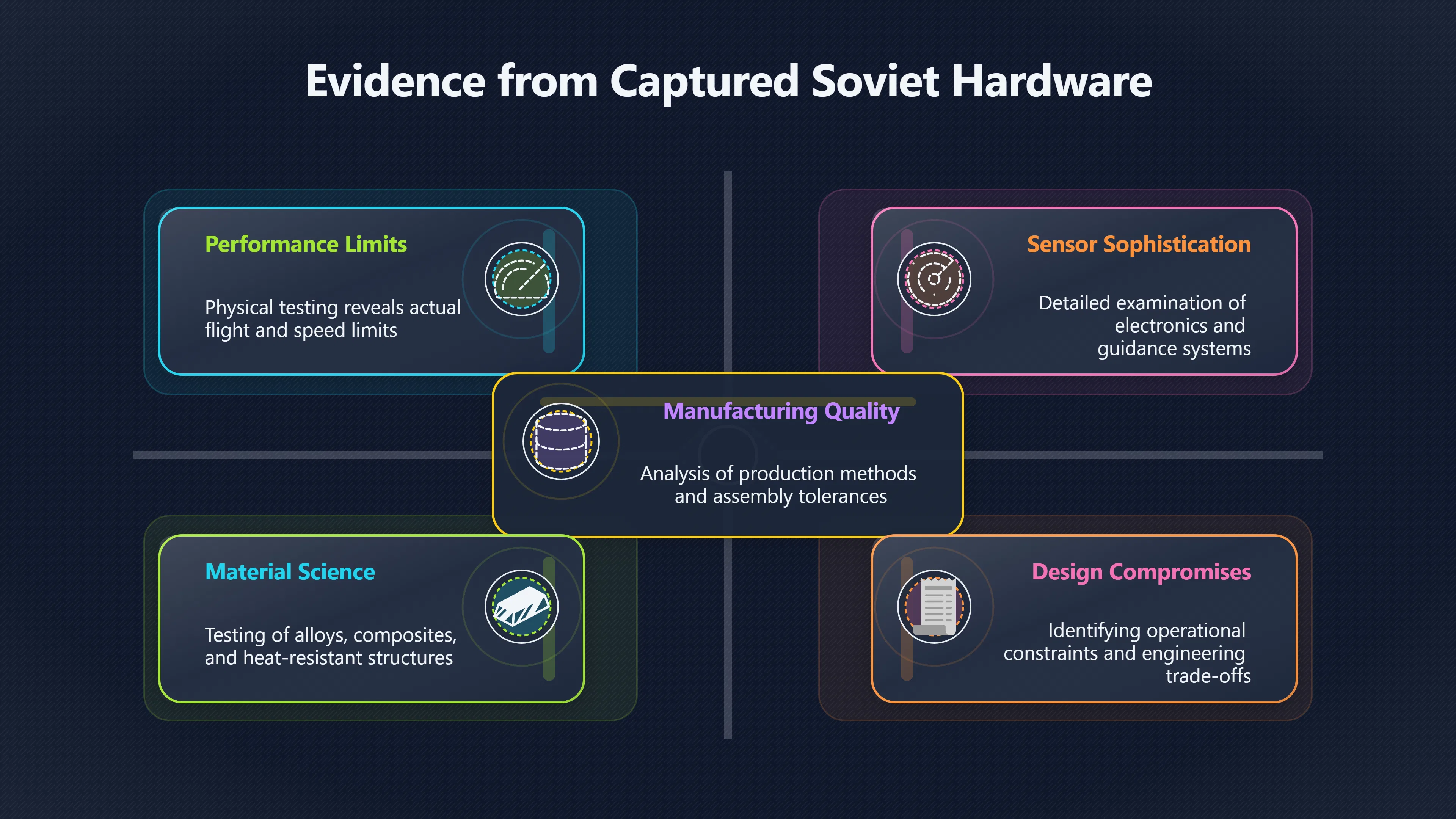
- Actual performance limits rather than advertised or estimated specifications.
- The sophistication of sensors, electronics and guidance systems.
- Manufacturing quality and production methods.
- Material science capabilities, including alloys, composites and heat-resistant structures.
- Design compromises that exposed weaknesses or operational constraints.
- Whether an apparently revolutionary system represented a genuine technological breakthrough or a practical compromise.[National Security Archive]nsarchive.gwu.eduNational Security Archive The U.SGovernment's Secret Search for Foreign Objects…31 Jan 2018 — These foreign material exploitation activities, conducted by the CIA and…
This distinction mattered because Cold War intelligence often operated under worst-case assumptions. An unfamiliar Soviet aircraft observed in photographs might appear far more capable than it truly was. Conversely, an apparently ordinary system might contain unexpected advances. Captured hardware transformed speculation into measurable facts.
The difference between seeing and touching
Imagery intelligence could show the shape of an aircraft. Signals intelligence might reveal how often it flew or what frequencies it used. Neither could easily determine the metallurgy of its airframe, the quality of its electronics, or the practical limitations imposed by fuel consumption, maintenance requirements or manufacturing methods.
Foreign materiel exploitation filled that gap. According to declassified US records, the CIA and Department of Defense expanded collection efforts beyond battlefield trophies to include missiles, spacecraft debris and other foreign technological objects specifically because physical examination contributed directly to scientific and technical intelligence.[National Security Archive]nsarchive.gwu.eduNational Security Archive The U.SGovernment's Secret Search for Foreign Objects…31 Jan 2018 — These foreign material exploitation activities, conducted by the CIA and…
Capabilities, limits and production clues
One of the most important insights gained from captured equipment concerned the relationship between military capability and industrial capacity. Intelligence agencies wanted to know not only what a machine could do today, but what its existence implied about future weapons.
The famous examination of the Soviet MiG-25 Foxbat illustrates this process. Before detailed access became available, Western analysts often regarded the aircraft as evidence of a major Soviet technological leap. After close examination, analysts discovered a more complicated reality. The aircraft’s structure relied heavily on welded nickel-steel alloys rather than the extensive titanium construction many Western observers had assumed. Investigators also learned important details about production methods, avionics choices and operational limitations. The aircraft remained an impressive interceptor, but physical inspection replaced several assumptions with measurable facts.[Wikipedia]WikipediaMikoyan-Gurevich Mi G-25Mikoyan-Gurevich Mi G-25
The significance went beyond the aircraft itself. Manufacturing choices revealed information about Soviet industry:
- Which materials Soviet factories could produce economically.
- How designers balanced performance against manufacturing complexity.
- Whether production emphasised sophistication, durability or scale.
- The likely cost and sustainability of large production runs.
In this sense, a captured aircraft functioned as a compressed record of an entire defence-industrial system. Analysts could infer not only engineering decisions but also broader economic and industrial realities.[CIA]cia.govCIA's Analysis of Soviet Science and TechnologyThis paper offers a general assessment of CIA's overall contribution to the analysis of…

Captured equipment as industrial evidence
Cold War intelligence organisations increasingly viewed foreign materiel as a source of production intelligence. Declassified US documentation shows that exploitation programmes sought information about research, development and production methods, not merely battlefield performance. The goal was to understand how adversaries transformed scientific knowledge into deployable military systems.[National Security Archive]nsarchive.gwu.eduNational Security Archive The U.SGovernment's Secret Search for Foreign Objects…31 Jan 2018 — These foreign material exploitation activities, conducted by the CIA and…
This approach explains why even damaged equipment, fragments and debris attracted intense interest. A small component could reveal manufacturing tolerances, electronic design philosophy, supplier capabilities or material availability. Such evidence often provided a more reliable picture of technological maturity than public statements or intelligence estimates.
Why uncertainty made objects strategic
The strategic value of captured hardware arose from uncertainty. Cold War leaders feared surprise more than almost anything else. Overestimating an adversary could trigger expensive and unnecessary weapons programmes. Underestimating one could create dangerous vulnerabilities.
Physical objects reduced that uncertainty because they imposed constraints on analysis. An analyst could debate a photograph indefinitely; a captured radar transmitter could be tested directly. A missile seeker could be examined under laboratory conditions. An aircraft engine could be measured and compared with theoretical performance estimates.
The competition for foreign equipment therefore became a competition for confidence. Governments wanted evidence that could support decisions involving billions of dollars, military doctrine and nuclear deterrence. Foreign materiel exploitation helped determine whether perceived threats were real, exaggerated or misunderstood.[National Security Archive]nsarchive.gwu.eduNational Security Archive The U.SGovernment's Secret Search for Foreign Objects…31 Jan 2018 — These foreign material exploitation activities, conducted by the CIA and…
Battlefield captures as intelligence opportunities
Many of the most valuable exploitation opportunities emerged through conflicts involving allies and proxy states. Declassified records show strong US interest in Soviet-made equipment captured by Israel during the Six-Day War. The objective was not merely to acquire weapons but to analyse them systematically and answer unresolved questions about Soviet military technology.[National Security Archive]nsarchive.gwu.edu16277 document 25 exploitation soviet equipmentWhile the CIA was taking…
Such captures were especially valuable because they provided access to equipment that would otherwise remain inaccessible behind political and military barriers. Every recovered radar, missile component or vehicle represented a chance to replace inference with evidence.
Why real machines often beat Cold War rumours
Cold War intelligence was filled with rumours, projections and worst-case assumptions. New aircraft sightings, military parades and fragmentary reports frequently produced competing interpretations. Foreign materiel exploitation offered a rare opportunity to move beyond inference.
Real machines exposed trade-offs. They revealed where engineers had accepted compromises, where industrial limitations shaped design choices and where impressive specifications concealed practical weaknesses. They also occasionally confirmed fears by demonstrating capabilities that analysts had only suspected.
The enduring significance of foreign materiel exploitation lies in this evidentiary role. Captured technology was not simply something to copy or defeat. It was a source of hard data in a strategic environment dominated by uncertainty. By turning foreign weapons into measurable objects, Cold War intelligence organisations gained insights into capability, production quality and future military potential that photographs, intercepted signals and rumours could never fully provide.[gwu.edu]nsarchive.gwu.eduNational Security Archive The U.SGovernment's Secret Search for Foreign Objects…31 Jan 2018 — These foreign material exploitation activities, conducted by the CIA and…
Amazon book picks
Further Reading
Books and field guides related to Why real machines beat Cold War rumors. Use these as the next step if you want deeper reading beyond the article.
The Puzzle Palace
Explains the strengths and limits of intelligence collection methods.
The Black Banners
Illustrates evidence-based intelligence analysis as a broader principle.
eBay marketplace picks
Marketplace Samples
Live-tested eBay searches with available results related to this page.


Endnotes
1.
Source: cia.gov
Link:https://www.cia.gov/resources/csi/static/Watching-the-Bear-4-Chap4-ScienceandTechnology.pdf
Source snippet
CIA's Analysis of Soviet Science and TechnologyThis paper offers a general assessment of CIA's overall contribution to the analysis of...
2.
Source: Wikipedia
Title: Mikoyan-Gurevich [Mi G-25]({{ ‘mi-g-25/’ | relative_url }})
Link:https://en.wikipedia.org/wiki/Mikoyan-Gurevich_MiG-25
3.
Source: cia.gov
Title: Assessing the Soviet Threat The Early Cold War Years
Link:https://www.cia.gov/resources/csi/static/Assessing-the-Soviet-Threat-The-Early-Cold-War-Years.pdf
Source snippet
explOitation of Eastern European resources or increase. Satellite dependability in the event of hostilities. Since Tito's defection last...
4.
Source: archive.org
Link:https://archive.org/download/coldwaranthropol00pric/coldwaranthropol00pric.pdf
Source snippet
exploitation of workers by 'bosses,' who manipulate the traditionalistic structure and demand loyalty in return for protection” (4). Occa...
5.
Source: nsarchive.gwu.edu
Title: National Security Archive The U.S
Link:https://nsarchive.gwu.edu/briefing-book/intelligence/2018-01-31/scavenging-intelligence-us-governments-secret-search-foreign-objects-during-cold-war
Source snippet
Government's Secret Search for Foreign Objects...31 Jan 2018 — These foreign material exploitation activities, conducted by the CIA and...
6.
Source: globalaircraft.org
Title: Global Aircraft Mi G-25 Foxbat
Link:https://www.globalaircraft.org/planes/mig-25_foxbat.pl
Source snippet
MiG-25 Foxbat - Global AircraftThe aircraft was built of a nickel-steel alloy and not titanium as was assumed tolerant of temperature ext...
7.
Source: nsarchive.gwu.edu
Title: 16277 document 25 exploitation soviet equipment
Link:https://nsarchive.gwu.edu/document/16277-document-25-exploitation-soviet-equipment
Source snippet
While the CIA was taking...
8.
Source: primarysources.brillonline.com
Title: cold war intelligence
Link:https://primarysources.brillonline.com/browse/cold-war-intelligence
Source snippet
War IntelligenceThe captured agents were then turned by Soviet intelligence, radioing false... Soviet nuclear weapons research, developm...
9.
Source: pq-static-content.proquest.com
Title: brochure dnsa
Link:https://pq-static-content.proquest.com/collateral/media2/[documents
Source snippet
National Security ArchiveThe documents address military strategy, as well as political and human rights issues such as prisoner abuse, co...
10.
Source: warhistoryonline.com
Title: mikoyan gurevich mig 25
Link:https://www.warhistoryonline.com/aircraft/mikoyan-gurevich-mig-25.html
Source snippet
The Mikoyan-Gurevich MiG-25 Scared the West30 Jan 2024 — The Mikoyan-Gurevich MiG-25 was designed to give the Soviet Union an edge agains...
11.
Source: nsarchive.gwu.edu
Link:https://nsarchive.gwu.edu/search?op=Search&page=285&s=The+Cold+War
Source snippet
National Security ArchiveU.S. Government's Secret Search for Foreign Objects during the Cold War Jan 31, 2018 … Project MEXPO Exploitatio...
12.
Source: aup.nl
Title: National Security Archive Cold War Reader
Link:https://www.aup.nl/en/series/national-security-archive-cold-war-reader-ceu-press
Source snippet
CEU PressThe series, edited by Malcolm Byrne, explores key episodes in the Cold War based on the latest archival documentation from the f...
Additional References
13.
Source: irp.fas.org
Link:https://irp.fas.org/doddir/army/ar381-26.htm
Source snippet
AR 381-26 Army Foreign Material Exploitation ProgramPreliminary plans will be as complete as possible and may guide the conduct of exploi...
14.
Source: academia.edu
Link:https://www.academia.edu/100432343/Cold_War_Pioneers_in_Combined_Intelligence_and_Analysis
Source snippet
Cold War Pioneers in Combined Intelligence and AnalysisFirst sightings of new equipment outside of the Soviet Union, in a place where tec...
15.
Source: greydynamics.com
Link:https://greydynamics.com/fmep-us-foreign-material-exploitation-programs/
Source snippet
FMEP: US Foreign Material Exploitation ProgramsUS Foreign Material Exploitation Programs (FMEPs) covertly and overtly acquire and analyse...
16.
Source: facebook.com
Link:https://www.facebook.com/AFmuseum/posts/mikoyan-gurevich-mig-25the-mig-25s-capabilities-were-not-discovered-until-1976-w/804980591661828/
Source snippet
Mikoyan-Gurevich MiG-25 The MiG-25's capabilities were...The unusual stainless steel planes served in the Soviet Union, Middle East and...
17.
Source: facebook.com
Link:https://www.facebook.com/CitizenKamran/posts/the-mig-25-the-soviet-fighter-that-terrified-the-westuntil-they-opened-one-upin-/1381981900642840/
18.
Source: bsb-muenchen.de
Link:https://www.bsb-muenchen.de/en/article/cold-war-intelligence-new-digital-source-collection-on-the-history-of-the-cold-war-1709/
Source snippet
Cold War Intelligence – New digital source collection on...3 Mar 2017 — It pools documents on the activities of US intelligence services...
19.
Source: youtube.com
Link:https://www.youtube.com/watch?v=W1L1sU0uI0o
Source snippet
This Jet Terrified the West: The MiG-25 FoxbatThe MIG 25 was an interceptor built to chase nuclear bombers during a nuclear war not to do...
20.
Source: reddit.com
Title: So just curious if there is a weapon system or aircraft technology
Link:https://www.reddit.com/r/WarCollege/comments/yamwfx/are_there_any_notable_or_suspected_examples_of/
Source snippet
Are there any notable or suspected examples of the US...As per the title, as you usually hear about Soviet attempts to copy US military...
21.
Source: nationalinterest.org
Link:https://nationalinterest.org/blog/reboot/how-cia-seized-soviet-weapons-systems-during-cold-war-193266/
Source snippet
A collection of documents compiled by the nonprofit National Security Archive shows just...
22.
Source: reddit.com
Title: The steel components were formed by a combination of spot welding.Read more
Link:https://www.reddit.com/r/SpaceXLounge/comments/betyze/spacex_stainless_steel_the_mig25_and_sovietstyle/
Source snippet
SpaceX, Stainless Steel, the MiG-25, and Soviet-style...The MiG-25 was constructed from 80% nickel-steel alloy, 11% aluminum, and 9% tit...
Topic Tree
Follow this branch
Parent topic
Cold War Race Why the Cold War Prized Captured MachinesRelated pages 5
- Danish Mi G When a defected Mi G became a diplomatic problem
- Mi G 15 Recovery How a salvaged Mi G 15 became an intelligence prize
- Mi G 25 Myths Did the Mi G 25 deserve its terrifying reputation?
- Proxy War Finds How proxy wars fed the hardware chase
- SA 2 Clues Why small SA 2 clues mattered in air combat