Within Export Systems
When An Export Fighter Outlives An Alliance
Iran's F-14 fleet shows how a friendly sale can become a long-term intelligence and sustainment problem after politics change.
On this page
- Why Iran received the F 14
- What changed after the 1979 revolution
- Why spare parts controls became central
Page outline Jump by section
Introduction
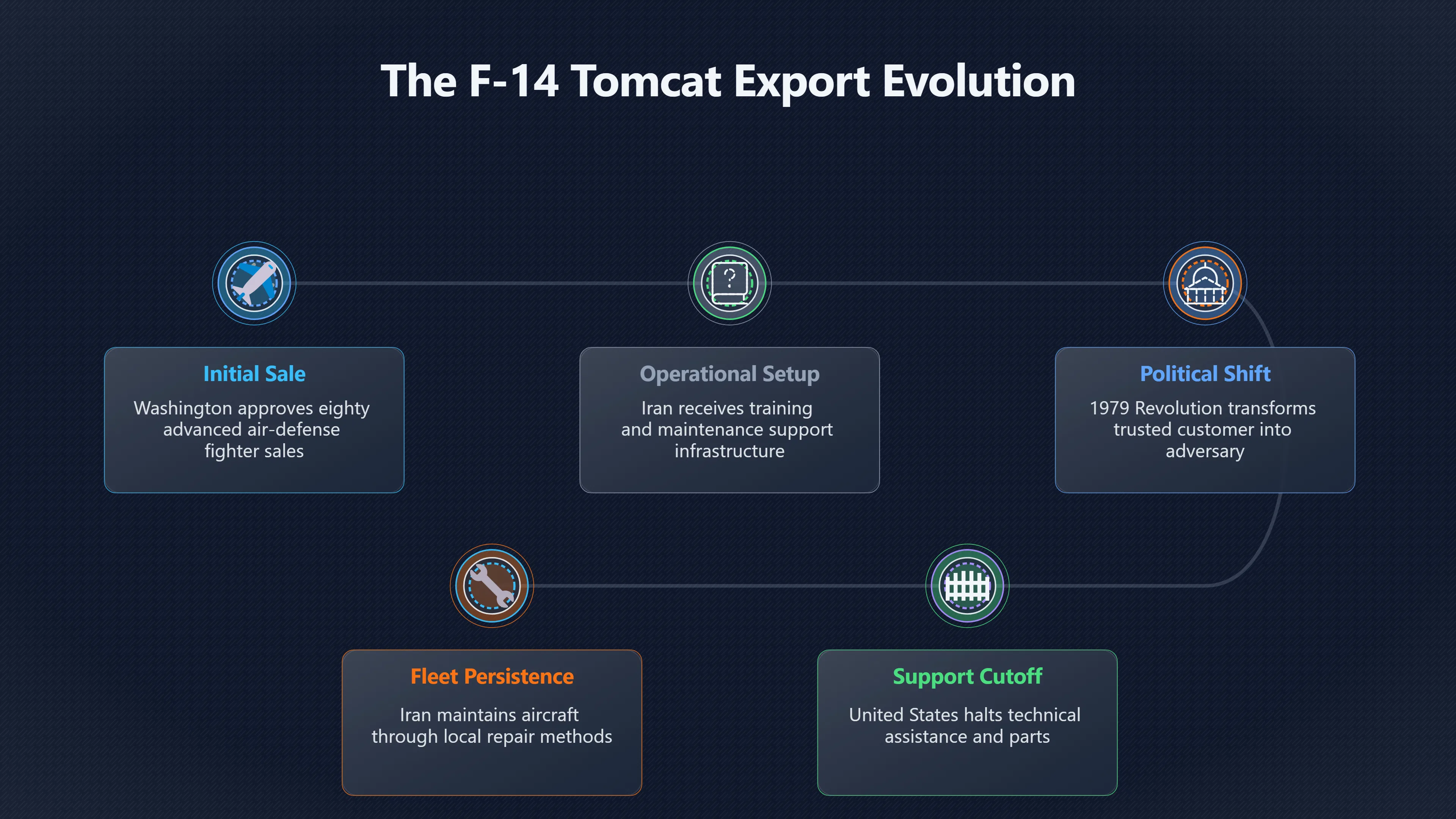
The sale of the F-14 Tomcat to Iran is one of the clearest historical examples of why arms exporters worry not only about who buys a weapon today, but who may control it decades later. In the 1970s, Iran was one of Washington’s closest regional partners, and the United States approved the export of its most advanced air-defence fighter, complete with long-range AIM-54 Phoenix missiles, training, support infrastructure and a large spare-parts package. Within a few years, the 1979 Iranian Revolution transformed that trusted customer into an adversarial state. The aircraft remained in Iranian hands, but American influence over how they were used vanished. The resulting struggle over spare parts, technical knowledge and long-term sustainment turned the Iranian F-14 programme into a lasting export-control warning.[Wikipedia]WikipediaGrumman F-14 TomcatGrumman F-14 Tomcat

Why Iran Received the F-14
In the mid-1970s, the government of Shah Mohammad Reza Pahlavi was a major American security partner in the Persian Gulf. Iran faced concerns about Soviet reconnaissance flights and sought a high-performance interceptor capable of engaging targets at long range. The F-14, equipped with the AWG-9 radar and AIM-54 Phoenix missile system, offered capabilities that few other aircraft in the world possessed at the time. Washington approved the sale, ultimately providing roughly eighty aircraft, hundreds of Phoenix missiles, training programmes, maintenance support and years of spare parts.[Wikipedia]WikipediaGrumman F-14 TomcatGrumman F-14 Tomcat
From an export-control perspective, the significance was not merely the aircraft itself. Iran received access to a sophisticated operational ecosystem. Pilots trained in the United States, maintenance personnel learned how to support the aircraft, and Iranian organisations acquired documentation, equipment and experience needed to keep the fleet functioning. The assumption behind the sale was that the political relationship would remain stable for the foreseeable future. That assumption proved fragile.[Wikipedia]WikipediaGrumman F-14 TomcatGrumman F-14 Tomcat
What Changed After the 1979 Revolution
The Islamic Revolution overturned the political foundations that had justified the sale. The new government inherited one of the world’s most advanced fighter fleets even as relations with Washington collapsed. The United States halted military support and imposed restrictions on further transfers of equipment and technical assistance. Yet the aircraft already delivered could not be recalled.[The National Interest]nationalinterest.orgCiting the new sanctions,The National InterestFact: Iran's Air Force Flies American-Made F-14 TomcatsIn 1981 an Iranian trade agent wrote to the London office of…
This created a dilemma that would become central to later export-control thinking. The United States no longer wanted Iran operating the F-14, but the aircraft remained physically present, along with trained personnel, accumulated expertise and existing stocks of parts. During the Iran–Iraq War, Iranian F-14s continued to play an important operational role despite embargoes and support cut-offs. The fleet’s survival demonstrated that once a sophisticated weapon has been exported and integrated into a military force, political change alone does not eliminate the capability.[Wikipedia]WikipediaGrumman F-14 TomcatGrumman F-14 Tomcat
For analysts concerned with reverse engineering foreign military technology, the case highlighted another risk: an exported system can become available for prolonged examination by a government that was never expected to be an adversary. Even if some classified components had been removed before delivery, Iran still possessed a uniquely advanced American combat aircraft and decades to study, repair and adapt it.[Wikipedia]WikipediaGrumman F-14 TomcatGrumman F-14 Tomcat
Why Spare-Parts Controls Became Central
The most enduring lesson of the Iranian F-14 case was that sustaining a weapon can matter as much as selling it.
After the revolution, Washington attempted to use spare-parts controls to reduce the fleet’s effectiveness. Without replacement components, engines, electronics and missile support, many observers expected the aircraft gradually to become unusable. Instead, Iran adopted a mixture of cannibalisation, local repair, reverse-engineered components and clandestine procurement networks to keep at least part of the fleet operational.[wikipedia.org]WikipediaAir force history of IranAfter the 1979 Iranian revolution, some of the IIAF's F-14s were not in… Due to the continuous spare parts shortages faced by the air…
The persistence of the fleet exposed a weakness in the assumption that embargoes alone could neutralise previously exported systems. Even limited access to components could significantly extend the life of ageing aircraft. Reports of surplus American parts reaching Iranian procurement networks alarmed US policymakers because they suggested that decades-old export decisions were still generating security consequences.[Arms Control Association]armscontrol.orgmilitary to suspend the selling of F-14 parts. Rep. Christopher Shays (R-Conn.) Jan. 16 called the cases “a huge…Read more…
As a result, spare-parts control became the centre of policy. The Pentagon halted sales of F-14 components, Congress moved to prohibit transfers, and officials increasingly treated retired Tomcat inventories as a proliferation risk rather than surplus property.[flightglobal.com]flightglobal.comFlight GlobalUS House votes to ban sale of F-14 parts21 May 2007 — The US House of Representatives has voted to ban the Pentagon from sel…
Why the United States Went Beyond Normal Restrictions
The intensity of the American response made the F-14 case unusual.
When the US Navy retired its own Tomcat fleet in 2006, officials feared that components from retired aircraft could eventually reach Iran through secondary markets, brokers or illicit procurement channels. Rather than merely storing or selling excess equipment, the United States chose to destroy many retired F-14 airframes and tightly restrict the disposal of parts. Congress passed measures limiting sales, while the Department of Defense expanded controls over remaining inventories.[cbsnews.com]cbsnews.comshredding f 14s to keep parts from iranCBS NewsShredding F-14s To Keep Parts From IranJul 2, 2007 — The Pentagon is paying a contractor at least $900,000 to destroy old F-14s…
This reaction reflected a broader export-control lesson. The concern was no longer the initial transfer in the 1970s. The concern was the long tail of sustainment. Decades after the original sale, policymakers were still trying to prevent technical leakage and operational support from reaching the only foreign operator of the aircraft. The F-14 had effectively outlived the alliance that delivered it.[Navy Times]navytimes.comNavy Times'Maverick Act' saves last 3 F-14 Tomcats from destructionMay 7, 2026 — The Fiscal Year 2008 National Defense Authorization Act specifically prohibited the Department of Defense from selling any…

What the F-14 Case Revealed About Exported Technology
The Iranian F-14 story is often cited because it compresses several export-control challenges into a single case:
- Political alliances can change faster than the service life of major weapons systems.
- Training, maintenance knowledge and technical documentation may have lasting value long after formal support ends.
- Spare parts can become strategic assets because they determine whether a sophisticated platform remains operational.
- Embargoes may limit capability but do not automatically eliminate it.
- A recipient with enough time can study, modify and locally sustain parts of an imported technology base.[wikipedia.org]WikipediaAir force history of IranAfter the 1979 Iranian revolution, some of the IIAF's F-14s were not in… Due to the continuous spare parts shortages faced by the air…
The result was a lasting shift in how many governments think about technology protection. Modern export decisions increasingly consider not only whether a partner is trusted today, but also what might happen if political conditions change years later. The Iranian F-14 fleet became a warning because it demonstrated that an advanced exported weapon can survive its original strategic relationship, creating intelligence, sustainment and technology-security problems long after the sale itself has faded into history.[navytimes.com]navytimes.comNavy Times'Maverick Act' saves last 3 F-14 Tomcats from destructionMay 7, 2026 — The Fiscal Year 2008 National Defense Authorization Act specifically prohibited the Department of Defense from selling any…
Amazon book picks
Further Reading
Books and field guides related to When An Export Fighter Outlives An Alliance. Use these as the next step if you want deeper reading beyond the article.
Iranian F-14 Tomcat Units in Combat
Directly covers Iran's operation and sustainment of the F-14 after the revolution.
Arms and Influence
Provides context for arms transfers, alliances and long-term security relationships.
Military Power
Helps readers understand how equipment performs within real military organizations.
Skunk Works
Helps readers understand advanced Cold War aerospace technology and export concerns.
eBay marketplace picks
Marketplace Samples
Live-tested eBay searches with available results related to this page.


Endnotes
1.
Source: Wikipedia
Title: Grumman F-14 Tomcat
Link:https://en.wikipedia.org/wiki/Grumman_F-14_Tomcat
2.
Source: Wikipedia
Title: Air force history of Iran
Link:https://en.wikipedia.org/wiki/Air_force_history_of_Iran
Source snippet
After the 1979 Iranian revolution, some of the IIAF's F-14s were not in... Due to the continuous spare parts shortages faced by the air...
3.
Source: aerospaceweb.org
Title: Ask Us
Link:https://aerospaceweb.org/question/planes/q0077.shtml
Source snippet
Iranian Air Force F-14By whatever means, Iran has been able to maintain a steady supply of spare parts for its F-14s, F-4s, and F-5s in s...
4.
Source: reuters.com
Title: pentagon stops f 14 parts sales amid iran concerns idUSN30380370
Link:https://www.reuters.com/article/economy/pentagon-stops-f-14-parts-sales-amid-iran-concerns-idUSN30380370/
Source snippet
Pentagon stops F-14 parts sales amid Iran concerns9 Aug 2007 — The Pentagon's Defense Logistics Agency said it halted sales of certain se...
5.
Source: history.state.gov
Link:https://history.state.gov/historicaldocuments/frus1969-76ve04/d181
Source snippet
[Documents]({{ 'documents/' | relative_url }}) - Office of the HistorianIran purchased some 90 F–86 jet fighters, air-to-air missiles, artillery, ammunition, and spare parts...
6.
Source: Wikipedia
Title: F 14 Tomcat operational history
Link:https://en.wikipedia.org/wiki/F-14_Tomcat_operational_history
Source snippet
F-14 Tomcat operational historyThe Grumman F-14 Tomcat has served with the United States Navy and the Imperial Iranian Air Force, then...
7.
Source: nationalinterest.org
Title: Citing the new [sanctions]({{ ‘sanctions/’ | relative_url }}),
Link:https://nationalinterest.org/blog/buzz/revealed-irans-air-force-flies-american-made-f-14-tomcats-16758/
Source snippet
The National InterestFact: Iran's Air Force Flies American-Made F-14 TomcatsIn 1981 an Iranian trade agent wrote to the London office of...
8.
Source: armscontrol.org
Link:https://www.armscontrol.org/act/2007-03/iran-nuclear-briefs/iran-receives-smuggled-surplus-f-14-parts
Source snippet
military to suspend the selling of F-14 parts. Rep. Christopher Shays (R-Conn.) Jan. 16 called the cases “a huge...Read more...
9.
Source: flightglobal.com
Link:https://www.flightglobal.com/us-house-votes-to-ban-sale-of-f-14-parts/73715.article
Source snippet
Flight GlobalUS House votes to ban sale of F-14 parts21 May 2007 — The US House of Representatives has voted to ban the Pentagon from sel...
Published: May 2007
10.
Source: cbsnews.com
Title: shredding f 14s to keep parts from iran
Link:https://www.cbsnews.com/news/shredding-f-14s-to-keep-parts-from-iran/
Source snippet
CBS NewsShredding F-14s To Keep Parts From IranJul 2, 2007 — The Pentagon is paying a contractor at least $900,000 to destroy old F-14s...
11.
Source: navytimes.com
Title: Navy Times’Maverick Act’ saves last 3 F-14 Tomcats from destruction
Link:https://www.navytimes.com/news/your-navy/2026/05/07/maverick-act-saves-last-3-f-14-tomcats-from-destruction/
Source snippet
May 7, 2026 — The Fiscal Year 2008 National Defense Authorization Act specifically prohibited the Department of Defense from selling any...
Published: May 7, 2026
12.
Source: nationalinterest.org
Link:https://nationalinterest.org/blog/reboot/somehow-iran-keeps-producing-f-14-tomcats-197102
Source snippet
Somehow, Iran Keeps Producing F-14 Tomcats28 Nov 2021 — ” Lawmakers passed a bill specifically banning any trade in Tomcat components to...
Additional References
13.
Source: militarywatchmagazine.com
Link:https://militarywatchmagazine.com/article/evolution-of-iranian-military-aviation-from-the-1979-revolution-to-the-2020-arms-embargo-part-one
Source snippet
Evolution of Iranian Military Aviation: From the 1979...3 Aug 2020 — Although Iran had little problem acquiring spare parts for its Sovi...
14.
Source: reddit.com
Link:https://www.reddit.com/r/WarCollege/comments/ch1zt0/why_did_the_shah_buy_f14s/
Source snippet
Why did the Shah buy F-14s?: r/WarCollegeI understand why the Islamic Republic of Iran today is the world's only operator of F-14s. But...
15.
Source: theaviationist.com
Link:https://theaviationist.com/2024/08/27/us-iranian-national-charged-for-attempting-to-export-military-aircraft-parts-to-iran/
Source snippet
US-Iranian National Charged for Attempting to Export...27 Aug 2024 — The US DoJ (Department of Justice) charged a US-Iranian citizen for...
16.
Source: kval.com
Title: senator tries to stop sale of surplus f 14 parts coveted by iran 11 12 2015
Link:https://kval.com/news/nation-world/senator-tries-to-stop-sale-of-surplus-f-14-parts-coveted-by-iran
Source snippet
Senator tries to stop sale of surplus F-14 parts coveted by...30 Jan 2007 — The Oregon Democrat's legislation would ban the Defense Depa...
17.
Source: youtube.com
Link:https://www.youtube.com/watch?v=WNP_ifehr9E
Source snippet
Deep Intel on the Smugglers Who Keep Iran's F-14s FlyingIran desperately needed to keep its Fleet of f-14s flying and so they turned to a...
18.
Source: youtube.com
Link:https://www.youtube.com/watch?v=JIdiwi7U9Gc
Source snippet
US destroys old fighter jets to keep parts from IranOfficials say F-14 spare parts may be especially appealing to Iran... How Iran strap...
19.
Source: youtube.com
Link:https://www.youtube.com/watch?v=kJjvO4fVFEw
Source snippet
How 80 F-14 Tomcat Aircraft Where Sold To Iran | DocumentaryHow the U.S. sold 80 F-14 Tomcat Aircraft to Iran. Five years before the 1979...
20.
Source: facebook.com
Title: With Iran’s F-14 Tomcat fleet decimated beyond repair, does it mean
Link:https://www.facebook.com/MaxDefense/posts/with-irans-f-14-tomcat-fleet-decimated-beyond-repair-does-it-mean-the-us-can-res/1375267621306756/
Source snippet
March 16, 2026 — Cut off from American spare parts and support, Iran somehow kept a portion of its fleet flying for decades through ingen...
Published: March 16, 2026
21.
Source: avionews.it
Title: 73437 america suspends the sale of the spare parts for f 14 tomcat
Link:https://www.avionews.it/item/73437-america-suspends-the-sale-of-the-spare-parts-for-f-14-tomcat.html
Source snippet
America suspends the sale of the spare parts for F-14 Tomcat2 Jan 2007 — America decided to suspend the sale of the spare parts of F-14 T...
22.
Source: foxnews.com
Title: pentagon halts sale of f 14 parts to iran following criticism
Link:https://www.foxnews.com/story/pentagon-halts-sale-of-f-14-parts-to-iran-following-criticism
Source snippet
Pentagon Halts Sale of F-14 Parts to Iran Following Criticism30 Jan 2007 — The decision comes as a Democratic senator moves to cut off al...
Topic Tree