Within Paperclip
Why Captured Hardware Was Not Enough
German specialists helped turn captured machines, documents and defects into usable American weapons knowledge.
On this page
- What hardware could and could not reveal
- Design intent, shortcuts and unresolved defects
- How experts accelerated the learning cycle
Page outline Jump by section
Introduction
Captured German rockets, aircraft and military equipment gave the United States a valuable starting point after the Second World War, but they did not provide a complete understanding of how those systems worked, why they had been designed in particular ways, or how they could be improved. This gap explains why Project Paperclip focused on recruiting engineers and scientists as well as collecting machines, documents and components. American officials believed that technical expertise was itself a strategic asset. The people who had designed and tested advanced weapons could explain hidden assumptions, manufacturing compromises, unresolved failures and future development paths that were often invisible in the hardware alone. As the United States sought to exploit foreign military technology, imported specialists became a force multiplier for reverse engineering rather than a replacement for it.[National Air and Space Museum]airandspace.si.eduproject paperclip and american rocketry after world war iiNational Air and Space MuseumProject Paperclip and American Rocketry after World War IIMarch 31, 2023 — 31 Mar 2023 — Project Paperclip w…

What Hardware Could and Could Not Reveal
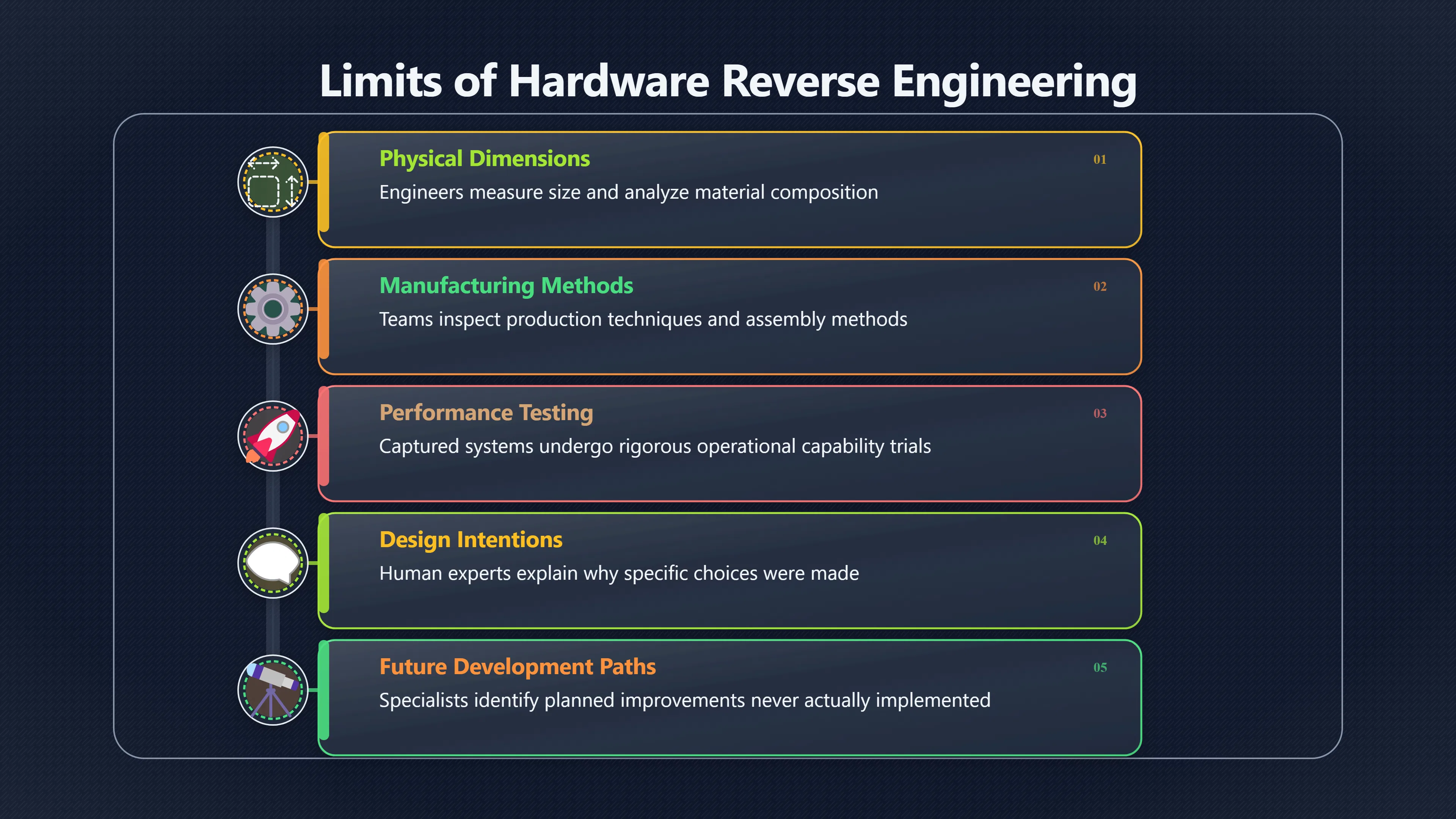
Reverse engineering begins with physical artefacts. Engineers can measure dimensions, analyse materials, inspect manufacturing methods and test performance. Captured German V-2 rockets, jet aircraft and guided weapons yielded enormous amounts of information through this process. Allied technical intelligence teams were specifically organised to seize equipment, laboratories, reports and industrial facilities for detailed study.[Wikipedia]WikipediaOperation LUSTYOperation LUSTY
Yet even sophisticated examination has limits. A finished machine shows what was built, not necessarily why it was built that way. Engineers studying a missile could identify components and performance characteristics, but they could not always determine:
- Which design alternatives had already been tried and rejected.
- Which features represented deliberate choices and which reflected wartime shortages.
- Which components were known weaknesses.
- How manufacturing problems affected reliability.
- What future improvements designers had planned but never implemented.
Modern research on reverse engineering still emphasises that understanding complex technology involves both physical analysis and human interpretation. Technical artefacts alone rarely reveal the full reasoning behind a design.[arXiv]arxiv.orgarXiv Hardware Reverse Engineering: Overview and Open ChallengesHardware Reverse Engineering: Overview and Open ChallengesOctober 1, 2019…
For American military planners in 1945, this meant that possessing a rocket was not the same as possessing the knowledge required to reproduce, improve or operationally deploy it.
Design Intent, Shortcuts and Unresolved Defects
One reason German specialists were considered so valuable was that they carried what would now be called tacit knowledge: practical understanding that existed in experience, conversations and engineering judgement rather than in blueprints.
A wartime weapon often reflected compromises invisible to outsiders. German engineers knew which parts had been simplified because of production constraints, which materials had been substituted because of shortages, and which recurring failures had never been fully solved before the war ended. A captured system might appear to be the optimal version of a design when, in reality, it was merely the version that could be produced under wartime conditions.
The V-2 rocket illustrates this problem. The United States obtained rockets, parts, documents and test facilities, but Paperclip personnel such as Wernher von Braun and members of the Peenemünde team could explain development history, testing results and operational lessons accumulated over years of experimentation. Their value was not limited to describing the rocket’s components. They could identify why specific engineering decisions had been made and where the technology could be pushed next.[National Air and Space Museum]airandspace.si.eduproject paperclip and american rocketry after world war iiNational Air and Space MuseumProject Paperclip and American Rocketry after World War IIMarch 31, 2023 — 31 Mar 2023 — Project Paperclip w…
This distinction mattered because reverse engineering is not simply reconstruction. Military organisations want to know how to adapt a technology to new requirements. Understanding intent is often more useful than copying the exact original design.
How Experts Accelerated the Learning Cycle
The most important contribution of imported specialists was speed. Without access to the original designers, American engineers would have had to rediscover many lessons through costly experimentation.
In complex military systems, development frequently follows a cycle:
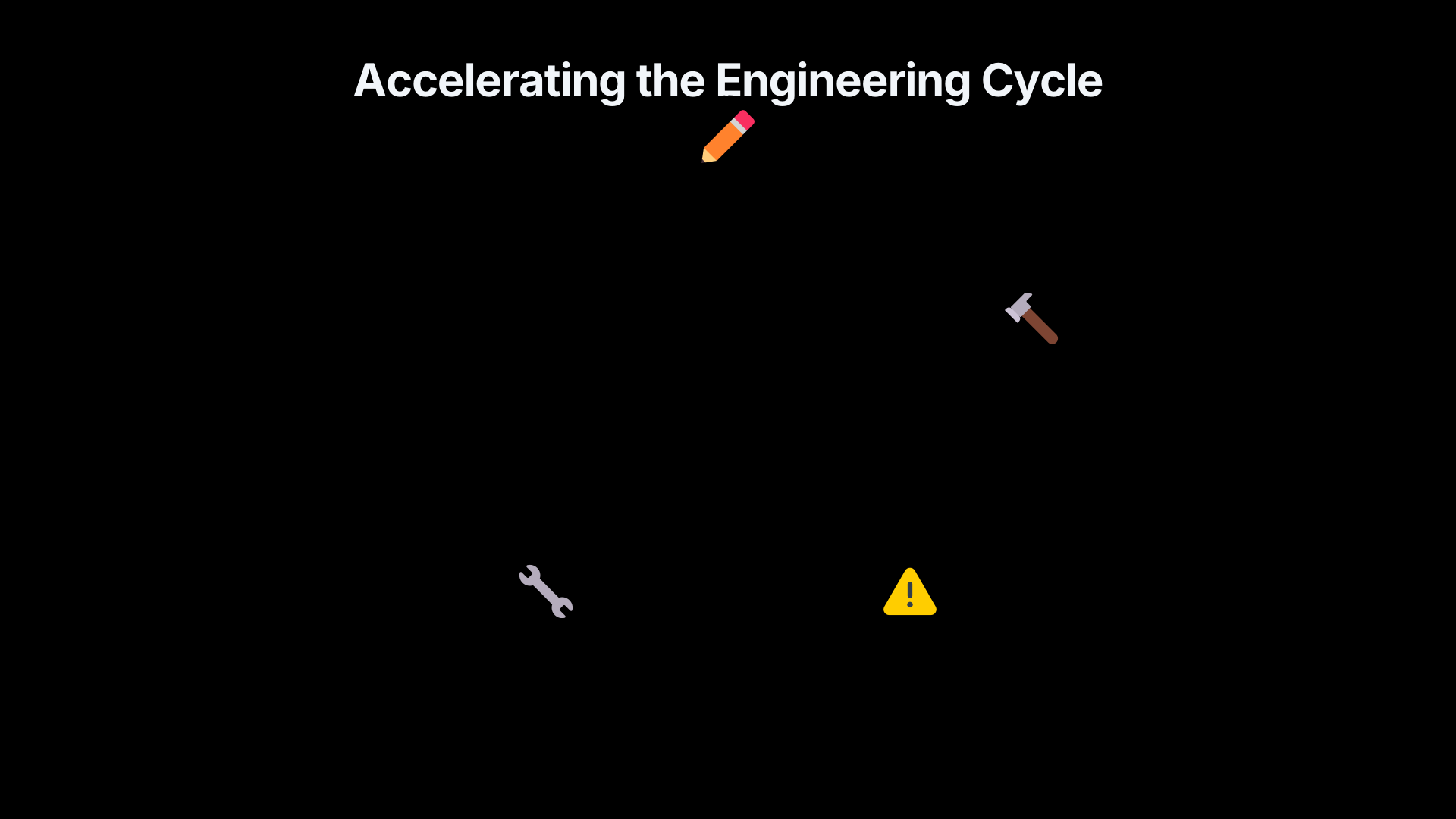
- Design a solution.
- Build prototypes.
- Test them.
- Discover failures.
- Modify the design.
- Repeat.
Captured hardware showed only the endpoint of that process. The engineers who created it remembered the earlier stages.
As a result, Paperclip specialists could shorten development timelines by explaining:
- Which experiments had already failed.
- Which test results mattered most.
- Which performance limits were fundamental.
- Which obstacles were merely engineering problems awaiting better resources.
The National Air and Space Museum notes that American authorities sought not only German technology but also the people who had invented and designed it because those individuals were needed to transfer the technology effectively.[National Air and Space Museum]airandspace.si.eduproject paperclip and american rocketry after world war iiNational Air and Space MuseumProject Paperclip and American Rocketry after World War IIMarch 31, 2023 — 31 Mar 2023 — Project Paperclip w…
This transfer of knowledge was especially important in fields such as rocketry, where performance depended on the interaction of propulsion, guidance, structures, fuels and manufacturing processes. Possessing documents and hardware without experienced personnel risked repeating years of trial-and-error work.
Engineers as Living Technical Archives
Post-war intelligence programmes often treated scientists and engineers as sources of information before treating them as employees. Some specialists were interrogated extensively because their knowledge could not be captured completely through documents. Allied programmes sought not only equipment and records but also key personnel whose expertise represented an irreplaceable repository of technical understanding.[Wikipedia]WikipediaOperation PaperclipOperation Paperclip
This reflected a broader reality of technological exploitation. Even detailed documentation can omit informal practices that determine whether a system succeeds in operation. Engineers frequently rely on unwritten rules, practical workarounds and accumulated experience. Such knowledge can disappear when a project ends or a team is dispersed.
For American analysts, the German specialists therefore functioned as living technical archives. They could answer questions that no captured blueprint could address and clarify ambiguities that might otherwise delay development programmes.
Why the Human Element Changed Reverse Engineering
Project Paperclip demonstrated that exploiting foreign military technology required more than collecting artefacts. Hardware revealed capabilities, but people revealed understanding. Captured machines showed what Germany had achieved; the engineers explained how those achievements had been reached, where their limits lay and how they might be extended.
That combination of material evidence and human expertise transformed reverse engineering from a process of imitation into a process of accelerated learning. In the American view, the greatest value of many German specialists was not that they could rebuild existing weapons exactly as before, but that they could help turn captured technology into new knowledge, reducing uncertainty and compressing years of engineering effort into months.[si.edu]airandspace.si.eduproject paperclip and american rocketry after world war iiNational Air and Space MuseumProject Paperclip and American Rocketry after World War IIMarch 31, 2023 — 31 Mar 2023 — Project Paperclip w…
Amazon book picks
Further Reading
Books and field guides related to Why Captured Hardware Was Not Enough. Use these as the next step if you want deeper reading beyond the article.
The Design of Everyday Things
Highlights the importance of understanding design intent.
eBay marketplace picks
Marketplace Samples
Live-tested eBay searches with available results related to this page.

Endnotes
1.
Source: Wikipedia
Title: [Operation LUSTY]({{ ‘operation-lusty/’ | relative_url }})
Link:https://en.wikipedia.org/wiki/Operation_LUSTY
2.
Source: Wikipedia
Link:https://en.wikipedia.org/wiki/T-Force
3.
Source: arxiv.org
Title: arXiv Hardware Reverse Engineering: Overview and Open Challenges
Link:https://arxiv.org/abs/1910.01518
Source snippet
Hardware Reverse Engineering: Overview and Open ChallengesOctober 1, 2019...
Published: October 1, 2019
4.
Source: arxiv.org
Link:https://arxiv.org/abs/2105.14943
5.
Source: Wikipedia
Title: Operation Paperclip
Link:https://en.wikipedia.org/wiki/Operation_Paperclip
6.
Source: Wikipedia
Link:https://en.wikipedia.org/wiki/TICOM
7.
Source: airandspace.si.edu
Title: project paperclip and american rocketry after world war ii
Link:https://airandspace.si.edu/stories/editorial/project-paperclip-and-american-rocketry-after-world-war-ii
Source snippet
National Air and Space MuseumProject Paperclip and American Rocketry after World War IIMarch 31, 2023 — 31 Mar 2023 — Project Paperclip w...
Published: March 31, 2023
8.
Source: airandspaceforces.com
Link:https://www.airandspaceforces.com/article/0607paperclip/
Source snippet
Air & Space Forces MagazineProject Paperclip1 Jun 2007 — A spontaneous international race to acquire equipment, documents, engineers, and...
Additional References
9.
Source: cia.gov
Link:https://www.cia.gov/readingroom/document/00010786
Source snippet
DOCUMENTS FOR PROJECT PAPERCLIP INCLUDES...UNTITLED (DOCUMENTS FOR PROJECT PAPERCLIP INCLUDES MEMO REPORTS AND JOINT INTELLIGENCE OBJECT...
10.
Source: linkedin.com
Link:https://www.linkedin.com/posts/william-r-g-3182ba37_operation-paperclip-operation-paperclip-activity-7469314019514867712-iLw7
Source snippet
William R. G.OPERATION PAPERCLIP Operation Paperclip was a secret United States intelligence program in which more than 1600 German scien...
11.
Source: calameo.com
Link:https://www.calameo.com/books/0059815616f2f10edfc7a
12.
Source: facebook.com
Title: after world war ii ended in 1945 the united states faced a new fear the soviet u
Link:https://www.facebook.com/investingwithcolleen/posts/after-world-war-ii-ended-in-1945-the-united-states-faced-a-new-fear-the-soviet-u/916802740935195/
Source snippet
After World War II ended in 1945, the United States faced...Operation Paperclip was: a secret United States intelligence program in whic...
13.
Source: facebook.com
Link:https://www.facebook.com/AmericanExperiencePBS/posts/operation-paperclip-brought-1600-of-germanys-most-accomplished-scientists-to-the/10157376173099122/
Source snippet
Operation Paperclip brought 1600 of Germany's most...The operation aimed to bring German scientists, particularly those with expertise i...
14.
Source: instagram.com
Link:https://www.instagram.com/p/DNlWPrqodBA/?hl=en
Source snippet
government program launched after World War II that brought more than 1,600 German scientists, engineers...Read more...
15.
Source: facebook.com
Title: Owner of V-2 rocket piece shares its history and connection
Link:https://www.facebook.com/groups/spacehipsters/posts/1456126777765534/
Source snippet
V-2. Operation Paperclip recruited German engineers and Special Mission V-2 transported the captured V-2 parts to the United States. At t...
16.
Source: mjhnyc.org
Title: from wwii to the space race the story of project paperclip
Link:https://mjhnyc.org/events/from-wwii-to-the-space-race-the-story-of-project-paperclip/
Source snippet
From WWII to the Space Race: The Story of Project PaperclipBetween 1945 and the 1960s, the United States government brought more than 1,5...
17.
Source: press.jhu.edu
Title: project paperclip was stranger fiction
Link:https://www.press.jhu.edu/newsroom/project-paperclip-was-stranger-fiction?srsltid=AfmBOoonkq4tgA6jj2lkPekUnPHwDQIDX6ovkq2u9SHsmw4B8-D764
Source snippet
Paperclip Was Stranger Than Fiction | Hopkins Press20 Feb 2020 — Our Germans is a reminder that the history of this dynamic period can be...
18.
Source: youtube.com
Title: Operation Paperclip — How America Used Nazi Scientists to Win the Cold War
Link:https://www.youtube.com/watch?v=uAEMLgG4_FM
Source snippet
Operation Paperclip: The US Plan for German Scientists After World War II...
Topic Tree