Within Radar Signatures
Why Radar Warnings Get More Specific
A captured radar can turn uncertain pulses into cockpit warnings that better distinguish search, tracking and weapon-support modes.
On this page
- What a warning receiver actually compares
- How captured modes refine threat identity
- What misclassification costs in flight
Page outline Jump by section
Introduction
Captured radars improve radar warning receiver (RWR) threat calls because they replace educated guesses with measured knowledge. An RWR does not recognise an enemy system by name; it observes radio-frequency emissions and compares their characteristics against a stored library of known emitters. The more complete that library becomes, the more accurately the aircraft can distinguish a harmless search radar from a radar that is tracking the aircraft or supporting a weapon engagement. Modern electronic-warfare systems are built around precisely this process of comparing observed electromagnetic parameters against known emitter data.[Defense Security Cooperation Agency]samm.dsca.mildscaDefense Security Cooperation AgencyDSCA 10-65 | Defense Security Cooperation Agency16 May 2011 — The EWIRDB is the primary DoD source for…
Within radar exploitation programmes, a captured radar is especially valuable because analysts can operate it under controlled conditions, forcing it through modes that may never have been observed in combat. The result is not merely better identification of a radar type, but more specific threat calls that tell aircrew what the radar is actually doing at that moment.
What a warning receiver actually compares
An RWR receives radar pulses and extracts measurable characteristics such as carrier frequency, pulse width, pulse repetition behaviour, signal strength, timing relationships, and angle of arrival. Those measurements are compared against a mission data file or threat library containing known emitter characteristics.[afahc.ro]afahc.roIntroduction-to-radar-warning-receiver.pdf24 Feb 2009 — How Does an RWR Work? • Hardware handles detection. • Hardware detects radar…
The key point is that identification is rarely based on a single parameter. Many radars can operate in similar frequency bands, and several unrelated systems may produce superficially similar signals. Accurate identification therefore depends on recognising combinations of parameters and behavioural patterns rather than one unique fingerprint.[ResearchGate]researchgate.netUsually threat analysis is combined with emitter…Read more…
This is why defence organisations invest heavily in emitter databases. The Electronic Warfare Integrated Reprogramming Database (EWIRDB), for example, exists specifically to provide parametric emitter data used to programme warning receivers and other electronic-warfare systems so they can correctly identify emitters by their electromagnetic characteristics.[Defense Security Cooperation Agency]samm.dsca.mildscaDefense Security Cooperation AgencyDSCA 10-65 | Defense Security Cooperation Agency16 May 2011 — The EWIRDB is the primary DoD source for…
A warning such as “search radar”, “acquisition radar”, “tracking radar”, or “fire-control radar” is therefore the result of a classification process. The quality of the threat call depends directly on the quality and completeness of the stored signatures.
How captured modes refine threat identity
The greatest advantage of a captured radar is that analysts are no longer limited to whatever emissions happened to be intercepted during operations.
Seeing the full behavioural range
Signals intelligence collection may record a radar during routine surveillance activity but never observe its combat modes. A captured system can be powered up repeatedly and tested across its entire operating envelope. Analysts can record how pulse structures, scan patterns, dwell times, and waveform characteristics change as the radar transitions from broad-area search to target acquisition, precision tracking, or weapon-support functions.
That matters because the same radar can appear very different depending on its operating state. A radar that looks like a routine surveillance emitter in one mode may generate a distinctive pattern when it begins supporting missile guidance or high-precision tracking. Captured equipment allows those transitions to be mapped and stored in threat libraries.[baesystems.com]baesystems.comBAE SystemsAN/ALR-56 Radar Warning Receivers (RWR)Detection and identification of modern search, acquisition, and tracking radars of grou…
Separating similar-looking emitters
Another benefit is the reduction of ambiguity. Two radar families may share overlapping frequencies or pulse characteristics when conducting search operations. Without deeper knowledge, an RWR may classify both under a broad threat category.
Testing a captured radar often reveals subtle distinguishing features that are difficult to collect from long range. These can include timing variations, mode-switch sequences, scan behaviour, or other parametric relationships. Once incorporated into threat databases, those distinctions allow the RWR to identify not merely a class of radar but a specific system or variant.[researchgate.net]researchgate.netUsually threat analysis is combined with emitter…Read more…
Understanding mode transitions
Threat assessment depends heavily on context. A pilot cares not only that a radar exists, but whether its behaviour indicates increasing danger.
Captured systems help analysts learn what a radar does immediately before target lock, during target tracking, or while supporting a missile engagement. When those behavioural signatures are added to mission data files, the RWR can associate observed changes with escalating threat levels rather than treating every detection equally. This is one reason modern RWR manufacturers emphasise identification of search, acquisition, and tracking radars as distinct warning functions.[BAE Systems]baesystems.comBAE SystemsAN/ALR-56 Radar Warning Receivers (RWR)Detection and identification of modern search, acquisition, and tracking radars of grou…
Why specific threat calls matter in the cockpit
A pilot confronted with multiple emitters must prioritise attention and defensive actions within seconds.
A generic warning that an unknown radar is present provides less value than a warning indicating that a known fire-control radar has transitioned into a tracking mode. The latter conveys both identity and intent. It helps aircrew decide whether to manoeuvre, deploy countermeasures, activate jamming systems, alter mission routing, or continue as planned.[BAE Systems]baesystems.comBAE SystemsAN/ALR-56 Radar Warning Receivers (RWR)Detection and identification of modern search, acquisition, and tracking radars of grou…
The distinction becomes even more important in dense electromagnetic environments where dozens of emitters may be present simultaneously. Threat analysis systems increasingly combine emitter identification with prioritisation logic because raw detections alone do not provide sufficient situational awareness.[ResearchGate]researchgate.netUsually threat analysis is combined with emitter…Read more…
Captured-radar exploitation therefore improves more than recognition accuracy. It improves the quality of the decisions made from that recognition.
What misclassification costs in flight
Misclassification creates two opposite problems, both dangerous.
The first is underestimating a threat. If a radar operating in a weapon-support mode is mistaken for a routine search radar, aircrew may delay defensive action until too late. The warning receiver has detected the emitter, but its threat library has interpreted the signal incorrectly.
The second is overestimating a threat. If benign or low-priority emitters are repeatedly classified as immediate dangers, pilots become overloaded with warnings. Excessive false alarms can complicate threat prioritisation and consume attention during already demanding missions. Research into RWR threat analysis has long recognised that unidentified or poorly classified emitters can distort threat assessments and degrade decision-making.[ResearchGate]researchgate.netUsually threat analysis is combined with emitter…Read more…
Captured radars help reduce both forms of error by supplying verified parametric data rather than inferred assumptions.
From exploited hardware to better warnings
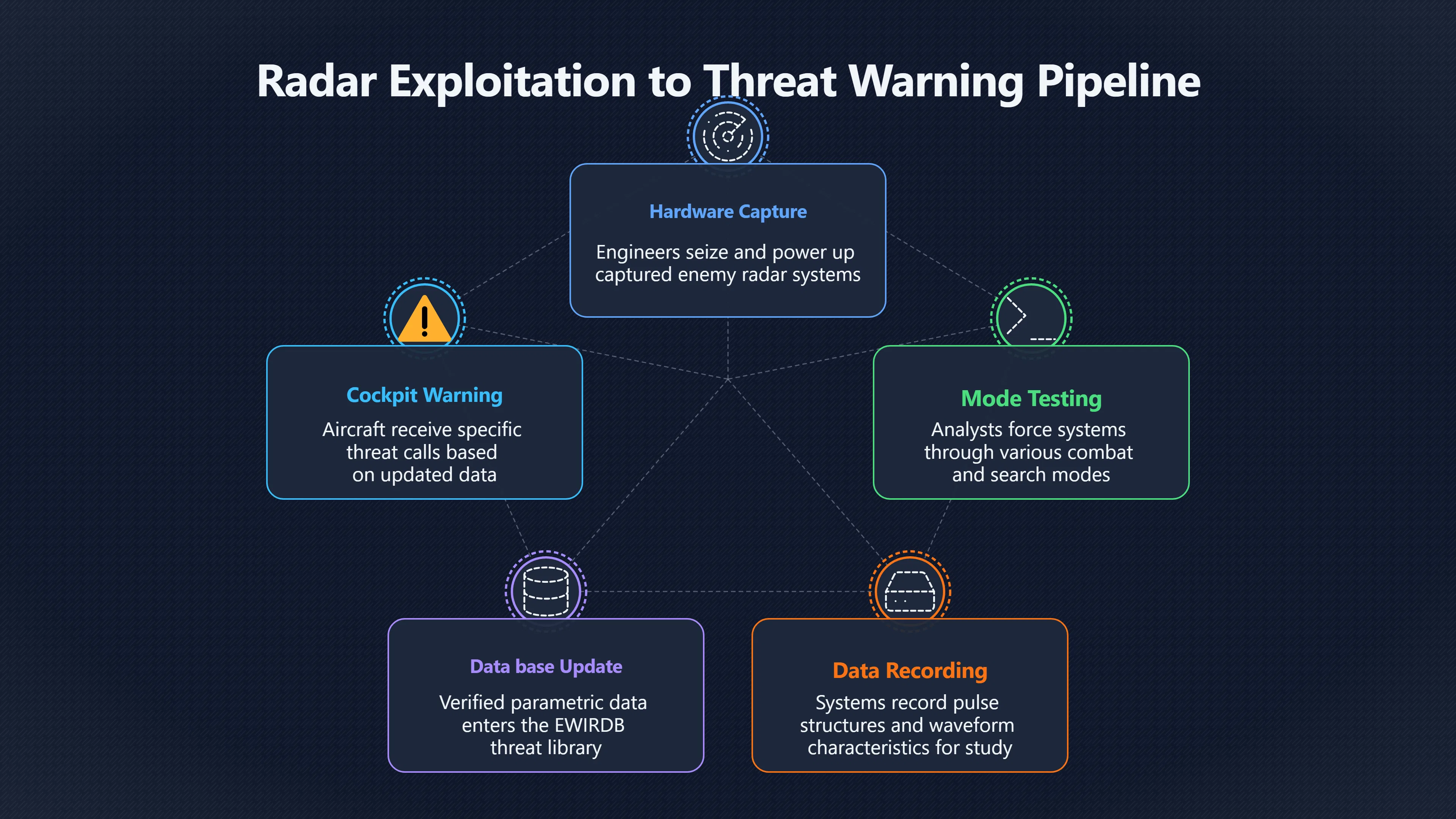
The practical chain is straightforward. Engineers exploit a captured radar, record its emissions across multiple operating modes, identify distinguishing characteristics, and add those observations to electronic-warfare databases. Those databases are then used to update mission data files carried by aircraft warning receivers and other defensive systems.[Defense Security Cooperation Agency]samm.dsca.mildscaDefense Security Cooperation AgencyDSCA 10-65 | Defense Security Cooperation Agency16 May 2011 — The EWIRDB is the primary DoD source for…
The result is that an aircraft encountering the radar in the future is more likely to receive a specific and meaningful warning. Instead of merely reporting radio-frequency activity, the system can indicate whether the emitter is searching, acquiring, tracking, or supporting a weapon engagement. In operational terms, that transformation—from pulse detection to actionable threat identity—is one of the most valuable outcomes of radar exploitation within the broader effort to reverse engineer foreign military technology.[baesystems.com]baesystems.comBAE SystemsAN/ALR-56 Radar Warning Receivers (RWR)Detection and identification of modern search, acquisition, and tracking radars of grou…
Amazon book picks
Further Reading
Books and field guides related to Why Radar Warnings Get More Specific. Use these as the next step if you want deeper reading beyond the article.
Introduction to Electronic Warfare Modeling
Directly addresses emitter identification and warning systems.
Electronic Warfare in the Information Age
Explains signal classification and electronic support measures.
eBay marketplace picks
Marketplace Samples
Live-tested eBay searches with available results related to this page.


Endnotes
1.
Source: srcinc.com
Link:https://www.srcinc.com/services/intel-analysis-and-production/ewirdb.html
2.
Source: afahc.ro
Link:https://www.afahc.ro/ro/erasmus/DDHE/Courses/Electronic%20Warfare/Introduction-to-radar-warning-receiver.pdf
Source snippet
Introduction-to-radar-warning-receiver.pdf24 Feb 2009 — How Does an RWR Work? • Hardware handles detection. • Hardware detects radar...
3.
Source: researchgate.net
Link:https://www.researchgate.net/publication/265918287_An_Expert_System_For_Threat_Analysis_In_Radar_Warning_Receivers
Source snippet
Usually threat analysis is combined with emitter...Read more...
4.
Source: researchgate.net
Link:https://www.researchgate.net/publication/398009719_Cognitive_Electronic_Warfare_Application_to_Emitter_Identification_Process_in_Airborne_Radar_Warning_Receiver_Systems
Source snippet
Effective RWR systems accurately identify [radar emitters]({{ 'radar-emitters/' | relative_url }}) in complex...Read more...
5.
Source: samm.dsca.mil
Title: dsca 10 65
Link:https://samm.dsca.mil/policy-memoranda/dsca
Source snippet
Defense Security Cooperation AgencyDSCA 10-65 | Defense Security Cooperation Agency16 May 2011 — The EWIRDB is the primary DoD source for...
Published: May 2011
6.
Source: samm.dsca.mil
Title: Defense Security Cooperation Agency Chapter 3
Link:https://samm.dsca.mil/chapter/chapter-3
Source snippet
data related to EM emitters. The Electronic Warfare Integrated Reprogramming Database (EWIRDB) is the primary DoD source for technical pa...
7.
Source: globalsecurity.org
Link:https://www.globalsecurity.org/intell/systems/ewirdb.htm
Source snippet
The modules are: The National Security Agency (...Read more...
8.
Source: baesystems.com
Link:https://www.baesystems.com/en/product/an-alr-56-radar-warning-receivers
Source snippet
BAE SystemsAN/ALR-56 Radar Warning Receivers (RWR)Detection and identification of modern search, acquisition, and tracking radars of grou...
9.
Source: static.e-publishing.af.mil
Title: dafman10 703
Link:https://static.e-publishing.af.mil/production/1/af_a5/publication/dafman10-703/dafman10-703.pdf
Source snippet
E-Publishingdafman10-703.pdf2 Jun 2021 — EWIRDB—electronic warfare integrated reprogramming database. FLDCOM... parametric data to the d...
10.
Source: Wikipedia
Title: Radar warning receiver
Link:https://en.wikipedia.org/wiki/Radar_warning_receiver
Source snippet
Radar warning receiverModern RWR systems are often capable of classifying the source of the radar by the signal's strength, phase and...
11.
Source: theochem.ru.nl
Title: nl Radar warning receiver
Link:https://www.theochem.ru.nl/~pwormer/Knowino/knowino.org/wiki/Radar_warning_receiver.html
Source snippet
warning receiver - Knowino19 Dec 2010 — A radar warning receiver (RWR) detects radar signals that might be targeting the platform carryin...
12.
Source: f4.manuals.heatblur.se
Title: se Radar Warning Receiver
Link:https://f4.manuals.heatblur.se/systems/defensive_systems/radar_warning_receiver.html
Source snippet
Warning Receiver - Heatblur F-4E Phantom IIThe ALR-46 Radar Warning Receiver (subsequently RWR) is the F-4E's passive situational awarene...
Additional References
13.
Source: reddit.com
Link:https://www.reddit.com/r/explainlikeimfive/comments/1fuy1ue/eli5_how_does_a_radarwarningsystem_rwr_identify/
Source snippet
ELI5: How does a Radar-Warning-System (RWR) identify...I understand how you'd detect lasing but not radar lock, especially at the distan...
14.
Source: hal.science
Link:https://hal.science/hal-04950695v1/file/An_Overview_and_Classification_of_Machine_Learning_Approaches_for_Radar_Signal_Deinterleaving.pdf
Source snippet
An Overview and Classification of Machine Learning...by L Lesieur · 2025 · Cited by 16 — ABSTRACT Electronic Warfare (EW) receivers are...
15.
Source: patreon.com
Title: Each letter represents a category of emitter, defined
Link:https://www.patreon.com/posts/cyrillic-101-for-141097668
Source snippet
Cyrillic-101 for DCS MiG-29 Pilots - SPO-15 LM Radar...Oct 13, 2025 — the SPO-15LM radar warning receiver uses single-letter codes to cl...
16.
Source: forum.dcs.world
Title: world SP O-15LM Radar Warning Receiver Q&A
Link:https://forum.dcs.world/topic/378726-spo-15lm-radar-warning-receiver-qa/
Source snippet
dcs.worldSPO-15LM Radar Warning Receiver Q&A - DCS World ForumsSep 11, 2025 — The SPO-15 does not measure the AoA of the signal continuou...
17.
Source: soaneemrana.org
Link:https://soaneemrana.org/onewebmedia/INTRODUCATION%20TO%20RADAR%20SYSTEM%20BY%20MERRIL%2C%20I%20SKLOINK%20%284%29.pdf
Source snippet
Introduction to Radar Systems, Second EditionAlthough the fundamentals of radar have changed little since the publication of the first ed...
18.
Source: army-technology.com
Title: visualising electronic warfare
Link:https://www.army-technology.com/features/visualising-electronic-warfare/
Source snippet
12 Jun 2018 —... Reprogramming Database, which is the standard source of parametric data for radars and other non-communications emitter...
19.
Source: electricajournal.org
Link:https://www.electricajournal.org/index.php/pub/article/download/1264/1253
Source snippet
Cognitive Electronic Warfare Application to Emitter...by İÇ Taş · 2025 — Radar warning receiver systems aim to detect, intercept, identi...
20.
Source: youtube.com
Link:https://www.youtube.com/watch?v=DOGazUgUdsQ
Source snippet
Warning sensors, and Laser Warning Receivers in War Thunder...
21.
Source: youtube.com
Title: Lockheed Martin Develops Advanced Electronic Warfare Capabilities
Link:https://www.youtube.com/watch?v=HgzY85ICxZU
Source snippet
Elbit Systems Unified EW Airborne Self-Protection Suite...
22.
Source: youtube.com
Title: AI in Combat A New Era of Radar Warning and Electronic Warfare
Link:https://www.youtube.com/watch?v=5MTJVCp0Jag
Source snippet
HENSOLDT Kalaetron RWR – Radar Warning Receiver...
Topic Tree